Packed with information, ideas, and more than 300 excellent illustrations, this classic of the genre was written by the father of modern planing sailboats. Most of text focuses on individual vessels; among the 20 profiled are the 60-foot-long Landfall; the Patience; and the author's own creation, the Vigilant.
SEAMEN are made up of deepwater men and coasters, and until I met Typhoon and her owner I was a coaster only, not having sailed off soundings; so Typhoon having given me perspective, which, like humour in life, gives a sense of proportion and balance, Typhoon shall have the honour of going in to bat first.
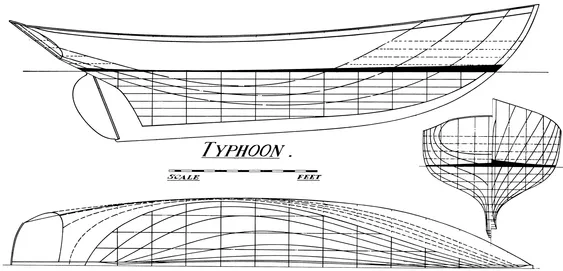
Bill Nutting and Billy Atkin were both on the staff of Motor Boat, a New York magazine, and if we remember this fact when looking at Typhoon’s lines they do not appear so unbalanced. The easy hollow bow and the powerful stern are typical of motor boats, which tend to squat by the stern through the propeller kicking away the ground or rather the water from under their quarters. Typhoon’s lines, every time I look at them, bring to my eyes a picture of two sailing men, lovers of sail, made through force of circumstances prisoners in the offices of a Motor Boat Journal, and while there, being unable to stifle their love of sail any longer, they break out with a sailing boat, which to appear in their paper must bear a strong resemblance to a motor boat. And the fact that when I met her she had already crossed from Nova Scotia to Cowes in 22 days and had sailed the ocean part from Cape Race to the Bishops in 15 days 9 hours, balanced the ends far more in my eyes than I then realised. Typhoon arrived in Cowes early in August 1920, and my troop of Cowes Sea Scouts badly wanted me to take them aboard to see her and her crew ; but I could not very well take fifteen or twenty youngsters over a stranger’s vessel without some reasonable excuse, and it was not until the end of that month that one came. We heard that Typhoon needed two more to make up her crew for the homeward voyage via the trades to New York, so as I wished to be one, and Charles Hookey, one of my boys, who was 6 ft. 2 in. overall, wished to be the other, we took the troop aboard, hoping that the owner would look upon us favourably as candidates for his crew and upon the troop much as he would upon an engine in a steam launch, and not mind.
We found an owner who was kindness itself, and the only excuse we needed was that we were fond of sailing and the sea. Ever since, when feeling shy, I have remembered this and have just dived into rooms full of people, rather like diving into the sea for a swim, knowing that if I had to wade in slowly I should lose my breath and run out frightened, when there would really be no need for the sea and human nature are naturally kind. Both however are alike in the fact, that although naturally kind, liberties must not be taken with either, for then the serene brow becomes ruffled and trouble is found.
And so we visited Typhoon in our whaleboat, and I asked Bill Nutting if I could make up his third man, and if he needed another Charles Hookey would be that man. . . . All the troop would have liked to go, but we were the only two that could.
Then next morning I told my family I wished to sail back to America in Typhoon, and my father argued with me. Typhoon, he said, was an unbalanced boat with her hollow weak bow and her broad stern. I said that she had already crossed the Atlantic, and he was not impressed ; for, he said, if you threw a box overboard in North America it would cross the Atlantic and be unable to help itself coming to England; and he warmed up to September gales, and the storms of October and November, from which I gathered he was against my starting.
So I went aboard again that evening with the gang, and Nutting said better not come ; he wanted me to, I wanted to, my father did not want me to. So the only thing to do was to toss up. And it came tails, so I passed the penny to the youngest in the troop, and the next two came heads so all was settled. . . . Years afterwards Harry Partridge told me the other two calls came tails too ; hence we learn that the right thing to do is that which you want to do.
It was now late, so as all my gear was aboard the schooner Black Rose, in which I had been cruising, we started for Hamble to fetch it, and there being no wind this meant a fourteen mile row in the whaler, and we arrived back aboard Typhoon at 3.00 a.m. Then the skipper fed us with soup, and off we went home to bed at 6.00 a.m. or rather to collect the rest of the gear.
The last day of August found Typhoon ready for sea with her owner and Charles in one watch and myself and Jim Dorset in the other, the owner delighting me by giving me charge of that watch.
Those of the troop who could came down in our racing gig to say farewell, and we left Cowes at 1.00 p.m. for New York, under a
horse power one-lung Diesel; and at 3.00 p.m. we were still without wind, roaring through Hurst with the engine peacefully quiet. Engines to me seem just like that; they behave perfectly well until really needed and then they drop peacefully to sleep, and here we were with every chance of being swept to the shingles by the fierce ebb without an engine. Auxiliary power in a sailing vessel does not receive the attention it should have, and the result is that it is often unreliable. However this case was soon remedied, for it was the stuffing box overheated through being set up too tightly, and easing it off and throwing water over it enabled us to restart the engine and stand over towards the Island shore and safety, with the ebb tide. On the flood the tide sweeps towards the Island, and vessels should keep near the shingles then.
By 4.00 p.m. we had cleared the Island, and outside the Needles we found a westerly wind making, which by 6.00 was enough to enable us to set sail and steer S.W. by W. ; but by dark the wind had fallen away, and we kept the engine going all through the night until 4.00 a.m. the next morning, September 1, when there was enough wind for sailing. However this faded away for two hours from 8.00 till 10.00 a.m., when it came in again quite strongly, and at 4.00 in the afternoon we had all we could stagger under with full sail. At 5.00 p.m. we put two reefs in the mainsail, and three hours later we stowed it entirely, as by now it was really blowing hard. Myself, Jim and Charles were all seasick, so as the skipper was on watch we stretched out in bunks feeling rather small.
At 4.00 a.m. I turned out and discovered everyone turned in, and Typhoon steering herself under her headsail only, while away on the port bow was the glow from two lighthouses, which later we found were on a small island to the east of Ile de Batz (the Sept Iles). And so sitting steering Typhoon, with the French coast in sight, there was time to think quietly over everything. Here we were, four of us crossing the Atlantic, three of us very young and seasick, and a kind-hearted skipper who, rather than disturb our slumbers, had taken the mizen off Typhoon, hung a riding light in the rigging, and turned in with us when he felt tired (so the log read between the lines) with the English Channel full of shipping.
It took but a few seconds to realise that when it came to weather our vessel could stand far more than we could, that we three youngsters were the weak links in the chain, and that our too indulgent skipper would let us sleep when we were under the weather, all of which was very humiliating. So three hours later, while the owner cooked the breakfast, I explained my thoughts and feelings, and he agreed that it was far better for his crew to feel dreadfully seasick than humiliated. . . . And that never more, if it were humanly possible, would Typhoon be left alone with the night.
At 10.30 a.m. we reset the mizen and steered S.W. along the French coast, which gradually gained on us, as with the wind ahead we could not weather the point ahead, Ile de Batz. After trying to fight our way to windward in vain for three hours against a strong wind and steep sea, we decided to go in, and away we went between two lighthouses on rocks and ran aground on some mud—it seemed to be the only piece of mud amongst masses of rocks.
The log read 172 from the Needles, and we thought and hoped that the town we saw across the masses of rocks was Roscoff, for having only a small scale chart we were not sure of our position ; and as long as no harm comes of it (as it easily can) there is more fun in cruising on a strange coast with a very small scale chart, as then one feels something of the doubts and fears that beset the earliest explorers.
The young flood was making, and there would be no difficulty in kedging off ; so the dinghy was launched and I was detailed off to buy food. Not speaking French I took a paper plate and a pencil to draw sketches of the food we wished to have, and as drawing is the oldest and most natural form of language I returned triumphant, if stony broke.
The town was Roscoff, and there was a fine little harbour in front which dried out at low water. So we cooked and enjoyed an excellent dinner, and afterwards sailed into the harbour in the twilight and moored alongside the stone quay. We walked through the unlighted streets and then to bed with the feeling that we had an int...
Table of contents
Title Page
Copyright Page
Dedication
INTRODUCTION
ACKNOWLEDGMENT
Table of Contents
PART I - CRUISING
PART II - RACING
EPILOGUE - HEART’S DESIRE
INDEX
Trusted by 375,005 students
Access to over 1.5 million titles for a fair monthly price.
Study more efficiently using our study tools.
Frequently asked questions
Yes, you can cancel anytime from the Subscription tab in your account settings on the Perlego website. Your subscription will stay active until the end of your current billing period. Learn how to cancel your subscription
No, books cannot be downloaded as external files, such as PDFs, for use outside of Perlego. However, you can download books within the Perlego app for offline reading on mobile or tablet. Learn how to download books offline
Perlego offers two plans: Essential and Complete
Essential is ideal for learners and professionals who enjoy exploring a wide range of subjects. Access the Essential Library with 800,000+ trusted titles and best-sellers across business, personal growth, and the humanities. Includes unlimited reading time and Standard Read Aloud voice.
Complete: Perfect for advanced learners and researchers needing full, unrestricted access. Unlock 1.5M+ books across hundreds of subjects, including academic and specialized titles. The Complete Plan also includes advanced features like Premium Read Aloud and Research Assistant.
Both plans are available with monthly, semester, or annual billing cycles.
We are an online textbook subscription service, where you can get access to an entire online library for less than the price of a single book per month. With over 1.5 million books across 990+ topics, we’ve got you covered! Learn about our mission
Look out for the read-aloud symbol on your next book to see if you can listen to it. The read-aloud tool reads text aloud for you, highlighting the text as it is being read. You can pause it, speed it up and slow it down. Learn more about Read Aloud
Yes! You can use the Perlego app on both iOS and Android devices to read anytime, anywhere — even offline. Perfect for commutes or when you’re on the go. Please note we cannot support devices running on iOS 13 and Android 7 or earlier. Learn more about using the app
Yes, you can access Sailing, Seamanship and Yacht Construction by Uffa Fox in PDF and/or ePUB format, as well as other popular books in Technology & Engineering & Marine Transportation. We have over 1.5 million books available in our catalogue for you to explore.