A bloody episode that epitomised the political dilemmas of the eighteenth century
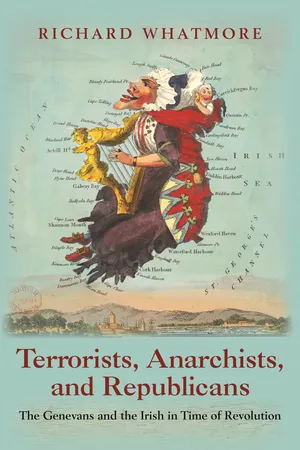
In 1798, members of the United Irishmen were massacred by the British amid the crumbling walls of a half-built town near Waterford in Ireland. Many of the Irish were republicans inspired by the French Revolution, and the site of their demise was known as Geneva Barracks. The Barracks were the remnants of an experimental community called New Geneva, a settlement of Calvinist republican rebels who fled the continent in 1782. The British believed that the rectitude and industriousness of these imported revolutionaries would have a positive effect on the Irish populace. The experiment was abandoned, however, after the Calvinists demanded greater independence and more state money for their project. Terrorists, Anarchists, and Republicans tells the story of a utopian city inspired by a spirit of liberty and republican values being turned into a place where republicans who had fought for liberty were extinguished by the might of empire.
Richard Whatmore brings to life a violent age in which powerful states like Britain and France intervened in the affairs of smaller, weaker countries, justifying their actions on the grounds that they were stopping anarchists and terrorists from destroying society, religion and government. The Genevans and the Irish rebels, in turn, saw themselves as advocates of republican virtue, willing to sacrifice themselves for liberty, rights and the public good. Terrorists, Anarchists, and Republicans shows how the massacre at Geneva Barracks marked an end to the old Europe of diverse political forms, and the ascendancy of powerful states seeking empire and markets—in many respects the end of enlightenment itself.
eBook - ePub
Terrorists, Anarchists, and Republicans
The Genevans and the Irish in Time of Revolution
- 240 pages
- English
- ePUB (mobile friendly)
- Available on iOS & Android
eBook - ePub
Terrorists, Anarchists, and Republicans
The Genevans and the Irish in Time of Revolution
About this book
Information
Publisher
Princeton University PressYear
2019Print ISBN
9780691206646
9780691168777
eBook ISBN
9780691197470
PART I
Rebellion
CHAPTER ONE
The Power of Place
THE OLD AND ramshackle walls in a large field in Crook parish in the village of Passage East, on a hill beyond the city of Waterford on the southern coast of Ireland, have been overtaken by grass, broken down over the years and form part of a ruin. It is a ruin with a peculiar and largely forgotten history. When the local historian Patrick Egan walked around the site in the 1890s, he was informed by a local farmer that foreign folk had once lived there, but their attempt to establish a silk industry had failed because of the weather:
You see, sir, these people that came here were great silk waivers [sic], and they expected, of course, to go on well at their trade. Myself doesn’t know, but as I hears. They set a lot of mulberry trees to feed the silk-worms, but sure you know they wouldn’t grow, the climate was too damp, so they gave up the place and went back again to their own country.1
Events that are better remembered are recalled by the plaque that can be found at the site today, stating that here in 1798 republicans were martyred at ‘New Geneva Barracks’, a dirty and foul prison:
NEW GENEVA BARRACKS 1798. Thousands of United Irishmen were held here under inhumane conditions, many awaiting transportation. Described by Col. Thomas Cloney, a prisoner himself, … as the filthiest most damp and loathsome prison devoid of any comfort … Remember all who died here, Liberty, Equality, Fraternity.
An earlier plaque stated, incorrectly, that the buildings dated from 1786 and correctly that New Geneva was ‘associated with many dark deeds against the United Irishmen’.2
The Society of United Irishmen, whose original proposed name had been the Irish Brotherhood, for the promotion of ‘the rights of man in Ireland’, was founded in Belfast on 14 October 1791.3 It was inspired by William Drennan, the poet and physician, who in 1784, unhappy with the lack of progress in the Volunteer movement in achieving reform, had begun to speculate about the necessity of Irish independence. In the same year Drennan had published, anonymously, the Letters of Orellana, an Irish helot, boldly declaring that the Irish were slaves; the national unity that was required for economic and political progress could only come by means of a union between Catholics, Anglicans and dissenters.4 By 1791 Drennan had become a republican, and proposed that men gather together in a secret society, contracting solemnly, wearing a symbol next to the heart, and communicating with ‘leading men in France, in England and in America’ in the hope of cementing ‘the scattered and shifting sand of republicanism into a body’. Drennan’s idea was for a ‘benevolent conspiracy—a plot for the people’ aimed at securing in society the ‘rights of men and the greatest happiness of the greatest number’. Rights and happiness could only be secured by ‘real independence to Ireland’ and the creation of a republic. Drennan told his friend Samuel McTier that ‘such schemes’ should not ‘be laughed at as romantic’, because ‘without enthusiasm nothing great was done, or will be done’.5 Theobald Wolfe Tone, a fellow-founder of the United Irishmen, wrote in a pamphlet of 1791 that Ireland was blessed as no other country in Europe with regard to natural resources, which were ‘necessary materials for unlimited commerce’. Ireland had an ‘evil government’ rather than a ‘national government’, so that ‘religious intolerance and political bigotry, like the tyrant Mezentius, bind the living Protestant to the dead and half corrupted Catholic’.6 James Napper Tandy, acting as secretary for the Dublin branch of the Society of United Irishmen, declared on 9 November 1791 that as Ireland was in a ‘state of abject slavery’, a ‘sincere and hearty union of all the people’ must be established, seeking a ‘radical reform of parliament’ and ‘the removal of absurd and ruinous distinctions’, and ‘promoting a complete coalition of the people.’7
William Drennan was in the chair when the Society reached out to Scottish republicans like Thomas Muir. Scotland was described as ‘the land where Buchannan wrote, and Fletcher spoke, and Wallace fought’, the fear being that it was in the process of being ‘merged and melted down into another country’ (that is, England).8 In the London parliament, it was noted that the United Irishmen were linked to the Constitutional Society, ‘which had long existed, but about this time [1792] assumed a new character’, the Corresponding Society, ‘which was instituted in the Spring of 1792’, and The Friends of the People. These groups embraced ‘all the extravagant and violent Principles of the French Revolution’ and laboured with ‘bigotry and enthusiasm’, to propagate ‘among the lower classes of the community, a spirit of hatred and contempt for the existing laws and government of the country’.9 The rebels responded to what they perceived to be libel by themselves shaming the ‘sanguinary system of terror’ of the government, and the ‘infernal system of terror, slavery and oppression, with all their attendant evils of poverty and famine’.10 The United Irishmen had embraced Thomas Paine’s philosophy espoused in parts one and two of his Rights of Man in 1791 and 1792, that the end of every political association was the establishment of the rights of man, that all men were born free and equal, and that sovereignty lay in the body of the nation.11 Such views were fostered in the newspaper Northern Star, which was launched by United Irishmen in Belfast in January 1792.
Views that smacked of republicanism were branded treacherous in 1793. Theobald McKenna, the pamphleteer and campaigner for an end to penal laws against Catholics in Ireland, warned in February 1792 that ‘the dangers of this age seem to impend rather from the people than the monarch’. McKenna praised the English constitution as ‘highly estimable’, having ‘all eminent writers on its side’, and asserted that ‘a double experience justifies it; that of England, in which it has produced great good; that of every other form of government, none of which have ever procured permanent and radical happiness’. For McKenna, ‘the oppressions of absolute monarchy [and] the convulsions of democracy, constitute alike the panegyric of the English Constitution’.12 McKenna attempted to prove that republicanism was incompatible with commercial society, which needed inequality to promote the desire for improvement. It was a fact that all historic republics were factious, which meant that republics tended to collapse, and were incompatible with what he termed ‘the social arts’:
In fact, as nations have improved in the social arts, they have declined from the forms of Republicanism, they found them incompatible with tranquility. Carthage was ruined by the factions which arose from the want of a presiding influence. Rome abandoned her liberties in despair, after the most sanguinary contests ever known in the world. Holland, which was much more adapted by its size than Ireland for a Republic, has subsided into an aristocracy, or rather into a limited monarchy. Inequality of condition is inevitable in society, and the controlled pre-eminence of one [figure in the person of the monarch] remedies the evils arising from this inequality. From all these reasons, from the experience of other nations, and the experience of our own, we are led to conclude in favour of a limited monarchy; but it is not alone necessary to have a king; he should be invested with power and influence sufficient to keep him so.13
Advocates of republicanism such as Paine had to be refuted to prevent the collapse of any state. For McKenna, ‘The example of America, and the small expense of the Republican system, are the principal arguments of Mr. Paine and his adherents.’ In fact, the circumstances of North America were entirely different from those to be found across Europe. As McKenna put it, there were particular reasons for the initial success of republican ideas across the Atlantic, which could never be replicated in Europe, and were likely in any case, sooner or later, to be become problematic in North America too:
Paine, having America constantly in view, reasons uniformly wrong, for he supposes uniformly, that every other country is in the same circumstances. Six words refute him completely, There is no mob in America. There are yet in that country but two classes, those which correspond to the middle gentry, and to the yeomanry of England. The population of the States not affording such a number of hands, that some find it necessary to minister to the indolence of others, every man is occupied, and there is not leisure for the speculations or the contentious passions which distract Europe. Thus the casualty of the moment renders America the most easily governed country, and guarantees her from the imperfections of Republicanism. She has few sufficiently idle to pursue ambition, sufficiently rich to bribe, or poor to be corrupted. But the series of cause and effect which lead to the dissolution of the American Democracy, or at least to alter it materially, may be easily traced by any man of discernment.14
McKenna concluded that ‘There can be very little of Republican design in Ireland’, because ‘the wretched speculations which involved France in calamity, can have few admirers’. The true risk was that the prerogative was weakened so as to allow republicanism, the ‘inconvenient [and] boisterous form of government’ to become an option in Ireland.15 McKenna was entirely incorrect about the attractiveness of republican ideas in Ireland. Once it was accepted that the Irish were not free, and that the British were unwilling to grant further reforms that promised future liberty, especially after the Roman Catholic Relief Act of 1791 failed to emancipate Catholics in Ireland fully, republican ideas became more attractive. To many observers, creating a republic in Ireland presented an opportunity to create a nation in a unified sense, overcoming through shared commitment to republican ideas of equality the divisions that were responsible for the political corruption and economic backwardness of the country. This was what had happened in France, where a diverse and divided nation was becoming a unified, and singularly powerful, republican patrie. Paine himself recognised this;16 the links between the United Irishmen and French republicans were especially strong from 1792, with many prominent figures in the movement spending time in Paris.17
II
When, on December 14 1793, the United Irish Society issued an address to the volunteer companies of Ireland, calling upon them to take up arms as citizens, to force the government to undertake parliamentary reform and Catholic emancipation, a Rubicon was perceived by the authorities to have been crossed. Already dealing with widespread Catholic Defender insurrections, what became a war against the United Irishmen was commenced by government. The proprietors of the Northern Star and John Rabb its printer, were prosecuted for seditious libel in January 1793. On February 22 1793, an act was passed that prevented the importation or movement of arms without a licence. On April 9 in the same year a Catholic Relief Act extended the franchise to propertied Catholics and allowed them to take a university degree, while the Militia Act established a fifteen thousand-strong force, which was increased to over twenty-one thousand in 1795. On August 16 1793, the government forbade assemblies in the name of the people from preparing petitions to George III or to parliament. By this time French agents such as Eleazer Oswald and the Reverend William Jackson were active in Ireland. The popular barrister and landowner Archibald Hamilton Rowan was found guilty of distributing the seditious proclamation of the United Irish Society of December 14 1792, and on January 29 1794 he was fined the large sum of £500 and imprisoned for two years. He escaped on May 2 and fled to France. The Reverend William Jackson was arrested in Dublin and charged with high treason on April 28 1794, committing suicide in prison almost exactly a year later. William Drennan was prosecuted for seditious libel but acquitted by a jury on June 25. This was a rare victory, as on May 23 the United Irishmen were declared an illegal society, and through the informer Thomas Collins their Dublin premises at Tailors Hall were raided and all their documents seized. The Society went underground and established close links with other clandestine organisations, and especially the Defenders.18
Throughout 1796 a large number of United Irishmen were arrested, and others fled to North America or to France, the latter in the hope of promoting the invasion of Ireland. On March 24 1796 the Insurrection Act promised the death penalty for the taking of illegal oaths, legitimised searches for armaments and impositions of curfew and gave magistrates the authority to imprison any person found in an unlawful assembly. Thomas Russell, named as ‘an United Irishman’, published his A Letter to the people of Ireland, on the present situation of the country in September 1796, calling the Protestant landlords of Ireland agents of England and a vile aristocracy. Russell attacked the Whigs as false friends of the people for having betrayed the Irish since the failure of the volunteer movements in the early 1780s, and for failing t...
Table of contents
- Cover Page
- Title Page
- Copyright Page
- Dedication
- Epigraph
- Contents
- List of Illustrations
- Preface
- Acknowledgements
- Note on the Text
- Abbreviations
- Part I: Rebellion
- Part II: Divided Geneva
- Part III: Disunited Ireland
- Conclusion: After Revolution
- Notes
- Bibliography
- Index
- A Note on the Type
Trusted by 375,005 students
Access to over 1.5 million titles for a fair monthly price.
Study more efficiently using our study tools.
Frequently asked questions
Yes, you can cancel anytime from the Subscription tab in your account settings on the Perlego website. Your subscription will stay active until the end of your current billing period. Learn how to cancel your subscription
No, books cannot be downloaded as external files, such as PDFs, for use outside of Perlego. However, you can download books within the Perlego app for offline reading on mobile or tablet. Learn how to download books offline
Perlego offers two plans: Essential and Complete
- Essential is ideal for learners and professionals who enjoy exploring a wide range of subjects. Access the Essential Library with 800,000+ trusted titles and best-sellers across business, personal growth, and the humanities. Includes unlimited reading time and Standard Read Aloud voice.
- Complete: Perfect for advanced learners and researchers needing full, unrestricted access. Unlock 1.5M+ books across hundreds of subjects, including academic and specialized titles. The Complete Plan also includes advanced features like Premium Read Aloud and Research Assistant.
We are an online textbook subscription service, where you can get access to an entire online library for less than the price of a single book per month. With over 1.5 million books across 990+ topics, we’ve got you covered! Learn about our mission
Look out for the read-aloud symbol on your next book to see if you can listen to it. The read-aloud tool reads text aloud for you, highlighting the text as it is being read. You can pause it, speed it up and slow it down. Learn more about Read Aloud
Yes! You can use the Perlego app on both iOS and Android devices to read anytime, anywhere — even offline. Perfect for commutes or when you’re on the go.
Please note we cannot support devices running on iOS 13 and Android 7 or earlier. Learn more about using the app
Please note we cannot support devices running on iOS 13 and Android 7 or earlier. Learn more about using the app
Yes, you can access Terrorists, Anarchists, and Republicans by Richard Whatmore in PDF and/or ePUB format, as well as other popular books in History & Early Modern History. We have over 1.5 million books available in our catalogue for you to explore.