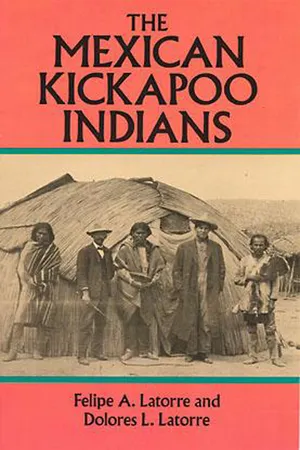
Fascinating anthropological study of a group of Kickapoo Indians who left their Wisconsin homeland for Mexico over a century ago. Focus on why they left, why they settled in northern Mexico, how they live. "One of the most thorough and authentic studies...yet produced..." — Publishers Weekly. 26 illustrations. Map. Introduction. Bibliography. Index.
- 416 pages
- English
- ePUB (mobile friendly)
- Available on iOS & Android
eBook - ePub
The Mexican Kickapoo Indians
About this book
Information
Subtopic
North American HistoryIndex
HistoryChapter 1
Historical Sketch
Since the purpose of this work is to present the Kickapoos from an ethnological viewpoint, no attempt will be made to give a detailed historical background. Their history has been adequately treated by several writers, in particular A. M. Gibson, who in 1963 published a painstakingly documented volume, The Kickapoos: Lords of the Middle Border, which is the best-delineated history of the Kickapoos thus far.
The Mexican Kickapoos belong to the Algonquian-speaking family, which once included tribes from the Delawares of the Atlantic seaboard to the Cheyennes of the western Great Plains. The Algonquian heartland, however, was in the Old Northwest, where twenty-odd Algonquian tribes were situated, all possessing a common language and, in general, the culture traits of one tribe.1
Specifically, the Kickapoos belong to the North-Central Algonquian group, whose members had three common cultural features: a lineage-structured kinship system with Omaha terminology, a complex system of clans regulating personal names, and division into moieties.2
Relations with the French and English, 1600–1765
The first mention of the Kickapoos places them in lower Michigan, between Lake Michigan and Lake Erie, in 1600.3 When the French explored Wisconsin in 1654, they found the Sauk, Fox, Kickapoo, and Potawatomi tribes established as refugees among the Menomini and Winnebago in Wisconsin, having been driven westward to this area by the Iroquois. (The Iroquois had exhausted the fur resources in their own area and had obtained arms from the Dutch and English, with which they easily pushed the Kickapoos and others farther west.)4
Many writers concur that Father Claude-Jean Allouez was the first white man to record meeting the Kickapoos in the Green Bay area, in 1672. They lived in villages, raised crops, and, when these were harvested, hunted game over a large area.5
Fascinated by European goods and warmed by the fiery brandy dispensed by the French, most of the Algonquians became easy prey to French exploitation. The Kickapoos, however, were an exception. From the beginning of their contact with the French they showed a conspicuously independent spirit and a studied hostility toward acculturation and particularly toward the Jesuit priests. Forming a confederacy with the Mascoutens and the Fox, their neighbors, the Kickapoos became leaders of a combination which produced constant trouble for New France. As a result, the Kickapoos and their allies became outlaws in the western French territory, seriously threatening the dream of a French empire in America.6
Ultimately, a series of depredations brought the conflict between the French, the Kickapoos, and their allies into an open war. In 1712 a band of Kickapoos living near the Maumee River took as prisoner a French messenger returning from the Louisiana country. In retaliation, a canoe filled with Kickapoos was captured by the Hurons and Ottawas, allies of the French. Among the slain was the principal Kickapoo chief. That same year the Mascoutens plotted with the Fox and the Kickapoos for the capture of Fort Detroit and approached it in preparation for the siege. The Mascoutens were attacked by the Hurons and Ottawas until they were finally forced to retreat to Presque Isle, where they were taken as slaves.7
The Kickapoos, enraged over the defeat of their allies, engaged in an all-out war against the French and their Indian allies. This spurred the French to organize a massive campaign of retaliation against the Kickapoos, forcing them to come to terms.8
Having made friends with the French—under duress—the Kickapoos were sufficiently impressed with the European goods that they received as payment for their pelts to stay close to the trading posts, protecting the French against the Iroquois, who continued their trade with the English.9 For two decades, the Kickapoos were allies of the French at one time, their enemies at another, at other times fighting other Indian tribes at French instigation, pawns in the French and Indian War.
The habitat of the western tribes slowly shifted eastward during the first half of the eighteenth century. This was in part due to the concentration policy of the French, because of the Fox wars, but was chiefly due to the tribesmen’s desire to return to the home from which they had been driven nearly a hundred years earlier. By the end of the first quarter of the century, the French allies (including the Kickapoos) occupied the land west and north of the Wabash and Maumee rivers.10
After the Kickapoos, Sauk, and Fox destroyed the Illinois Confederacy in 1765, the Kickapoos fixed their headquarters for a time near Peoria. One group established themselves at about the mid-point of the Sangamon River; another group went farther east and settled on the Wabash. The first contingent became known as the “Prairie band,” while the portion who settled on the Sangamon were known as the “Vermilion band.”11
The French began their countermeasures by sending scouts to the Kickapoo villages to take women and children as hostages while the warriors were away. This threat drove the Kickapoos across the Mississippi, where they built villages on the Skunk River in present Iowa and reunited with their old allies, the Fox. The opportunity to regain their captive relatives presented itself a year after their move, when they took the explorer Pierre Boucher and the Jesuit priest Michel Guignois prisoners and later exchanged them for the hostages.12 The exchange of prisoners resulted in a new alliance between the French and the Kickapoos and led to the renunciation of Kickapoo friendship with the Fox, bitter enemies of the French.
Between 1735 and 1763, British agents moved up the Tennessee toward the Ohio Valley in an attempt to cut the Wabash-Maumee trade route, the most direct passage between New France and Louisiana. Supplying the Chickasaw and Natchez Indians with arms and gifts, they offered bounties for raids into French territory north of the Ohio River. The French struck back by sending their newly made allies, the Kickapoos, into Chickasaw and Natchez territory on various occasions with great success —thereby reducing the British threat to the French interests north of the Ohio River. When the British saw their Indian allies defeated and the continuance of the French trade route now protected by the Kickapoos, they attempted to provoke a conspiracy among the French-allied Indians, but the Kickapoos resisted these overtures and remained loyal to the French.13
It was during these days of struggle between the British and the French to gain the loyalty of the Kickapoos that the French presented them with a Louis XV medal, a treasure that the Mexican Kickapoos still possess.
During the French and Indian War the Kickapoos defended the Ohio-Mississippi perimeter of New France. By 1759 the French were on the retreat in America.14 With the Treaty of Paris in 1763, vanquished France transferred to the British title to Canada and the land of New France east of the Mississippi River; West Louisiana was ceded to Spain in compensation for Florida, which Spain yielded to Great Britain.15
These negotiations brought general fear to the Algonquians and led the Ottawa Indian leader Pontiac to attempt the capture of Fort Detroit. The Kickapoos, resentful toward the British and their Indian allies, the Chickasaws and the Miamis, took Pontiac’s side, guarding the southern routes to Detroit during the taking of the fort by Pontiac and his Indian army.
The British attempted a reconciliation with the Algonquians by sending Capt. Thomas Morris to Fort Miami, where he found French traders and a large Kickapoo force; but when the Kickapoos learned of Captain Morris’s intention of visiting other tribes, he was forced to desist from his mission. Unable to take the Illinois country in the face of mounting losses in men and goods, the British sent a second mission in 1765, headed by George Croghan. While approaching the mouth of the Wabash he was captured, and five of his fourteen men were scalped. The Kickapoos repeated the Boucher-Guignois maneuver they had so adroitly executed with the French in 1729: they held Croghan captive for thirty-five days, after which they utilized his release as their means of gaining recognition by the British on their own terms.16
Spanish Overtures, 1765–1815
With the ceding of Louisiana to Spain by the Treaty of Paris, the Kickapoos, among other Indians, were in a position to make friends or enemies with the Spanish. Antonio de Ulloa, distinguished naval officer and geographer, was appointed governor of Louisiana and soon built a chain of posts and settlements along the Mississippi, in the meantime establishing himself as a patron of the Indians of the Illinois country and inviting them to settle within Spanish territory. A Kickapoo chief, Serena, led his band to Spanish Louisiana in 1765, settling on the Missouri River near Saint Louis.
Relations with the Americans after 1779
After the capitulation of Henry Hamilton, British lieutenant governor, at Vincennes in 1779, the lower Northwest was attached to the United States. The Kickapoos switched their allegiance from the British to the Americans when Gen. George Rogers Clark promised that no colonizers would invade the conquered territory. However, before General Clark left Fort Massac on the lower Ohio, twenty families of settlers from Kentucky followed his army to Illinois country, soon to be trailed by many others. Strangled by the alarming encroachment of settlers and bitter over Clark’s broken promise that the Americans had no designs on their land, the Kickapoos turned for counsel to the British, who still held Detroit in 1789 and whose objective, like that of the Indians, was to stem the American influx.17
The post-Revolutionary War period was a time of chaos in the villages of the settlers. The Indians of the Old Northwest took up their tomahawks against the Americans and attacked everyone—sparing not even the French. All Indians of that area, including the Kickapoos, were counted as American enemies. No law existed in the land—Indians were fighting each other as well as the settlers. The British, occupying areas of Michigan, carried on extensive trade with the Indians and encouraged them in their hostility to the American settlers.
After several attempts at subduing the hostile Indians, President Washington sent Gen. Anthony Wayne, whose troops defeated the Indians at the Battle of Fallen Timbers in 1794. The result of this overthrow was the Treaty of Greenville the following year, establishing a new boundary line for the Indians and legally opening Ohio to settlement. For fifteen years a relative peace prevailed throughout the country.18 The Kickapoos and their allies agreed to sign a land-cession treaty with the United States relinquishing land claimed by them in Ohio in return for land in Illinois and a five-hundred-dollar annuity.19
As these newly ceded lands began to be invaded by settlers, the Indians began organizing again, this time with the secret support of the British. The leaders in this movement were Tecumseh and his brother, the Shawnee “Prophet.” Headed by Chief Tecumseh, large bands of Shawnees, Delawares, Kickapoos, and others, who had formed a village at Tippecanoe (where the Wabash and Tippecanoe rivers meet), called on Gen. William Henry Harrison at Vincennes and told him they no longer would tolerate the occupation of the Indian lands by whites.20
Alarmed over the new movement of the Indians and fearing an uprising that could become uncontrollable, General Harrison met them at Tippecanoe in an encounter which ended in the defeat of the Indians. Hiram W. Beckwith describes the participation of the Kickapoos: “They fought in great numbers and with frenzied courage at the battle of Tippecanoe. As a military people, the Kickapoos were inferior to the Miamis, Delawares, and Shawnees, in movements requiring large bodies of men; but they were preeminent in predatory warfare.”21
When Congress declared war against Great Britain in 1812, the Indians of many tribes, including the Kickapoos north of the Ohio River, arrayed themselves on the side of the British.22 When Tecumseh and his brother, the Prophet, fled to Amherstburg, Ontario, where a great intertribal village had been established, 150 Kickapoos and their families joined them.23
After the War of 1812, Henry Clay, John Quincy Adams, and Albert Gallatin met with the British in Ghent to negotiate the terms of the settlement, one of which dealt with the Indians: “The Indian allies of Great Britain [are] to be included in the pacification, and a boundary [is] to be settled between the domain of the Indians and those of the United States. Both parts of this point are considered by the British government as sine qua non to the conclusion of the treaty.”24
Although the American commission presented many protests, over a period of two years treaties were signed with thirty-four tribes or parts of tribes of American Indians, including the Kickapoos, who had previously fought on Britain’s side against the United States. These Indians agreed to the terms of the treaties and signalized their fealty to the United States, concluding one of the most remarkable episodes of United States history, in which domestic Indian policy was dictated by diplomatic relations with a foreign government.25
Migration to the West, 1815–1850
During the administration of President James Monroe (1817–1825), the United States embarked on a policy of forcing eastern Indians, including the Kickapoos, to emigrate west of the Mississippi. At Edwardsville, Illinois, in 1819, the Kickapoos living in Wabash country agreed to a treaty by which they conveyed to the United States more than thirteen million acres of their land between the Illinois and Wabash rivers. The United States gave them in return a tract of land in the southwestern part of Missouri on the Osage River, near the Delaware reservation, and agreed to pay them an annuity of two thousand dollars for fifteen years.26
Thus began the slow migration of the Kickapoos to the Osage River, where they settled next to the Osage tribe. The Osages resented the Kickapoos, accusing them of depleting the game. The inevitable result was constant conflict between the two tribes, requiring severe interference from the U.S. authorities....
Table of contents
- DOVER BOOKS ON THE AMERICAN INDIANS
- Title Page
- Dedication
- Copyright Page
- Table of Contents
- List of Tables
- Foreword
- Acknowledgments
- Introduction
- Chapter 1 - Historical Sketch
- Chapter 2 - Setting, Language, and Transportation
- Chapter 3 - Habitation
- Chapter 4 - Food and the Quest for Food
- Chapter 5 - Crafts
- Chapter 6 - Dress, Personal Care, and Adornment
- Chapter 7 - Economy
- Chapter 8 - Political and Legal Organization
- Chapter 9 - Social Structure
- Chapter 10 - Life Cycle
- Chapter 11 - Concept of Self and Others
- Chapter 12 - Knowledge and Tradition
- Chapter 13 - Disease, Medicine, and Intoxicants
- Chapter 14 - Religion
- Chapter 15 - Rituals and Ceremonies
- Chapter 16 - Magical Beliefs and Practices
- Notes
- Glossary
- Bibliography
- Index
Trusted by 375,005 students
Access to over 1.5 million titles for a fair monthly price.
Study more efficiently using our study tools.
Frequently asked questions
Yes, you can cancel anytime from the Subscription tab in your account settings on the Perlego website. Your subscription will stay active until the end of your current billing period. Learn how to cancel your subscription
No, books cannot be downloaded as external files, such as PDFs, for use outside of Perlego. However, you can download books within the Perlego app for offline reading on mobile or tablet. Learn how to download books offline
Perlego offers two plans: Essential and Complete
- Essential is ideal for learners and professionals who enjoy exploring a wide range of subjects. Access the Essential Library with 800,000+ trusted titles and best-sellers across business, personal growth, and the humanities. Includes unlimited reading time and Standard Read Aloud voice.
- Complete: Perfect for advanced learners and researchers needing full, unrestricted access. Unlock 1.5M+ books across hundreds of subjects, including academic and specialized titles. The Complete Plan also includes advanced features like Premium Read Aloud and Research Assistant.
We are an online textbook subscription service, where you can get access to an entire online library for less than the price of a single book per month. With over 1.5 million books across 990+ topics, we’ve got you covered! Learn about our mission
Look out for the read-aloud symbol on your next book to see if you can listen to it. The read-aloud tool reads text aloud for you, highlighting the text as it is being read. You can pause it, speed it up and slow it down. Learn more about Read Aloud
Yes! You can use the Perlego app on both iOS and Android devices to read anytime, anywhere — even offline. Perfect for commutes or when you’re on the go.
Please note we cannot support devices running on iOS 13 and Android 7 or earlier. Learn more about using the app
Please note we cannot support devices running on iOS 13 and Android 7 or earlier. Learn more about using the app
Yes, you can access The Mexican Kickapoo Indians by Felipe A. Latorre,Dolores L. Latorre, Dolores L. Latorre in PDF and/or ePUB format, as well as other popular books in History & North American History. We have over 1.5 million books available in our catalogue for you to explore.