![]()
CHAPTER I.
Experience of the Indian Character
HAVING had frequent opportunities of observing the customs and traits of character by which the various tribes of Indians are distinguished, and more particularly of those who inhabit the western part of North America beyond the Rocky Mountains, I have been surprised to remark how falsely their character is estimated in the recently published journals of certain travellers. These gentlemen have been delighted to represent the aborigines of North America, as quiet, peaceable souls, meriting nothing so much as the most delicate attention on the part of their European visitors. Two works of this description are more particularly in my mind at this moment. The author of the first, it is to be observed, scarcely left the confines of civilization; and the second had merely an opportunity of communicating with a few Indians who had resided from their infancy in the vicinity of long established trading posts, where they had acquired the art of comporting themselves with some degree of propriety, in order the more readily to gain a livelihood and to acquire the means of satisfying their fictitious wants. The forefathers of these people, being independent of the traders, made no scruple of exhibiting the vices which their sons are studious to conceal. Their wants were comparatively few; the bow and arrow supplied the means of procuring large animals; from the bark of the willow they made fishing nets; the skin of the hare or the beaver sufficed them for clothing; and fire was always at their command by resort to friction. By these and the like simple means were all their necessities supplied; and there is no reason to doubt that they lived as happily as their natural disposition to indulge in war and rapine would permit. It cannot be said that the present generation is really improved by the change they have undergone in some of these respects. The trader, having in view his own sole benefit, has taught them the use of European clothing, with the addition of much superfluous finery; and their modern virtues become them about as well as these garments, and are just as consistent with their real character. In a word, those very Indians whose quiet demeanour has been so much lauded, only conceal, under this specious mask, all the vices which their fathers displayed more openly: unprovoked murder and habitual theft are committed by them whenever the opportunity offers; and their character, generally, is of a description to afford a constant source of anxiety to those who reside among them.
Such being the treacherous disposition of those Indians who, residing in the immediate vicinity of the trading posts, are in a great measure restrained by fear, and other causes co-operating, to check their evil propensities, what must he be destined to experience who wanders among the lawless tribes that are strangers to the faces of Europeans? It is the dark character of the latter that I shall here endeavour to illustrate, leaving it to my readers’ judgment whether the reports that travellers have chosen to spread respecting them, are worthy of his reliance. In some of the succeeding sketches, the savage virtues are also a little shown; for what may be called virtue in the breast of a wild Indian cannot be denied them, though it may be manifested in glaring defiance of the laws of civilized society.
In 1829 I was appointed to explore the tract lying south of the Columbia, between that river and California. For five years previously I had been similarly employed to the eastward of that tract, where I had had many rencontres with the warlike tribes that cross from the east side of the Rocky Mountains to wage war with those residing on the west. War, hunting, and horse-thieving, are the sole pursuits of these reckless and most terrrible of all foragers, in the prosecution of which they have no respect for persons. The prizes they most covet are scalps and horses—it matters not whether they be snatched from trader or Indian; though, in the former case, they have been taught to purchase them more dearly than the latter. In my different meetings with them, I have been so far fortunate as to lose only three men, but it is in this quarter that drawing-room authors should travel, and I will venture to say they will return—if indeed they are so fortunate as to escape home again—with a far different impression of the character of Indians than they seem to entertain.
It was in the month of September that I bade adieu to the shores of the Columbia River, with a party composed of thirty men, well appointed, to overcome the obstacles and encounter the perils which long experience had taught me to anticipate. True, indeed, we could not boast of India-rubber pillows or boots, nor of preserved meats and soups, with many other deemed indispensable adjuncts introduced by modern travellers. However, let me confess at once the vast difference between those who travel in pursuit of amusement or science, and men like us who only encounter these hardships for vile lucre. Though we must need content ourselves with the blanket and the gun, we do, at least, possess this advantage over them, that we usually succeed in our arduous undertakings. On the other hand, we descend unnoticed to the grave, while honours and titles are lavished upon our rivals in enterprise!
Difficulties, many and greater than I had anticipated, began to crowd upon us; and though, by perseverance, we were enabled to surmount them, our sufferings and trials were truly great. There were times when we tasted no food, and were unable to discover water for several days together; without wood, we keenly felt the cold; wanting grass, our horses were reduced to great weakness, so that many of them died, on whose emaciated carcasses we were constrained to satisfy the intolerable cravings of our hunger, and as a last resource, to quench our thirst with their blood. Such are the privations and miseries to which Indian traders are subject in the prosecution of their precarious vocation.
After leaving the Columbia, we journeyed a month through a sterile country, before we came upon the traces of any human inhabitants, who then appeared more numerous than I had expected. On the day following their first appearance, a party consisting of ten men, who had been sent in advance as scouts, came in sight of about fifty Indians, who fled on their approach, but not soon enough to prevent the capture of two of their number. These were fully sufficient to answer all my views, which were to obtain, if possible, some information of the country before us; the amount of our knowledge at present being the course pursued, which, as indicated by the compass, was south-west. Having secured the two strangers, we treated them with all possible kindness, and by signs endeavoured to express our wishes. This is the policy adopted by all explorers of wild countries, and there surely cannot be a more humane one; although, in my opinion, which is founded on general experience, and confirmed, as will immediately appear, by the event in this particular case, it is directly opposed to the attainment of the desired end. It is something to hazard the remark, yet I will venture the opinion, that had it, on the first discovery of new countries, been resolved to treat the savages with the greatest severity, the eventual sacrifice of many lives on their own part would have been avoided, and the murderous blow averted from many an unfortunate victim, whose only offence has been the heaping of undeserved favours on wretches whose hearts were callous to the emotions of gratitude.
Having succeeded in gaining some partial information of the country in advance of us, I dismissed my informants, first presenting them with a few baubles in return. Wild as deer, they were soon out of sight, but the kind reception they had met with being, as I suppose, duly represented to their countrymen, they returned on the morrow, accompanied by a large body of men, who soon became very troublesome. Every thing about us attracted their curious attention; our horses, if possible, still more than ourselves. It was with evident reluctance that our numerous visitors left us in the evening, a few of them, indeed, hinting a wish to remain. This, I doubt not, was with the double view of observing how we secured our horses, and the precautions we took to guard against surprise, and to enable themselves to concert measures with their associates the more effectually to betray us. I gave orders to clear the camp, and for the night watch to turn out, upon which they went away.
At the dawn of day, according to my invariable custom, I had all the men aroused, the fires lighted, and the horses collected in the camp; this being the hour that Indians always fix upon for making their predatory attacks, it being then, as they say, that men sleep most soundly. In this, as in other calculations of a savage cunning, they are not far wrong. They would certainly have found it so in our case, had the precaution alluded to not been adopted; for, fatigued with the long march of the day, and wearied with anxious watching during the several divisions of the night, the long-deferred slumbers of the men were doubly sweet and sound when tired Nature could at last indulge herself. Thanks to the method we observed, every one was awake and stirring—preparing, in fact, for a start—when I perceived, in the gray dawn, a large body of Indians drawing near. When within a short distance of the camp, they hesitated to advance, as if dubious of the reception that awaited them. This had a suspicious appearance, nothing having occurred on the previous day to give rise to any doubt that it would be otherwise than friendly. We were not long left in uncertainty of their hostile intentions, for a shower of arrows was presently discharged into the camp. This was too much for our forbearance; I considered it high time to convince them that we could resent the unprovoked attack. Three of our horses were already wounded, and if we ourselves had escaped, it was probably owing to the poor beasts having sheltered us from the arrows. I therefore ordered a rifle to be discharged at them. The ball was true to its aim, and a man fell. This was sufficient as a first lesson; for on witnessing it they at once took to flight, leaving their companion dead on the field, as a mark of their evil design and its punishment. I trust they were not only duly impressed with our superiority over them, but likewise with a sense of the lenient treatment they had received, although, from past experience, I could have little hope at the time that the effect of either would be very durable.
After three days’ further travelling, over a country as barren as ever Christian traversed, we came to the lands of another tribe, residing on the waters of the Rio Colorado. These Indians I strongly suspected to be the same who, the year preceding, had massacred ten men attached to the party of Mr. Smith, an American adventurer.
This ill-fated party consisted originally of thirty-five individuals, all of whom, excepting four, fell victims on this and other occasions to the blood-thirsty spirit of the natives. Though he was one of those who escaped, it would almost appear as if this enterprising American had been doomed eventually to suffer a like fate, for the following year, while on his way from St. Louis to California, for the purpose of purchasing mules and horses, he left the main party about three miles, accompanied only by two men, in quest of water. He found the object of his search, and paid for it the heavy price of his life. His protracted absence naturally exciting considerable alarm, though his true fate was not immediately suspected, search was made, and his body, together with those of his two companions, found stark and stiff upon the ground. The unhappy men had been murdered in cold blood, by Indians concealed in the bushes till the favourable moment arrived for the accomplishment of their ruthless purpose.
I was intimately acquainted with poor Smith, and it was from himself that I learned the particulars of his misfortunes first alluded to. As the brief story will tend to confirm my observations upon the Indian character, I will here relate it in the narrator’s own words.
“After suffering severely in crossing the barren desert, I was truly well pleased,” said he, “to discover a fine stream of fresh water, which proved to be the north branch of the Rio Colorado. On sounding it, I found it too deep to ford, and as grass, which my lean horses much required, appeared to be far more abundant on the opposite side, I ordered ten men of the party to get them across, which they accordingly did, by driving them into the water, and accompanying them swimming. For several days I had been unsuccessfully searching above and below our position for a fording place, without discovering a vestige of any human inhabitants; but no sooner had my men landed on the opposite shore, than upwards of a hundred Indians rushed on them, from behind a thicket of willows, and murdered the whole. My horses were speedily secured and driven out of sight, and it is scarcely necessary to say that any attempt at pursuit under such circumstances had been in vain. Such was the situation in which I found myself, with property to the value of ten thousand dollars; and rather than the villains who had so deeply injured me should reap any benefit from it, I had the whole thrown into the river. We then made a raft, and crossed over, when we found the bodies of my unfortunate men so mutilated as to be scarcely recognizable. We consigned them also to the keeping of the deep, for as you well know, not even the dead are respected by the wild tribes of these parts.”
The details of their now melancholy journey till their arrival at St. Gabriel, a Spanish mission in California, need not be repeated. Being unsuccessful in his errand, owing to the deficiency of his property and the mistrust with which the Spaniards viewed him as the first American who had penetrated to their settlement by land, Mr. Smith now resolved on proceeding to our depot on the Columbia, which is known as Fort Vancouver. The Spaniards, I may remark, had subjected him to a brief confinement in prison, but being liberated through the influence of an American captain, whose ship was in the vicinity, he left St. Gabriel with the purpose I have mentioned. When within three days’ journey of his new destination, being arrived on the borders of the river Umpqua, he again experienced a reverse—a more dreadful one than that already related. Here, then, I shall resume the narrative in his own words, and it will hence appear by what a slender tenure the trader holds his existence; if he escapes to return to his home, he may, indeed, thank the Almighty alone for his preservation.
It is proper to observe that myself, as well as several of our gentlemen, had on various occasions visited the village where the first treason occurred, but then we were at all times strictly on our guard. The natives, too, were sometimes in the habit of resorting to Vancouver to trade, and were well acquainted with us. They soon, however, discovered poor Smith’s party to be strangers, and determined to take advantage of the misplaced confidence he seems to have reposed in their mild and peaceable disposition.
“Finding myself among Indians,” he says, “whom, from their possessing many articles of European merchandize, and frequently naming you and several other gentlemen, I began to consider no longer as enemies, I relaxed my usual vigilance. Having prolonged my stay for two days, to recruit the worn-down animals I had purchased at St. Gabriel, on the third morning I directed Mr. Rogers, my assistant, to have everything in readiness, desiring the men also to clean their rifles, preparatory to start on the morrow. I then, accompanied by two men, embarked in a canoe, and proceeded in search of a suitable crossing-place, the banks opposite our encampment being too steep for the horses to surmount. On my return, after an absence of three hours, when within half a mile of the tents, I observed a number of Indians running towards us along the bank, yelling most fearfully. Immediately suspecting what had happened, we crossed over, and secreted ourselves in the bushes, the Indians discharging their guns at us without effect. Anxious to ascertain the fate of my party, I then ascended an eminence, from whence I could plainly perceive that the camp was destroyed, and not a vestige of man, horse, or mule, to be seen.
“Though conscious that the wretches would not dare to pursue us, in a country so thickly wooded, I yet considered it to be most prudent to be concealed during the day, and to travel only under cover of the night. On the second day we perceived some of the Company’s servants, who conducted us safely to Vancouver.”
The day preceding Mr. Smith’s arrival under these circumstances, one of his party named John Black, who had escaped the massacre at the camp, had also made his way to Fort Vancouver, and preparations had at once been commenced by the superintendent of the Company’s affairs, to ascertain the fate of Mr. Smith and his two men. This party was on the eve of setting out, when the arrival of the fugitives relieved us of that anxiety. From Black we elicited the particulars of the massacre in the following words:—“Soon after Mr. Smith’s departure, while some of the men were cleaning their rifles, some cooking, and others trafficking with the natives, on a sudden the latter, in number exceeding two hundred, with dreadful shouts, rushed on us, before any one was prepared for defence. I,” said the poor fellow, “escaped the general fate, being wounded and left for dead, but recovering, succeeded in effecting my retreat hither.”
Thus fell eighteen men, far from their homes, their relations and their friends. As for the survivors, they met with every attention from us which their destitute situation demanded. Decisive measures were adopted to recover Mr. Smith’s property. All the furs, with most of the horses and mules, were recovered and restored to their right owners, who subsequently made them over to the Company at a valuation rather exceeding the current price, which the agents of the Company cheerfully offered to the adventurer, in sympathy for his forlorn condition. I have only to add that his losses and misfortunes were insufficient to deter him from new enterprises. With the persevering spirit characteristic of his countrymen, he again entered the field the next year, when his career was closed as has already been related.
To return to my own situation. As I have before remarked, I strongly suspected that the Indians among whom we now found ourselves, were the same party who, the year before, had cut off part of Mr. Smith’s men as first related. They appeared to be bolder than any I had yet seen; but on a narrow scrutiny, I could perceive nothing to confirm my suspicion of their identity. No tracks of horses were seen, but this was a circumstance readily accounted for by the fact that the country was too barren to admit of their being easily maintained. My men were eager to revenge the massacre upon them; but as I had no proof that these were the guilty persons, I withheld my consent to their entreaties.
That punishment, however, which I was slow to inflict on them for past deeds, of which they were doubtless guilty, they shortly drew upon themselves by present misconduct. On the day following our appearance among them, they swarmed about the camp, every man carrying, in addition to his proper arms, a long stick on his shoulder, in derision of the manner in which we carry our guns. Observing the greatness of their numbers, I took the precaution of posting an extra guard over our horses, and warned the men to hold themselves in readiness for the worst. Besides their usual fire-arms, I furnished each of our little party with a spear, giving orders not to reload after the first volley, but to charge; for I was apprehensive lest, during the interval of loading, the Indians might make a rush and overpower us; and that a speedy attack was meditated, I could no longer doubt. Our preparations completed, I admitted a few Indians into the camp, purposely that they might observe our state of defence and with the hope that it might deter them from attacking us. Unhappily for them, the desired effect was not produced, for presently one of the guard was wounded, and the alarm given that the Indians were securing our horses. This was sufficient for me. They had shed the first blood, and I was resolved that theirs should repay it; and as it was now for life or death with us, I ordered a general discharge, to be followed up by a charge with the spear. The first, however, sufficed; for on seeing the number of their fellows who in a single moment were made to lick the dust, the rest ingloriously fled, and we saw no more of them. Twenty-six remained dead on the field.
It would be inconsistent with my object to continue the narrative of the expedition, and our other travelling adventures in this region. It is not my purpose to write a book of adventure, but to illustrate, as far as my acquaintance with circumstances may enable me, and from various points of view, the character of the Indian tribes. The little I have advanced, from my own experience, may suffice to show that they do not possess the fine qualities attributed to them in recent publications, and the following sketches will make both their better and their worse characteristics still more manifest. If any one be sceptical, after all, in regard to the latter, I can only say that it would be easy to multiply instances of the most atrocious and unprovoked cruelty practised by the Indians against those engaged in the fur trade. It is enough to hint at the sad fate of Livingston, Henry, Hughes, Millar, Jones, Kennet, Smith, McKenzie, and Corrigal, chiefly officers of the service, besides nearly three hundred and fifty men, Americans and servants of the Company in nearly equal proportions, who have fallen victims within the last twenty years.
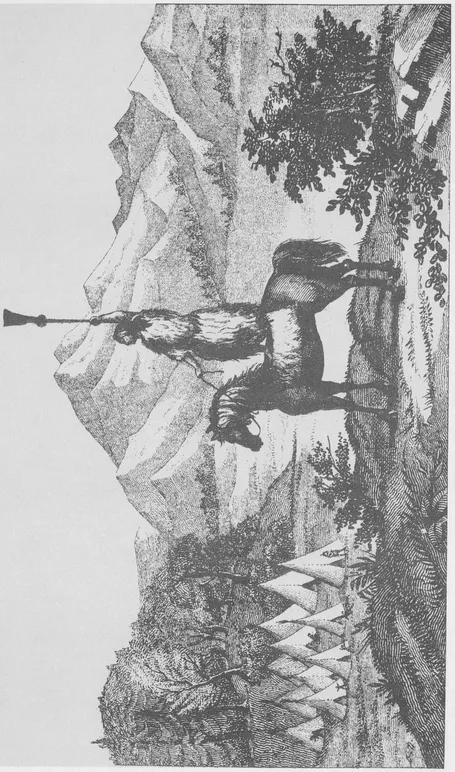
PLATE III.
The Hunter Signals the Presence of Game
![]()
CHAPTER II.
The Red Feather, FLATHEAD CHIEF
IN the year 1823, I...