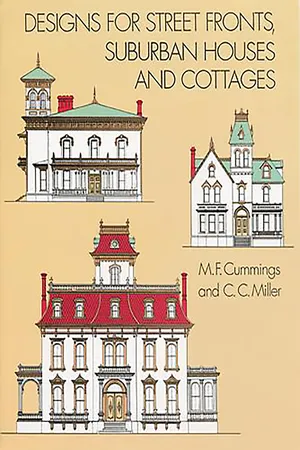
Excellent sourcebook includes elevations of building fronts as well as enlarged drawings of architectural elements incorporated in these facades: residential entrances, cornices, a curved roof, dormer window, and much more. Indispensable archive for preservationists, restorationists, architectural historians, and urban archaeologists. 714 illustrations on 52 plates.
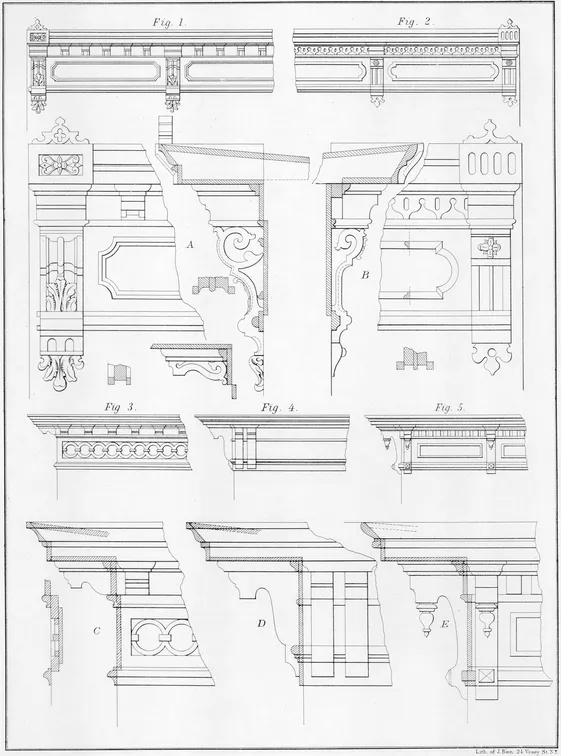
Fig. 1. Shows a cornice having trusses, which are moulded on the face and enriched with carved leaves and beads. Over the trusses are moulded modillions, and over the end trusses and modillions are end-blocks, having raised panels and surmounted by scrolls 4 inches thick. Between the trusses are panels, having mouldings at the top and bottom and sawed scrolls at the ends. Over the panels are dentils, sawed to a mould on the face. At A are the details of the cornice, comprising an elevation and section, and sections of the face of the trusses and modillions.
Fig. 2. Shows a cornice having trusses, fluted on the face, enriched at the foot and panelled at the top. Between the trusses are sunk panels in the frieze, and in these are raised blocks with balls in the centre. The end-blocks are panelled and enriched. Over the frieze panels are sawed dentils, 3 inches thick. At B are the details, comprising an elevation and section of the cornice, and a section of the trusses.
Fig. 3. Shows a cornice having sawed trusses with modillions placed over them. The end-block has sawed rosettes and top scrolls. The frieze is plain, and over it are plain dentils. At C is a section and elevation of the cornice and a section of the trusses.
Figs. 4, 5, 6, 7, 8, and 9. Show elevations and sections of window caps.
The cornices shown at Figs. 1 and 2 are designed for buildings three stories in height, and the cornice shown at Fig. 3 is designed for a building two stories high. The end-blocks should be used where the cornice cannot extend around the building. The window-caps may be executed in stone, cast-iron, or wood; if of wood, they should be covered with tin on the top.
All details on this plate are drawn to a scale of
of an inch to the foot; the designs are drawn to a scale of
inch to the foot.
PLATE 2.
CORNICES FOR STREET FRONTS.
Fig. 1. Shows a cornice having enriched and moulded trusses, having moulded caps. The end-blocks are panelled and enriched, and have top scrolls. Between the trusses are moulded frieze panels, and over them are sawed modillions. At A is an elevation and section of cornice, side of modillions and section of trusses.
Fig. 2. Shows a cornice having trusses made of five thicknesses of plank. The foot leaves are sawed and have raised balls. The trusses have moulded caps and are enriched with carved rosettes. The end-blocks are fluted and have top scrolls. The frieze is panelled with raised mouldings, and over the panels are sawed dentils 3 inches thick. At B is an elevation and section of the cornice and a section of the trusses.
Fig. 3. Shows a cornice having modillion, and a sawed ornament in the frieze. At C are the details.
Fig. 4. Shows a cornice having sawed brackets, 6 inches thick, placed in pairs. At D are the details.
Fig. 5. Shows a cornice having brackets 6 inches thick, having turned drops, and raised panels. The frieze is panelled, and over it are plain dentils.
The cornices shown at Figs. 1 and 2 are designed for buildings three stories in height; those shown at Figs, 3, 4, and 5, for buildings two stories in height.
All designs in this plate are drawn to a scale of
inch to the foot; the details are of an inch to the foot.
Plate 2.
Plate 3.
PLATE 3.
CORNICES AND DOORS FOR STREET FRONTS.
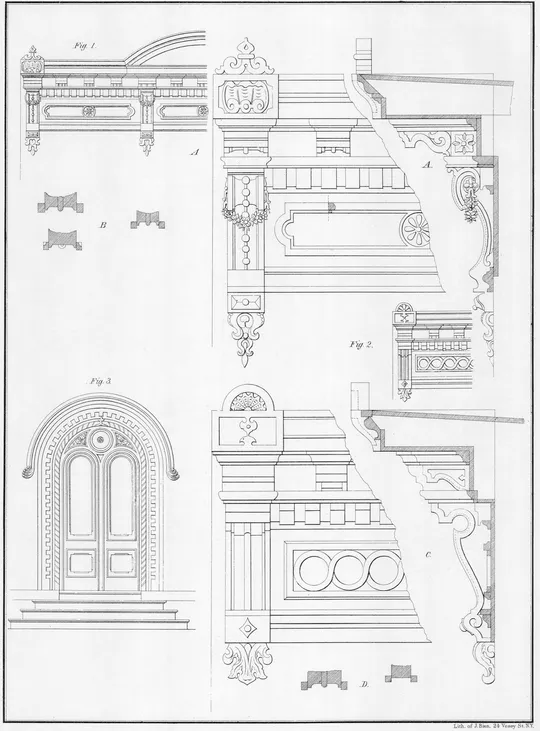
Fig. 1. Shows a cornice having carved and moulded trusses elaborately enriched. The end-blocks are carved and have top scrolls. Over the trusses are moulded modillions, and like modillions are placed over the frieze. The frieze is panelled and moulded, and rosettes are placed in the centre of the panels. Over the panels are dentils, and the cornice is formed into a pediment in the centre. At A is a section and elevation of the cornice, and at B are shown sections of the face of the trusses and modillions.
Fig. 2. Shows a cornice having moulded and enriched trusses, with caps. The end-blocks are panelled and enriched. The frieze is panelled, and in the panels are sawed chain ornaments. Over the panels are dentils and sawed modillions. At C is shown an elevation and section of the cornice, and at D sections of the trusses and modillions.
The cornices on this plate should be used in buildings which are four or more stories in height.
The cornices shown in Plates 1, 2, and 3, are designed for buildings having fronts of from 20 feet to 30 feet wide; those having the bold trusses should have one truss to each pier; those that are shown at Figs. 4 and 5, on Plate 2, should have the brackets placed from 3 feet to 5 feet apart. The pediment shown in Fig. 1, Plate 3, may be introduced with good effect in any of the designs of cornices shown.
Fig. 3, on Plate 3, shows a design for a doorway, having brick joints, moulded stone hood, and carved wood frame. This doorway would make an appropriate entrance for a chapel or church of moderate expense.
The details of the cornices on this plate are drawn to a scale of
of an inch to the foot, and the doorway to a scale of
inch to the foot. The designs of the cornices are also drawn inch to the foot.
PLATE 4.
DESIGNS FOR CORNICES OF BRICK.
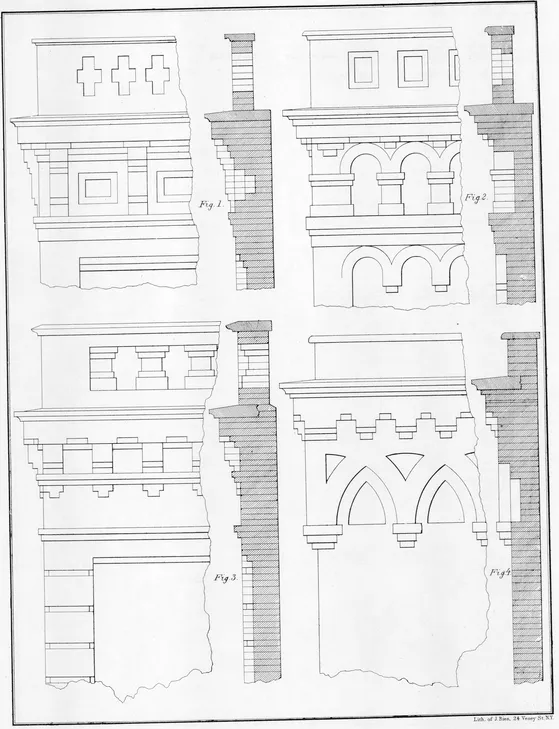
On this plate are shown four designs of cornices to be constructed of plain or common brick. The upper moulded members of the cornices and balustrades should be of cut stone or of wood; if of wood, they should be tinned on the top.
Fig. 1. Shows an elevation and section of a cornice having brackets 8 inches thick, and between them are sunk panels. The balustrade is 8 inches thick, with openings made through it. At the corners of the building should be plain pilasters.
Fig. 2. Shows a cornice having corbel arches at the bottom, projecting 4 inches from the wall. The frieze has arched recesses 8 inches deep. The balustrade is pierced with square panels.
Fig. 3. Shows a cornice having blocks 8 inches on the face, and projecting as shown on the section. At the corners of the building are placed pilasters, cut into blocks by receiving every sixth course of brick. The balustrade is pierced with openings, with piers between them.
Fig. 4. Shows a cornice having a frieze formed of intersecting arches, terminating on corbels; under the arches are panels and above them are corbelled projections. The balustrade is plain. The cornices shown on this plate are drawn to a scale of
inch to a foot.
Plate 4.
Plate 5.
PLATE 5.
DESIGNS FOR SHOP OR STORE FRONTS.
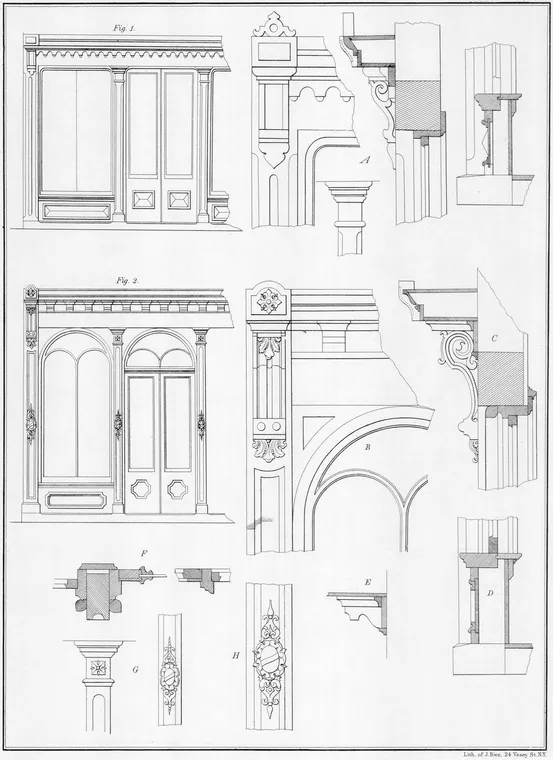
Fig. 1. Has posts and lintels of wood or iron, chamfered at the corners, and the posts have vases and caps; those at the ends are also fluted in the centre. Brackets with panelled end-blocks are placed over the end-posts, and have top scrolls. The sills of the windows are moulded, and under them, and in the doors, are raised, chamfered and moulded panels. The details at A, show an elevation and section of the cornice, cap of centre-posts and section of sills and panels under the windows.
Fig. 2. Has panelled and enriched columns of cast-iron. The cornice and lintels may be of wood or iron. The cornice has enriched trusses over the end columns, and between them are modillions. The end-blocks are panelled and enriched. The door and window frames are arched and secured to the iron columns. The windows have moulded sills and panels under them. The details show sections and elevations of the cornice, column...
Table of contents
Title Page
Copyright Page
Table of Contents
INTRODUCTION
PLATE 1. - CORNICES AND WINDOW-CAPS FOR STREET FRONTS.
PLATE 2. - CORNICES FOR STREET FRONTS.
PLATE 3. - CORNICES AND DOORS FOR STREET FRONTS.
PLATE 4. - DESIGNS FOR CORNICES OF BRICK.
PLATE 5. - DESIGNS FOR SHOP OR STORE FRONTS.
PLATE 6. - DESIGNS FOR STORE FRONTS.
PLATE 7. - DESIGN FOR STORE OR SHOP FRONT.
PLATE 8. - DESIGNS FOR SHOP OR STORE FRONTS.
PLATE 9. - DESIGN FOR A FRONT ENTRANCE DOOR FOR A DWELLING-HOUSE.
PLATE 10. - DESIGNS FOR FRONT ENTRANCE DOORS FOR DWELLING-HOUSES.
PLATE 11. - DESIGNS FOR ENTRANCE DOORS TO DWELLING-HOUSES.
PLATE 12. - DESIGNS FOR BELT-COURSES, RUSTIC QUOINS, STRING-COURSES, BASEMENT FRONTS, AND WINDOW FINISH.
PLATE 13. - DESIGNS FOR THE EXTERIOR FINISH OF WINDOWS.
PLATE 14. - DESIGNS FOR WINDOW-CAPS AND OUTSIDE FINISH FOR WINDOWS.
PLATE 15. - DESIGN OF BUILDING APPROPRIATE FOR TWO BANKING HOUSES OR INSURANCE OFFICES.
PLATE 16. - DESIGNS FOR THREE STORES, EACH TWENTY FEET FRONT.
PLATE 17. - ELEVATIONS OF STREET FRONTS OF DWELLING-HOUSES.
PLATE 18. - ELEVATIONS OF STREET FRONTS FOR DWELLING-HOUSES AND STORES.
PLATE 19. - ELEVATIONS OF STREET FRONTS FOR STORES.
PLATE 20.
PLATES 21, 22, AND 23,
PLATE 24. - DESIGNS FOR CORNICES FOR STREET FRONTS AND FOR SUBURBAN BUILDINGS.
PLATE 25. - CORNICES DESIGNED FOR VILLAS AND SUBURBAN RESIDENCES.
PLATE 26. - CONTINUATION OF DESIGNS FOR CORNICES OF VILLAS, SUBURBAN AND COUNTRY HOUSES.
PLATE 27. - DESIGNS FOR CORNICES, CURVED OR FRENCH ROOFS, AND DORMER WINDOWS.
PLATE 28. - DESIGN FOR CORNICE, CURVED ROOF, AND DORMER WINDOW.
PLATE 29. - DESIGNS OF GABLE ORNAMENTS AND VERGE-BOARDS.
PLATE 30.
PLATE 31. - DESIGNS FOR WINDOW-CAPS.
PLATE 32. - PORCHES.
PLATE 33. - DESIGNS FOR PORCHES.
PLATE 34.
PLATE 35. - PIAZZAS.
PLATE 36.
PLATE 37. - CANOPIES FOR WINDOWS OR DOORS.
PLATE 38. - DESIGNS FOR AN ENTRANCE DOOR, BAY WINDOW, AND DOOR-CAPS.
PLATE 44. - DESIGNS FOR STAIR NEWELS. BALUSTERS, STAIR BRACKETS, AND SECTION OF RAIL FOR STAIRS.
PLATE 45.
PLATE 46. - SECTIONS OF WINDOW-FRAMES, SASH, AND INSIDE SHUTTERS, OR BLINDS.
PLATE 47.
PLATE 48.
PLATE 49. - ELEVATIONS. THREE VILLAS, OR SUBURBAN RESIDENCES.
PLATE 50. - FRONT ELEVATIONS OF SUBURBAN OR COUNTRY HOUSES.
PLATE 51. - FRONT ELEVATION OF SUBURBAN OR COUNTRY HOUSES.
PLATE 52. - FRONT ELEVATIONS OF SUBURBAN OR COUNTRY HOUSES.
Trusted by 375,005 students
Access to over 1.5 million titles for a fair monthly price.
Study more efficiently using our study tools.
Frequently asked questions
Yes, you can cancel anytime from the Subscription tab in your account settings on the Perlego website. Your subscription will stay active until the end of your current billing period. Learn how to cancel your subscription
No, books cannot be downloaded as external files, such as PDFs, for use outside of Perlego. However, you can download books within the Perlego app for offline reading on mobile or tablet. Learn how to download books offline
Perlego offers two plans: Essential and Complete
Essential is ideal for learners and professionals who enjoy exploring a wide range of subjects. Access the Essential Library with 800,000+ trusted titles and best-sellers across business, personal growth, and the humanities. Includes unlimited reading time and Standard Read Aloud voice.
Complete: Perfect for advanced learners and researchers needing full, unrestricted access. Unlock 1.5M+ books across hundreds of subjects, including academic and specialized titles. The Complete Plan also includes advanced features like Premium Read Aloud and Research Assistant.
Both plans are available with monthly, semester, or annual billing cycles.
We are an online textbook subscription service, where you can get access to an entire online library for less than the price of a single book per month. With over 1.5 million books across 990+ topics, we’ve got you covered! Learn about our mission
Look out for the read-aloud symbol on your next book to see if you can listen to it. The read-aloud tool reads text aloud for you, highlighting the text as it is being read. You can pause it, speed it up and slow it down. Learn more about Read Aloud
Yes! You can use the Perlego app on both iOS and Android devices to read anytime, anywhere — even offline. Perfect for commutes or when you’re on the go. Please note we cannot support devices running on iOS 13 and Android 7 or earlier. Learn more about using the app
Yes, you can access Designs for Street Fronts, Suburban Houses and Cottages by M. F. Cummings,C. C. Miller, C. C. Miller in PDF and/or ePUB format, as well as other popular books in Architecture & Architecture General. We have over 1.5 million books available in our catalogue for you to explore.