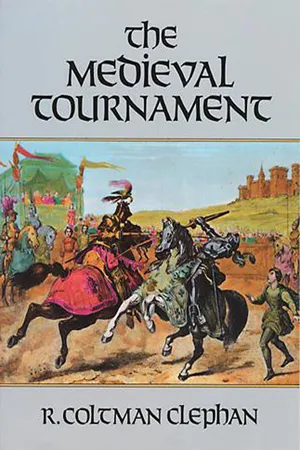
Complete, detailed history of English and European tournaments, based on rare manuscripts and original sources. Topics include Arthurian and other round tables, body armor, chain mail, plate armor, royal jousts, introduction of firearms in the 14th century, the tilt, effigies, trial by combat, duels and many other aspects. 24 illustrations. Bibliography. Index.
- 240 pages
- English
- ePUB (mobile friendly)
- Available on iOS & Android
eBook - ePub
The Medieval Tournament
About this book
Information
Topic
GeschichteSubtopic
Militär- & SeefahrtsgeschichteCHAPTER I
IT is impossible to trace the beginnings of these martial exercises, mention of which first appears in history in chronicles of the eleventh century ; but they doubtless grew out of earlier forms of the rough games and sports engaged in by the noble youth of the period as practice for actual warfare.
Du Cange in his Glossarium, under the heading “Torneamentum,” cites Roger de Hoveden, who defines tournaments as being military exercises carried out in a spirit of comradeship, being practice for war and a display of personal prowess.3 Their chief distinction from other exercises of a kindred nature lies in the fact that they were actual contests on horse-back, carried out within certain limitations, of many cavaliers who divided themselves into contending troops or parties, which fought against each other like opposing armies.
Mention of rules for observance in the conducting of these martial games is made by more than one chronicler of the period as having been framed in the year 1066, by a French Seigneur, Geoffroi de Preuilli of Anjou, and it is stated that he had invented them and even been killed in one of them ;4 and the very names “ tourneamentum” and “tournoi” would imply a French origin. These designations would seem to have been derived from “tournier,” to wheel round; though Claude Fauchet, writing in the last quarter of the sixteenth century,5 expresses the opinion that the word “tournoi” came about from the cavaliers running par tour, that is by turns at the quintain : “ fut premièrement appellé Tournoy pource que les Cheualiers y coururent par tour; rompans premièrement leur bois et lances contre vne Quintaine. . . .”
Military games of a similar nature are often stated to have been practised in Germany earlier than this, and Favine in Theatre of Honour and Knighthood6 prints a list of rules and ordinances for observance at a “ tournament” to be held at Magdeburg, as having been issued by the Emperor of Germany Henry I, surnamed the Fowler, 876–936, a century and a half earlier than the date of the promulgation of the rules of Pruilli. The German text, however, bears the impress of a later period than early in the tenth century, and this view is expressed by Claude Fauchet, who gives the rules, which are curious enough for insertion here ; and he mentions the authority from which Favine drew his statement.7
“ Sebastien Munster au troisiesme liure de sa Geografie, certifie que Henry premier de ce nom viuant enuiron Pan VCCCCXXXVI fit publier vn Tournoy, pour tenir en la ville de Magdebourg qui est en Saxe, lequel fut le premier, & tenu l’an VCCCCXXXVIII. Le mesme Munster recite douze articles de loix de Tournoy :—
- Qui fera quelque chose contre la Foy.
- Qui aura fait quelque chose contre le sacré Empire, et la Cesarce Majesté.
- Qui aura trahy son Seigneur, ou sans cause iceluy delaisse fuyant en vne bataille : tué, ou meurdry ces compagnons.
- Qui aura outragé fille, ou femme, de fait ou de parolles.
- Qui aura falcifié vn seel, ou fait un faux serment. Qui aura esté declaré infame, & tenu pour tel.
- Qui en repost (c’est secrettement & en cachette) aura meurdry sa femme. Qui d’aide ou de conseil, aura cósenty la mort de son Seigneur.
- Qui aura pillé les Eglises, femmes vefues, ou orphelins: ou retenu ce qui leur appartenoit.
- Qui ayant esté offensé par aucun, ne le poursuit par guerre, ou en Iustice : ains secrettement & par feu ou rapines. Qui gaste les bledz & vignes dont le public est substanté.
- Qui mettra nouuelles impositions sans le sceu de l’Empereur : ou ie croy qu’il entéd parler d’vn Seigneur qui surchargera sa terre.
- Qui aura cómis adultere, ou rauy vierges & pucelles.
- Qui fait marchandise pour reuendre.
- Qui ne pourra prouuer sa race de quatre grands beres, soit battu & chassé du Tournoy.”
Jousts and Tournaments were classed under the heading of Hastiludia or spear-play : as also was the behourd or buhurt, Bohordicum in Mediæval Latin,8 a military exercise of a similar nature ; though in what respect it differed from the joust or tournament is nowhere stated. That it was an exercise with lance and shield is clearly shown in a passage in Concilium Albiense.9
That the behourd was practised continuously for long after the introduction of the joust and tournament is known by the fact of the issue of royal edicts for the prohibition of these exercises, as late as the reign of King Edward I.10
The origin of the joust does not appear to be less ancient than that of the tourney itself,11 which it gradually almost supplanted; and it may have been suggested by the quintain. William of Malmesbury thus defines it:—Justa, jouste. Monomachia ludicra, hastiludium singulare.12 The Bayeux tapestry shows a kind of combat with spears.
The terms “tourney” and “joust” are often confounded with each other, but they are sharply different, the former being a battle in miniature, an armed contest of courtesy on horseback, troop against troop; while the other is a single combat of mounted cavaliers, run with lances in the lists; though jousting was by no means confined to these enclosures; indeed, such contests were sometimes run in the open street or square of a town. Jousts were often included with the tourney, though frequently held independently; and as the lance was the weapon of the former so was the sword greatly that of the latter. The lance was to be directed at the body only, otherwise it was considered foul play. The joust more especially was run in honour of ladies. These martial games were much practised in all the countries of chivalry.
The chroniclers are vague in their definitions of the Round Table game, the Tabula Rotunda, or as Matthew Paris calls it “Mensa Rotunda.”13 He expressly distinguishes it from the tournament, though in what respect it differs from it he does not enlighten us. He describes a tabula rotunda, held at the Abbey of Wallenden in the year 1252, which was attended by a great number of cavaliers, both English and foreign, and states that on the fourth day of the meeting a knight named Arnold de Montigney was pierced in the throat by a lance “which had not been blunted as it ought to have been.” The lance-head remained in the wound and death soon followed. We see from this incident that already in the middle of the thirteenth century it was customary to joust with blunted or rebated lances! In 1279 (8 Ed. I) a Round Table was held by Roger Earl of Mortimer, at his castle of Kenilworth, which is thus described in Historia Prioratus de Wigmore14 :—“He (Mortimer) invited a hundred knights and as many ladies to an hastilude at Kenilworth, which he celebrated for three days at a vast expense. Then he began the round table; and the golden lion, the prize for the triumphant knight, was awarded to him.” Dugdale states that the reason for the institution itself was to assert the principle of equality and to avoid questions of precedence among the knights.
In some “Observations on the Institution of the Most Noble Order of the Garter,” printed in Archæologia of the year 1846,15 it is stated that in 1343, King Edward III in imitation of King Arthur, the traditional founder of British Chivalry, bent on reviving the fabled glories of a bygone age, determined to hold a Round Table at Windsor on the 19th of January, 1344. The intended meeting was proclaimed by heralds of the king, in France, Scotland, Burgundy, Hainault, Flanders, Brabant, and in the German Empire, offering safe-conducts to all foreign knights and esquires wishful to take part in it.16 King Edward fixed the number of the tenans at forty, enrolling the bravest in the land; and he appointed that a “Feast” should be kept from year to year at Windsor on every following St. George’s Day. Walsingham, writing about half a century after Froissart, states that in 1344 the King began to build a house in Windsor Park, which should be called the “Round Table”; that it was circular in form, and 200 feet in diameter. It is also stated that a circular table, made of wood, was constructed at Windsor sometime before 1356; and that the Prior of Merton was paid L26-13-4 for 52 oaks, taken from his woods near Reading, for the material.17 Walsingham relates that Philip of France, jealous of the fame of our king, had a table made on the Windsor model.
Matthew of Westminster chronicles that a round table was held in 1352, which had a fatal ending.
There is an actual round table of ancient provenance hanging on the eastern wall of the hall of the royal palace at Winchester, the reputed “painted table of Arthur,” and there are some remarks concerning it in the Winchester volume of the Archaeological Institute, 1846, telling all that is known concerning it. The hall itself may have been standing in the reign of Henry III; and in the sixteenth century, and probably long before, a round table was an appendage to it; but as to the approximate date of its make there is no reliable evidence. The earliest historic reference to the table is by Hardyng, late in the reign of Henry VI or early in that of Edward IV, who alludes to it as “han...
Table of contents
- DOVER BOOKS ON HISTORY, POLITICAL AND SOCIAL SCIENCE
- Title Page
- Copyright Page
- PREFACE
- INTRODUCTION
- Table of Contents
- BIBLIOGRAPHY
- CHAPTER I
- CHAPTER II
- CHAPTER III
- CHAPTER IV
- CHAPTER V
- CHAPTER VI
- CHAPTER VII
- CHAPTER VIII - TRIAL BY COMBAT, ITS SCOPE AND HISTORY
- APPENDIX A
- APPENDIX B
- APPENDIX C
- APPENDIX D
- APPENDIX E
- APPENDIX F
- APPENDIX G
- APPENDIX H
- INDEX
Trusted by 375,005 students
Access to over 1.5 million titles for a fair monthly price.
Study more efficiently using our study tools.
Frequently asked questions
Yes, you can cancel anytime from the Subscription tab in your account settings on the Perlego website. Your subscription will stay active until the end of your current billing period. Learn how to cancel your subscription
No, books cannot be downloaded as external files, such as PDFs, for use outside of Perlego. However, you can download books within the Perlego app for offline reading on mobile or tablet. Learn how to download books offline
Perlego offers two plans: Essential and Complete
- Essential is ideal for learners and professionals who enjoy exploring a wide range of subjects. Access the Essential Library with 800,000+ trusted titles and best-sellers across business, personal growth, and the humanities. Includes unlimited reading time and Standard Read Aloud voice.
- Complete: Perfect for advanced learners and researchers needing full, unrestricted access. Unlock 1.5M+ books across hundreds of subjects, including academic and specialized titles. The Complete Plan also includes advanced features like Premium Read Aloud and Research Assistant.
We are an online textbook subscription service, where you can get access to an entire online library for less than the price of a single book per month. With over 1.5 million books across 990+ topics, we’ve got you covered! Learn about our mission
Look out for the read-aloud symbol on your next book to see if you can listen to it. The read-aloud tool reads text aloud for you, highlighting the text as it is being read. You can pause it, speed it up and slow it down. Learn more about Read Aloud
Yes! You can use the Perlego app on both iOS and Android devices to read anytime, anywhere — even offline. Perfect for commutes or when you’re on the go.
Please note we cannot support devices running on iOS 13 and Android 7 or earlier. Learn more about using the app
Please note we cannot support devices running on iOS 13 and Android 7 or earlier. Learn more about using the app
Yes, you can access The Medieval Tournament by R. Coltman Clephan in PDF and/or ePUB format, as well as other popular books in Geschichte & Militär- & Seefahrtsgeschichte. We have over 1.5 million books available in our catalogue for you to explore.