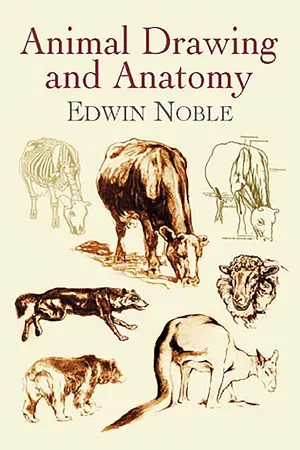
"No artist, designer, or craftsman can be regarded as fully equipped without a knowledge of natural forms," asserts this instructive volume. "All forms of life offer rich material for design, whether realistic or conventional," it notes, adding that studies from life "of the human figure, the forms of all animals and birds, and of the inhabitants of the waters, and of plants, must precede mastery of the art of design."
With this profusely illustrated guide, beginners can learn the fundamentals of animal drawing, and more experienced artists can find tips that will assist them in refining their skills. Written and illustrated by a distinguished artist and art instructor of the early twentieth century, this volume features valuable insights into reproducing accurate images of horses, cows, dogs, sheep, birds, and wild animals. The explanatory text, highlighted by 233 drawings, offers advice not only on depicting musculature, hair, feathers, and other obvious physical features, but also on such essentials as action, pose, proportions, and character.
- 128 pages
- English
- ePUB (mobile friendly)
- Available on iOS & Android
eBook - ePub
Animal Drawing and Anatomy
About this book
Information
Topic
ArtSubtopic
Art TechniquesCHAPTER I
SHEEP
AS a model, the domestic sheep has always been of interest to the artist. Its stereotyped movements, constantly repeated by dozens of companions in its immediate vicinity, should logically mean an easy animal to study, whereas the contrary is the case and capable draughtsmen and painters when making such sketches find them most baffling, owing to the lack of any salient points to seize upon. This, however, is largely due to their own lack of knowledge of the one great important fact —namely, the Anatomy of the Wool.
A general impression exists that feathers and hair grow from the body in a manner similar to that of the bristles from a door-mat. If that were so, we should expect to find a wrinkling of the feathers similar to that of the human skin becoming apparent at every point of movement during violent action. This, however, does not occur owing to the feathers themselves passing one above another by a telescopic or fanlike movement, laying closely overlapped upon the inner side and upon the outer side allowing a larger portion of each feather to be visible. On this account undue exposure of flesh is seldom noticeable in birds, but in the case of animals it is often more apparent.
Very few animals are without a coat or hairy covering in some form or another, and in most cases this has two characteristics—namely, a woolly undergrowth close to the skin for the purpose of warmth, and an outer covering or thatch, of long and usually straight hairs, for protection against weather.
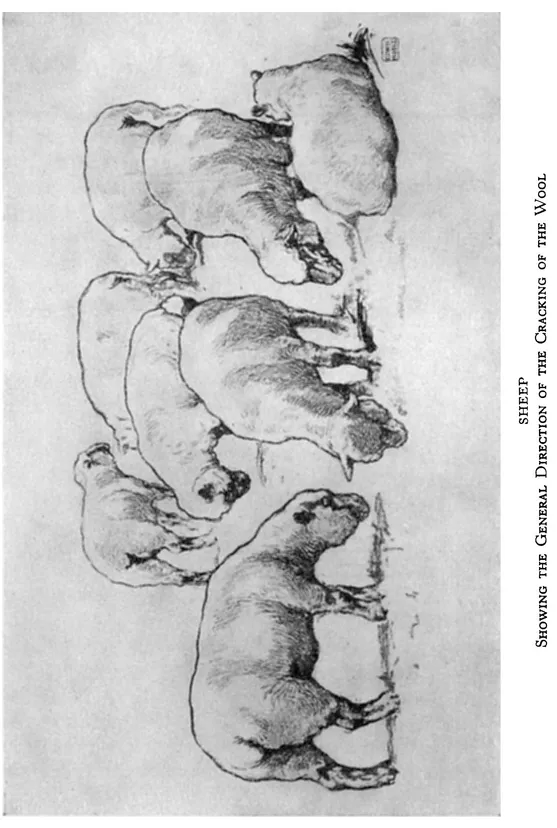
PLATE I
The latter usually predominates upon the upper parts of the body, and in most cases at the angles of limbs, etc., serving the purpose of a gutter to run away the rain or prevent it settling upon the under side of the body where the more delicate organs are situated. Wool serves better than hair for such portions of the body whereon the skin has excessive play due to the movements of the limb beneath, and consequently distinct areas of wool may be found which appear to crack open when the skin is thus extended. This peculiarity is of great importance from the picturesque point of view, inasmuch as it ceases to exist after the death of the animal, with the result that the slightest of notes from the living model will give something never found in the stuffed specimen. The movements of the head, for example, may be very slight, so much so as to be almost unrecognisable by change in the contour, but this break in the regularity of the hair gives just the amount of emphasis necessary to show the action.
In the domestic sheep the wool has been more or less artificially developed to produce as far as possible an equal quantity all over the body, and the result is a packing of the masses at the points of movement, whilst equal masses betray no movement whatever at points less in action. These latter masses being thus more lethargic are at once seized upon by the inexperienced draughtsman, with the result that unimportant masses are drawn and essentials neglected, and the drawing is a wooden, toy-like sheep without action or life.
Observe the manner in which the neck falls away from the shoulders (Plate 11). In very few animals does this occur in so marked a manner, the general rule being for it to take a slight convex form, due to the heavy muscles which support the head. A ewe neck is a term of disparagement often used to denote a similar formation in a horse or dog, with its consequent loss of strength and beauty.
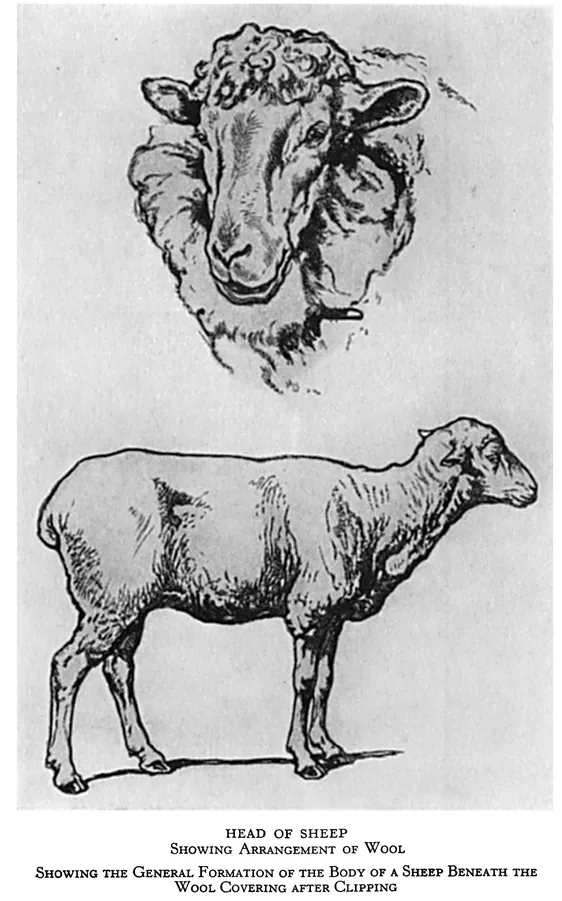
PLATE II
Careful study of Plate 11 will show how high the elbow and hind limbs are set upon the body, with its resultant cracking of the wool at these parts. Comparison should be made on these points between the domestic sheep and wild sheep and goats, whereby the symmetry of Nature has been altered with consequent deterioration of stamina. The domestic sheep is unable to travel either far or fast, whilst the wool is unable to stand continuous rain through the loss of the outer coat of long hairs.
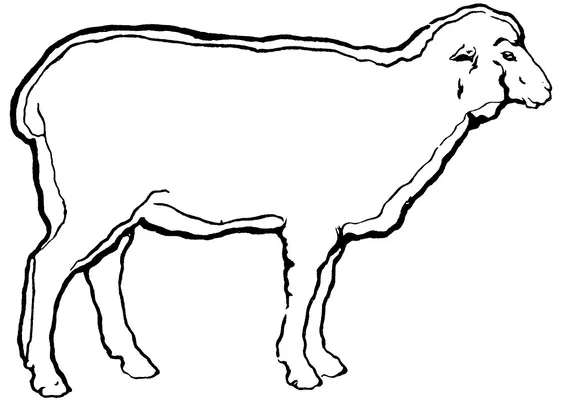
FIG. 1 SHOWING DIFFERENCE OF OUTLINE BETWEEN THE WOOL AND THE BODY OF A SHEEP
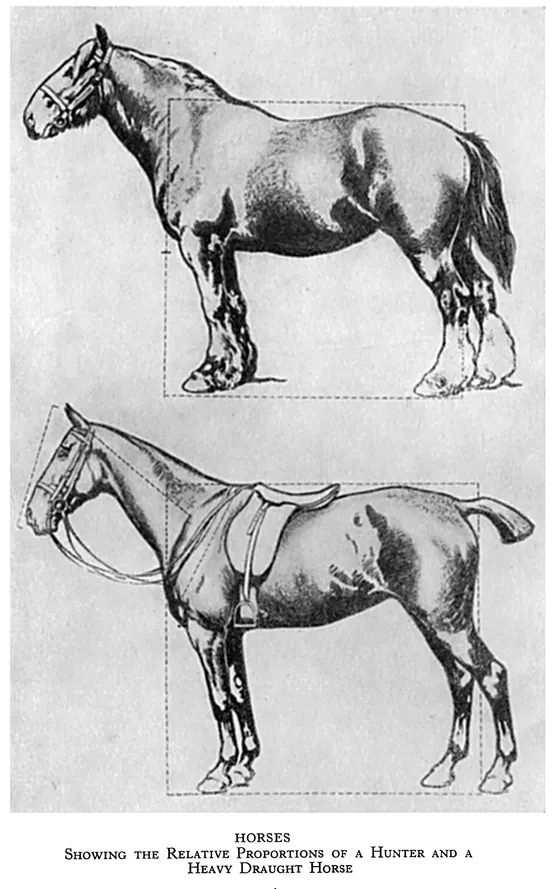
PLATE III
CHAPTER II
THE HORSE
WHEN dealing with all the domesticated animals. consideration should be given to their present-day artificial conditions of life and interbreeding for special requirements, such as flesh for food, speed, or strength, quantity of coat, etc. In other words, a knowledge of the common ancestor is essential, and provided one can visualise this correctly, the divergence from type can be easily traced, and the character at once seized upon. For example, the bones of a horse’s leg become simple to understand if one realises that originally it was of a five-toed animal, about the size of a fox, and known as the Hyracotherium (Fig. 2). During the progress of time he grew in size, but lost the use of two of his toes, and the next link comes in the shape of Mesobippus (Fig. 3), a three-toed horse with first and fifth toes present, but barely reaching the ground.
From this we come down to the comparatively modern Hipparion (Fig. 4), which inhabited these islands previous to man, and excellent fossils are to be found in the Natural History Museum at South Kensington of the bones of the leg and head of this animal.
Living types are found in the Tapir and the Rhinoceros, both closely allied to the Horse tribe. Observe the identical action of their muzzles with that of the upper lip of a Horse when searching for small particles of foods. Both eye and ear are again similar, and the feet of the Tapir show four distinct toes to each front leg and three to each hind leg (Fig. 6), which it has retained in its environment of marshy swamps. Scientific theory is that some forms of this animal left the low-lying swamps and gained an existence in higher and firmer grounds, wherein the soft splay foot not only ceased to become a support, but actually a hindrance to sustained or quick movement. Figs. 2 to 6 show plainly the hypothetical process of evolution and how the middle finger nail finally becomes converted into hoof. The horse still is a three-toed animal, for the splint bones are merely relics of the second and fourth toes in the last stages of their disuse.
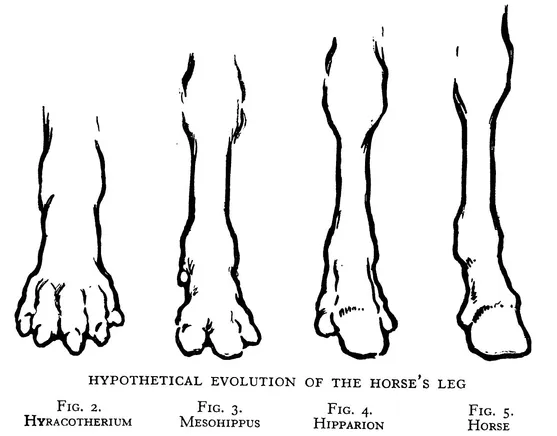
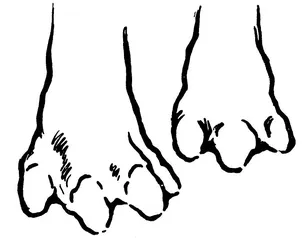
FIG. 6. FORE AND HIND FOOT OF TAPIR
Another point of interest is the evolution of the tail of a Horse which explains certain characteristics in early sculptures and drawings. Figs. 7 to 10 show the tail of common Donkey, Zebra, Prjevalski’s Horse of Siberia, and domestic Horse. Prjevalski’s Horse is believed to be a living type of the original wild horse of Europe, and we find the exact type of tail which is depicted on all drawings of horses by prehistoric man in France. It is also quite typical of many of the coarser and underbred horses which may be found in Northern Europe to-day, but not that of the Southern parts where the influence of the Barb or Arabian Horse is greater. The tail of the Arab is set on the body in such a way that the spinal column is continued a few inches in a horizontal direction before slowly and gracefully curving downwards, whilst the long plumes of hair commence at the root.
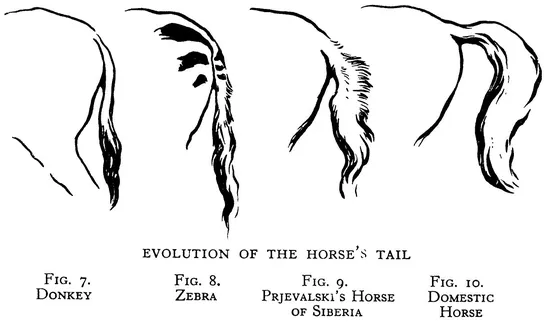
Our race of English Thoroughbreds are descendants from an early Arabian ancestor, and consequently all carry the plumed tail in contrast to that of the English Shire Horse, or Cart Horse, where the tail is curved immediately upon leaving the body, and has a series of short stiffer hairs upon upper part, and plumed upon lower portion only, a similar type well shown on vases and ornaments of Early Greek Art.
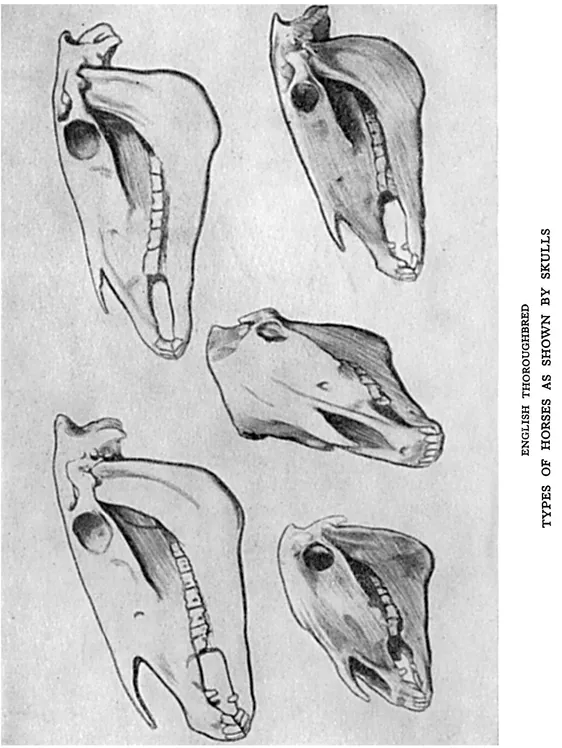
PLATE IV
Upon the Parthenon Frieze will be found the Hog Mane of the Prjevalski Horse, and the Ass tribe.
For all ordinary purposes of proportion, the following simple measurements will be sufficient.
A well-bred Hunter (Plate 111) or Polo Pony should stand in a square. A line drawn from top of withers to ground should equal one...
Table of contents
- Title Page
- Copyright Page
- PREFACE
- INTRODUCTION
- Table of Contents
- CHAPTER I - SHEEP
- CHAPTER II - THE HORSE
- CHAPTER III - THE COW
- CHAPTER IV - THE DOG
- CHAPTER V - BIRDS
- CHAPTER VI - WILD ANIMALS
- INDEX
- A CATALOG OF SELECTED DOVER - BOOKS IN ALL FIELDS OF INTEREST
Trusted by 375,005 students
Access to over 1.5 million titles for a fair monthly price.
Study more efficiently using our study tools.
Frequently asked questions
Yes, you can cancel anytime from the Subscription tab in your account settings on the Perlego website. Your subscription will stay active until the end of your current billing period. Learn how to cancel your subscription
No, books cannot be downloaded as external files, such as PDFs, for use outside of Perlego. However, you can download books within the Perlego app for offline reading on mobile or tablet. Learn how to download books offline
Perlego offers two plans: Essential and Complete
- Essential is ideal for learners and professionals who enjoy exploring a wide range of subjects. Access the Essential Library with 800,000+ trusted titles and best-sellers across business, personal growth, and the humanities. Includes unlimited reading time and Standard Read Aloud voice.
- Complete: Perfect for advanced learners and researchers needing full, unrestricted access. Unlock 1.5M+ books across hundreds of subjects, including academic and specialized titles. The Complete Plan also includes advanced features like Premium Read Aloud and Research Assistant.
We are an online textbook subscription service, where you can get access to an entire online library for less than the price of a single book per month. With over 1.5 million books across 990+ topics, we’ve got you covered! Learn about our mission
Look out for the read-aloud symbol on your next book to see if you can listen to it. The read-aloud tool reads text aloud for you, highlighting the text as it is being read. You can pause it, speed it up and slow it down. Learn more about Read Aloud
Yes! You can use the Perlego app on both iOS and Android devices to read anytime, anywhere — even offline. Perfect for commutes or when you’re on the go.
Please note we cannot support devices running on iOS 13 and Android 7 or earlier. Learn more about using the app
Please note we cannot support devices running on iOS 13 and Android 7 or earlier. Learn more about using the app
Yes, you can access Animal Drawing and Anatomy by Edwin Noble in PDF and/or ePUB format, as well as other popular books in Art & Art Techniques. We have over 1.5 million books available in our catalogue for you to explore.