A leading authority examines the facts and fancies behind the Atlantis theme in history, science, and literature. Sources include the classical works from which Plato drew his proposal of the existence of an island continent, Sir Thomas More's Utopia, the Lemurian Continent theory, K. T. Frost's equation of Atlantis with Crete, and many other citations of Atlantis in both famous and lesser-known literature. Related legends are also recounted and refuted, and reports include accounts of actual expeditions searching for the sunken continent and attempts to prove its existence through comparative anatomy and zoology.
There was an island in the sea That out of immortal chaos reared Towers of topaz, trees of pearl For maidens adored and warriors feared.
Long ago it sunk in the sea; And now, a thousand fathoms deep, Sea-worms above it whirl their lamps, Crabs on the pale mosaic creep.1
Aiken
MEN have always longed for a land of beauty and plenty, where peace and justice reigned. Failing to make one in the real world, they have often sought consolation by creating imaginary Edens, Utopias, and Golden Ages. Formerly they located these ideal commonwealths in the distant past or in undiscovered parts of the world. Now, however, that the unexplored places left on earth are few and uninviting, and the history of the remote past is fairly well known, they prefer to place their utopias in the distant future or even on other planets.
Many such dreams have been written up, and to lend extra interest to their stories the writers have sometimes pretended that their tales were literally true. This practice has had the unfortunate effect of convincing some readers (who have enough trouble distinguishing fact from fiction anyway) that such indeed was the case. For instance, when the noted sixteenth-century idealist Sir Thomas More published his famous Utopia—a story about an imaginary island where people led lives of simple virtue—the conscientious More was much disconcerted when one of his pious contemporaries, the learned Budé, wrote him urging that missionaries be sent to convert the Utopians to Christianity! And when G. B. McCutcheon wrote his Graustark novels, he was deluged with fan mail asking how to get to Graustark, or taking exception to the author’s statements about his imaginary Balkan kingdom. None of his correspondents, evidently, thought to look at a map.
Of all these creators of imaginary worlds, the one with the widest and most lasting influence was the Greek philosopher Aristokles the son of Ariston, better known by his nickname of Plato, the inventor or historian of Atlantis. Although his Atlantis story made but little stir at the time he wrote it, it became so popular in later centuries that to this day the name “Atlantis” evokes a picture of a beautiful world with a high and colorful culture (now, alas, gone forever) in the minds of thousands of people who never heard of Plato.
Nearly two thousand books and articles have been written about Atlantis and other hypothetical continents, ranging in tone from the soberest science to the wildest fantasy. Explorers have travelled thousands of miles looking for traces of the Atlantean culture described by Plato, and geologists have devoted thousands of hours to study of the earth’s crust to find out whether continents do rise and sink, and if so when and why. And many plain men to whom it is no great matter whether
. . . a strange city lying alone Far down within the dim West
ever sank beneath “the dragon-green, the luminous, the dark, the serpent-haunted sea” have turned their attention to Atlantis.
Recently a group of English newspapermen voted the reëmergence of Atlantis as the fourth most important news story they could imagine—five places ahead of the Second Coming of Christ. Astronomers have bestowed the name “Atlantis” (along with many others from Classical mythology) upon an area on the planet Mars. The Woods Hole Oceanographic Institution calls the little ship it explores with the Atlantis, and the name has served as a title for several periodicals, a theatrical company, a hotel in Miami, and several establishments (a book shop, an engineering firm, and a restaurant) in London. Finally, in 1951 the Minsky’s Burlesque show at the Rialto Theatre in Chicago included an aquatic strip-act called “Atlantis, The Sea-Nymph.” Evidently the Atlantis theme has a grip upon the fancy all out of proportion to its practical importance—though I wouldn’t say it were entirely trivial, since the question of Atlantis does enter into the general problem of the origins of man and of civilization.
Perhaps the very impracticality of Atlantism constitutes part of its charm. It is a form of escapism that lets people play with eras and continents as a child plays with blocks.
As many people have heard vaguely of the lost-continent theories, and as many seem interested in them without ever having looked into the historical and scientific sides of the question, I will try to tell the story of the Atlantis concept and its progeny such as Mu and Lemuria. Where did the Atlantis story originate? Is the tale fact, fiction, or fiction founded on fact? What is there to the various lost-continent theories? Did Atlantis or Lemuria ever exist? If not, what then is this curious hold that the idea of lost continents has upon the minds of men? I can’t t guarantee final answers to all these questions, but that is the chance you take.
First, to consider the story of Atlantis in its earliest known form: About the year 355 B.C. Plato wrote two Socratic dialogues, Timaios and Kritias, wherein he set forth the basic story of Atlantis. At that time Plato was in his seventies and had been through a lot, including enslavement and liberation and an unsuccessful attempt to apply his theories of government at the court of the Tyrant of Syracuse. For many decades he had lectured at Athens, during which time he wrote a number of dialogues: little plays representing his old teacher Socrates and his friends sitting around and discussing such problems as politics, morals, and semantics.
Although Socrates is the chief talker in many of these dialogues, we cannot be sure which of the ideas set forth are really those of Socrates and which those of Plato. While we find many of Plato’s ideas unsympathetic today—he sneered at experimental science, glorified male homosexuality, and advocated a type of government that we should call “fascistic” or “technocratic”—he pioneered in some departments of human thought. Furthermore he wrote with such poetic charm and vivacity that he seduced many later thinkers into exaggerating his solid contributions to man’s intellectual growth.
Some years previously he had written his best-known dialogue, The Republic, in which he gave his prescription for an ideal state. Now he undertook Timaios as a sequel to The Republic, since the same cast of characters is assembled in the house of Plato’s great-uncle or distant cousin Kritias on the day following the conversation of The Republic.
The time is about 421 B.C., when in real life Socrates was not yet fifty and Plato a small child; and early in June, during the festival of the Lesser Panathenaia, just after that of the Bendideia. The characters are Socrates, Kritias, Timaios, and Hermokrates. Kritias, Plato’s relative, was a talented historian and poet on one hand, and on the other a scoundrelly politician, a leader of the Thirty Tyrants who inflicted a reign of terror on Athens after that state had been defeated by Sparta in the Peloponnesian War. Timaios (not to be confused with the later historian of the same name) was an astronomer from Locri in Italy, while Hermokrates was an exiled Syracusan general.
Timaios was intended as the first book of a trilogy, in which, first, Timaios lectured on the creation of the world and the nature of man according to the Pythagorean philosophy; second, Kritias told the tale of the war between Atlantis and Athens; and third, Hermokrates was to have spoken on some similar subject—perhaps the military side of the Atheno-Atlantean war after Kritias had finished with the theological and political aspects. It is quite likely that Plato, a thorough militarist, should have had some such discourse in mind. However, the trilogy was never completed. Some time (perhaps years) after finishing Timaios, Plato began a rough draft of Kritias, but dropped the whole project before he had finished this piece and instead wrote his last dialogue, The Laws.
Timaios starts with Socrates and Timaios recalling the discourse of Socrates on the previous day; that is, the dialogue of The Republic. Hermokrates then says that Timaios, Kritias, and he himself are all ready to give speeches on man and the universe, especially Kritias, who has already “mentioned to us a story derived from ancient tradition.”
Pressed for details, Kritias tells how, a century and a half before, the half-legendary Athenian statesman Solon heard the story in Egypt, whither he had withdrawn because of the unpopularity he had incurred by his reform of the Athenian constitution. On his return to Athens he repeated it to his brother Dropides, Kritias’s great-grandfather, who in turn passed it on down to his descendants. Solon had intended to make an epic poem of the narrative, but had never found enough time off from politics to complete the work.
During his Egyptian tour Solon stopped off at Saïs, the capital of the friendly King Aahmes. (Here is a discrepancy; Solon is supposed to have made his trip between 593 and 583 B.C., whereas Aahmes II reigned from 570 to 526. But never mind that now.) Here Solon got into a discussion of ancient history with a group of priests of the goddess Neïth or Isis, whom the Greeks identified with their own wise and warlike Athena. When Solon tried to impress them by telling them some of the Greek traditions, like that of Deukalion and Pyrrha and their Flood, the oldest priest (named Sonchis, according to Plutarch) laughed at him. The Greeks were children, he said; they had no ancient history because their records had all been destroyed by the periodical catastrophes of fire and flood that overwhelm the world—all but Egypt, which, being proof against such misfortunes, had kept records from the Creation on down.
The priest went on to tell Solon that Athena had founded a great Athenian empire 9000 years previously (that is, about 9600 B.C.) divinely organized along the lines that Plato had sketched in his Republic. A communistic military caste had ruled the state, and everybody was brave, handsome, and virtuous.
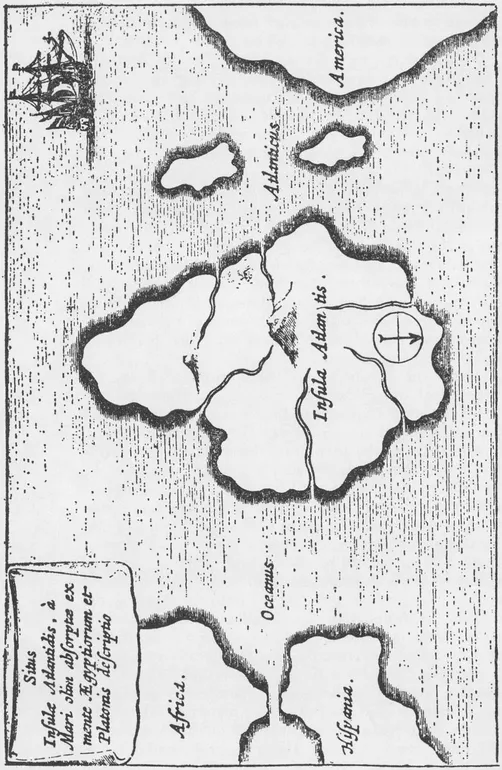
Fig. 2. MAP OF ATLANTIS from Athanasius Kircher’s Mundus Subterraneus (1644). Note that, in contrast to modern maps, north is down and south up.
There had also been a mighty empire of Atlantis, centering upon an island west of the Pillars of Herakles (the Strait of Gibraltar) larger than North Africa and Asia Minor combined, and surrounded by smaller islands. In those days you could, by traversing this great archipelago island by island, reach the super-continent, beyond Atlantis, which surrounded the ocean that encircled the inhabited world.
The Atlanteans, not satisfied with ruling their own islands and parts of the outer “true” continent, had tried to conquer the whole Mediterranean region. They had extended their rule as far as Egypt and Tuscany when they were defeated by the brave Athenians, who led the fight against them and persisted in it even after their allies had fallen away. Then a great earthquake and flood devastated Athens, swallowed the Athenian army, and caused Atlantis to sink between the waters of the Atlantic Ocean. Forever after the waters west of Gibraltar were unnavigable because of the shoals left by the sinking of Atlantis.
Kritias then says he lay awake all night trying to remember the details of the story, since it would illustrate the theories that Socrates had propounded the previous day. In fact, he goes on: “the city with its citizens which you described to us yesterday, as it were in a fable, we will now transport hither into the realm of fact; for we will assume that the city is that ancient city of yours, and declare that the citizens you conceived are in truth those actual progenitors of ours, of whom the priest told.”
Socrates is enthusiastic, especially since the account “is no invented fable but genuine history.” However, Kritias prefers that Timaios deliver his discourse first. So Timaios takes up the conversation and devotes the rest of this long dialogue to Pythagorean scientific theories: the movements of the Solar System, the shape of the atoms comprising the Four Elements, the creation of mankind, and the working of the human body and soul.
In the next dialogue, Kritias, Kritias resumes his narration: When the gods divided up the world, Athena and Hephaistos received Athens and set up the Athenian state on suitably Platonic lines. Not only were its workers and farmers incredibly industrious, and its “Guardians” inhumanly noble, but Greece itself, also, was larger and more fertile in those days. Another of Plato’s inconsistencies is that in Timaios Athens (and, by implication, Atlantis) was founded 9000 years before Solon’s time, while in Kritias it is said that “many generations” after this founding Atlantis was sunk—also 9000 years before Solon’s time.
Meanwhile Poseidon, the leading sea-god and also the god of earthquakes and horsemanship, had received Atlantis as his share. The population of Atlantis then consisted of a couple who had sprung from the earth, Euenor and Leukippë, and their daughter Kleito. When the old couple died, Poseidon (undeterred by the fact that he was already married to Amphitritë, one of the daughters of the other sea-god Okeanos) set up housekeeping with Kleito on a hill in Atlantis. To keep his sweetheart safe he surrounded the hill with concentric rings of land and water. He also supplied the hill with hot and cold fountains from underground streams. (The Greeks had exaggerated ideas about subterranean watercourses, believing for instance that the Alpheios River in western Greece, the original of Coleridge’s sacred River Alph, ducked under the Adriatic to reappear as the spring Arethusa in Sicily.)
Poseidon, a fertile fellow like all the gods, begat ten sons—five pairs of twins—upon Kleito, and when they grew up divided the land and its adjacent islands among them to rule as a confederacy of kings. The eldest of the first pair, Atlas (after whom Atlantis was named) he made the chief king over all. Atlas’s brother Gadeiros (or to translate it into Greek, Eumelos, “rich in sheep” or “in fruit”) received as his portion the region of Gadeira (later Gades or Cadiz) in Spain. Plato says that Solon translated the original Atlantean names into Greek to make them easier for his hearers. Somebody was evidently a poor linguist, since “Gadeira” is actually from a Phoenician word for “hedge.”
Since the kings were prolific and the land rich in vegetation, minerals, and elephants, Atlantis in time became a mighty power. The kings and their descendants built the city of Atlantis on the south coast of the continent. The city took the form of a circular metropolis about 15 miles in diameter, with Kleito’s ancient hill in the center. Around this hill the rings of land and water still existed (two of land and three of water) forming a circular citadel three miles in diameter. The kings built bridges connecting the land rings and tunnels big enough for ships connecting the rings of water. The city’s docks were located on the outer margin of the outermost ring. A canal of enormous size ran straight through the city, connecting the harbor works with sea at the south end, and with a great rectangular irrigated plain, 230 by 340 miles in dimensions and surrounded by lofty mountains, at the north end. This plain was divided into square lots which were assigned to the leading farmers, who in turn had to furnish men for the Atlantean army—light and heavy infantry, cavalry, and chariots (thousands of years before cavalry and chariots were invented).
On the central island the kings erected a royal palace and, over the sacred spot where Poseidon had dwelt with Kleito, a temple surrounded by a golden wall. The rings of land were covered with parks, temples, barracks, racecourses, and other public facilities. These structures were all lavishly decorated with gold, silver, brass, tin, ivory, and the mysterious metal oreichalk
n which “glowed like fire.”
Note that Plato says nothing about the explosives, searchlights, or airplanes with which some imaginative modern Atlantists have credited the Atlanteans. The only ship he mentions is the trireme (or tri
r
, a type of ship said to have been invented by Ameinokles of Corinth about 700 B.C.) and, except for oreichalk
n, he described no technics not known to his own time. While orichalc (literally “mountain bronze”) has not been identified beyond doubt, Classical writers like Hesiod casually mention it in a way that implies that the term was applied to some unusually good grade of bronze or brass.
The kings met at alternate intervals of five and six years to consult on matters of state. They assembled in the sacred precincts of Poseidon, captured...
Table of contents
DOVER BOOKS ON THE OCCULT
Other Books by L. Sprague de Camp
Title Page
Copyright Page
Dedication
Table of Contents
Table of Figures
PREFACE
CHAPTER I - THE STORY OF ATLANTIS
CHAPTER II - THE RESURGENCE OF ATLANTIS
CHAPTER III - THE LAND OF THE LEMURS
CHAPTER IV - THE HUNTING OF THE COGNATE
CHAPTER V - THE MAYAN MYSTERIES
CHAPTER VI - WELSH AND OTHER INDIANS
CHAPTER VII - THE CREEPING CONTINENTS
CHAPTER VIII - THE SILVERY KINGDOM
CHAPTER IX - THE AUTHOR OF ATLANTIS
CHAPTER X - THE LAND OF HEART’S DESIRE
CHAPTER XI - EVENING ISLES FANTASTICAL
APPENDIX A
APPENDIX B
APPENDIX C
BIBLIOGRAPHY
INDEX
A CATALOG OF SELECTED DOVER BOOKS IN ALL FIELDS OF INTEREST
Trusted by 375,005 students
Access to over 1.5 million titles for a fair monthly price.
Study more efficiently using our study tools.
Frequently asked questions
Yes, you can cancel anytime from the Subscription tab in your account settings on the Perlego website. Your subscription will stay active until the end of your current billing period. Learn how to cancel your subscription
No, books cannot be downloaded as external files, such as PDFs, for use outside of Perlego. However, you can download books within the Perlego app for offline reading on mobile or tablet. Learn how to download books offline
Perlego offers two plans: Essential and Complete
Essential is ideal for learners and professionals who enjoy exploring a wide range of subjects. Access the Essential Library with 800,000+ trusted titles and best-sellers across business, personal growth, and the humanities. Includes unlimited reading time and Standard Read Aloud voice.
Complete: Perfect for advanced learners and researchers needing full, unrestricted access. Unlock 1.5M+ books across hundreds of subjects, including academic and specialized titles. The Complete Plan also includes advanced features like Premium Read Aloud and Research Assistant.
Both plans are available with monthly, semester, or annual billing cycles.
We are an online textbook subscription service, where you can get access to an entire online library for less than the price of a single book per month. With over 1.5 million books across 990+ topics, we’ve got you covered! Learn about our mission
Look out for the read-aloud symbol on your next book to see if you can listen to it. The read-aloud tool reads text aloud for you, highlighting the text as it is being read. You can pause it, speed it up and slow it down. Learn more about Read Aloud
Yes! You can use the Perlego app on both iOS and Android devices to read anytime, anywhere — even offline. Perfect for commutes or when you’re on the go. Please note we cannot support devices running on iOS 13 and Android 7 or earlier. Learn more about using the app
Yes, you can access Lost Continents by L. Sprague de Camp in PDF and/or ePUB format. We have over 1.5 million books available in our catalogue for you to explore.