- 432 pages
- English
- ePUB (mobile friendly)
- Available on iOS & Android
eBook - ePub
General Economic History
About this book
This book, the last work of the great German sociologist and historian Max Weber (1864–1920), is based on a series of lectures he delivered in 1919–20. The present volume brings together major ideas that explain economic life and change. Beginning with descriptions and analyses of the early agrarian systems, Part One takes the reader through the manorial system, the guilds, and early capitalism as developed on plantations and other estates. Part Two considers the economic organization of industry and mining, while Part Three discusses the development of commerce, technical requisites for transporting goods, and banking systems. The last section surveys, among other topics, the evolution of capitalism and the capitalistic spirit. It also includes Weber's famous discussion of the relationship of religion to the cultural history of capitalism. This excellent English-language version of a work renowned for its interpretive brilliance, is intended for students of the social sciences as well as general readers.
Information
Topic
ÉconomieSubtopic
Histoire économiquePART ONE
HOUSEHOLD, CLAN, VILLAGE AND MANOR a
(The Agrarian Organization)
CHAPTER I
THE AGRICULTURAL ORGANIZATION AND THE PROBLEM OF AGRARIAN COMMUNISM 1
The idea of a primitive agrarian communism at the beginning of all economic evolution was first suggested by investigations into the ancient German economic organization, especially by Hanssen and von Maurer.2 These men originated the theory of the ancient German agrarian communism, which became the common property of scholarship. Analogies from other lands to the ancient German rural organization led finally to the theory of an agrarian communism as the uniform beginning of all economic development, the theory developed especially by E. de Laveleye. Such analogies came from Russia and from Asia, especially India. Recently, however, a strong tendency has set in to assume private property in land and a manorial type of development for the most ancient periods accessible to us, whether in Germany or in other economic systems.
If we consider first the German national agricultural organization as it presents itself to us in the eighteenth century, and go back from it to older conditions poorly and scantily illuminated by the sources, we must begin by restricting ourselves to regions originally settled by the Teutons. Thus we exclude, first, the previously Slavic region east of the Elbe and Saal; second, the region formerly Roman, that is, the Rhine region, Hessia, and South Germany generally south of a line drawn roughly from the Hessian boundary to the vicinity of Regensburg ; and finally, the region originally settled by Celts, to the left of the Weser.
The land settlement in this originally German region had the village form, not that of the isolated farmstead. Connecting roads between the villages were originally quite absent as each village was economically independent and had no need of connections with its neighbors. Even later the roads were not laid out systematically but were broken by traffic according to need and disappeared from one year to the next until gradually in the course of centuries an obligation to maintain them was established, resting upon the individual holding of land. Thus the General Staff maps of this region today give the impression of an irregular network whose knots are the villages.
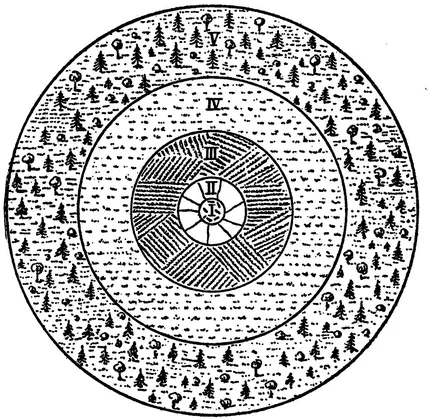
In the sketch, the first or innermost zone contains the dwelling lots, placed quite irregularly. Zone Two contains the fenced garden land (Wurt), in as many parts as there were originally dwelling lots in the village. Zone Three is the arable (see below), and Zone Four pasture (“Almende”). Each household has the right to herd an equal number of livestock on the pasture area, which, however, is not communal but appropriated in fixed shares. The same is true of the wood (Zone Five) which incidentally does not uniformly belong to the village ; here also the rights to wood cutting, to bedding, mast, etc., are divided equally among the inhabitants of the village. House, dwelling lot, and the share of the individual in the garden land, arable (see below), pasture and forest, together constitute the hide (German Hufe, cognate with “have. ”)
The arable is divided into a number of parts called fields (Gewanne); these again are laid off in strips which are not always uniform in breadth and are often extremely narrow. Each peasant of the village possesses one such strip in each field, so that the shares in the arable are originally equal in extent. The basis of this division into fields is found in the effort to have the members of the community share equally in the various qualities of the land in different locations. The intermixed holdings which thus arose brought the further advantage that all the villagers were equally affected by catastrophes such as hailstorms, and the risks of the individual were reduced.
The division into strips, in contrast with the Roman custom, where squares predominate, is connected with the peculiarities of the German plow. The plow is universally, to begin with, a hoe-like instrument wielded by the hands or drawn by animals, which merely scratches the soil and makes grooves in the surface. All peoples which did not get beyond this hoe-plow were compelled to plow the fields back and forth in order to loosen up the soil. The most suitable division of the surface for this purpose was the square, as we find it in Italy from Cæsar’s time on, and as the general staff maps of the Campagna and the outer boundary marks between the individual land holdings still show it. In contrast, the German plow consisted, as far as we can tell, of a knife which cut the earth vertically, a share which cut it horizontally, and finally, at the right, a moldboard which turned it over. This plow made the criss-cross plowing unnecessary, and for its use the division into long strips was most appropriate. The size of the separate strips was usually determined in this connection, by the amount which an ox could plow in a day without giving out—hence the German names “Morgen” (English, “morning” but equivalent to acre) or “Tagwerk” (English, day’s work). In the course of time these divisions underwent much confusion, since the plow, with its moldboard on the right, had a tendency to work over to the left. Hence the furrows became uneven, and since there were no balks, originally at least, between the separate strips, only boundary furrows being drawn, strips of land belonging to another were often plowed up. The original arrangement would be restored by “field juries” with the rod or later the so-called spring circle.
As there are no roads between the single allotments, tillage operations can only be carried on according to a common plan and at the same time for all. This was normally done according to the three field system, which is the most general though by no means the oldest type of husbandry in Germany. Its introduction must be set back at least to the eighth century, since it is assumed as a matter of course in a document of the Rhenish monastery of Lorsch of about the year 770.
The three-field husbandry means that in the first place the whole arable area is divided into three tracts, of which at any one time the first is sown to a winter grain and the second to a summer grain, while the third is left fallow and, at least in historical time, is manured. Each year the fields are changed in rotation, so that the one sown with winter grain is the next year put to summer grain and in the year following left fallow, and the others correspondingly. There is stall feeding of livestock in the winter, while in summer they run on the pasture. Under such a system of husbandry it was impossible for any individual to use methods different in any way from those of the rest of the community; he was bound to the group in all his acts. The reeve of the village determined when sowing and reaping were to be done, and ordered the parts of the arable which were sown with grain fenced off from the fallow land. As soon as harvest was over, the fences were torn down; anyone who had not harvested on the common harvest day must expect the cattle, which would be driven on to the stubble, to trample his grain.
She hide belonged to the individual and was hereditary.3 It could be of varying size and was different in nearly every village. Frequently, as a sort of norm, an extent of 40 acres was taken as the amount of land necessary to support a typical family. The part of the holding consisting of dwelling lot and garden land was subject to free individual use. The house sheltered a family in the narrow sense of parents and children, often including grown sons. The share in the arable was also individually appropriated, while the rest of the cleared land belonged to the community of hide-men or peasant holders (Hüfner), that is, of the members in full standing or freemen of the village. These included only those who held title to some share in each of the three fields of arable. One who had no land or did not have a share in every field did not count as a hide-man.
To a still larger group than the village belonged the common “mark” which included wood and waste land and is to be distinguished from the almend or pasture. This larger group was made up of several villages. The beginnings and original form of the mark association (Markgenossenschaft ) are lost in obscurity. In any case it goes back before the political division of the land into districts by the Carolingians, and yet it is not identical with the hundred. Within the common mark there existed, joined in inheritance with a certain farm, a “head official” of the mark (Obermärkeramt), an office which had usually been pre-empted by the king or feudal lord, and in addition a “wood court,” and an assembly of deputies of the hidemen of the villages belonging to the mark.
Originally there was in theory strict equality among the members in this economic organization. But such an equality broke down in consequence of differences in the number of children among whom the inheritance was divided and there arose alongside the hide-men half and quarter hidemen. Moreover, the hide-men were not the only inhabitants of the village. There were in addition other sections of the population. First, younger sons who did not succeed to holdings. These were allowed to go and settle on the outskirts of the holdings on still uncleared land and received the right of pasture, for a payment in both cases (Hufengeld, Weidegeld). The father could also give them, out of his garden allotment, land on which to build a house. From the outside came hand workers and other neighbors who stood without the organization of associated hide-men. Thus there arose a division between the peasants and another class of village dwellers, called in South Germany hirelings or cottagers (Seldner, Häusler), and in the north “Brinksitzer” or “Kossäten.” These latter belonged to the village only on the strength of their ownership of a house but had no share in the arable. However, they could acquire such a share if some peasant, with the consent of the village reeve or of the overlord (originally the clan) sold them a part of his share or if the village leased them a piece of the almend. Such parcels were called “rolling holdings” (walzende Äcker); they were not subject to the special obligations of the hide holding or to the jurisdiction of the manorial court, and were freely transferable. On the other hand their holders had no share in the rights of the hide-man. The number of these people of reduced legal status was not small; it happened that villages transformed up to half of their arable into such rolling holdings.
As a result the peasant population became divided into two strata as regards land ownership, the hide-men with their different subclasses on the one hand, and on the other those who stood outside the hide organization. But. there was also formed above the hide-men a special economic stratum who with their land holdings also stood outside the main village organization. In the beginning of the German agricultural system, as long as there was unclaimed land available, an individual could clear land and fence it; so long as he tilled it, this so-called “Bifang” was reserved to him; otherwise it reverted to the common mark. Acquisition of such “bifangs” presupposed considerable possessions in cattle and slaves and in consequence was ordinarily possible only for the king, princes, and overlords. In addition to this procedure, the king would grant land out of the possessions of marks, the supreme authority over which he had assumed for himself. But this granting took place under other conditions than the allotment of hide land. In this case the allotment affected forest area with definite boundaries, which had first to be rendered tillable, and was subject to more favorable legal relations by being free from the open field obligations. In measuring off these grants a definite area came into use called the royal hide, a rectangle of 40 or 50 hectares (1 hectare = 2½ acres, nearly).
The old German settlement form with the hide system spread out beyond the region between the Elbe and the Weser. Countries into which it made its way include, first, Scandinavia—Norway as far as Bergen, Sweden up to the river Dalelf, the Danish Islands and Jutland; second, England, after the invasions of the Anglo-Saxons and Danes (the open field system) ; third, almost all northern France, and a large part of Belgium, as far as Brabant, while North-Belgium, Flanders and a part of Holland belonged to the realm of the Salic Franks with a different settlement form; fourth, in south Germany, the region between the Danube and Iller and Lech, including parts of Baden and Wurtemberg, as well as upper Bavaria or the region around Munich, especially the vicinity of Aibling. With German colonization, the old German form of settlement also spread over the Elbe eastward, though in a somewhat rationalized form, since the aim of making the country take up the largest number of settlers led to the establishment of “street villages” with favorable property institutions and with the greatest possible freedom of economic life. The house lots lay not in irregular groups but to the right and left along the village street, each one on its own allotment or hide, which allotments lay adjoining each other in long strips: but here also the divisions into fields and the compulsory common tillage were retained.
With the expansion of the German land settlement system beyond its original home, notable distinctions arose. This was especially true in Westphalia, which is divided by the river Weser into regions sharply distinct as regards the mode of settlement. At the river the Germanic settlement form stops suddenly and on the left begins the region of settlement in isolated farmsteads. There is no village or common (Almend), and mixed holdings occur only to a limited extent. The separate farms are cut out of the common mark which is originally uncultivated land. By clearing, new field areas are made which are allotted to the members of the community, called “Erbexen.” Moreover, by the process of division other settlers were admitted to the mark, corresponding more or less to the “Kossäten” farther east—craftsmen, small peasants and laborers who stand in the relation of renters to the erbexen, or are dependent upon them as wage workers. The Westphalian erbex or farmer is in possession of land to the extent on the average of 200 acres, a result of the mode of settlement, and is in a much more independent position than a peasant with intermixed holdings. The individual farmstead system dominates from the Weser to the Dutch coast and thus embraces the main territory of the Salic Franks.
In the southeast the German settlement region abuts on that of Alpine husbandry and on the territory of the South Slavs. The Alpine husbandry is based entirely on cattle raising and grazing, and the common pasture or almend is of predominant importance. All economic regulations are therefore derived from the necessity of “stooling” (Schat-zung, Seyung), that is, the control of opportunity for sharing the utilization of the pasture by those entitled to it. Stooling involves division of the pasture into a number of “strikes” (Stösze), a strike being the amount of pasture necessary to support one head of stock through the year.
The economic unit of the South Slavs in Servia, in the Banat and also in Croatia, is in historical times not the village but the house community or zadruga, the age of which is a disputed point. The zadruga is an expanded family living under the leadership of a male head of the house and including all his descendants, often with married couples numbering up to forty or eighty persons, and carrying on economic life on a communistic basis. They do not indeed ordinarily live under a single roof, but in production and consumption they act as a single household using the “common kettle.”
In the southwest the Germanic rural organization came in contact with the remains of the Roman method of distributing the land, in which we have the seigniorial estate in the midst of small dependent establishments of colons. In lower Bavaria, Baden, and Wurtemberg there came to be a considerable mixture of these two systems, and especially in the upland and hilly districts the Germanic system tends to disappear. There are mixed holdings but on the other hand it also happens that the cleared land of the village falls into unified sections in which the possessions of the individual lie in divisions without there being any effort at equality in sharing or any discoverable principle of division. The origin of this “hamlet distribution,” as Meitzen calls it, is uncertain; it may have originated through the granting of land to unfree persons.
The origin of the specifically Germanic agricultural system is obscure. In the time of the Carolingians it is already present, but the division of the open field into equal strips is too systematic to be primitive. Meitzen has shown that it was preceded by another system, a division into so-called Lagemorgen (“locus acres”). The Lagemorgen designates that quantity of land, varying widely according to the quality of the soil, the “lie” of the field, distance from the dwelling lot, etc., around which a peasant could plow with a yoke of oxen in a forenoon. The Lagemorgen thus forms the basis of the open field or Gewann, which always shows this irregular form wherever the old division has survived, in contrast with the geometrical form given to it by later division into strips of equal size.
This view rejects the recent attempt of Rietsehel to prove a military origin for the German land and tillage system. According to this theory, the system developed out of the organization into “hundreds.” It holds that the hundred was at the same time a tactical unit and a political grouping of about a hundred hide-men, whose holdings must have been at least four times as large as the later community hide. The central figure of the organization would be available for military service, since they lived on an income derived from the labor of their serfs and could be spared from the community. Thus the hide (Hufe), like the later Anglo-Saxon hyde, was an ideal unit, suitable for carrying the burden of supporting a full-armed mounted warrior. Out of a hide organization of this sort, it is argued, grew the community hide by a process of rationalization, through the division of the holdings of the great hidemen into four, eight or ten parts. It is decidedly against this theory that the field divisions of the German hide organization did not originate by any rational process, but grew out of the Lagemorgen. On the other hand, there remains the difficulty that in northern France the hide organization arose only in the territory over which the Salic Franks extended their conquests, and not in the territory which belonged to them originally.
The original German settlement form no longer survives. Its disintegration began rather early, and not as a result of steps taken by the peasants, who were not in a position to make such changes, but through interference from above. The peasant very early fell into a position of dependence upon a political superior or feudal overlord; as a community hide-man (Volkshufner) he was weaker in an economic and military sense than the royal hide-man. After the establishment of permanent peace, the nobility took an increasing interest in economic affairs. It was the managerial activity of a portion of the nobility which destroyed the rural organization, especially in south Germany. The imperial abbey of Kempten, for example, began in the 16th century the so-called “enclosures” (“Vereinödungen”) which were continued into the 18th century. The cleared land was re-distributed and the peasant placed upon his compacted and enclosed farm (the so-called Einödhof) and as nearly as practicable in the center of it. In north Germany the state set aside the old distribution of land in the 19th century, in Prussia by the ruthless use of force. The “Gemeinheitsteilungsordnung” or Decree for the Division of Communities, of 1821, which was intended to force the transition to an exchange economy, was issued under the influence of liberal ideas opposed to mixed holdings, and the common mark, and pasture. The community with mixed holdings was set aside by compulsory un...
Table of contents
- Title Page
- Copyright Page
- Table of Contents
- TRANSLATOR’S PREFACE
- FROM THE PREFACE BY THE GERMAN EDITORS
- PART ONE - HOUSEHOLD, CLAN, VILLAGE AND MANOR
- PART TWO - INDUSTRY AND MINING DOWN TO THE BEGINNING OF THE CAPITALISTIC DEVELOPMENT
- PART THREE - COMMERCE AND EXCHANGE IN THE PRE-CAPITALISTIC AGE 1
- PART FOUR - THE ORIGIN OF MODERN CAPITALISM
- NOTES
- INDEX OF NAMES
- SUBJECT INDEX
Trusted by 375,005 students
Access to over 1.5 million titles for a fair monthly price.
Study more efficiently using our study tools.
Frequently asked questions
Yes, you can cancel anytime from the Subscription tab in your account settings on the Perlego website. Your subscription will stay active until the end of your current billing period. Learn how to cancel your subscription
No, books cannot be downloaded as external files, such as PDFs, for use outside of Perlego. However, you can download books within the Perlego app for offline reading on mobile or tablet. Learn how to download books offline
Perlego offers two plans: Essential and Complete
- Essential is ideal for learners and professionals who enjoy exploring a wide range of subjects. Access the Essential Library with 800,000+ trusted titles and best-sellers across business, personal growth, and the humanities. Includes unlimited reading time and Standard Read Aloud voice.
- Complete: Perfect for advanced learners and researchers needing full, unrestricted access. Unlock 1.5M+ books across hundreds of subjects, including academic and specialized titles. The Complete Plan also includes advanced features like Premium Read Aloud and Research Assistant.
We are an online textbook subscription service, where you can get access to an entire online library for less than the price of a single book per month. With over 1.5 million books across 990+ topics, we’ve got you covered! Learn about our mission
Look out for the read-aloud symbol on your next book to see if you can listen to it. The read-aloud tool reads text aloud for you, highlighting the text as it is being read. You can pause it, speed it up and slow it down. Learn more about Read Aloud
Yes! You can use the Perlego app on both iOS and Android devices to read anytime, anywhere — even offline. Perfect for commutes or when you’re on the go.
Please note we cannot support devices running on iOS 13 and Android 7 or earlier. Learn more about using the app
Please note we cannot support devices running on iOS 13 and Android 7 or earlier. Learn more about using the app
Yes, you can access General Economic History by Max Weber in PDF and/or ePUB format, as well as other popular books in Économie & Histoire économique. We have over 1.5 million books available in our catalogue for you to explore.