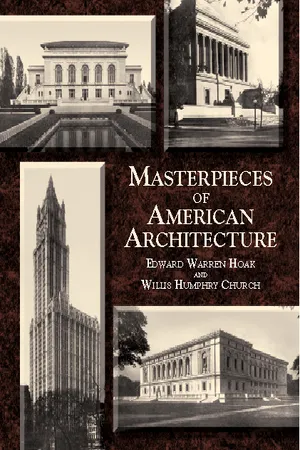
From the golden age of American architecture comes this splendid survey, documenting scores of masterpieces built between 1900 and 1930. More than 260 illustrations include plans, sections, exterior and interior details, and photographs. A sampling of featured buildings include Lincoln Memorial, Boston Public Library, Tribune Tower, and Woolworth Building.
eBook - ePub
Masterpieces of American Architecture
- 240 pages
- English
- ePUB (mobile friendly)
- Available on iOS & Android
eBook - ePub
Masterpieces of American Architecture
About this book
Information
Topic
ArchitectureSubtopic
Architecture GeneralPART I
MEMORIALS

THE LINCOLN MEMORIAL
WASHINGTON, D.C.
HENRY BACON, ARCHITECT
WASHINGTON, D.C.
HENRY BACON, ARCHITECT

THE LIBERTY MEMORIAL
KANSAS CITY, MISSOURI
H. VAN BUREN MAGONIGLE, ARCHITECT
KANSAS CITY, MISSOURI
H. VAN BUREN MAGONIGLE, ARCHITECT
THE LINCOLN MEMORIAL
WASHINGTON, D.C. JANUARY, 1917
Awarded Gold Medal of the Panama-Pacific Exposition at San Francisco, 1915, and Gold Medal of Honor of A. I. A., 1923
ON THE GREAT AXIS, planned over a century ago, we have at one end the Capitol, which is the monument of the Government, and to the west, over a mile distant from the Capitol, the monument to Washington, one of the founders of the Government. The Lincoln Memorial, built on this same axis still farther to the west, by the shore of the Potomac, is the monument of the man who saved the Government, thus completing an unparalleled composition which can not fail to impart to each of the monuments a value in addition to that which each standing alone would possess.
From the beginning of my study I believed that this memorial of Abraham Lincoln should be composed of four features—a statue of the man, a memorial of his Gettysburg Speech, a memorial of his Second Inaugural Address, and a symbol of the union of the United States, which he stated it was his paramount object to save —and which he did save. Each feature is related to the others by means of its design and position, and each is so arranged that it becomes an integral part of the whole, in order to attain a unity and simplicity in the appearance of the monument.
The most important object is the statue of Lincoln, which is placed in the center of the memorial, and, by virtue of its imposing position in the place of honor, the gentleness, power, and intelligence of the man, expressed as far as possible by the sculptor’s art, predominate. This portion of the memorial where the statue is placed is unoccupied by any other object that might detract from its effectiveness, and the visitor is alone with it.
The smaller halls at each side of the central space each contains a memorial—one of the Second Inaugural and the other of the Gettysburg Address. While these memorials can be seen from any part of the hall, they are partially screened from the central portion, where the statue is placed, by means of a row of Ionic columns, giving a certain isolation to the space they occupy and augmenting thereby their importance. I believe these two great speeches made by Lincoln will always have a far greater meaning to the citizens of the United States and visitors from other countries than a portrayal of periods or events by means of decoration.
Surrounding the walls inclosing these memorials of the man is a colonnade forming a symbol of the Union, each column representing a State, 36 in all, one for each State existing at the time of Lincoln’s death; and on the walls appearing above the colonnade and supported at intervals by eagles are 48 memorial festoons, one for each State existing at the present time.
I believe this symbol representing the Union, surrounding the memorial of the man who saved the Union, will give to them a great significance that will strengthen in the hearts of beholders the feelings of reverence and honor for the memory of Abraham Lincoln.
By means of terraces the ground at the site of the Lincoln Memorial is raised until the floor of the memorial itself is 45 feet higher than grade. First a circular terrace 1,000 feet in diameter is raised 11 feet above grade and on its outer edge are planted four concentric rows of trees, leaving a plateau in the center 755 feet in diameter, which is greater than the length of the Capitol. In the center of this plateau, surrounded by a wide roadway and walks, rises an eminence supporting a rectangular stone terrace wall 14 feet high, 256 feet long, 186 feet wide. On this rectangular terrace rises the marble memorial. All the foundations of the steps, terraces, and memorial are built on concrete piling which extends down to the solid rock.
Three steps 8 feet high form a platform under the columns. This platform at its base is 204 feet long and 134 feet wide.
The colonnade is 188 feet long and 118 feet wide, the columns being 44 feet high and 7 feet 5 inches in diameter at their base.
The total height of the structure above the finished grade at the base of the terrace is 99 feet. The finished grade at the base of the terrace is 23 feet above grade; the total height of the building above grade is 122 feet.
The outside of the Memorial Hall is 84 feet wide and 156 feet long. The central hall, where the statue stands, is 60 feet wide, 70 feet long, and 60 feet high. The halls where the memorials of the speeches are placed are 37 feet wide, 57 feet long, and 60 feet high. The interior columns are of the Ionic order and are 50 feet high.
Congress appropriated the sum of $2,939,720 for the construction of the memorial according to the approved design, including retaining wall and approaches, statue of Lincoln, and steps, but excluding the lagoon construction and construction of roads and walks around the memorial and leading thereto.
The statue of Lincoln is by Daniel Chester French. The seated figure is 20 feet high, carved of Georgia marble.
The two murals are by Jules Guerin. They are 60 feet long by 12 feet high, painted on canvas with weather-proof paint, a mixture of pigment with white wax and kerosene. The decorations are affixed to the wall with a mixture of white lead and Venetian varnish. These decorations typify in allegory the principles evident in the life of Abraham Lincoln. There are six groups, each grou...
Table of contents
- DOVER BOOKS ON ARCHITECTURE
- Title Page
- Copyright Page
- Dedication
- FOREWORD
- Table of Contents
- PREFACE
- PART I - MEMORIALS
- PART II - MUSEUMS
- PART III - LIBRARIES
- PART IV - CHURCHES
- PART V - PUBLIC BUILDINGS
- PART VI - HOTELS
- PART VII - OFFICE BUILDINGS
Trusted by 375,005 students
Access to over 1.5 million titles for a fair monthly price.
Study more efficiently using our study tools.
Frequently asked questions
Yes, you can cancel anytime from the Subscription tab in your account settings on the Perlego website. Your subscription will stay active until the end of your current billing period. Learn how to cancel your subscription
No, books cannot be downloaded as external files, such as PDFs, for use outside of Perlego. However, you can download books within the Perlego app for offline reading on mobile or tablet. Learn how to download books offline
Perlego offers two plans: Essential and Complete
- Essential is ideal for learners and professionals who enjoy exploring a wide range of subjects. Access the Essential Library with 800,000+ trusted titles and best-sellers across business, personal growth, and the humanities. Includes unlimited reading time and Standard Read Aloud voice.
- Complete: Perfect for advanced learners and researchers needing full, unrestricted access. Unlock 1.5M+ books across hundreds of subjects, including academic and specialized titles. The Complete Plan also includes advanced features like Premium Read Aloud and Research Assistant.
We are an online textbook subscription service, where you can get access to an entire online library for less than the price of a single book per month. With over 1.5 million books across 990+ topics, we’ve got you covered! Learn about our mission
Look out for the read-aloud symbol on your next book to see if you can listen to it. The read-aloud tool reads text aloud for you, highlighting the text as it is being read. You can pause it, speed it up and slow it down. Learn more about Read Aloud
Yes! You can use the Perlego app on both iOS and Android devices to read anytime, anywhere — even offline. Perfect for commutes or when you’re on the go.
Please note we cannot support devices running on iOS 13 and Android 7 or earlier. Learn more about using the app
Please note we cannot support devices running on iOS 13 and Android 7 or earlier. Learn more about using the app
Yes, you can access Masterpieces of American Architecture by Edward Warren Hoak,Willis Humphrey Church, Willis Humphrey Church in PDF and/or ePUB format, as well as other popular books in Architecture & Architecture General. We have over 1.5 million books available in our catalogue for you to explore.