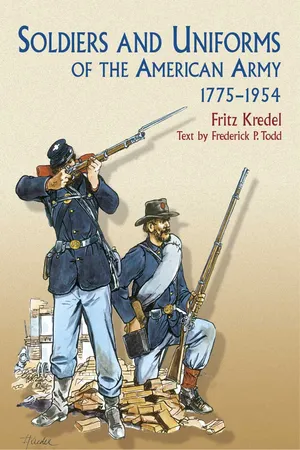
Splendid pictorial history of military apparel includes meticulously researched, beautifully rendered illustrations of regimental attire from the Revolutionary War, uniforms worn by the Texas Rangers (1846), Louisiana Zouaves (1861), Philippine Scouts (1904), and members of the Women's Army Corps (1954). Descriptive text accompanies each illustration. 32 full-color plates.
eBook - ePub
Soldiers and Uniforms of the American Army, 1775-1954
- 72 pages
- English
- ePUB (mobile friendly)
- Available on iOS & Android
eBook - ePub
Soldiers and Uniforms of the American Army, 1775-1954
About this book
Information
PLATE 1. General George Washington
FAREWELL ORDERS to the Armies of the United States:
¶ “. . . It only remains for the Comdr in Chief to address himself once more, and that for the last time, to the Armies of the U States (however widely dispersed the individuals who compose them may be) and to bid them an affectionate, a long farewell....
“A contemplation of the compleat attainment (at a period earlier than could have been expected) of an object for which we contended against so formidable a power cannot but inspire us with astonishment and gratitude. The disadvantageous circumstances on our part, under which the war was undertaken, can never be forgotten. The singular interpositions of Providence in our feeble condition were such, as could scarcely escape the attention of the most unobserving; while the unparalleled perserverance of the Armies of the U States, through almost every possible suffering and discouragement for the space of eight long years, was little short of a standing miracle.
“It is not the meaning nor within the compass of this address to detail the hardships peculiarly incident to our service, or to describe the distresses, which in several instances have resulted from the extremes of hunger and nakedness, combined with the rigours of an inclement season; nor is it necessary to dwell on the dark side of our past affairs. Every American Officer and Soldier must now console himself, for any unpleasant circumstances which may have occurred by a recollection of the uncommon scenes in which he has been called to Act no inglorious part, and the astonishing events of which he has been a witness, events which have seldom if ever before taken place on the stage of human action, nor can they probably ever happen again. For who has before seen a disciplined Army form’d at once from such raw materials? Who, that was not a witness, could imagine that the most violent local prejudices would cease so soon, and that men who came from the different parts of the Continent, strongly disposed, by the habits of education, to despise and quarrel with each other, would instantly become but one patriotic band of Brothers, or who, that was not on the spot, can trace the steps by which such a wonderful revolution has been effected, and such a glorious period put to all our warlike toils?
“It is universally acknowledged, that the enlarged prospects of happiness, opened by the confirmation of our independence and sovereignty, almost exceeds the power of description....
“To the various branches of the Army the General takes this last and solemn opportunity of professing his inviolable attachment and friendship.”
Rock Hill, near Princeton,
November 2, 1783
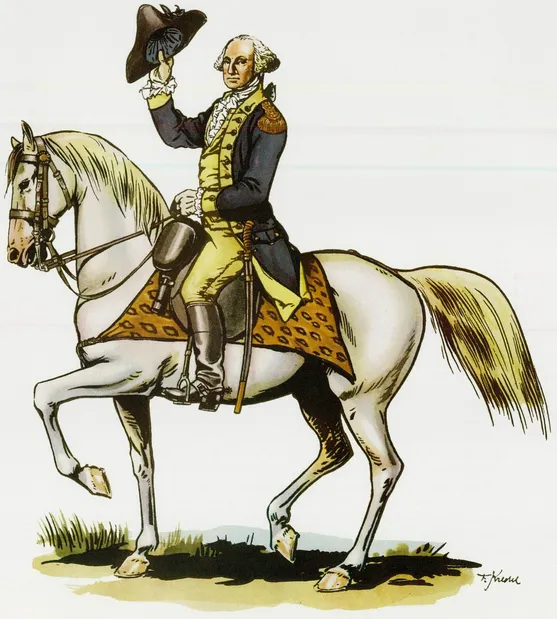
GENERAL GEORGE WASHINGTON
PLATE 2. Thompson’s Pennsylvania Rifle Battalion, 1775
OF ALL the types of soldier which made up the Continental Line—foot, horse, and gunners —the rifleman was the most distinctly American. He was just as distinctive as the frontier from which he came; not because he carried a rifle or wore a buckskin shirt, but rather because he came from a folk whose resourcefulness, tenacity, and vision won an entire continent. Bred to these qualities, the rifleman had a natural dislike of convention which was at once his strength and his weakness. Like the ranger of the Old French War before him, he was ever the irregular, hard to manage, contemptuous of discipline, restless under the inevitable routine of an army, but deadly when properly employed.
Since riflemen could be found only along the western borders of the colonies, they numbered but a few special corps. The most distinguished were those commanded by William Thompson and Samuel Miles of Pennsylvania and by Daniel Morgan of Virginia. The first corps, raised in June and July 1775, was composed of expert riflemen from Pennsylvania, Maryland, and Virginia. It took part in the siege of Boston in that year, and two of its companies accompanied Arnold on his march to Quebec. During the months that followed, the frontiersman were transformed into disciplined, efficient soldiers, and on January 1, 1776, the regiment became the ist of the Continental Line. When the Line was renumbered the next year, it became the 1st Pennsylvania; as such, its history is the history of the Revolution.
The hunting or rifle shirt in which this corps was clothed is shown in the plate. It was the familiar frontier garment. In its most common form it was made of deerskin for winter and linen for summer, reaching often to the knees and having one or more capes. Being open down the front and without buttons, it had to be held together by a broad leather belt by which was carried a knife or hatchet. The cloth shirts were dyed in a wide variety of shades, but those of skin appear usually to have been of an ash or tan color. This hunting shirt was widely used throughout the entire army by mounted and foot troops alike.
In the course of the war most of the companies of the 1st Pennsylvania turned in their rifles for smoothbore muskets. The rifle, although highly accurate, was difficult to load and unable to carry a bayonet so that it did not measure up as a military weapon. The right figure in the plate is a rifleman; the man on the left is from a company which has been altered to infantry. Both wear the painted canvas knapsacks issued to Pennsylvania units early in the war.
[Pennsylvania Archives, 2nd ser., X, 3-42, 305-90; John W. Wright, “Some Notes on the Continental Army,” in the William and Mary College Quarterly, 2nd ser., XI, 196-98; Charles M. Lefferts, Uniforms. . . of the American Revolution (New York, 1926); John G. W. Dillin, The Kentucky Rifle (Washington, 1924); colored engraving by Daniel N. Chodowiecki, in Allgenaeines historisches Taschenbuch . . . für 1784 ... ; MS Archives of Maryland, Red Book 4, No. 13.]
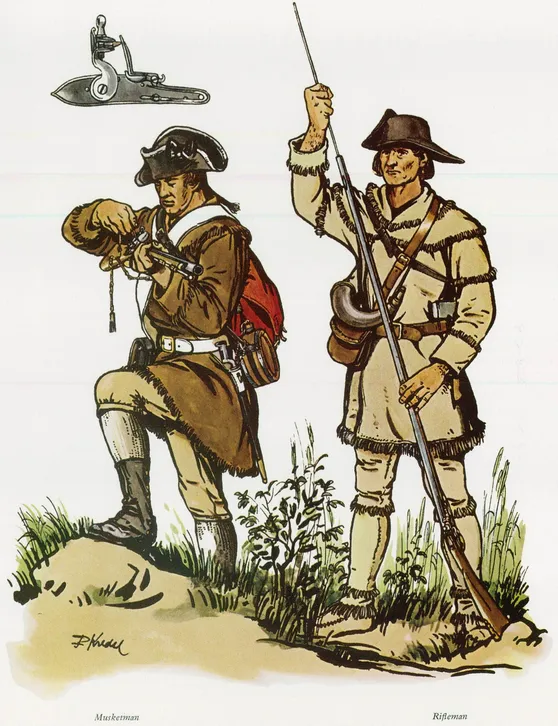
THOMPSON’S PENNSYLVANIA RIFLE BATTALION · 1775
PLATE 3. Baylor’s 3rd Continental Dragoons, 1778
THE EASTERN seaboard along which the Revolution was fought was not ideal terrain for cavalry. Nevertheless, there were numerous occasions upon which mounted men were urgently needed but were not available. Late in 1776 Congress authorized four regiments of horse to be called, after the British system, light dragoons. But so great was the difficulty in procuring mounts, equipment, and men that the troops were always far under strength. A cavalryman had to take care of his horse as well as perform all the other tasks of a soldier, and the service, consequently, was not overly popular. One state cavalry regiment had enlisted its men on the promise of exemption from menial tasks, but Washington wisely declined its services on the grounds of impartiality and discipline.
Then, too, care had to be taken to enlist in the dragoons only native Americans of known stability and proven loyalty. This was a practice in all armies of that day, for the horsemen were often called upon to act as military police. So it was that the dragoons became an elite corps, and no unit was more so than Colonel George Baylor’s 3rd Regiment, the “Lady Washington Dragoons.” Raised in 1777, it served throughout the war. Its officers and men came principally from the horse raising districts of Virginia and Maryland, although at least one troop was formed in Pennsylvania. Its personnel were, therefore, born horsemen.
During much of 1777 and 1778 Baylor’s Dragoons furnished details to the Commander-in-Chief’s Guard. The Guard itself was an infantry unit of picked men stationed permanently at headquarters, and the attached dragoons served as patrols, videttes, and couriers, as escort for Washington and his staff, and as guards of honor to distinguished visitors.
The light dragoon regiments wore distinctive uniforms when they could get them. The 1st used blue faced with red, or brown faced with green; the 2nd, blue faced with buff; the 3rd, white faced with light blue; and the 4th, red faced with blue, and later green faced with red. As shown in the plate, they were armed with heavy sabres and flint-lock pistols, the latter carried in holsters hanging from the pommel of the saddle. When procurable, they carried carbines as well, but these weapons were so extremely scarce that cavalry were often unable to protect their own camps from enemy attack. The 3rd Dragoons was almost annihilated near Hackensack in September 1778 when its post was attacked in the night by a British force under Major General Charles Grey—“No-Flint Grey” of Paoli notoriety. But the regiment recovered and under Colonel William Washington played a gallant part in the Southern campaigns where it was pitted against such vigorous foemen as Tarleton’s Legion.
[Wright, op. cit., 189-92; Lefferts, op. cit.; Carlos E. Godfrey, The Commander-in-Chief’s Guard (Washington, 1904); colored engraving by Daniel N. Chodowiecki, in Allgenaeines historisches Taschenbusch . . . für 1784 ... ; portrait of Lt. Col. William Washington in the Maryland Historical Society.]
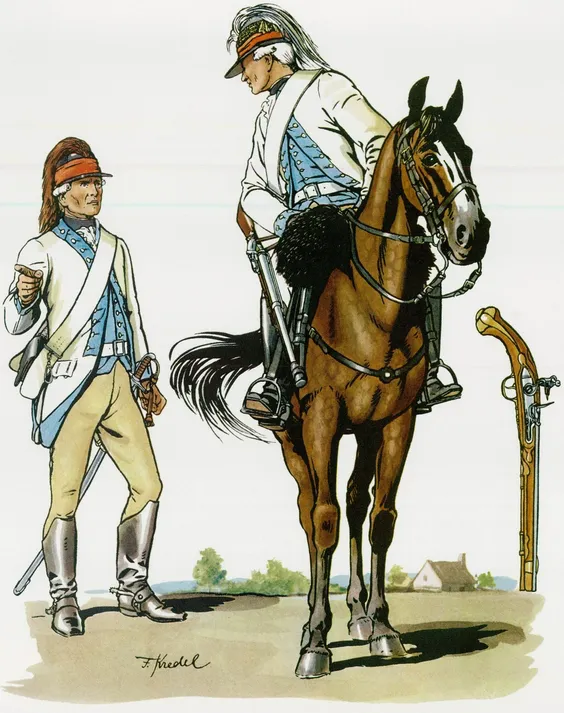
BAYLOR’S 3rd CONTINENTAL DRAGOONS
TROOPERS SERVING AS CAVALRY OF THE COMMANDER.1N-CHIEF’S GUARD · 1778
PLATE 4. “Congress’ Own” and the Continental Artillery, 1780
MOST OF the regiments of the Continental Army were named and numbered for the states from which they came. Although Washington strove for a national army, he soon discovered that troops from the different states would not mix. By stressing the state spirit within the regiments, he thus turned this jealousy to advantage.
Certain units, however, were drawn from the country at large, and one of these, the 2nd Canadian Regiment, “Congress’ Own,” is of particular interest. It was raised early in 1776, partly in Canada and from among Canadian refugees, the rest from various states. Its commander was Moses Hazen, a vigorous and independent soldier who had won his spurs as an officer of rangers in the Old French War and had later held the King’s commission. The regiment fought through part of the Northern campaign, saw action on numerous fields including Brandywine, Germantown, and Yorktown. From the first to last it was counted a splendid command.
The officer shown is the captain of a light company, as is indicated by the leather cap worn in place of the cocked hat. He is in the dress uniform of the regiment, brown faced with red. Although his subaltern officers sometimes carried light muskets, he himself is shown with an i, the weapon with which he was armed both on parade and in battle. This was a doctrine laid down by Baron Steuben; an officer busy shooting his musket was not much good as a leader.
The Artillery was also drawn from the country at large. This important branch, comprising four fine regiments and several auxiliary units, was almost entirely the outgrowth of a Volunteer artillery company called “The Train,” formed in Boston in 1763. Here such leading artillerymen as Henry Knox, John Crane, and Winthrop Sargent obtained their first training in arms.
The soldier shown here is a gunner. It was his duty to load the piece and, after each shot, to swab the bore with the wet sponge he holds in his right hand lest a spark remain to explode the next charge. He also carries a drag rope which, fastened to hooks on the carriage, aided him in moving the piece. His uniform of dark blue or black, faced with red, was one of the most common of the Revolution and was regularized for the Artillery in 1779. His long overalls—a most practical garment for service on this Continent—had by 1780 become the popular form of leg covering. Like the rifle shirt, it was worn by all arms and ranks.
Both of the men in the plate make a smart appearance. The white ribbons on their black cockades indicate the French alliance and the consequent improvement in supplies, but this alone was not the reason for their smartness. To understand it one must look back to that winter at Valley Forge when Steuben had made over the Continental Army.
[Lefferts, op. cit.; Pennsylvania Archives, 1st ser., VIII 17-20; John Muller, A Treatise of Artillery ... (Philadelphia, 1779); Francis S. Drake, Life and Correspondence of Henry Knox (New York, 1873) 14, 21.]
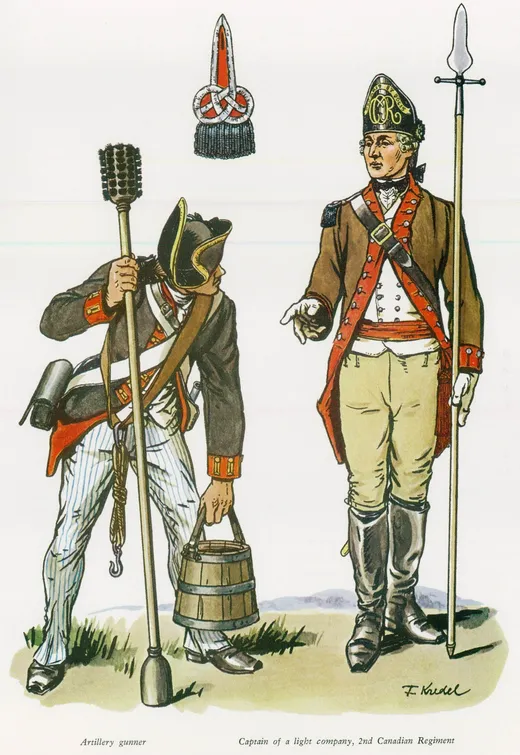
“CONGRESS’ OWN”...
Table of contents
- Title Page
- Copyright Page
- Introduction
- Introduction to the First Edition
- Table of Contents
- PLATE 1. General George Washington
- PLATE 2. Thompson’s Pennsylvania Rifle Battalion, 1775
- PLATE 3. Baylor’s 3rd Continental Dragoons, 1778
- PLATE 4. “Congress’ Own” and the Continental Artillery, 1780
- PLATE 5. Infantry of the Legion, 1795
- PLATE 6. The Regiment of Artillerists, 1812
- PLATE 7. Regular Infantry, 1814
- PLATE 8. United States Military Academy, 1825
- PLATE 9. Common Militia, 1830
- PLATE 10. 7th Infantry, 1835
- PLATE 11. State Volunteer Corps, 1840
- PLATE 12. Texas Rangers and Mississippi Rifles, 1846
- PLATE 13. 3rd Artillery, 1847
- PLATE 14. Corps of Engineers and the Mexican Spy Company, 1847
- PLATE 15. 1st Dragoons, 1851
- PLATE 16. 7th Regiment, New York State Militia, 1861
- PLATE 17. Louisiana Zouaves, 1861
- PLATE 18. Federal Infantry, 1862
- PLATE 19. Stuart’s Cavalry Division, C.S.A., 1862
- PLATE 20. Confederate Infantry, 1863
- PLATE 21. New York Zouave, 1863
- PLATE 22. Corps D’Afrique, 1864
- PLATE 23. 7th Cavalry, 1876
- PLATE 24. Organized Militia 1885
- PLATE 25. Cuban Expedition, 1898
- PLATE 26. Philippine Scouts, 1904
- PLATE 27. Staff and Pioneer Infantry, A. E. F., 1918
- PLATE 28. Parachute and Ranger Infantry, 1944
- PLATE 29. United States Constabulary, 1950
- PLATE 30. 1st Cavalry Division, 1950
- PLATE 31. Women’s Army Corps, 1954
- PLATE 32. Army Bands, 1954
- References
Trusted by 375,005 students
Access to over 1.5 million titles for a fair monthly price.
Study more efficiently using our study tools.
Frequently asked questions
Yes, you can cancel anytime from the Subscription tab in your account settings on the Perlego website. Your subscription will stay active until the end of your current billing period. Learn how to cancel your subscription
No, books cannot be downloaded as external files, such as PDFs, for use outside of Perlego. However, you can download books within the Perlego app for offline reading on mobile or tablet. Learn how to download books offline
Perlego offers two plans: Essential and Complete
- Essential is ideal for learners and professionals who enjoy exploring a wide range of subjects. Access the Essential Library with 800,000+ trusted titles and best-sellers across business, personal growth, and the humanities. Includes unlimited reading time and Standard Read Aloud voice.
- Complete: Perfect for advanced learners and researchers needing full, unrestricted access. Unlock 1.5M+ books across hundreds of subjects, including academic and specialized titles. The Complete Plan also includes advanced features like Premium Read Aloud and Research Assistant.
We are an online textbook subscription service, where you can get access to an entire online library for less than the price of a single book per month. With over 1.5 million books across 990+ topics, we’ve got you covered! Learn about our mission
Look out for the read-aloud symbol on your next book to see if you can listen to it. The read-aloud tool reads text aloud for you, highlighting the text as it is being read. You can pause it, speed it up and slow it down. Learn more about Read Aloud
Yes! You can use the Perlego app on both iOS and Android devices to read anytime, anywhere — even offline. Perfect for commutes or when you’re on the go.
Please note we cannot support devices running on iOS 13 and Android 7 or earlier. Learn more about using the app
Please note we cannot support devices running on iOS 13 and Android 7 or earlier. Learn more about using the app
Yes, you can access Soldiers and Uniforms of the American Army, 1775-1954 by Fritz Kredel,Frederick P. Todd, Frederick P. Todd in PDF and/or ePUB format, as well as other popular books in History & Military & Maritime History. We have over 1.5 million books available in our catalogue for you to explore.