Originally created in the late 19th century to catalog Indian and Oriental arms and armor for a British museum, this volume has long since become a sourcebook of vital information on the military history of India. Enhanced with excellent illustrations, it remains one of the few books available on the subject, providing factual accounts of events ranging from the earliest invasions of the subcontinent in 200 B.C. to the decline of the Mogul Empire (early 18th century) and the First Burmese War in 1824. In addition to information on military history, succeeding chapters describe Indian swords, helmets, knives, shields, daggers, spears, javelins, blowpipes, sabers, and a host of other weapons, including arms used for athletic and sacrificial purposes. Descriptive notes, grouped according to geographical areas, comment on styles of decoration, manufacturing processes, and ethnological characteristics. A shorter section of the book includes detailed information on Arab and Persian arms (maces, battle axes, matchlock guns, bows and arrows, etc.) and Japanese armor. Students of Far Eastern arms and armor as well as enthusiasts of military history will welcome this comprehensive reference. 350 halftones and line illustrations. 350 halftones and line illustrations.
- 224 pages
- English
- ePUB (mobile friendly)
- Available on iOS & Android
eBook - ePub
Indian and Oriental Arms and Armour
About this book
Information
DESCRIPTIVE CATALOGUE OF INDIAN ARMS, WITH INTRODUCTORY NOTES ON STYLES OF DECORATION, PROCESSES OF MANUFACTURE, AND ETHNOLOGICAL CHARACTERISTICS.
I.—DECORATION APPLIED TO INDIAN ARMS, AND PROCESSES OF MANUFACTURE.
A.—DECORATION.
THE decorative arts have been in all ages employed on weapons used by distinguished or royal persons, and in the East the custom of giving presents at the Durbar of the Native Chiefs, and at every public reception of a guest, has contributed to a demand for ornamental arms.
Arms belonging to kings have from the remotest antiquity been of gold or inlaid with gold and jewels both in India and Persia.104 Fashion changes slowly in India, and although it is affected from time to time by foreign influence, yet the type of decoration has probably been handed down from a remote antiquity. It is a question how far the art died out in the dark ages, and was revived again under the Mogul empire. Few, if any, of the ornamental weapons we possess are older than the time of the Mogul invasion or the beginning of the 16th century, and it is from that period to the present that my remarks will principally apply. In treating of Art as applied to arms, I must first make a few general observations.
The writers105 on Indian Art have been few, and their remarks have been generally directed to the architecture, which has been greatly influenced by the religions, the Brahmanical, the Buddhist, the Jain, and the Mahomedan, which have successively swayed over India. Owen Jones, in his Grammar of Ornament, takes most of his examples from the architecture of the Rock Temples, textile materials or manuscripts; only a few are taken from metal and those not from arms, but from hookahs in Bidri-ware. This course has been generally followed by other writers who have edited the catalogues at the International Exhibitions and at South Kensington.106 There is, however, as great a variety of art in Indian weapons as there is in architecture, and there is as strongly marked a line between Aryan and Turanian art, or, speaking roughly, between the arms of the north and south of India, as between the architecture of the Taj and the temple of Chillumbrum.
I have stated elsewhere the grounds for the ethnological classification of arms. It is, however, impossible to draw a hard and fast line in the limits of art in India. There is much in Aryan and Turanian art that has a common origin; they have both borrowed from Assyria and perhaps from Egypt.107 The cone and flower pattern originally derived from the tree worship of the Aryan race is not only used nearly all over India, but is likewise spread over all the east from Greece to Calcutta. There is unquestionably much resemblance between the art of southern India and that of Assyria, as has been pointed out in architecture by Mr. Ferguson, and Dr. Birdwood rightly attributes to a common Turanian source all that is similar between them, that is of a coarse and grotesque character, such as is seen in the temples of southern India, redeemed as it is only by the greatest richness and exuberance of detail.
I do not think we have evidence sufficient to determine whether the Art of northern India has a common origin with that of Persia, as a branch of the Aryan stock, or has been introduced into India by the Mogul Emperors, or restored under their rule; it certainly reached its culminating point when the rule of the great Akbar extended from Bengal to Kandahar. The Aryan races of northern India, are far from being of pure unmixed descent, but the Aryans seem to have left together with the heritage of language, a certain character of art in the countries in which they settled; and even in Persia, the works of art are almost exclusively confined to the parts of the country inhabited by the old Aryan stock, i.e., to the centre, south, and east, in Ispahan, Shiraz and Meshed, which are famous108 for armour and enamels. In Cashmere, the north-west of India, as well as in Khorassan the influence of Greek art from the Bactrian rule must also have been very considerable, and can be traced in the temples and sculpture of India as far as Bengal.
Fergusson remarks that the Aryans were not such builders as the Turanians. In arms, perhaps more than in architecture, Aryan art preponderates over Turanian, and, though it is not the oldest, demands the prominent place. It may be divided into Hindi or Indian and Iranic or Persian.
Hindi or Indian.
The purest style of ornament in geometrical and floral decoration is to be found in the north-west provinces, Kashmir and the Punjab, the most ancient settlement of the Aryan race; but it is not confined to these, as there are good workmen over the whole of Hindostan using the traditional patterns, which vary in different localities slightly, but sufficiently to enable a practised eye to tell by the style from what part of India the work comes. It will be seen from the examination of the various groups that Indian art may be divided into five zones—(1.) Punjab and north-west Provinces; (2.) Sind; (3.) Rajputana; (4.) Central India; and (5.) the Deccan, the differences between which will be more fully alluded to in the examples hereafter quoted.
The favourite subjects are generally drawn from the familiar flowers and indigenous birds, the lily or iris, the lotus, the pink (Fig. 32), the parrot and the peacock. When figures of beasts or men are introduced, they are more accurately drawn and more lifelike than in the south, where they are frequently of a purely conventional type, and bordering on the grotesque. Sometimes figures of the gods in relief are chiselled on the flat surface of a blade; the lion and tiger, men on horseback, hunting, or a man leading a horse or running away from an elephant are frequently selected.
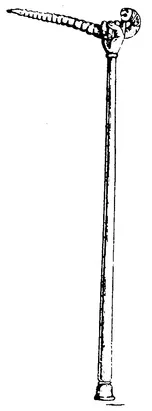
Fig. 4.—A Fakir’s Crutch.
(E. Collection.)
Exuberant fancy is also displayed wherever the form of the arm or accoutrement permits it, such as in the elephant ankus, in the crutch, and in powder flasks. In Fig. No. 4 is seen a Fakir’s crutch forming also a mace, which is formed out of a solid piece of steel, representing an antelope’s horn coming out of a human hand on one side, and ending in a serpent with a tiger’s head. The priming horn (E. Collection) shewn in Fig. 5 represents a winged female figure, picked out in colour, proceeding out of the mouth of a monster whose body and tail are formed out of a gayal horn. In the British Museum there is a powder flask, the horn of which terminates in a primer of similar shape, in steel inlaid with gold; in another, the horn is replaced by jade, terminating in the head of an antelope with his horns thrown back. In a similar one carved in ivory there is the addition of a tiger springing on the antelope, pursued by an elephant and other wild animals. These are 16th or 17th century work.
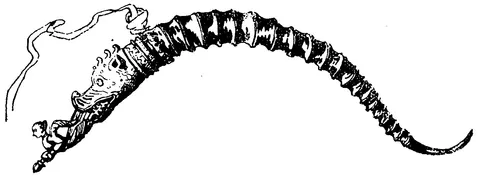
Fig. 5.—Powder Flask. (E. Collection.)
The delicate floral patterns of Central India and the Deccan will be remarked on the plate mail and vambraces of this collection (587 T & 590).
In the Mahomedan kingdoms of the Deccan during the last century a bolder treatment of design prevailed, and raised patterns,109 chiselled out of the solid steel, in imitation of the best period of Persian art, were common (Group IX., Part ii., see Plate XII.).
The large shields of damascened steel offer a rich field for or...
Table of contents
- Title Page
- Copyright Page
- INTRODUCTION
- Table of Contents
- Table of Figures
- ABBREVIATIONS.
- A DESCRIPTION OF INDIAN AND ORIENTAL ARMOUR.
- NOTE ON THE TRANSLITERATION AND SPELLING OF INDIAN WORDS. BY COLONEL YULE, C.B.
- PREFACE TO NEW EDITION.
- INTRODUCTION.
- A SKETCH OF THE MILITARY HISTORY OF INDIA.
- DESCRIPTIVE CATALOGUE OF INDIAN ARMS, WITH INTRODUCTORY NOTES ON STYLES OF DECORATION, PROCESSES OF MANUFACTURE, AND ETHNOLOGICAL CHARACTERISTICS.
- ARTILLERY.
- The Egerton Collection
- COLLECTION OF ORIENTAL ARMOUR AND WEAPONS - FORMED BY LORD EGERTON OF TATTON, AND NOW HUNG IN THE ARMOURY, TATTON PARK.
- INDEX.
Trusted by 375,005 students
Access to over 1.5 million titles for a fair monthly price.
Study more efficiently using our study tools.
Frequently asked questions
Yes, you can cancel anytime from the Subscription tab in your account settings on the Perlego website. Your subscription will stay active until the end of your current billing period. Learn how to cancel your subscription
No, books cannot be downloaded as external files, such as PDFs, for use outside of Perlego. However, you can download books within the Perlego app for offline reading on mobile or tablet. Learn how to download books offline
Perlego offers two plans: Essential and Complete
- Essential is ideal for learners and professionals who enjoy exploring a wide range of subjects. Access the Essential Library with 800,000+ trusted titles and best-sellers across business, personal growth, and the humanities. Includes unlimited reading time and Standard Read Aloud voice.
- Complete: Perfect for advanced learners and researchers needing full, unrestricted access. Unlock 1.5M+ books across hundreds of subjects, including academic and specialized titles. The Complete Plan also includes advanced features like Premium Read Aloud and Research Assistant.
We are an online textbook subscription service, where you can get access to an entire online library for less than the price of a single book per month. With over 1.5 million books across 990+ topics, we’ve got you covered! Learn about our mission
Look out for the read-aloud symbol on your next book to see if you can listen to it. The read-aloud tool reads text aloud for you, highlighting the text as it is being read. You can pause it, speed it up and slow it down. Learn more about Read Aloud
Yes! You can use the Perlego app on both iOS and Android devices to read anytime, anywhere — even offline. Perfect for commutes or when you’re on the go.
Please note we cannot support devices running on iOS 13 and Android 7 or earlier. Learn more about using the app
Please note we cannot support devices running on iOS 13 and Android 7 or earlier. Learn more about using the app
Yes, you can access Indian and Oriental Arms and Armour by Lord Egerton of Tatton in PDF and/or ePUB format, as well as other popular books in History & Military & Maritime History. We have over 1.5 million books available in our catalogue for you to explore.