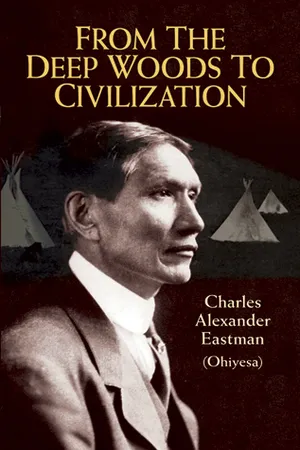
From the Deep Woods to Civilization
eBook - ePub

From the Deep Woods to Civilization

  1. 128 pages
  2. English
  3. ePUB (mobile friendly)
  4. Available on iOS & Android
eBook - ePub

From the Deep Woods to Civilization

About this book

"Has a many-sided appeal …. This stimulating book is one of the few that really deserve the over-worked term, a human document." — Publishers Weekly.
In the first of his memoirs, the popular Indian Boyhood, Charles Alexander Eastman recounted his traditional upbringing among the Santee Sioux. From the Deep Woods to Civilization resumes his story, recounting his abrupt departure from tribal life at age 15 to pursue his education among whites — a path that led him to certification as a medical doctor, the publication of many successful books, and a lifetime of tireless efforts to benefit his native culture. Through his social work and his writings, Eastman became one of the best-known Indians of the early twentieth century and an important force in interpreting and relating the spiritual depth and greatness of the Native American traditions.
Eastman became a physician in hopes of serving the Native American community; he received a Bachelor of Science degree from Dartmouth in 1887 and a medical degree from Boston University in 1890. He began college just a few months after the Battle of Little Bighorn, and his first job as a physician at Pine Ridge Reservation coincided with the Ghost Dance uprisings that culminated in the U. S. Army's attack at Wounded Knee. The only doctor available to assist the massacre's victims, Eastman writes movingly of the event's appalling inhumanity and injustice. Afterward, he lobbied Capitol Hill on behalf of the Sioux and devoted the rest of his life, both in and out of government service, to helping Indians adapt to the white world while retaining the best of their own culture. His autobiography resonates with the impassioned thoughts and experiences of a profound contributor to the richness of American culture.

Frequently asked questions

Yes, you can cancel anytime from the Subscription tab in your account settings on the Perlego website. Your subscription will stay active until the end of your current billing period. Learn how to cancel your subscription.
No, books cannot be downloaded as external files, such as PDFs, for use outside of Perlego. However, you can download books within the Perlego app for offline reading on mobile or tablet. Learn more here.
Perlego offers two plans: Essential and Complete
  • Essential is ideal for learners and professionals who enjoy exploring a wide range of subjects. Access the Essential Library with 800,000+ trusted titles and best-sellers across business, personal growth, and the humanities. Includes unlimited reading time and Standard Read Aloud voice.
  • Complete: Perfect for advanced learners and researchers needing full, unrestricted access. Unlock 1.4M+ books across hundreds of subjects, including academic and specialized titles. The Complete Plan also includes advanced features like Premium Read Aloud and Research Assistant.
Both plans are available with monthly, semester, or annual billing cycles.
We are an online textbook subscription service, where you can get access to an entire online library for less than the price of a single book per month. With over 1 million books across 1000+ topics, we’ve got you covered! Learn more here.
Look out for the read-aloud symbol on your next book to see if you can listen to it. The read-aloud tool reads text aloud for you, highlighting the text as it is being read. You can pause it, speed it up and slow it down. Learn more here.
Yes! You can use the Perlego app on both iOS or Android devices to read anytime, anywhere — even offline. Perfect for commutes or when you’re on the go.
Please note we cannot support devices running on iOS 13 and Android 7 or earlier. Learn more about using the app.
Yes, you can access From the Deep Woods to Civilization by Charles Alexander (Ohiyesa) Eastman in PDF and/or ePUB format, as well as other popular books in History & North American History. We have over one million books available in our catalogue for you to explore.

Information

Index

Adler, Dr. Felix.
Algonquin Indians.
Allison, Senator William B..
American Horse; his pacific influence; interview with Eastman.
AnƦsthesia, Indian fear of; how Eastman overcame it.
ā€œApple Blossoms,ā€
Armstrong, General.
Arnold, Matthew.
Arnold Arboretum.
Assiniboine Indians.
Assiniboine River.
ā€œBad Lands,ā€
Bad Wound.
Bancroft, Edgar A..
Bartlett, President.
Battle Creek.
Bear Island, home of Leech Lake Ojibways.
Beloit College, Eastman enters; life at.
Beveredge, Old Tom.
Bible, Eastman first hears reading of.
Big Foot.
ā€œBig Issueā€ day at Pine Ridge Agency.
Blackfeet Indians.
Black Hawk; figure of.
Blue Horse, old.
Blumenschein, Ernest.
Boggimogishig, Ojibway war chief.
Boston, Mass., Eastman’s first impressions of; a medical student in; charm of
Boston University, studies medicine at.
Boy Scouts; interest in work of.
Brooke, General, negotiations with Ghost Dancersefforts to maintain peace with Indians; places Eastman in charge of wounded Indians.
Brooklyn, N.Y..
Buffalo Bill.
Burke Bill, the.
Camp Fire Club of America.
Camp Fire Girls.
Cass Lake.
Chapin, President.
Cherokee Indians.
Cheyenne Indians.
Cheyenne River Agency.
Chicago, Ill..
Christ.
Christianity.
Church of the Ascension, New York, Eastman’s marriage in.
Clemens, Samuel L., ā€œMark Twain,ā€
Cleveland, President Grover; an Indian’s opinion of.
Cochrane, Thomas.
Commissioner of Indian Affairs.
Congregational Club of Chicago, address before the.
Congress of Races. See First Universal Congress of Races.
Congress of the United States.
Cook, Mrs. Charles Smith.
Cook, Rev. Charles Smith, Eastman’s first meeting with
Court of Claims.
Craft, Father.
Crazy Horse.
Cree Indians.
Crook, General.
Crow Indians.
Custer, General.
Dartmouth College, Eastman enters; his life and activities at graduation at.
Davenport, Ia..
Dawes, Senator H. L..
Dawes Bill, the.
Deming Edwin W..
Devil’s Lake, N.D..
Donald, Rev. Dr. Winchester, Eastman married by.
Dorchester, Mass..
Drink evil.
Eastman, Charles A., early training; feeling toward tribal foes; betrayal and capture of his father; early cause of hatred for United States; as a youth with the Sioux; turning-point in his life; his father’s influence; return with his father to the United States; a narrow escape; on his father’s farm; starts his schooling; goes to Santee; experiences at Santee; letter from his father; earns his first money; progress in his studies; death of his father; goes to Beloit College; first ride on railroad; life at Beloit; life at Knox College; choice of a profession; starts for the East; the journey; in Boston; at Dartmouth College; reflections and ambitions; prepares at Kimball Union Academy; enters Dartmouth; humorous athletic incident; broadening views; interest in literature and history; summer business experiences; reverence for New England; high ideals; life in Boston; acquaintance with eminent men; lectures at Wellesley College; views on social life; graduation at Dartmouth; appointed government physician at Pine Ridge Agency; attends Lake Mohonk conference; arrival at Pine Ridge Agency; meager accommodations; ā€œBig Issueā€ day; first learns of Ghost Dance; an evening with Rev. Charles S. Cook; first meeting with his future wife; busy life at the Agency; a second warning of the Ghost Dance; an acceptable present; a word of caution; an exciting incident and a brave admonition; advice concerning the Ghost Dance; cause of Sioux unrest; anxiety at the Agency; arrival of the troops; wild rumors and excitement; preparations for Christmas; engagement to Miss Goodale; disturbing news from the ā€œBad Lands,ā€ trouble narrowly averted; caring for the wounded; search for the wounded after the massacre; distressing experience and a severe ordeal; quiet restored; property losses of the Indians; address in Chicago; friendship of the Indian Commissioner; demands for proper equipment; prejudice of the Indians; fear of anƦsthesia and amputation and its removal; experience with ā€œmedicine men,ā€ a touching tribute; marriage in New York; the new home; birth of his first child; dishonesty in payment to Indians; protest to Washington; a farcical investigation; strained relations with Indian bureau; summoned to Washington; leaves the Indian service; removes to St. Paul, Minn.; warm social welcome; temporary hardships; professional temptations; disappointment in official character; regret for abandoned work; contributions to St. Nicholas; field service for Y.M.C.A.; extended travel; reflections on religion; Indian philosophy; a Scotchman’s story; visits his uncle in Canada; among the Ojibways; in Indian Territory; address at Bacone College; speaking tours in the East; depressed by poverty of the slums; visits the Sac and Fox tribe; an old chief’s rebuke; efforts to Christianize the Indians; association with leading men; representative of Sioux tribe in Washington; cessions by and treaties with the Sioux; bad faith of the government; trials of Washington life; before Congressional committees; relations with four Presidents; arduous duties; Indian views of officials; new phase of Indian life; Indian political influence; search for Indian curios and relics; methods of search; his reception by former enemies; witnesses ancient ceremonies; visits Boggimogishig; the Sugar Point Ojibways; with the Red Lake Ojibways; at Rainy Lake; a fine type of Indian; harvesting wild rice; the call of the wild; hunting the loon; its curious maneuvers; an interesting aged squaw; a narrow escape from drowning; the deserted village; a strange visitor; last work for the government; the Sioux allotment rolls; confusion of Indian names; method of work; overcoming prejudice; remarkable memory of the Indian; difficulties of the work; publication of ā€œIndian Boyhoodā€ in 1902, ā€œWigwam Evenings,ā€ writing in collaboration with Mrs. Eastman; as a public speaker; enters the lecture field; the object in view; a cordial response; an opinion of ā€œThe Soul of the Indian,ā€ the Indian’s philosophy; representative to the First Universal Races Congress, London, 1911,; impressions of the Congress; an incident of the Congress; an invitation from the Orient; at banquet to Mark Twain; unique appearance as a speaker; before the Camp Fire Club; extended traveling; large acquaintance with noted personages; voluminous and inspiring correspondence; interest in the work of Boy Scouts; camps for boys and girls; beli...

Table of contents

  1. Title Page
  2. Copyright Page
  3. Foreword
  4. Table of Contents
  5. I. The Way Opens
  6. II. My First School Days
  7. III. On the White Man’s Trail
  8. IV. College Life in the West
  9. V. College Life in the East
  10. VI. A Doctor among the Indians
  11. VII. The Ghost Dance War
  12. VIII. War with the Politicians
  13. IX. Civilization as Preached and Practised
  14. X. At the Nation’s Capital
  15. XI. Back to the Woods
  16. XII. The Soul of the White Man
  17. Index