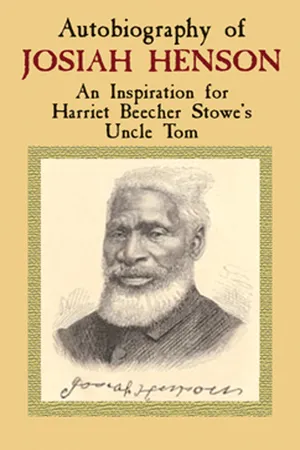
Firsthand account by the man widely regarded as the person who provided much of the material for the revered character in Uncle Tom's Cabin. Henson recalls his childhood, forced separation from his wife and children, escape to Canada, role as "conductor" on the Underground Railroad, and meeting with Queen Victoria in England.
eBook - ePub
Autobiography of Josiah Henson
An Inspiration for Harriet Beecher Stowe's Uncle Tom
- 224 pages
- English
- ePUB (mobile friendly)
- Available on iOS & Android
eBook - ePub
About this book
Information
MRS. H. BEECHER STOWE’S “UNCLE TOM”
CHAPTER I
MY BIRTH AND CHILDHOOD
Earliest Memories—Born in Maryland—My Father’s Fight with an Overseer—One Hundred Stripes and His Ear Cut Off—Throws Away His Banjo and Becomes Morose—Sold South
The story of my life, which I am about to record, is one full of striking incident. Keener pangs, deeper joys, more singular vicissitudes, few have been led in God’s providence to experience. As I look back on it through the vista of more than eighty years, and scene after scene rises before me, an ever fresh wonder fills my mind. I delight to recall it. I dwell on it as did the Jews on the marvellous history of their rescue from the bondage of Egypt. Time has touched with its mellowing fingers its sterner features. The sufferings of the past are now like a dream, and the enduring lessons left behind, make me to praise God that my soul has been tempered by Him in so fiery a furnace and under such heavy blows.
I was born June 15th, 1789, in Charles county, Maryland, on a farm belonging to Mr. Francis Newman, about a mile from Port Tobacco. My mother was a slave of Dr. Josiah McPherson, but hired to Mr. Newman, to whom my father belonged. The only incident I can remember which occurred while my mother continued on Mr. Newman’s farm, was the appearance one day of my father with his head bloody and his back lacerated. He was beside himself with mingled rage and suffering. The overseer had brutally assaulted my mother, when my father sprang upon him like a tiger. In a moment the overseer was down, and, mastered by rage, my father would have killed him but for the entreaties of my mother, and the overseer’s own promise that nothing should ever be said of the matter. The promise was kept—like most promises of the cowardly and debased—as long as the danger lasted.
The laws of slave states provide means and opportunities for revenge so ample, that miscreants like him never fail to improve them. “A nigger has struck a white man;” that is enough to set a whole county on fire; no question is asked about the provocation. The authorities were soon in pursuit of my father. The penalty was one hundred lashes on the bare back, and to have the right ear nailed to the whipping-post, and then severed from the body. For a time my father kept out of the way, hiding in the woods, and at night venturing into some cabin in search of food. But at length the strict watch set baffled all his efforts. His supplies cut off, he was fairly starved out, and compelled by hunger to come back and give himself up.
The day for the execution of the penalty was appointed. The negroes from the neighboring plantations were summoned to witness the scene. A powerful blacksmith named Hewes laid on the stripes. Fifty were given, during which the cries of my father might be heard a mile, and then a pause ensued. True, he had struck a white man, but as valuable property he must not be damaged. Judicious men felt his pulse. Oh! he could stand the whole. Again and again the thong fell on his lacerated back. His cries grew fainter and fainter, till a feeble groan was the only response to the final blows. His head was then thrust against the post, and his right ear fastened to it with a tack; a swift pass of a knife, and the bleeding member was left sticking to the place. Then came a hurra from the degraded crowd, and the exclamation, “That’s what he’s got for striking a white man.”
In the estimation of the illiterate, besotted poor whites who constituted the witnesses of such scenes in Charles county, Maryland, the man who did not feel rage enough at hearing of “a nigger” striking a white, to be ready to burn him alive, was only fit to be lynched out of the neighbourhood.
Previous to this affair, my father, from all I can learn, had been a good-humoured and light-hearted man, the ringleader in all fun at corn-huskings and Christmas buffoonery. His banjo was the life of the farm, and all night long at a merry-making would he play on it while the other negroes danced. But from this hour he became utterly changed. Sullen, morose, and dogged, nothing could be done with him. The milk of human kindness in his heart was turned to gall. He brooded over his wrongs. No fear or threats of being sold to the far south—the greatest of all terrors to the Maryland slave—would render him tractable. So off he was sent to Alabama. What was his after-fate neither my mother nor I have ever learned; the great day will reveal all. This was the first chapter in my history.
CHAPTER II
MY FIRST GREAT TRIAL
Origin of My Name—A Kind Master—He is Drowned—My Mother’s Prayer—A Slave Auction—Torn from My Mother—Severe Sickness—A Cruel Master—Sold Again and Restored to My Mother
After the sale of my father by Newman, Dr. McPherson would no longer hire out my mother to him. She returned, accordingly, to his estate. He was far kinder to his slaves than the planters generally were, never suffering them to be struck by any one. He was a man of good, kind impulses, liberal, jovial, hearty. No degree of arbitrary power could ever lead him to cruelty. As the first negro child ever born to him, I was his especial pet. He gave me his own Christian name, Josiah, and with that he also gave me my last name, Henson, after an uncle of his, who was an officer in the revolutionary war. A bright spot in my childhood was my residence with him—bright, but, alas! fleeting. Events were rapidly maturing which were to change the whole aspect of my life. The kind doctor was not exempt from that failing which too often besets easy, social natures in a dissipated community. He could not restrain his convivial propensities. Although he maintained a high reputation for goodness of heart and an almost saint-like benevolence, the habit of intemperance steadily gained ground, and finally occasioned his death. Two negroes on the plantation found him one morning lying dead in the middle of a narrow stream, not a foot in depth. He had been away the night previous at a social party, and when returning home had fallen from his horse, probably, and being too intoxicated to stagger through the stream, fell and was drowned. “There’s the place where massa got drownded at;” how well I remember having it pointed out to me in those very words.
For two or three years my mother and her young family of six children had resided on the doctor’s estate, and we had been in the main very happy. She was a good mother to us, a woman of deep piety, anxious above all things to touch our hearts with a sense of religion. How or where she acquired her knowledge of God, or her acquaintance with the Lord’s Prayer, which she so frequently taught us to repeat, I am unable to say. I remember seeing her often on her knees, and hearing her pray by repeating constant ejaculations, and short phrases which were within my infant comprehension, and have remained in my memory to this hour.
Our term of happy union as one family was now, alas! at an end. The doctor’s death was a great calamity to us, for the estate and the slaves were to be sold and the proceeds divided among the heirs. The first sad announcement that the sale was to be; the knowledge that all ties of the past were to be sundered; the frantic terror at the idea of being sent “down south;” the almost certainty that one member of a family will be torn from another; the anxious scanning of purchasers’ faces; the agony at parting, often for ever, with husband, wife, child—these must be seen and felt to be fully understood. Young as I was then, the iron entered into my soul. The remembrance of the breaking up of McPherson’s estate is photographed in its minutest features in my mind. The crowd collected round the stand, the huddling group of negroes, the examination of muscle, teeth, the exhibition of agility, the look of the auctioneer, the agony of my mother—I can shut my eyes and see them all.
My brothers and sisters were bid off first, and one by one, while my mother, paralysed by grief, held me by the hand. Her turn came, and she was bought by Isaac Riley, of Montgomery county. Then I was offered to the assembled purchasers. My mother, half-distracted with the thought of parting for ever from all her children, pushed through the crowd, while the bidding for me was going on, to the spot where Riley was standing. She fell at his feet, and clung to his knees, entreating him in tones that a mother only could command, to buy her baby as well as herself, and spare to her one, at least, of her little ones. Will it, can it be believed that this man, thus appealed to, was capable not merely of turning a deaf ear to her supplication, but of disengaging himself from her with such violent blows and kicks, as to reduce her to the necessity of creeping out of his reach, and mingling the groan of bodily suffering with the sob of a breaking heart? As she crawled away from the brutal man, I heard her sob out, “Oh, Lord Jesus, how long, how long shall I suffer this way?” I must have been then between five and six years old.
I was bought by a stranger named Robb, and truly a robber he was to me. He took me to his home, about forty miles distant, and put me into his negro quarters with about forty others, of all ages, colours, and conditions, all strangers to me. Of course nobody cared for me. The slaves were brutalised by this degradation, and had no sympathy for me. I soon fell sick, and lay for some days almost dead on the ground. Sometimes a slave would give me a piece of corn-bread, or a bit of herring. Finally I became so feeble that I could not move. This, however, was fortunate for me; for in the course of a few weeks, Robb met Riley, who had bought my mother, and offered to sell me to him cheap. Riley said he was afraid “the little nigger would die;” but he agreed, finally, to pay a small sum for me in horse-shoeing if I lived, and nothing if I died. Robb was a tavern-keeper, and owned a line of stages with the horses, and lived near Montgomery Court House; Riley carried on blacksmithing about five miles from that place. This clenched the bargain, and I was soon sent to my mother. A blessed change it was. I had been lying on a lot of rags, thrown on a dirt floor. All day long I had been left alone, crying for water, crying for mother; the slaves, who left at daylight, when they returned cared nothing for me. Now, I was once more with my best friend on earth, and under her care; destitute as she was of the proper means of nursing me, I recovered my health, and grew to be an uncommonly vigorous boy and man.
I faithfully served Riley for many years. He was coarse and vulgar in his habits, and unprincipled and cruel in his general deportment. His slaves had little opportunity for relaxation from wearying labour, were supplied with the scantiest means of sustaining their toil by necessary food, and had no security for personal rights. When such a master is a tyrant, the slaves often become cringing, treacherous, false, and thieving. Riley and his slaves were no exception to the general rule, but might be cited as apt illustrations of the nature of the relation.
CHAPTER III
MY BOYHOOD AND YOUTH
Early Employments—Slave-Life—Food, Lodging, Clothing—Amusements—Gleams of Sunshine—My Knight-Errantry—Become an Overseer and General Superintendent
My earliest employments were, to carry buckets of water to the men at work, and to hold a horse-plough, used for weeding between the rows of corn. As I grew older and taller, I was entrusted with the care of master’s saddle-horse. Then a hoe was put into my hands, and I was soon required to do the day’s work of a man; and it was not long before I could do it, at least as well as my associates in misery.
A description of the everyday life of a slave on a southern plantation illustrates the character and habits of the slave and the slaveholder, created and perpetuated by their relative position. The principal food of those upon my master’s plantation consisted of corn-meal, and salt herrings; to which was added in summer a little buttermilk, and the few vegetables which each might raise for himself and his family, on the little piece of ground which was assigned to him for the purpose, called a truck-patch.
In ordinary times we had two regular meals in a day: breakfast at twelve o’clock, after labouring from daylight, and supper when the work of the remainder of the day was over. In harvest season we had three. Our dress was of tow-cloth; for the children, nothing but a shirt; for the older ones a pair of pantaloons or a gown in addition, according to the sex. Besides these, in the winter a round jacket or overcoat, a wool-hat once in two or three years, for the males, and a pair of coarse shoes once a year.
We lodged in log huts, and on the bare ground. Wooden floors were an unknown luxury. In a single room were huddled, like cattle, ten or a dozen persons, men, women, and children. All ideas of refinement and decency were, of course, out of the question. We had neither bedsteads, nor furniture of any description. Our beds were collections of straw and old rags, thrown down in the corners and boxed in with boards; a single blanket the only covering. Our favourite way of sleeping, however, was on a plank, our heads raised on an old jacket and our feet toasting before the smouldering fire. The wind whistled and the rain and snow blew in through the cracks, and the damp earth soaked in the moisture till the floor was miry as a pig-sty. Such were our houses. In these wretched hovels were we penned at night, and fed by day: here were the children born and the sick—neglected.
Notwithstanding this system of management I grew to be a robust and vigorous lad. At fifteen years of age there were few who could compete with me in work or sport. I was as lively as a young buck, and running over with animal spirits. I could run faster, wrestle better, and jump higher than anybody about me, and at an evening shakedown in our own or a neighbor’s kitchen, my feet became absolutely invisible from the rate at which they moved. All this caused my master and my fellow-slaves to look upon me as a wonderfully smart fellow, and prophecy the great things I should do when I became a man. My vanity became vastly inflamed, and I fully coincided in their opinion. Julius Caesar never aspired and plotted for the imperial crown more ambitiously than did I to out-hoe, out-reap, out-husk, out-dance, out-strip every competitor; and from all I can learn he never enjoyed his triumph half as much. One word of commendation from the petty despot who ruled over us would set me up for a month.
God be praised, that, however hedged in by circumstances, the joyful exuberance of youth will bound at times over them all. Ours is a light-hearted race. The sternest and most covetous master cannot frighten or whip the fun out of us; certainly old Riley never did out of me. In those days I had many a merry time, and would have had, had I lived with nothing but moccasins and rattlesnakes in Okafenoke swamp. Slavery did its best to make me wretched, but, along with memories of miry cabins, frosted feet, weary toil under the blazing sun, curses and blows, there flock in others, of jolly Christmas times, dances before old massa’s door for the first drink of egg-nog, extra meat at holiday times, midnight-visits to apple-orchards, broiling stray chickens, and first-rate tricks to dodge work. The God who makes the lambs gambol, the kittens play, the birds sing, and the fish leap, gave me a light, merry, and joyous heart. True it was, that the fun and freedom of Christmas, at which time my master relaxed his front, was generally followed up by a portentous back-action, under which he drove and cursed worse than ever; still the fun and freedom were fixed facts; we had had them and he could not help it.
Besides these pleasant memories I have others of a deeper and richer kind. I early learned to employ my spirit of adventure for the benefit of my fellow-sufferers. The condition of the male slave is bad enough; but that of the female, often compelled to perform severe labour, sick or well, unpitied and unaided, is one that arouses the spirit of sympathy in every heart not dead to all feeling. The miseries which I saw many of the women suffer, often oppressed me with a load of sorrow. No white knight, rescuing a white fair lady from cruel oppression, ever felt the throbbing of a chivalrous heart more intensely than I, a black knight, did, when running down a chicken to hide it in an out-of-the-way place till dark, that I might be able then to carry it to some poor overworked black fair one, to whom it was at once food, luxury, and medicine. No Scotch borderer, levying black mail or sweeping off a drove of cattle, ever felt more assured of the justice of his act than I of mine, when I was driving a pig or a sheep a mile or two into the woods, to slaughter for the good of those whom Riley was starving. I felt good, moral, heroic.
Was this wrong? I can only say in reply, that, at this distance of time, my conscience does not reproach me for it. Then I esteemed it among the best of my deeds. It was my training in the luxury of doing good, in the divinity of a sympathetic heart, in the righteousness of indignation against the cruel and oppressive. There and then was my soul made conscious of all the chivalry of which my circumstances and condition in life admitted. I love the sentiment in its splendid environment of castles, and tilts, and gallantry; but having fallen on other times, I loved it also in the homely guise of Sambo as Paladin, Dinah as an oppressed maiden, and old Riley as grim oppressor.
By means of the influence thus acquired, the great amount of work I performed upon the farm, and by the detection of the knavery of the overseer, who plundered his employer for more selfish ends, was caught in the act and dismissed, I was promoted to be superintendent of the farm-work, and managed to raise more than double the crops, with more cheerful and willing labour, then was ever seen on the estate before.
I was now, practically, overseer. My pride and ambition had made me master of every kind of farmwork. But, like all ambition, its reward was increase of burdens. The crops of wheat, oats, barley, potatoes, corn, tobacco, all had to be cared for by me. I was often compelled to start at midnight with the waggon for the distant market, to drive on through mud and rain till morning, sell the produce, reach home hungry and tired, and nine times out of ten, reap my sole reward in curses for not getting higher prices. My master was a fearful blasphemer. Clearly as he saw my profitableness to him, he was too much of a brute to reward me with kindness or even decent treatment. Previous to my attaining this important station, however, an incident occurred which produced so powerful an influence on my intellectual development, my character, condition, my religious culture, and in short, on my whole nature, body and soul, that it deserves especial notice and commemoration. This, however, requires another chapter.
CHAPTER IV
MY CONVERSION
My Praying Mother—A Good Man—Hear A Sermon for the First Time—Its Effect Upon Me—Prayer and Communion—Its First Fruits
I remember being torn from a dear and affectionate mother; I saw her tears and heard her groans; I remember all the particulars. From a little boy up I have remembered my mother; I remember what the prayers of my dear mother were: I have heard her pray for me; for she was a good Christian woman before I was born; and I thank God that I was born of a good Christian mother, a mother whose prayers fell on my ear. Of all earthly blessings there is none can approach to a good mother. I remember her entreaties; I remember her prayers to God for me. Blessed is the child, the son or daughter, that has the prayers of a mother. I remember well the feeling that those prayers wrought upon my heart, though I was but a boy.
My heart exults with gratitude when I mention the name of a good man who first taught me the blessedness of religion. His name was Joh...
Table of contents
- Title Page
- Copyright Page
- Table of Contents
- INTRODUCTION
- PREFACE
- INTRODUCTORY NOTES
- EDITORIAL NOTE
- MRS. H. BEECHER STOWE’S “UNCLE TOM”
- CONCLUSION
- SUMMARY OF ‘UNCLE TOM’S’ PUBLIC SERVICES
- APPENDIX A - A SKETCH OF MRS. H. BEECHER STOWE
- APPENDIX B - THE EXODUS
Trusted by 375,005 students
Access to over 1.5 million titles for a fair monthly price.
Study more efficiently using our study tools.
Frequently asked questions
Yes, you can cancel anytime from the Subscription tab in your account settings on the Perlego website. Your subscription will stay active until the end of your current billing period. Learn how to cancel your subscription
No, books cannot be downloaded as external files, such as PDFs, for use outside of Perlego. However, you can download books within the Perlego app for offline reading on mobile or tablet. Learn how to download books offline
Perlego offers two plans: Essential and Complete
- Essential is ideal for learners and professionals who enjoy exploring a wide range of subjects. Access the Essential Library with 800,000+ trusted titles and best-sellers across business, personal growth, and the humanities. Includes unlimited reading time and Standard Read Aloud voice.
- Complete: Perfect for advanced learners and researchers needing full, unrestricted access. Unlock 1.5M+ books across hundreds of subjects, including academic and specialized titles. The Complete Plan also includes advanced features like Premium Read Aloud and Research Assistant.
We are an online textbook subscription service, where you can get access to an entire online library for less than the price of a single book per month. With over 1.5 million books across 990+ topics, we’ve got you covered! Learn about our mission
Look out for the read-aloud symbol on your next book to see if you can listen to it. The read-aloud tool reads text aloud for you, highlighting the text as it is being read. You can pause it, speed it up and slow it down. Learn more about Read Aloud
Yes! You can use the Perlego app on both iOS and Android devices to read anytime, anywhere — even offline. Perfect for commutes or when you’re on the go.
Please note we cannot support devices running on iOS 13 and Android 7 or earlier. Learn more about using the app
Please note we cannot support devices running on iOS 13 and Android 7 or earlier. Learn more about using the app
Yes, you can access Autobiography of Josiah Henson by Josiah Henson in PDF and/or ePUB format, as well as other popular books in Social Sciences & African American Studies. We have over 1.5 million books available in our catalogue for you to explore.