- 144 pages
- English
- ePUB (mobile friendly)
- Available on iOS & Android
eBook - ePub
The Energetic Line in Figure Drawing
About this book
Well-crafted and class-tested, this guide to figure drawing features a unique teaching method. It focuses on learning to draw complete figures prior to the study of individual components, and it stresses action figures rather than the customary static examples favored by most drawing and anatomy texts. Employing more text than typical art instruction books, it presents thirty figure drawing lessons and fifty-six drawings and figures. Each lesson includes detailed instructions on anatomical drawing, accompanied by visual examples of strokes, boxes, and measurements.
Author Alon Bement taught art instruction to future art teachers at Columbia University and later founded the prestigious Maryland Institute of Art. His students included Georgia O'Keeffe, who regarded him as a mentor and major influence. Bement's nontraditional approach offers students at all levels an excellent opportunity to build their visual acuity and technical skills.
Frequently asked questions
Yes, you can cancel anytime from the Subscription tab in your account settings on the Perlego website. Your subscription will stay active until the end of your current billing period. Learn how to cancel your subscription.
No, books cannot be downloaded as external files, such as PDFs, for use outside of Perlego. However, you can download books within the Perlego app for offline reading on mobile or tablet. Learn more here.
Perlego offers two plans: Essential and Complete
- Essential is ideal for learners and professionals who enjoy exploring a wide range of subjects. Access the Essential Library with 800,000+ trusted titles and best-sellers across business, personal growth, and the humanities. Includes unlimited reading time and Standard Read Aloud voice.
- Complete: Perfect for advanced learners and researchers needing full, unrestricted access. Unlock 1.4M+ books across hundreds of subjects, including academic and specialized titles. The Complete Plan also includes advanced features like Premium Read Aloud and Research Assistant.
We are an online textbook subscription service, where you can get access to an entire online library for less than the price of a single book per month. With over 1 million books across 1000+ topics, we’ve got you covered! Learn more here.
Look out for the read-aloud symbol on your next book to see if you can listen to it. The read-aloud tool reads text aloud for you, highlighting the text as it is being read. You can pause it, speed it up and slow it down. Learn more here.
Yes! You can use the Perlego app on both iOS or Android devices to read anytime, anywhere — even offline. Perfect for commutes or when you’re on the go.
Please note we cannot support devices running on iOS 13 and Android 7 or earlier. Learn more about using the app.
Yes, you can access The Energetic Line in Figure Drawing by Alon Bement in PDF and/or ePUB format, as well as other popular books in Art & Art Techniques. We have over one million books available in our catalogue for you to explore.
Information
Topic
ArtSubtopic
Art TechniquesLESSON NINETEEN
THE SITTING FIGURE (No. 1)
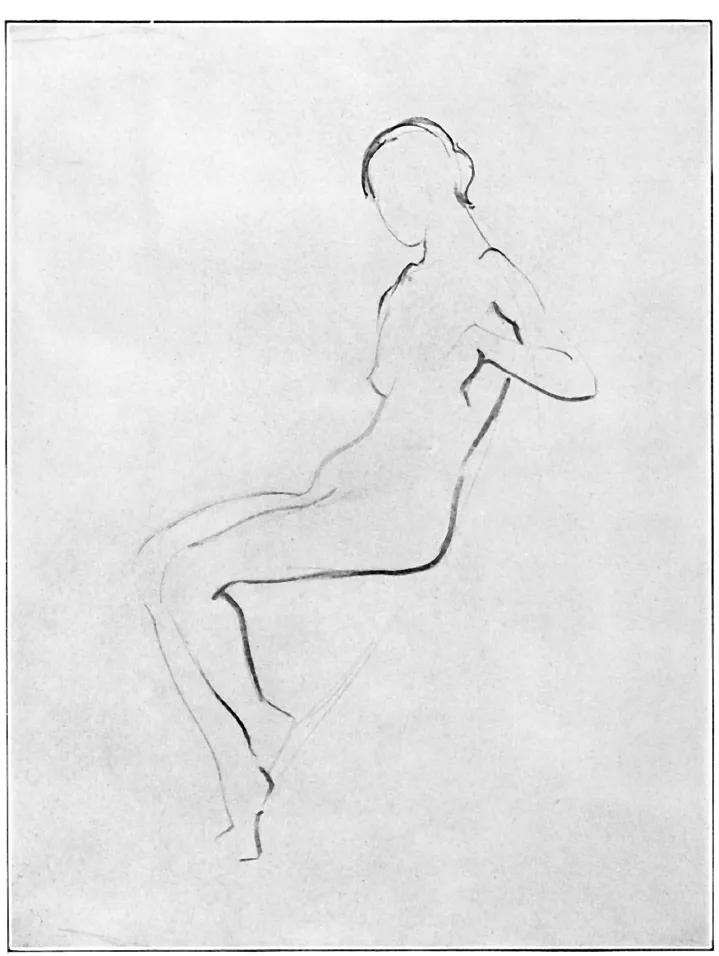
ASITTING figure is considered difficult to draw because of the short lengths into which the long lines are broken. ta In this apparent confusion, however, there is always a certain structural order that may be based on convex and concave curves.
In this case it is not difficult to imagine one beginning at the base of the skull and extending downward past the shoulders and back of the thighs, and finally to the feet, where it will usually pass directly along the soles of one of them.
The rules for the convex and concave lines in the other parts of the figure hold good in the sitting figure.
In drawing this figure the heavy and light lines were made with the same pencil. It was held nearly flat for the darker ones.
DIRECTIONS
Draw the figure four or five times as it is, without accent on the lines.
Draw it twice with the heavy lines made as shown in the drawing by holding the pencil flat in the hand.
Draw two figures with the accents in new places.
Draw this figure with the suggested drapery used in Lesson Eighteen.
Think carefully where the lines of drapery will best leave the lines of the figure, and then draw each with one clean sweep of the pencil. It is better to draw too few, rather than too many, lines.

QUESTIONS: Why is the sitting figure difficult to draw? What is the important structural line to be considered in drawing the sitting figure? Why do two kinds of line make the drawing more interesting? Why is “variety” the “spice of life”? Why is the drawing in Lesson Five so interesting when the lines are alike over nearly the whole figure? Is there more than one kind of beauty? Which has the figure in Lesson Eighteen?

PLATE NO. XIX
LESSON TWENTY
THE SITTING FIGURE (No. 2)
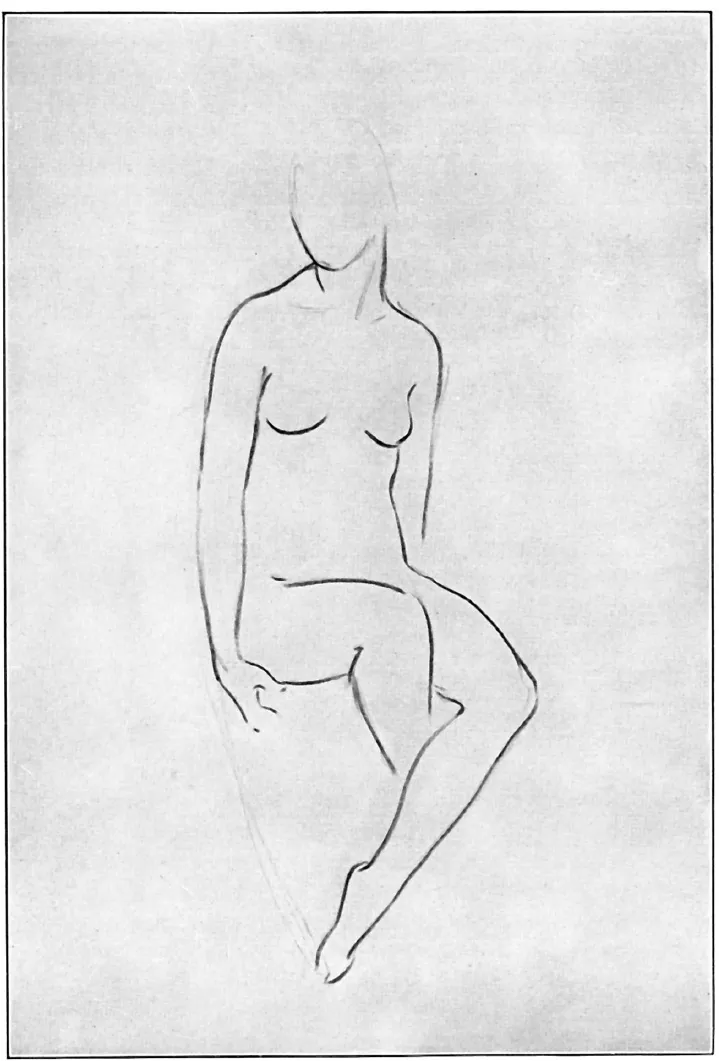
THE same line is as important in the three-quarters view as in the true profile. In this case it extends down the arm instead of the side, but it renders the same service as if it went down the side. If it is continued down it extends to the foot, but it reaches the toe rather than the heel.
The more nearly the figure faces the observer, the less likely is the construction line to end exactly in the foot.
In Plate XX, if a line be drawn down the right side of the head and neck it will pass, as a double curve, first through the left side at the waist, and then through the inside of the right leg down the left leg to the heel. If this line is not actually drawn as a construction line it should be very carefully studied before beginning the drawing.
DIRECTIONS
Draw the figure six times, every other time in reverse.
Without looking at it, draw the figure in Lesson Nineteen twice from memory.
Draw the figure with both arms in a different position.
Draw the figure and extend the lines as in Lesson Nineteen.
Draw the figure using hard and soft pencils on the same drawing.
Draw the construction lines very lightly. Make two figures facing each other, with costumes as in Lesson Eleven.
Hold the pencil well back from the end. Do not use the same one many times in succession.

QUESTIONS: How do the construction lines of the three-quarters view differ from those of the true profile? What is the similarity? Why is it better to use several kinds of paper? Can one pencil be made to serve the purpose of two? How? Where should the fingers be placed in relation to the point of the pencil? Why? Why is it better to draw rapidly rather than slowly?

PLATE NO. XX
LESSON TWENTY-ONE
THE SITTING FIGURE (No. 3)
THE construction lines of Lesson Twenty-one are exactly those of Lesson Nineteen, but the figure is handled in a very different manner. The line quality is not nearly as interesting as in Lesson Nineteen, but it is very much more in detail, particularly in the two extremities, the head and feet, the latter being carefully drawn for a short time drawing.
The feet and lower legs are also interesting, on account of the rhythmic quality that appears to connect the line of one with the other. The absence of a line down the arm seems to ameliorate the monotonous quality of the outline.
DIRECTIONS
Draw from memory the figure in Lesson Nineteen. Leave out any part of the outline that seems unimportant.
Draw the figure four times, every other time reversed. Draw it from memory and leave out any part that does not harm the action.
Draw the head, arms, and torso of the figure in Lesson Nine in a sitting position.
In the same manner draw the figure in Lesson Five in a sitting position.

QUESTIONS: With your pencil trace in the air the rhythmic lines in the feet and lower legs of the figure. Is the line quality especially good in this figure? What q...
Table of contents
- Cover
- Title Page
- Copyright Page
- What is Life Drawing—Introduction by Arthur Wesley Dow
- Preface
- Contents
- Illustrations
- Materials
- LESSON ONE: The Figure in Profile
- LESSON TWO: The Arm in Profile
- LESSON THREE: The Head in Profile
- LESSON FOUR: The Hand, the Forearm, and Simple Measurements
- LESSON FIVE: Variations of the Profile
- LESSON SIX: Dancing Figure
- LESSON SEVEN: The Head—Front View
- LESSON EIGHT: The Back—Three-quarters View
- LESSON NINE: The Front—Three-quarters View
- LESSON TEN: The Front of the Figure
- LESSON ELEVEN: Memory and Imagination
- LESSON TWELVE: Adaptability
- LESSON THIRTEEN: The Double Curve
- LESSON FOURTEEN: The Ear as a Pivot
- LESSON FIFTEEN: The Standing Figure—Three-quarters View
- LESSON SIXTEEN: Two Convex Sides
- LESSON SEVENTEEN: Adaptability
- LESSON EIGHTEEN: The Figure and Line
- LESSON NINETEEN: The Sitting Figure (No. 1)
- LESSON TWENTY: The Sitting Figure (No. 2)
- LESSON TWENTY-ONE: The Sitting Figure (No. 3)
- LESSON TWENTY-TWO: Beginning Shading
- LESSON TWENTY-THREE: Symmetry
- LESSON TWENTY-FOUR: Figure and Costume
- LESSON TWENTY-FIVE: Figure and Line
- LESSON TWENTY-SIX: Absence of Line
- LESSON TWENTY-SEVEN: Extreme Action
- LESSON TWENTY-EIGHT: The Foot
- LESSON TWENTY-NINE: The Hand
- LESSON THIRTY: The Head