A practical course in pen and ink drawing, this helpful guide includes a comprehensive survey of the best pen work in existence. A wide diversity of styles are presented ― from loose sketches to rich, engraving-like studies. Works from all periods include drawings by such masters as Dürer, Holbein, Doré, Gibson, Rackham, Pyle, Beardsley, and Klinger.
An opening chapter presents the evolution of pen drawing, while subsequent sections allow readers to select topics in self-contained units on line technique; the use of materials, drawing the figure, face and hands; humorous illustration; pen drawing for advertisers; fashion drawing; and landscape and architectural illustration.
An excellent reference for students, this book will also help illustrators and commercial artists further develop their own styles.
- 224 pages
- English
- ePUB (mobile friendly)
- Available on iOS & Android
eBook - ePub
The Art and Technique of Pen Drawing
About this book
Information
Topic
KunstSubtopic
KunsttechnikenCHAPTER I
INTRODUCTORY
“ILLUSTRATION is an important, vital, living branch of the Fine Arts, and will live for ever.”
The late Joseph Pennell concluded a book on “Modern Illustration” with the above words in 1895, some twelve years after the commercial adaptation of photo-zinco reproduction had made possible the use of comparatively cheap and rapidly produced blocks from line drawings.
“For ever” sounds a long time, even allowing for the pardonable enthusiasm of the author-artist in completing a monumental work on a congenial subject and intoxicated with the facilities which the new form of reproduction promised for the future ; but it is fairly safe to prophesy that illustration in some form will persist while people are interested in one another and the world they live in.
Pennell saw a golden future for illustration which should have matured, if the promise of the older magazines had been fulfilled, into a pageant of fine drawings covering every aspect of affairs. Papers have multiplied exceedingly since the publication of his book ; but although the demand for illustration is colossal now, compared to conditions in 1895, it is mainly for a totally different style of work. The overwhelming facilities of photography are largely responsible for this, in practically deleting illustration of current events from editors’ commissions to artists. Some people, especially some artists, do not agree that the camera gives better results ; but from an editorial point of view the matter does not admit argument insomuch as the ideal would be to put the reader in front of the actual happenings, and the camera is certainly the next best thing in giving the most faithful record of these.
America alone, with the courage of its huge circulations, has to some extent maintained a public appreciation of really well-produced magazines and weeklies dealing with things other than light fiction or relentless humour. In England, papers have increased in numbers and decreased in artistic interest. Reproductive methods have changed little in thirty years, but the requirements of editors have changed indeed with the expansion of the field of effort. Punch alone of the older papers maintains the tradition of the best procurable in pen drawing, and now carries on in friendly rivalry with many newcomers whose columns show work by some, but never by all, of the Punch men.
In the pages of Punch are to be found the finest flowers of pen artistry since the great times of Keene and Du Maurier in the early ‘seventies, and its volumes offer examples of a succession of old and new fashions and styles in handling the pen which well repay serious study.
It cannot be too strongly insisted that study of the older work is the finest training in all essentials concerned with taste as apart from actual drawings ; but also, it cannot be too strongly emphasised that the method of study is equally important.
With some men, success, even fame, has come as the result of intensive study of the methods of a favourite master whose drawings were copied, dissected, and analysed until they were grafted anew and commenced to grow into very similar fruit. But this is hardly the process that is recommended, and study can with advantage cover a wider field, where personality may be reinforced rather than obliterated.
For personality is the very essence of enduring work, and the surest way to develop it is in an intelligent search into the principles of presenting things seen, in such a way that they are not only recognisable by others, but convey a sense of distinct pleasure in that recognition.
It has been said that the only things necessary for good pen drawing are personality and a pen. This is literally true, for it carries a deceptive load of reservations in the word personality. Accepted literally, it amply justifies the work of the modern non-representational schools in appealing mainly to the mind through the senses ; for their intensely interesting penwork (in the case of the Nash’s, for instance) shows the very essence of personality strewn over nature, adding a new fragrance to the many she has to offer.
The fragrance is generally a little difficult for the average person to detect; its charm does not reach his mind owing to severe artistic adenoids, all of which is merely mixed metaphor for the very hard fact that this kind of work has a very restricted appeal, and may be safely left to those who feel the definite urge to neglect tradition, verity, and the soft ways of the well-understood and universally wanted for the thorny path of the innovator at second hand. Innovators in art are the salt of the earth, but they are only blessed in offering their own brand, absolutely red-hot.
Freely interpreted, the personality and pen idea is a very workable definition of the right approach to study. The right personality can be very rapidly built up by a bowing acquaintance with the technique of the great masters of to-day and yesterday, together with a strong determination to surpass them all. The pen can be bought, together with a tempting block of paper. Then all that remains is to put the pen and paper together in such a way that the result is good to look upon. To do this it is usually necessary to cover much paper with the disappointing results of concentrated efforts, to make drawings of everything in sight, memory, or imagination, and not abandon hope because the coveted technique is shy in developing. Optimism and hard work are the breakfast foods of genius ; it is only necessary to eat enough.
This is the whole art of pen drawing, but the road is rougher than the flippancy of this picture suggests, and it has been the aim throughout the following pages to smooth out the bumps as far as possible, so that the student may travel somewhat easier for having read it.
The infinite possibilities in pen drawing have never yet been dealt with from the standpoint of the interest they hold to the actual or intending producer of professional work. The few books on the subject published in England have been undertaken in the critical vein of the connoisseur, and their appeal is to the collector and amateur rather than the actual worker or student.
The opinions and preferences of a critic are of very little practical value to those who sigh for initiation into the mysteries of materials and handling, and seek guidance in the expression of their own observation or invention in definite lines or mass blacks for reproduction by the ordinary line process block, that wonderfully simple invention which called in the aid of photography to transfer the artist’s drawing on to the metal plate, and by mechanical biting made it possible for the great public to see the work of draughtsmen exactly as it left their hands, without the inevitable change for better or for worse to which it had been previously liable at the hands of the wood-engraver.
The process block, according to Mr J. M. Bulloch’s informative article on “British Pen Drawing” in the Studio Special Number for 1900, dates from about twelve years previous to that date, and he gives an idea of the progress in that period which seems absurdly small compared with the position of the process engraving business to-day. The following paragraph, quoted from Mr Bulloch’s article, shows an almost uncanny prescience of the newer weekly journals : “I believe there are great possibilities for simple decorative effect that will make a direct appeal. Indeed, the only means of differentiation between one journal and another will be solved by decorative art, for the more photographic our illustration becomes, the less individual will be each journal, unless it undertakes some sort of decorative accompaniment capable of very rapid manipulation. Already the cheapest Sunday papers in America are availing themselves of the decorative artist in a more or less crude way. On this side the editors are chary and conservative, but they are bound to follow.”
It has taken the editors until this last year or two to do it, but they have certainly come with a rush, and the policy indicated by Mr Bulloch is in full swing now, greatly to the advantage of artists of every kind, and especially to those who specialise in pen drawing, the ideal method of illustration for papers which aim at a high level of semi-decorative modernity.
Only in the last few years has technique in pen drawing been manifest to any appreciable extent ; technique being understood as the conscious desire to interest our audience in the manner as well as the matter of our pictorial statement, not with the idea of creating a singular method or bizarre touch that will shout and compel instant attention to our work, but undertaken sincerely to add interest to the job of producing and also to the resulting drawings, quite apart from their subjects.
One of the best methods of acquiring ease in the manipulation of the pen, and thereby taking the first step in the cultivation of technique, is to draw direct from nature—the nude, landscape, flowers, or everyday costume studies—in pen and ink. Incidentally this is a sure method of discovering one’s limitations, the best incentive to get rid of them.
Many examples exist of the early use of the quill pen as an instrument for purposes of study direct from nature, and such studies reproduce well in line, although they generally give a result strangely modern in effect when printed, caused by the elimination of gradations apparent in the lines of the old masters owing to the thin ink used. Conversely, it is very easy to impart an antique appearance to a quite fresh drawing by the use of antique paper and a quill pen used with diluted ink; a fact which has been recognised by the spurious art merchants and used to the detriment of many trusting collectors of old drawings.
It is not suggested that work direct from nature or memory should be the ideal of the budding pen draughtsman as a permanent method. There are many subjects that he will find much better if studied and composed in pencil first, either roughly, as a guide on the actual board or paper intended for the finished drawing, or in one or more separate studies and compositions to be finally translated into the ink state on this final board. But it cannot be too strongly insisted that this direct method is the best possible training for individuality of expression. Something indefinable seems ever to lead the adventurer in this method towards work that counts, and, moreover, it eliminates the ever present danger of following or attempting to follow the same technical method as an admired artist whose work is in demand.
The greatest asset of an illustrator or humorous artist is a sincere personal technique, allied with complete knowledge of the drawing and properties necessary for the range of work he undertakes. Specialism is almost inevitable to-day ; things move too rapidly for the combined animal, figure, and marine artist to keep pace in the journalistic world.
There is danger in the fascination of facility, and many great exponents of pen drawing have fallen victims to it. Herbert Railton’s name occurs as an outstanding example of an architectural artist who degenerated by sheer executive ability into a weaver of patterns and reckless employer of stunts of omission which rob his drawings of stability and verisimilitude. He absolutely romped with the pen and undoubtedly enjoyed himself hugely in a way that is permissible only to a limited extent in art. His facility naturally attracted hosts of followers, who accentuated his mannerisms, without a trace of his mitigating brilliance.
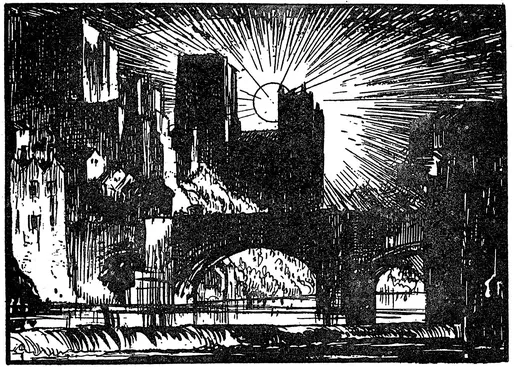
FIG. 2.—A Pen Drawing by FRANK BRANGWYN, R.A.
CHAPTER II
THE EVOLUTION OF PEN DRAWING
LINE was certainly the first method used by man for L expressing his thoughts and recording his impressions of natural objects.
That the reindeer hunter of long ago was an artist is shown by the wonderful “La Madelaine” drawing on ivory of a mammoth (Fig. 3), so full of action, so indicative of bulk and power, and interesting as showing the practised self-criticism in the artist’s corrections of his own first rendering, proving that the work is that of a really proficient student of line, equal in every respect to present-day animal draughtsmen.
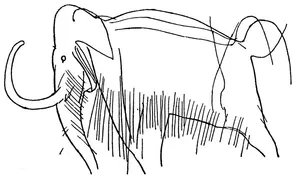
FIG. 3.—The La Madelaine Mammoth.
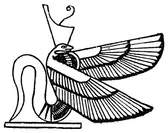
FIG. 4.—Egyptian Decorative Design.
Early civilisations, such as that of Egypt, evolved a more formal manner of treatment, adapting the subject to a decorative scheme to which it was subordinated, and rendering the human form, birds, animals, and the like according to a set code of rules (see Fig. 4). The Egyptians also acquired great power with the brush, using it much as the Japanese do at the present day.
Next in the line of great civilisations is that of Greece, which in its early stages came much under the influence of Egypt. Here again, in the many fine examples that have come down to us in the figured designs on vases, we see that Greek draughtsmanship, though freer and more fanciful than Egyptian, was ruled by certain conventions which again subordinated it to a general decorative effect (see Fig. 5). There is, however, an extraordinary charm and vigour in these drawings which in their delicacy of line and elimination of all but the essentials have found many disciples in modern French line work.
The first real stimulus to line drawing as we understand it to-day came with the writing of “Missals.” They were executed with a pen, and the instinct to decorate or in some way develop the use of the pen, led to drawing with it. Thus developed the notion of illustration, for the missal writers soon discovered that things drawn would save much time and labour in lengthy descriptions.
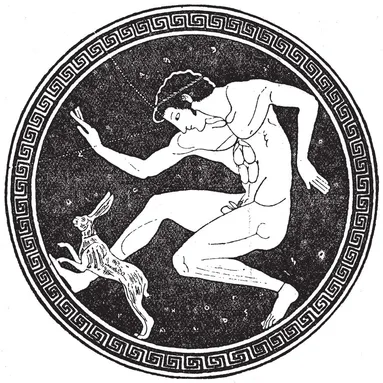
FIG. 5.—Greek Vase Decoration.
These old craftsmen, as members of strict religious houses, may be relied upon as having given their facts with all the accuracy their technical accomplishment allowed, and as records of customs, costume, and architecture, their crudely executed but often spirited drawings are of extraordinary interest at the present day.
With the introduction of printing, illustration of books by means of woodcuts was not long in developing. Fig. 6 shows a typical example of the rather crude methods employed by its early exponents. Though these woodcuts are often of the very poorest technique and childish in treatment, they brought about a veritable revolution, and in fact practically created the art of illustration along the lines on which we know it at the present day.
It only needed the work of a great innovator to raise this engraved illustration from its crude beginnings to a new and high standard, and such a one was found in Albrecht Dürer who, born in 1471, instigated a tradition in decorative line work which has hardly been surpassed at the present day. Besides his magnificent achievements as a painter, Dürer was absorbed in every process connected with his art. His extraordinary industry is shown in the stupendous tasks with which he constantly grappled in his paintings, engr...
Table of contents
- Title Page
- Copyright Page
- FOREWORD
- NOTE OF ACKNOWLEDGMENT
- Table of Contents
- CHAPTER I - INTRODUCTORY
- CHAPTER II - THE EVOLUTION OF PEN DRAWING
- CHAPTER III - LINE TECHNIQUE: ANALYSIS OF METHODS
- CHAPTER IV - MATERIALS
- CHAPTER V - STYLE IN PEN DRAWING
- CHAPTER VI - THE FIGURE, FACES, AND HANDS
- CHAPTER VII - LANDSCAPE AND ARCHITECTURAL ILLUSTRATION
- CHAPTER VIII - ARCHITECTURAL DRAWING
- CHAPTER IX - MODERN PEN ILLUSTRATION
- CHAPTER X - HUMOROUS ILLUSTRATION
- CHAPTER XI - PEN DRAWING FOR ADVERTISERS
- CHAPTER XII - FASHION DRAWING IN PEN AND INK
- INDEX TO TEXT AND ILLUSTRATIONS
Trusted by 375,005 students
Access to over 1.5 million titles for a fair monthly price.
Study more efficiently using our study tools.
Frequently asked questions
Yes, you can cancel anytime from the Subscription tab in your account settings on the Perlego website. Your subscription will stay active until the end of your current billing period. Learn how to cancel your subscription
No, books cannot be downloaded as external files, such as PDFs, for use outside of Perlego. However, you can download books within the Perlego app for offline reading on mobile or tablet. Learn how to download books offline
Perlego offers two plans: Essential and Complete
- Essential is ideal for learners and professionals who enjoy exploring a wide range of subjects. Access the Essential Library with 800,000+ trusted titles and best-sellers across business, personal growth, and the humanities. Includes unlimited reading time and Standard Read Aloud voice.
- Complete: Perfect for advanced learners and researchers needing full, unrestricted access. Unlock 1.5M+ books across hundreds of subjects, including academic and specialized titles. The Complete Plan also includes advanced features like Premium Read Aloud and Research Assistant.
We are an online textbook subscription service, where you can get access to an entire online library for less than the price of a single book per month. With over 1.5 million books across 990+ topics, we’ve got you covered! Learn about our mission
Look out for the read-aloud symbol on your next book to see if you can listen to it. The read-aloud tool reads text aloud for you, highlighting the text as it is being read. You can pause it, speed it up and slow it down. Learn more about Read Aloud
Yes! You can use the Perlego app on both iOS and Android devices to read anytime, anywhere — even offline. Perfect for commutes or when you’re on the go.
Please note we cannot support devices running on iOS 13 and Android 7 or earlier. Learn more about using the app
Please note we cannot support devices running on iOS 13 and Android 7 or earlier. Learn more about using the app
Yes, you can access The Art and Technique of Pen Drawing by G. Montague Ellwood in PDF and/or ePUB format, as well as other popular books in Kunst & Kunsttechniken. We have over 1.5 million books available in our catalogue for you to explore.