![]()
1
FIGHT AT IA DRANG
by John A. Cash
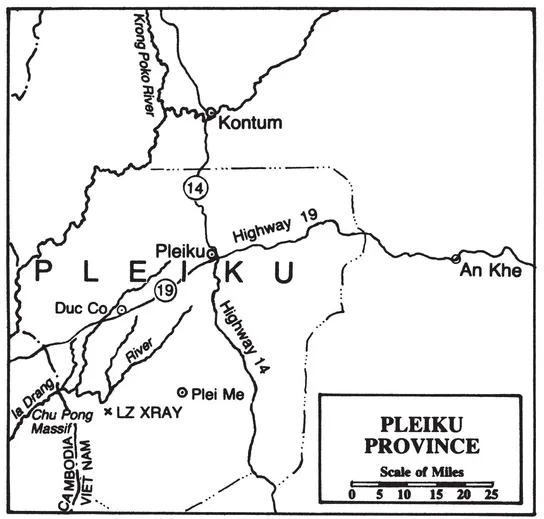
Up to the fall of 1965 the fighting by U. S. troops in Vietnam had been characterized, for the most part, by hit-and-run counterinsurgency operations against Viet Cong irregulars. It was during the week before Thanksgiving, amidst the scrub brush and stunted trees of the Ia Drang River valley in the western sector of Pleiku Province along the Cambodian border, that the war changed drastically. For the first time regular North Vietnamese regiments, controlled by a division-size headquarters, engaged in a conventional contest with U.S. forces. The 1st Battalion, 7th Cavalry, 1st Cavalry Division (Airmobile), took the lead in this battle. (Map 1)
North Vietnamese General Chu Huy Man’s Western Highlands Field Front headquarters had conceived a bold plan for operations in the Central Highlands of the Republic of Vietnam. To be carried out in the fall of 1965 and designated the Tay Nguyen Campaign, the enemy plan called for an offensive against the western plateau encompassing Kontum, Pleiku, Binh Dinh, and Phu Bon Provinces. It specified the destruction of Special Forces camps at Plei Me, Dak Sut, and Duc Co, the annihilation of the Le Thanh District headquarters, and the seizure of the city of Pleiku. Assault forces included the 32d and 66th North Vietnamese Army Regiments.
By the end of October, following an unsuccessful attempt to capture the Plei Me Special Forces Camp, the 32d and 33d Regiments were being pursued by units of the 1st Cavalry Division’s 1st Brigade in the Pleiku area. The American forces had deployed westward from the division base camp at An Khe when the Plei Me Camp was threatened and for twelve days had engaged in intensive search and destroy as well as reconnaissance in force operations, most of them involving fierce fighting and most of them successful.
On 9 November the 1st Brigade was relieved by the 3d, known as the Garry Owen Brigade. This name was a matter of no small pride to the troopers of the 3d Brigade. Originally a Gaelic song once sung by the Irish Lancers, Garry Owen was adopted by the 7th Cavalry Regiment of Lt. Col. George A. Custer during the American Indian wars in the nineteenth century. A mark of the esprit of the 7th Cavalry, the name and new words to the song came to Vietnam with the brigade. The 3d’s forces consisted of the 1st and 2d Battalions, 7th Cavalry, joined for this operation by the 2d Battalion, 5th Cavalry.
Concerned that the North Vietnamese might slip away entirely, Maj. Gen. Harry W O. Kinnard, the 1st Cavalry Division commander, directed Col. Thomas W. Brown, the 3d Brigade commander, to employ his units south and southeast of Plei Me. Colonel Brown, a tall, lean officer, well schooled in airmobile techniques and with plenty of experience in infantry tactics, began on 10 November to press the search vigorously with squad and platoon saturation patrolling.
When three days of patrolling turned up few North Vietnamese, General Kinnard ordered Colonel Brown to search westward toward the Cambodian border. Anxious to engage an enemy that was proving to be more and more elusive, Brown focused his attention on the densely wooded area south of the Ia Drang River at the base of the Chu Pong massif, a rugged mountain mass straddling the South Vietnamese-Cambodian border.
To Brown the prospect of finding the enemy near the banks of the slowly meandering Ia Drang River seemed good. This sector had been a bastion of the Viet Minh who earlier had fought the French in Indochina. And during a recent intelligence briefing Brown had seen on the G–2 situation map a big red star indicating a probable major base for at least one North Vietnamese regiment, which could be using it as a way station for soldiers infiltrating South Vietnam. Friendly troops, furthermore, had not been in this area for some time. If his efforts failed, Colonel Brown planned to search farther south, even closer to the Cambodian border.
On 10 November General Chu Huy Man, undismayed by his heavy losses in the failure at Plei Me, decided to try again on 16 November. The staging area his headquarters selected in preparation for the new attack included the very terrain Colonel Brown had chosen to search.
The 33d North Vietnamese Army Regiment, originally a 2,200-man fighting force, had lost 890 killed, 100 missing, and 500 wounded during the Plei Me debacle. It now began reorganizing its meager ranks into a single composite battalion in the valley between the Ia Drang River and Hill 542, the most prominent peak of Chu Pong in this area. Thirteen kilometers westward on the northern bank of the Ia Drang was the 32d North Vietnamese Army Regiment, still a formidable fighting force despite some losses during the recent battle. The force majeure for the second enemy attempt on Plei Me Special Forces Camp was the newly arrived 66th North Vietnamese Army Regiment. By 11 November its three battalions were positioned along both banks of the Ia Drang, a few kilometers west of the 33d Regiment. Although General Chu Huy Man intended to reinforce the three regiments with a battalion each of 120-mm. mortars and 14.5-mm. twin-barrel antiaircraft guns, both units were still on the Ho Chi Minh Trail in Cambodia, en route to the staging area.
Colonel Brown’s plan, meanwhile, was developing. On 13 November he directed his operations officer, Maj. Henri-Gerard (“Pete”) Mallet, who until a few weeks before had been the 2d Battalion, 7th Cavalry, executive officer, to move the 1st Battalion, 7th Cavalry, to a new area of operations southwest of Plei Me and to prepare a fragmentary order that would put the battalion at the base of the Chu Pong peak (Hill 542) as a jump-off point for search and destroy operations in the vicinity.
On the same day Major Mallet, grease pencil in hand, outlined an area comprising roughly fifteen square kilometers on the situation map. Heretofore the search areas assigned to the infantry battalions had been color-designated. Having run out of primary colors at this point, he designated the sector, which was shaped like an artist’s pallet, Area LIME.
At 1700 on the 13th Colonel Brown was with Lt. Col. Harold G. Moore, Jr., the 1st Battalion, 7th Cavalry, commander, at his Company A command post south of Plei Me. He told Moore to execute an airmobile assault into the Ia Drang valley north of the Chu Pong peak early the next morning and to conduct search and destroy operations through 15 November. Although the brigade had been allocated 24 helicopters a day, Colonel Brown could provide the 1st Battalion, 7th Cavalry, with only 16 for the move because his other two battalions needed 4 each for resupply purposes and some local movement of elements of squad and platoon size. Fire support, so important to an air assault, was to be provided by two 105-mm. howitzer batteries of the 1st Battalion, 21st Artillery. They would be firing from Landing Zone FALCON, nine kilometers east of the search area. One battery was to be airlifted from Plei Me to FALCON early on the 14th before the assault; the other was already in position. A note of concern in his voice, Colonel Brown reminded Moore to keep his rifle companies within supporting range of each other. Both men were sharply conscious that the battalion had yet to be tested in battle against a large enemy force.
Colonel Moore returned to his command post at Plei Me, where his headquarters soon buzzed with activity. Radioing his Company A and Company C commanders, whose troops were engaged in saturation patrolling throughout their sectors, the tall Kentuckian told them to concentrate their men at first light on 14 November at the largest pickup zones in each sector and to be ready themselves to take a look at the target area. He arranged for the helicopters to lift Company B back to Plei Me early on the morning of the 14th from brigade headquarters, twenty minutes away to the southwest. The unit had just been placed there on the evening of the 13th to secure Colonel Brown’s command post and other administrative and logistical facilities. Setting 0830 the following morning as the time for issuing the order, which would be preceded by a reconnaissance flight, Moore continued supervising preparations until by 2200 everything had been accomplished that could be done before the aerial reconnaissance.
That night before going to bed Colonel Moore reviewed his plan and decided on a fresh approach for this operation. Instead of setting down each company on a separate landing zone as he had been doing for the past few days, he would use one landing zone for the entire battalion. His whole force would then be available if he encountered the enemy on landing. Although American units had not engaged a sizable enemy force for some time, the big red star designating a possible enemy base that both he and Colonel Brown had seen on the map loomed large in his mind.
Colonel Moore considered his assets. Firepower would be no problem. The 21st Artillery, tactical air, and gunships had given him excellent support in previous operations, and he knew that Colonel Brown would provide additional fire support if he needed it.
The manpower situation was somewhat different. Of the twenty-three officers authorized for his three rifle companies and one combat support company, twenty were available and practically all had been with the battalion since air assault testing days at Fort Benning, Georgia. In the enlisted ranks the scene was less encouraging, for the 1st Battalion, 7th Cavalry, would be at only two-thirds strength. During the unit’s first two months in Vietnam, malaria and individual service terminations had taken their toll. At the moment, 8 to 10 men from the battalion were in transit for rest and recuperation, and each company had kept 3 to 5 men each back at Camp Radcliff, the An Khe permanent base camp, for various reasons—minor illness, guard duty, administrative retention, base camp development. Colonel Moore was not unduly concerned, however, for he had accomplished previous search and destroy missions with approximately the same numbers. Besides, rarely did any commander field a unit at 100 percent strength.
The 14th dawned bright and clear and by 0630 Company B had been lifted to Plei Me from brigade headquarters by CH–47 Chinook helicopters. Since it had already been assembled in one location, Colonel Moore had selected Company B to land first.
While he supervised preparations, Capt. John D. Herren, Company B commander, chewed on his pipe and thought of the impending operation. He and his men had gone without sleep the night before, having had to cope with an understandably jittery brigade command post. A few minutes before midnight on the 12th the post had been attacked by a local Viet Cong force that killed seven men and wounded twenty-three. Herren could only trust that the lack of rest would have little effect on the fighting ability of his men.
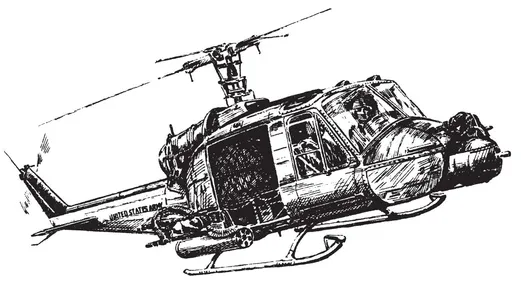
Amid a deafening roar of helicopters, the reconnaissance party assembled. The ships, finished with Herren’s company, had begun to move Battery A, 1st Battalion, 21st Artillery, to FALCON, where it would join Battery C as planned. Standing there to hear Colonel Moore were the Company B, Company D, and headquarters company commanders; a scout section leader from Troop C, 1st Squadron, 9th Cavalry; the commander of Company A, 229th Aviation Battalion (Airmobile), Maj. Bruce P. Crandall; and the battalion S–3, Capt. Gregory P. Dillon, Moore briefed the group on the battalion’s mission, the flight route, and what to look for. Then, using two UH–ID Huey helicopters and escorted by two UH–1B gunships, the reconnaissance party departed.
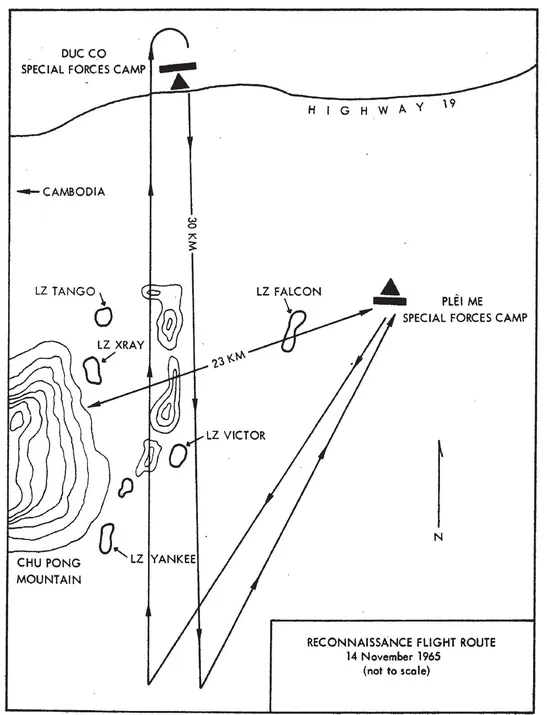
Flying at 2,500 feet and following a pattern that would both provide some deception and allow for maximum viewing of the target area, the four helicopters headed southwest to a point about eight kilometers southeast of the Ia Drang River. Then they turned and flew due north to Duc Co where they circled for five minutes, reversed course, and by 0815 returned to Plei Me. (Map 2B)
Once on the ground, the members of the party discussed possible landing zones to be chosen from open areas observed during the flight. While they were debating, the brigade fragmentary order, which specified Area LIME as the primary zone of interest, arrived. Within a few minutes the choice narrowed to three landing zones: TANGO, X-RAY, and YANKEE. Colonel Moore wanted the largest site available, one that would not unduly restrict the helicopters. This ruled out TANGO as inadequate. Surrounded by tall trees, it could accommodate three, perhaps four, Hueys at most, or half a rifle platoon. Both YANKEE and X-RAY seemed likely choices, for either could take eight to ten ships at a time; at least a platoon and a half could be put on the ground at the start, that most crucial of all moments during an airmobile assault. Announcing X-RAY as his tentative choice, Colonel Moore turned to the scout section leader from the 9th Cavalry and instructed him to fly another reconnaissance mission at “nap-of the-earth” level along the Ia Drang valley. He was to obtain more details about X-RAY, YANKEE, and the surrounding terrain and to look for any signs of enemy activity.
The scout section was back in forty minutes. Although the pilots had seen several trails during their low-level flight, they had drawn no enemy fire. YANKEE, they reported, was usable but risky because it had too many high tree stumps. X-RAY, they confirmed, could easily take eight to ten ships, and just a few hundred meters north of it they had seen communications wire stretched along an east-west trail. This last bit of intelligence was all Colonel Moore needed. X-RAY was to be the primary site, with YANKEE and TANGO as alternates to be used only on his order.
By this time it was 0855 and with the planning completed Colonel Moore reassembled the company commanders, his staff, and representatives of supporting forces to hear his order.
According to the latest available intelligence, an enemy battalion was located five kilometers northwest of X-RAY. Another hostile force of undetermined size was probably just southwest of the landing zone itself, and a secret base was believed to be three kilometers to the northwest. To develop these targets, Moore explained, the 1st Battalion was going to make an air assault into X-RAY, then search for and destroy enemy forces, concentrating on stream beds and wooded high ground. The low-level reconnaissance had no doubt alerted any enemy in the area. To keep the enemy guessing up to the last as to where an actual landing would occur, the 21st Artillery was to fire an 8-minute diversionary preparation on YANKEE and TANGO. This was to be followed by a 20-minute rain of fire on X-RAY, with emphasis on the slopes of a finger with a contiguous draw that jutted out from Chu Pong just northwest of X-RAY,Gunships of the 2d Battalion, 20th Artillery (Aerial Rocket) (Airmobile), were to follow the tube artillery barrage for thirty seconds with rocket and machine gun fire, after which the escort gunships of Company A, 229th Aviation Battalion, were to sweep the area.
Using sixteen Hueys, Herren’s Company B was to follow close on the heels of the fire preparation, land, and secure X-RAY, followed in turn and on order by Companies A, C, and D. Once on the ground Companies A and B were to assemble in attack formation just off the north and northeastern sectors of X-RAY, prepared to search east or northeast on order, with Company A on the right. Designated at first as the reserve force, Company C was upon landing to assume the security mission from Company B on order with a “be prepared” task to move west and northwest, searching the lower portion of Chu Pong. If Company C did hit anything, Moore reasoned, at least he would have his entire force readily available as a backup. Company B had priority of fire at the start, but once the westward push from X-RAY began the priority was shifted to Company A.
Colonel Moore directed each rifle company to bring one 81-mm. mortar tube and a maximum ammunition load and Company D to bring its three tubes. When all companies had closed at X-RAY, their mortars were to revert to control of the Company D mortar platoon.
Just as he completed his briefing, Colonel Moore learned that the artillery was in position. Setting 1030 as touchdown time at X-RAY for the air assault, with the 20-minute artillery preparatory fires to be completed by H minus 1 minute, Moore knew that it would be a split-second affair.
For this mission the troops of the 1st battalion, 7th Cavalry, would be well prepared. Standing operating procedure dictated that each rifleman carry at least 300 rounds of M16 ammunition, and each grenadier was ordered to bring between two and three dozen high-explosive shells for his 40-mm. grenade launcher. Machine gun crews were to transport at least 800 rounds of linked 7.62-mm. ammunition, and every man was to have no less than two M26 fragmentation grenades. There were to be at least two 66-mm. M72 light assault weapons per squad and five to six smoke grenades in each platoon. Every soldier was to carry one C ration meal and two canteens of water, as well as an ample supply of intrenching tools and machetes.
Colonel Brown arrived as Moore finished giving the order and Moore briefed him separately. The brigade commander liked the tactical plan, agreed with the selection of X-RAY as the primary landing zone, and was satisfied that Moore’s concept of the operation followed the guidance he had given him the previous afternoon.
At 1017, after a brief delay resulting from the too hasty positioning of the artillery pieces at FALCON, the preparatory fires began. Thirteen minutes later the leading elements of Company B lifted off the Plei Me airstrip with a thunderous roar in a storm of red dust. With volleys of artillery fire slamming into the objective area, the sixteen Hueys—four platoons of four each—filed southwestward across the mid-morning sky at two thousand feet. Two kilometers out, they dropped to treetop level. The aerial rocket artillery gunships meanwhile worked X-RAY over for thirty seconds, expending half of their loads, then circled nearby, available on call. The 229th’s escort gunships came next, rockets and machine guns blazing, immediately ahead of the lift ships. As the lead helicopters braked for the assault landing, their door gunners and some of ...