10. The First Lines of the Front View.
WHEN the artist begins to sketch in his figures he represents them by bold sketchy lines, which, though drawn rapidly, are sufficient for the purpose of summarizing the form and fixing the proportions. For a head, seen in front view, the first lines resemble an acorn in its cup. The oval of the acorn represents the face, while the more rounded curve of the cup gives the cranium and hair. It is in the woman’s head that the curves are seen in their greatest purity. For the heads of men and children a more angular treatment is advisable. Of course, the form of the head, whether of man, woman, or child, is entirely built upon curves; there are no actual angles, and the different parts glide into one another by the most beautiful fluctuations of the form, without any jerks or sharp corners. Nevertheless, when the various lines are taken, not so much in their delicacy as in their general character and position, their relation is angular rather than flowing. Throughout this study we shall lean toward the angular, or toward the curved, just as serves our purpose. In sketching in the head of a woman a generous curvature helps us ; while in sketching the heads of men and of children, a more angular form is of assistance.
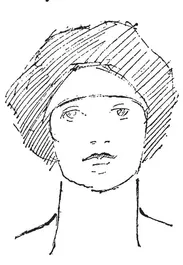
In Fig. 35, A, a woman’s head, we have a broad, full oval for the face. It is well that this oval should not be pinched and too pointed, for the outline represents the jaws rather than the cheeks—and one of the commonest mistakes is that of narrowing the jaws, which is done in the hope, no doubt, of securing refinement. Observe that the eyes are a little below the middle, and that the hair falls down obliquely, making the forehead not too wide.
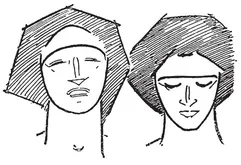
In Fig. 36 several points, which need to be considered here, are illustrated. The curve for the head was first drawn with a rather rough line—which is more appropriate when the hair is not confined to the head—and the oval for the face was added. This face-line is broad and ample, and even a little angular, threatening to give the head a masculine character, which was avoided, however, by the hair-line, which is distinctly feminine. Now, as a rule, when the head is upright, and is neither looking up nor down, the mouth is in that position which would be passed by the curve of the head if continued, in a circular manner, across the lower part of the face. In the present case such a continuation of the curve of the head would place the mouth very near the chin. We know, therefore, that the head must be slightly raised and foreshortened. The foreshortening of a head is best attacked in the line of the brows. The eyes are generally a little more than half-way down from top to bottom of the head, the brows a little less. If when he first sketches in the ovals for the head the draughtsman casts a few lines across the brow, he will easily see, if he has any eye for form, whereabouts the brows and the eyes will fall. The more foreshortened the face is, the more curved he should make these lines.
The neck both in Figs. 35 and 36 is represented by lines which diverge somewhat as they descend, and which are slightly convex above and slightly concave below. Usually these lines are unsymmetrical, not because the neck is unsymmetrical, but because the attitude rarely allows the two sides to appear the same. Note that the side upon which the more curved (convex) line is found is that toward which the head is turning. The neck will be seen to be in length about equal to its breadth, in woman; in man it is shorter.
The sloping lines of the shoulders strike the neck somewhere about the middle; but so great is the variation caused by the different attitudes, that little guidance can be found in any rule. Just as the lines for the neck suddenly turn outward below, so these lines for the shoulders as suddenly turn upward as they meet the neck. (Fig. 36.)
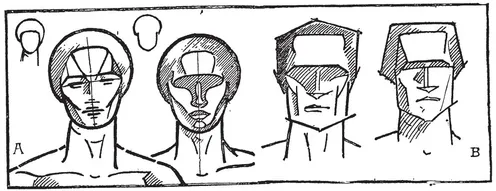
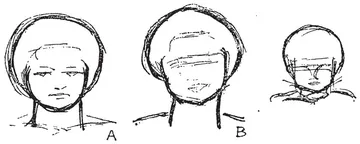
In Fig. 37 we have the commencements for the heads of children of four, six, and one years of age. In A the lines are rounded, in B pointed, and this difference is not to characterize the age, but to illustrate various modes of attacking the work. The pointed method of B is the better, though it is well to consider the pointing as a refinement upon the curved form. In all cases the face is short, and consequently broad. The neck also is short, but it must appear narrow as compared with the head, as if it were weak. The face of a child has, moreover, a great deal of squareness about it. The puffy cheeks are nearly the same width as the brow above, and the chin is very small, and does not as yet assert itself.
FIG. 37.—Commencements for the Heads of Children.
The difference between the heads of a man and a woman is seen when we convert one into the other. Comparisons may be made in Figs. 35 and 40.
To convert the head of a woman into the head of a man we give it a squarer or more box-like character. We keep its lines more vertical. We widen and shorten the neck, and reduce its mobility. We give the jaw more angularity; we make the mouth and the nose wider; but, above all, we expand the forehead, making it taller and more capacious above.
11. The Head in Full View; its Chief Lines.
IF we draw an oval for a head, but do not develop the internal space with lines or shading, the form will be regarded as egg-like in its rotundity. Of all forms, the egg-like and the sausage-like are the least acceptable in the rendering of the human figure, or, indeed, of any organic structure. Growth always seems to manifest itself in the pushing out of extremities and ridges. Consequently the form tends to become angular, and to consist of planes or surfaces of infinite variety, adjusted to one another at all sorts of angles. The form is never, in the human figure, of that hard angularity seen in crystals; it is smoothened, rounded, and the surfaces, far from being flat planes, in addition to being convex or concave, are more or less twisted. There is always a twist —that may be taken as one of the great facts concerning the form of the figure.
Now if it be true that the form is always tending toward a condition of plane against plane, it follows that it is of the very greatest importance to the draughtsman that he should seize these planes at once, for in the ridges which separate one from another lie the chief means of expression. Just as life and motion create form, so the sensitive rendering or revelation of form expresses vitality and movement. Outlines and ridges will therefore be to the artist the first and readiest indications of the form. A line within the outline will sug...