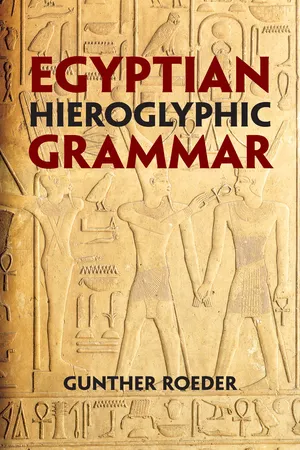
Written and spoken for about 4,000 years, Egyptian is no longer a living language (Arabic is the major language of modern Egypt); however, ancient Egyptian is still studied by Egyptologists, historians, archaeologists, and students interested in the age-old civilization along the Nile. Typically, students of ancient Egyptian begin with Middle, or Classical, Egyptian, which was written in hieroglyphic script. Middle Egyptian is especially important because it is the language in which many important literary works were written. Moreover, when it was no longer spoken, Middle Egyptian continued to be taught in temples and schools as a vehicle of literary and liturgical expression. This compact handbook, by a noted German Egyptologist, was specially designed for beginning students who wish to acquire enough basic knowledge to enable them to read the easier hieroglyphic texts. Toward that end, the author begins with a general discussion of Middle Egyptian and its script, followed by concise, accessible lessons in phonology, formation and usage of nouns and other parts of speech, and syntax. With careful study, the student should be able, even after the first lesson, to translate simple sentences independently. A list of hieroglyphs, a vocabulary section, and reading exercises complete this handy manual that offers students quick and easy access to the language and culture of ancient Egypt.
§ 1.EARLY PERIOD: Predynastic period and Dyn. 1–2. 4000–2000 B. C.
Primitive culture; beginning of the script.
§ 2.OLD KINGDOM: Dyn. 3–6 2900–2400 B. C.
Kings were buried in pyramids (in which are the “Pyramid texts”); rich private persons in Mastabas.
§ 3.MIDDLE KINGDOM: Dyn. 11–13 2200–1800 B. C.
Dynasty 12 is the period of classic literature and religion, Secular and religious texts were written on papyrus in hieratic, or engraved and painted in hieroglyphics on the walls of temples and private tombs and coffins.
§ 4.NEW KINGDOM: Dyn. 17–21 1600–1000 B. C.
The classic literature of the Middle Kingdom is further continued; gradually more and more elements from the vernacular penetrate into the classic language, and from the hieratic script pass into the hieroglyphics.
§ 5.LATE PERIOD: (Libyan, Nubian, and Persian supremacy): Dyn. 22–30 1000–332 B. C.
After the language and orthography had completely degenerated, there was a conscious return to antique words, forms, and writing; the “renaissance” was carried out by the kings of Sais, (“Saitic Period”).
§ 6.GRAECO-ROMAN PERIOD: since 332 B. C.
While in daily life a very slurred vernacular was used—written in the “demotic” script—the priests, studying the religious literature of all past epochs, placed their texts on the walls of the temples in mysterious reinterpreted hieroglyphics which none of the common people could read. The knowledge of the hieroglyphics died out with the last priests of the Egyptian gods, who in remote places served them until the fifth century A. D. The Greek language, which was spoken in Egypt since the last few centuries B. C., entirely replaced the native idiom in the first century A. D.
Nature of the language and Script,
§ 7.The Egyptian language is related to Semitic languages as well as to the Berber and East African Hamitic languages, and has connections, which are easily traceable, with each individual language of both these groups. The theory of the grafting of a Semitic on to an African language has lately been given up again. If this introduction associates itself closely with the Semitic languages, especially Hebrew, it does so only on superficial grounds: on the one hand, because the history of Semitic languages is better known to us than that of the African; and on the other, because the greater number of those who will use this book will be Semitic and theological students.
§ 8.The most important epochs in the development of the Egyptian language—only one of which is really taken into consideration by this introduction, namely, the classical language—are the following:
aTHE ANCIENT LANGUAGE: in the “Pyramid texts” (religious inscriptions of the Old Kingdom). Preserved almost entirely in the hieroglyphics.
bTHE CLASSICAL LANGUAGE: in the inscriptions and papyri of the Middle Kingdom; imitated in the official and religious inscriptions of all the following epochs; but became more and more intermingled with vernacular forms and words. They are written in hieroglyphics and hieratic.
cTHE VERNACULAR: in the earlier epochs only faintly traceable; generally used in daily intercourse and secular writings of the New Kingdom; written almost entirely in hieratic on papyrus. From this idiom the language of the Late Period was developed, which was written in demotic and used in official documents down to the Roman period.
COPTIC: spoken in Christian times, and also used for the translation of the Bible, etc. It is a development of the vernacular of earlier times, and is written with the Greek alphabet and native supplementary letters, and hence is known to us in vocalization also.
§ 9.The Egyptian language is written in three different styles of script, which in this introduction are always transposed into hieroglyphics, facing towards the left. All scripts render only the consonants, without considering the vowels.
aHIEROGLYPHICS: used in temples and tombs carved in stone and wood or painted in colours; facing usually towards the right, but sometimes, for decorative reasons, towards the left. The knowledge of them was confined to priests and scholars.
bHIERATIC: written on papyrus with a dried rush stem and black or red ink. The individual signs are written in more or less abbreviated form according to the hand-writing. They stand for hieroglyphs, and are always rendered in this introduction by hieroglyphs. They are written from right to left; but as hieroglyphics they are reversed in this introduction.
cDEMOTIC: an abbreviated script (brachygraph) of the Graeco-Roman period developed from the Hieratic; facing towards the right.
The Script.
§ 10.The hieroglyphic script originated in pictures of visible objects; a picture was drawn and the name of the represented object, or the act indicated thereby, was pronounced. For example
was written for
or “face”, or
for yar(t) “eye” and for words of “seeing”. Later on, these pictures were also used for words which happened to be composed of the same consonants as was those which made up their own name; thus
written also for
ir “upon” and for
ray “the upper”, likewise
was used for all forms of the verb “to make”, y...
Table of contents
Cover
Egyptian Hieroglyphic Grammar
Copyright Page
Dedication
Translators
Preface
Authors
Contents
Literature
Chronological Table §§ 1—6
Nature of the Language and of its Script §§ 7—9
Script §§ 10—19
Preliminary Survey §§ 20—28
Phonology §§ 29—34
Noun §§ 35—48
Pronoun §§ 49—59
Particles §§ 60—70
Verb §’§71—130
Syntax (The Sentence) §§ 131—141
List of Hieroglyphs
Vocabulary
Notes on the Beading Exercises
Index
Reading Exercises
Trusted by 375,005 students
Access to over 1.5 million titles for a fair monthly price.
Study more efficiently using our study tools.
Frequently asked questions
Yes, you can cancel anytime from the Subscription tab in your account settings on the Perlego website. Your subscription will stay active until the end of your current billing period. Learn how to cancel your subscription
No, books cannot be downloaded as external files, such as PDFs, for use outside of Perlego. However, you can download books within the Perlego app for offline reading on mobile or tablet. Learn how to download books offline
Perlego offers two plans: Essential and Complete
Essential is ideal for learners and professionals who enjoy exploring a wide range of subjects. Access the Essential Library with 800,000+ trusted titles and best-sellers across business, personal growth, and the humanities. Includes unlimited reading time and Standard Read Aloud voice.
Complete: Perfect for advanced learners and researchers needing full, unrestricted access. Unlock 1.5M+ books across hundreds of subjects, including academic and specialized titles. The Complete Plan also includes advanced features like Premium Read Aloud and Research Assistant.
Both plans are available with monthly, semester, or annual billing cycles.
We are an online textbook subscription service, where you can get access to an entire online library for less than the price of a single book per month. With over 1.5 million books across 990+ topics, we’ve got you covered! Learn about our mission
Look out for the read-aloud symbol on your next book to see if you can listen to it. The read-aloud tool reads text aloud for you, highlighting the text as it is being read. You can pause it, speed it up and slow it down. Learn more about Read Aloud
Yes! You can use the Perlego app on both iOS and Android devices to read anytime, anywhere — even offline. Perfect for commutes or when you’re on the go. Please note we cannot support devices running on iOS 13 and Android 7 or earlier. Learn more about using the app
Yes, you can access Egyptian Hieroglyphic Grammar by Gunther Roeder in PDF and/or ePUB format, as well as other popular books in Histoire & Histoire de l'Égypte antique. We have over 1.5 million books available in our catalogue for you to explore.