Composition
eBook - ePub

Composition

The Anatomy of Picture Making

  1. 48 pages
  2. English
  3. ePUB (mobile friendly)
  4. Available on iOS & Android
eBook - ePub

Composition

The Anatomy of Picture Making

About this book

Difficult to grasp and harder still to achieve, composition is a chief concern of artists at every level. This clear and focused introduction exposes the compositional devices that underlie successful artworks. Its many examples reduce pictures to their basic formal elements, offering a concise treatment of an oft-neglected topic.
Author Harry Sternberg, whose works appear in major museums throughout the United States, was a student and instructor at New York's prestigious Art Students League. He draws upon his extensive background as a teacher and professional to provide an approachable view of applying composition to graphic works. Novices and experienced artists alike will benefit from his well-illustrated explanations of handling such elements as the picture border, flat space, tensions, positive and negative space, geometric design, and volume, as well as the processes of analyzing pictures and communication through design.
Frequently asked questions

Yes, you can cancel anytime from the Subscription tab in your account settings on the Perlego website. Your subscription will stay active until the end of your current billing period. Learn how to cancel your subscription.
No, books cannot be downloaded as external files, such as PDFs, for use outside of Perlego. However, you can download books within the Perlego app for offline reading on mobile or tablet. Learn more here.
Perlego offers two plans: Essential and Complete
  • Essential is ideal for learners and professionals who enjoy exploring a wide range of subjects. Access the Essential Library with 800,000+ trusted titles and best-sellers across business, personal growth, and the humanities. Includes unlimited reading time and Standard Read Aloud voice.
  • Complete: Perfect for advanced learners and researchers needing full, unrestricted access. Unlock 1.4M+ books across hundreds of subjects, including academic and specialized titles. The Complete Plan also includes advanced features like Premium Read Aloud and Research Assistant.
Both plans are available with monthly, semester, or annual billing cycles.
We are an online textbook subscription service, where you can get access to an entire online library for less than the price of a single book per month. With over 1 million books across 1000+ topics, we’ve got you covered! Learn more here.
Look out for the read-aloud symbol on your next book to see if you can listen to it. The read-aloud tool reads text aloud for you, highlighting the text as it is being read. You can pause it, speed it up and slow it down. Learn more here.
Yes! You can use the Perlego app on both iOS or Android devices to read anytime, anywhere — even offline. Perfect for commutes or when you’re on the go.
Please note we cannot support devices running on iOS 13 and Android 7 or earlier. Learn more about using the app.
Yes, you can access Composition by Harry Sternberg in PDF and/or ePUB format, as well as other popular books in Art & Art Techniques. We have over one million books available in our catalogue for you to explore.

Information

eBook ISBN
9780486146133
Topic
Art

ANALYZING PICTURES

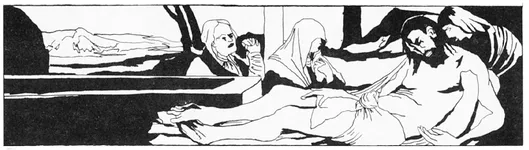
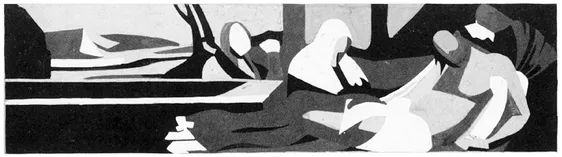
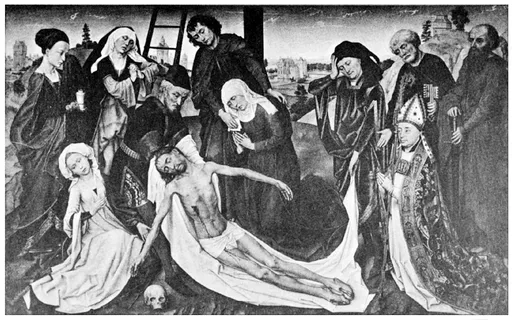
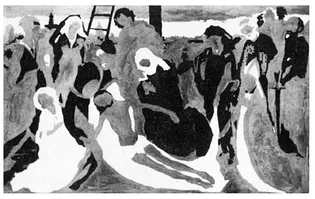
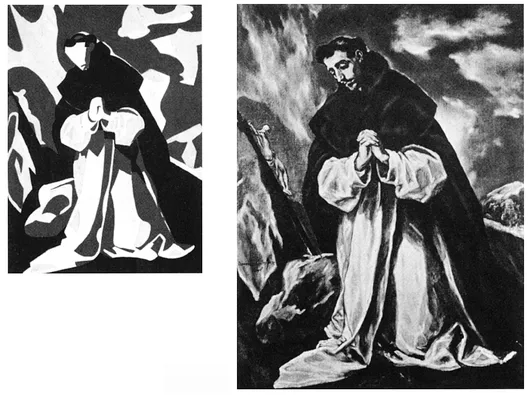
Analysis serves as a means of design dissection to bare the underlying structural elements in a picture.

When looking at a picture, we experience a complex set of visual experiences. The story, the symbols, the details, all the elements of the picture, interfere with seeing the design structure. These distractive elements must be pushed aside in order to observe the structure beneath. This can be accomplished by analysis.

All literary detail must be eliminated. Each object in the picture is then reduced to a basic shape. It is only then that the structural skeleton of the design can be seen. In this chapter various analytical means are discussed and demonstrated.
e9780486146133_i0070.webp
EL GRECO.
Kneeling Saint.
e9780486146133_i0071.webp
GRUNEWALD.
Altar Triptych.
Photo Courtesy of Metropolitan Museum of Art.
Analysis of Blacks.
e9780486146133_i0072.webp
Analysis of Blacks, Whites and Grays.
e9780486146133_i0073.webp
e9780486146133_i0074.webp
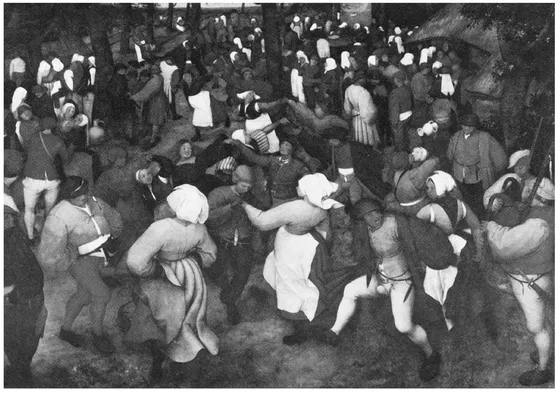
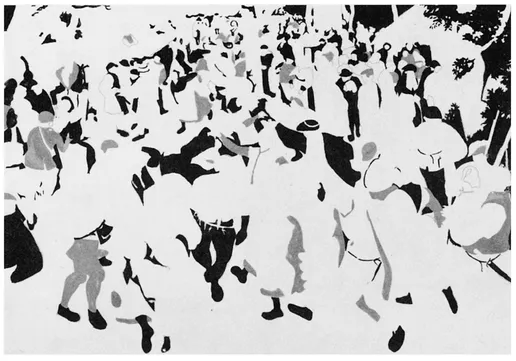
BREUGHEL.
Peasant Dance.
e9780486146133_i0075.webp
The analysis of the Breughel on the opposite page is particularly interesting because it gives evidence of the beautiful abstract design that underlies the literary communication. Note, in the analysis, the depth of spatial feeling resulting from diminishing the scale of the shapes as they recede. Breughel’s inventiveness in varying the size and activity of the shapes in the picture results in an exciting visual experience.
e9780486146133_i0076.webp
VAN DER WEYDEN.
Pieta.
Photo Courtesy of Metropolitan Museum of Art.
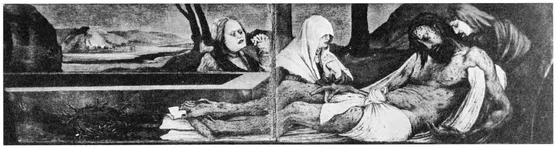
Analysis of Value Patterns.
e9780486146133_i0077.webp
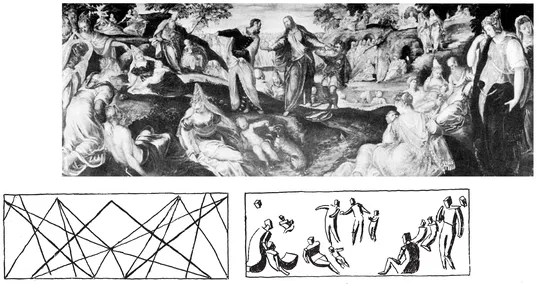
TINTORETTO.
Miracle of the Loaves and Fishes.
Metropolitan Museum of Art.
e9780486146133_i0078.webp
The use of the triangle as a basic design element was common to the Renaissance. The analysis of the Tintoretto at the left makes this quite evident.

The analysis to the right dissects the volume movements of some of the figures.
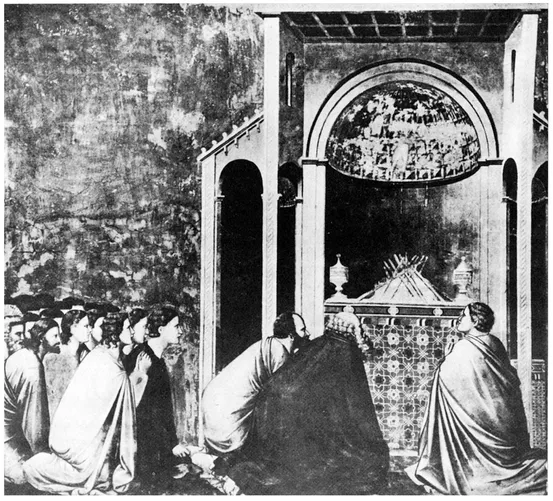
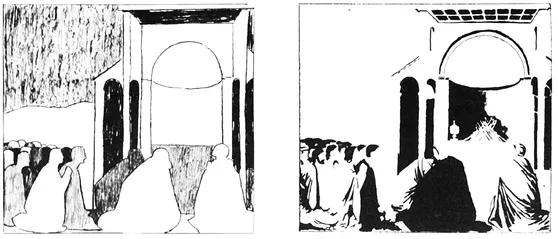
GIOTTO.
Detail.
e9780486146133_i0079.webp
e9780486146133_i0080.webp
The use of overlapping planes for spatial recession has been discussed in previous chapters. Giotto’s use of this principle is demonstrated in the first analysis.

His use of blacks to activate and unify the space is evident in the second analysis.
e9780486146133_i0081.webp
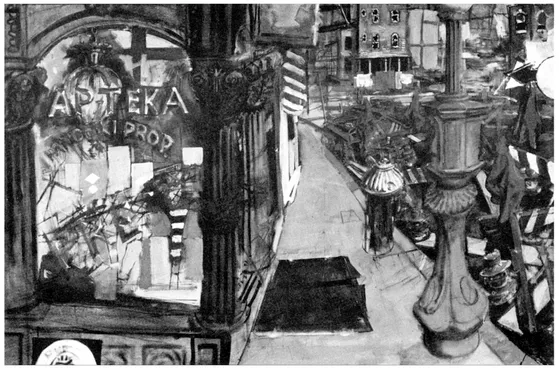
JACK LEVINE.
Apteka.
Collection of Dr. Michael Watter.
e9780486146133_i0082.webp
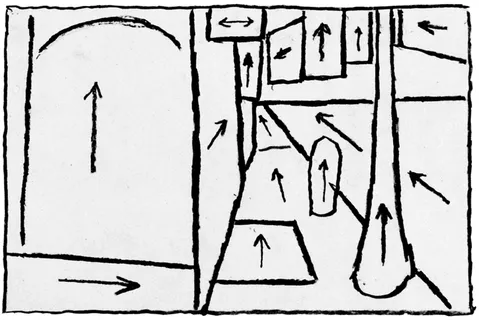
The design of the Levine painting is based on planes tilted into perspective. The planes are arranged so as to move swiftly and recessively, penetrating into deep space. The direction of the planes is indicated by the arrows.
e9780486146133_i0083.webp
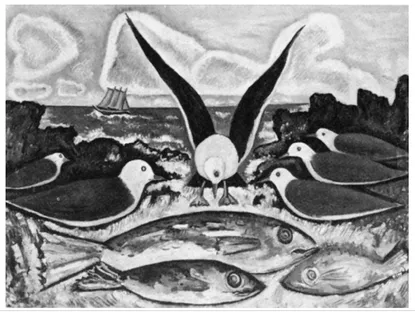
MARSDEN HARTLEY...

Table of contents

  1. Title Page
  2. Copyright Page
  3. Table of Contents
  4. Dedication
  5. INTRODUCTION
  6. COMPOSITION
  7. THE PICTURE BORDER
  8. FLAT OR SHALLOW SPACE
  9. POSITIVE AND NEGATIVE SPACE
  10. THE ACTIVITY OF SHAPES
  11. VALUES
  12. COMMUNICATION THROUGH DESIGN
  13. GEOMETRIC DESIGN: VOLUME
  14. ANALYZING PICTURES
  15. ACKNOWLEDGEMENTS