THE WALPOLE SOCIETY
DWIGHT BLANEY
MORGAN BULKELEY BRAINARD
JOSEPH DOWNS
HENRY FRANCIS DU PONT
HENRY WOOD ERVING
MANTLE FIELDING
HARRY HARKNESS FLAGLER
HOLLIS FRENCH
WILLIAM BROWNELL GOODWIN
R. T. HAINES HALSEY
NORMAN MORRISON ISHAM
J. FREDERICK KELLY
HENRY WATSON KENT
RUSSELL HAWES KETTELL
LUKE VINCENT LOCKWOOD
CHAUNCEY CUSHING NASH
WILLIAM DAVIS MILLER
JOHN HILL MORGAN
STEPHEN H. P. PELL
J. HALL PLEASANTS
FREDERICK BAYLEY PRATT
HERBERT LEE PRATT
GEORGE DUDLEY SEYMOUR
WILLIAM MITCHELL VAN WINKLE
ALEXANDER WILBOURNE WEDDELL
GEORGE PARKER WINSHIP
SAMUEL W. WOODHOUSE, JR.
JOHN MUNRO WOOLSEY
LAWRENCE COUNSELMAN WROTH
PREFACE
THE old architects or housewrights as well as the masons, the carpenters and the “joyners,” had a language of their own. Their successors have a good deal of it still, but they have lost many words and have, with the progress of the world, acquired possibly even more new ones.
The antiquary, the interested visitor to the museum or to our old houses and even the architect are sometimes at a loss for the meaning of these old words—the new do not often intrude. The question, “what is a summer?” is not unheard in Early American Rooms.
The Walpole Society, in following its declared purpose, “the pursuit, the acquisition, the enjoyment, the naming and the verification of things which may well be considered decently ancient, or charming, or beautiful—or all three,” has put forth already three Glossaries for Collectors—of Furniture, of Ceramics, and of Silver. It now follows these with a Glossary for the Collector of Old Houses.
This is not a general architectural dictionary—it knows nothing of Greek or Gothic as such. It intends to gather here and to define not only such terms of design and construction as may be needed by the visitor to Colonial Rooms or to old houses perhaps well known, perhaps by the wayside, but those curious words as well which are used in old contracts and in the old records whether of State, Church, or College, words which are not only venerable but of the greatest interest.
NORMAN MORRISON ISHAM
A GLOSSARY OF COLONIAL ARCHITECTURAL TERMS
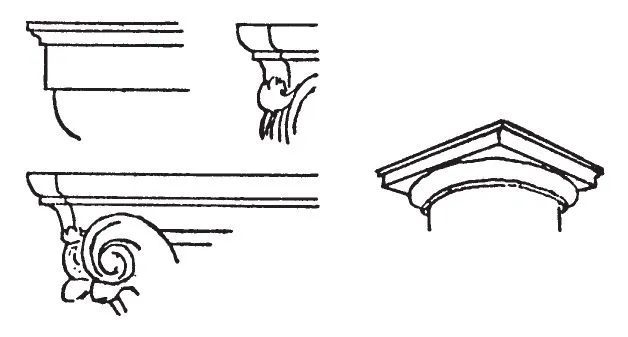
ABACUS. The crowning member of a capital, q. v. It varies with the order used.
ANCHOR. A bar of wrought iron fastened to the end of a beam and built into a brick or stone wall, or sometimes carried through the wall and secured by a cross-iron in the shape of an S.
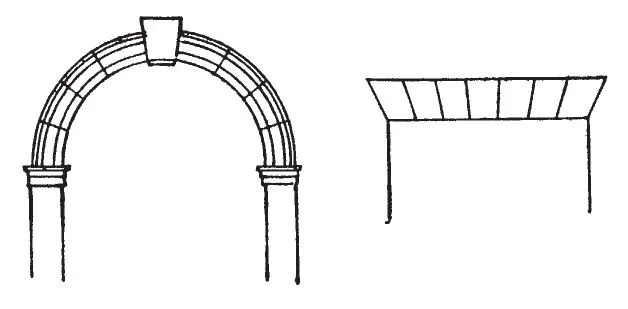
ARCH. An arrangement of radiating wedge-shaped stones or of brick with wedge-shaped joints which are set in the form of a curve, a half-circle, a segment or an ellipse, or even on a level line. The stones or bricks are called voussoirs, q. v. The word is used for the same forms when built up of wood.
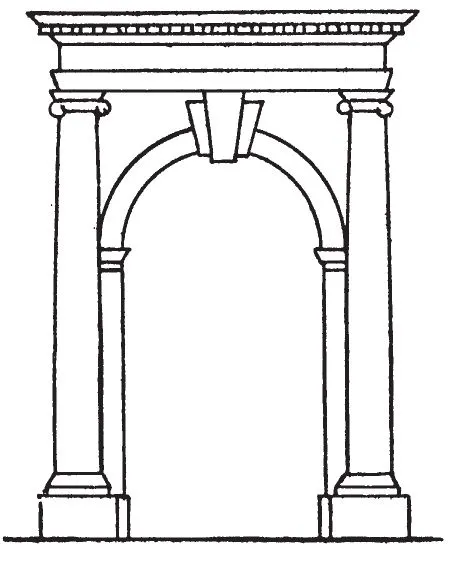
ARCH ORDER. An arch which has on the pier at either side an engaged column or a pilaster, q. v., carrying an entablature with or without a pediment. It is rare, but an analogous form is very common in wooden door frames in later work.
ARCHITRAVE. The lowest member of an entablature, q. v., resting on the abaci of the column capitals. Also used of both the horizontal and the vertical stone or wood trimming or casing around a square or rectangular opening.
ARCHIVOLT. The moulding of an architrave carried around the face of an arch, q. v.
ASHLAR. Stone cut square so that the exposed faces are rectangles. See Rustication.
ASTRAGAL. A small half round moulding. It generally has a fillet on one or both sides. See Bead, Neck Moulding.
ATTIC. A modern word for the garret.
BACK BAND. The outer moulding of a door or window casing, q. v.
BALUSTER. A turned or rectangular upright supporting a stair rail. It is set between this rail and the stair step, or the floor, or the top of a closed string. See Stair. Used also on the outside of a building.
BALUSTRADE. The combination of posts, rail and balusters of a stair, q. v., or of posts, bottom rail, top rail and balusters above a cornice on the outside of a building.
BAR. A small moulded piece of wood separating the panes of glass in a sash. It succeeded the lead calme or came, q. v.
BARGE BOARD. A false rafter set a little out from the clapboards of a gable. It protected the ends of the clapboards and concealed the underside of the roof board.
BASE. The moulded block of stone or wood on which a column, pilaster or pier directly rests. It stands upon a square block, the plinth. The mouldings vary with the order used. See Order.
BASE BOARD. A board of more or less width at the bottom of a wooden outside wall, or of a plastered inside wall.
BASE COURSE. An elaborately moulded base board or a stone course, plain or moulded, above the brick or stone underpinning. Moulded brick is often used.
BAT. A portion of a brick broken ...