"We are fortunate in having this minute compilation of cowboy lore." — Library Journal
"Quite likely the best book of its kind to appear . . . written by a veteran cowboy in colorful but explicit prose, and providing just about as complete a cow country manual as you could want. . . . A greenhorn could almost set up ranching by absorbing Mr. Fay's lore, and western fans will find this book a treasure-house of information." — Springfield Republican
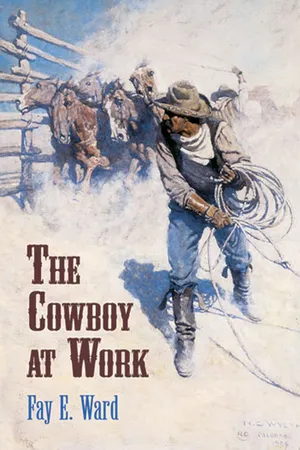
A self-described horse wrangler, bronc breaker, and rough-string rider for cow outfits from Canada to the Mexican border, old-time cowboy Fay Ward simply yet vividly describes every detail of the working cowhand's life and job.
Want to know how to throw a half-diamond hitch and wield a branding iron? How about learning how to trap wild mustangs and rig and use a saddle? Interested in the recipe for S. B. stew? This authoritative manual explains it all.
Illustrated with 600 drawings and diagrams by the author, this is a captivating and informative read for working cowboys, dude ranch wranglers, armchair bronc-busters, and anyone interested in cowboy life and lore.
- 304 pages
- English
- ePUB (mobile friendly)
- Available on iOS & Android
eBook - ePub
The Cowboy at Work
About this book
Information
1
EVOLUTION OF THE COWBOY
The evolution of the American cowboy and his equipment dates back to the Spanish conquest of Mexico in 1519 by Cortes and his conquistadors. The descendants of these same adventurous conquistadors settled in Mexico. Some of them became owners of large estates and were known as hacendados, and their extensive ranches were called haciendas. Eventually they drifted northward with their great herds of longhorn cattle and mustang horses and crossed the Rio Bravo, now called the Rio Grande.
The stock industry thrived and spread from Texas to California, and there naturally came into being a great number of stockmen who operated on a smaller scale than the hacendados. They were known as rancheros, or small ranch owners. The men who were employed to handle the range stock were known as vaqueros, meaning cowboys. The term “buckaroo” in common use in the West is derived from this Spanish word.
When Texas gained her independence in 1836, the American cowboy came into being. The Mexican ranchers abandoned their ranches and drifted muy pronto across the Rio Grande to avoid the wrath of the Tehanos. Even before the departure of the Mexican ranchers, and as early as the first Spanish settlements in Texas, a great many horses and a large number of cattle escaped and went wild in the brush. Since the Spaniards did not castrate their animals, these escaped horses and cattle multiplied rapidly, so that, together with the animals the Mexicans abandoned when they trekked back across the Border, the wild herds became incredibly numerous. The great number of horses and cattle running wild tempted many a buffalo hunter and Indian scout to go into the cattle business, for cattle and horses were to be had for the taking.
Naturally the Americans adopted the equipment and methods used by the Mexican rancheros and vaqueros. Therefore, the style of equipment used by the early-day buffalo hunters and scouts had its influence, to a certain extent, upon the outfits used by the old-time cowhand that followed. The illustrations on Plates 2 and 3 show the various stages of development of the cowhand’s equipment.
During the Civil War many of the ranchers and cowhands deserted the ranches and enlisted in the service of the Confederate army. As a consequence, the cattle and horses that were left to range unmolested increased to even greater numbers and ran wild over a vast territory. When the war was over, many of the former cowmen returned to their old occupation and with them came ex-soldiers, their friends and friends of their friends who saw that here was a great opportunity to build up independent stock businesses. When the northern trails were opened, the Texas cowhand came into his own. It is estimated that fully ninety per cent of the old-time Texas cowhands were former Confederate soldiers.
During the period from 1865 to 1895, the cowhand and his equipment changed materially. In California the Spanish methods and equipment retained their influence upon the outfits of the cowhand much longer than in any other part of the cow country north of the Mexican Border.
When the northern trails were closed, the northern cowhand became an important factor in the cattle businesses, and the equipment and methods he used were the result of Texas and California influences. But these influences, when fused with and then modified by conditions of climate and locale, produced a distinct type, as easily distinguishable and recognizable as its Texas or California counterparts.
However, Texas, California and Montana cowhands are the same kind of guys under the skin; they differ, actually, only in the style of their equipment and in the methods used in their work which are largely shaped by the kind of country they operate in and the sort of weather they have to face.
The species “cowhand” is no special breed of human; but he is a special type created by his special way of life. Perhaps, though, it does take a special kind of guy to choose to be a cowhand. The cowhand is possessed by a sort of pioneering spirit; he likes nature—that is, nature in the raw. He doesn’t mind taking a chance, win or lose. He can take it on the chin and keep coming back for more.
The cowhand and the stock range are as closely identified with each other as the cowhand and his horse. Anything written about the evolution of the cowboy assumes that the reader has some knowledge of the history of the cow country and the stock business. The author realizes that the short outline presented above does not cover the subject adequately. However, he hopes it will help in the understanding of the pages that follow which have, moreover, been made as self-explanatory as possible.
PLATE 2 Evolution of the Cowboy
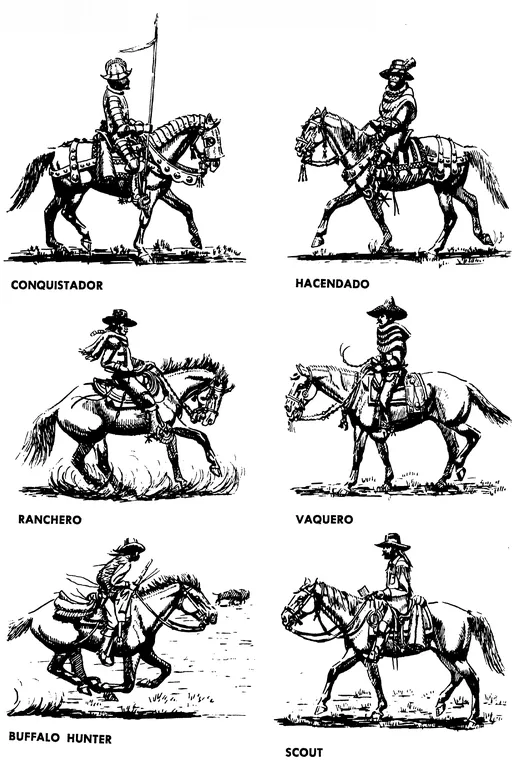
PLATE 3 Evolution of the Cowboy
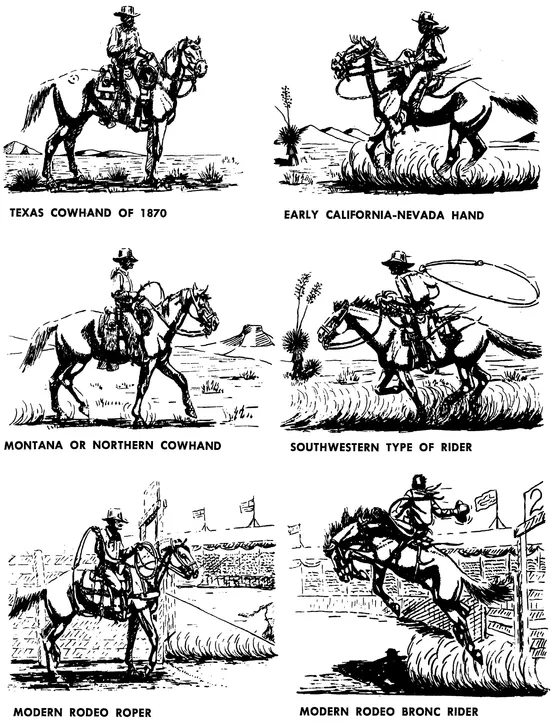
The professional rodeo1 hand is also a product of the cow country, generally speaking, and is of the same type as the average cowhand. As a rule he is a “top-hand” and was schooled in the actual work of riding and roping out where skyscrapers seldom grow. Because of the inducements offered in cash prizes to the winners of the various roping and riding events and the thrill of winning over the best men in the game, some of the finest riders and ropers have become professional rodeo contestants and have made history which will long be remembered. The rodeo or frontier-contest hand has become a popular figure wherever he is seen in action.
Rodeo work is highly specialized and every move that a contestant makes is carefully planned to save time. The equipment used is designed and arranged to promote speed and efficiency. The element of chance, which may stand between the rodeo artist and the winning of the contest, is far greater than in any other line of sport. And there are always many keen competitors for the prizes. Rodeo work is more dangerous, too, than any other sport at present featured before the American public.
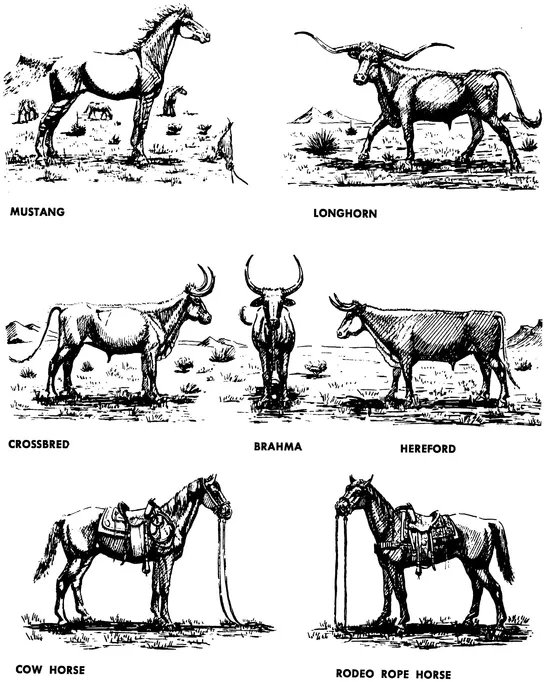
PLATE 4 Types of Range Stock
2
TYPES OF RANGE STOCK
The different breeds of horses and cattle which have been predominant in the cow country since the beginning of the stock industry are shown to some extent in the illustrations on Plate 4.
The mustang and the longhorn are of Spanish origin; they are the descendants of the cattle and horses which Cortes and the other conquistadors brought over from Spain 1519 (the date of the conquest of Mexico) and during the years that followed. The Spanish horse was of Moorish and Arabian origin. The original Arab strain had great endurance and certainly many of the Indian horses in the early 1800’s showed this quality. The cattle were for the most part of the Andalusian breed.
The mustang evolved from a process of inbreeding that went on among the horses that escaped from the Spaniards and lapsed into a wild state. Very few of them ever made good cow horses because they lacked the great stamina and endurance needed for cow work. Generally speaking, they were narrow-chested, light-boned and droop-rumped. This deterioration of the mustang can be ascribed to the fact that many of the best stallions were killed or badly injured in the fights between them during the mating season. What brought the wild mustangs of the Navajo country down in size more than anything else was probably the fact that they suffered from undernourishment. Also, the screwworm’s ravages contributed to the decimation of the best sires. So, for the most part, only the weaker specimens were left to propagate the species.
The Mexican horse, which is often referred to as the Spanish pony, and the Indian pony are descendants of the mustang; they are distinct breeds even though they have this common ancestry. Generally the Mexican or Spanish pony shows certain marked characteristics such as black stripes running down the length of the back and across the shoulders; frequently there are also black or dark-colored stripes or bars on the forelegs. The prevailing colorings are grulla (gru-ya), smoky blue or mouse color; palomina, a golden cream color; appalusa, a sort of bluish or red-roan color with spots of pure color juxtaposed in striking contrasts. Browns or buckskins are common colors, too. These Mexican or Spanish ponies are capable of great endurance and make good saddle horses.
The Indian pony is a decided improvement over the Mexican horse, both as to conformation and disposition. He is a blocky, well-proportioned horse, and because of the Indians’ partiality for the pinto (paint), this type of horse has, through selection, been widely propagated among Indian ponies. The colors of the “paint” are generally white and black or white and bay, each color in its purity, so that there is a strong contrast between them.
The modern range horse and cow horse is the result of crossbreeding the Mexican or Spanish pony mares with the saddle horse—Thoroughbred, standard-bred and purebred sires. In the northern sections of the cow country the breeding trend is toward a large-boned, blocky and clean-limbed type of horse. The Percheron sire is the type of horse used. In the southwest, the qualities mostly favored in a good cow horse are conformation, endurance and speed. The Thoroughbred and the quarter-horse types of sire are much in evidence.
The rodeo roping horse and the horses generally used for bulldogging purposes are of the quarter-horse type. They are very compact, clean-limbed and powerful. For short distances of up to one quarter of a mile, this type of horse has no equal for speed. This is a desirable quality for a roping horse.
The longhorn breed of cattle is also the outcome of inbreeding among the animals in their wild state. These cattle that escaped from the Spaniards were of Andalusian strain, the same breed that provides the famous bulls of the Spanish bull ring. Longhorns are of many colors, including appalusas, grullas, browns and duns, as well as blues and red-roans and blacks. They are among the sturdiest of all the cattle breeds; they can go farther to water and grass, and still thrive, than any other type of cattle to be found on the North American continent. The longhorn dominated the range until the late 19th century. By crossing the Durham and the Hereford with the longhorn, a crossbred type of range cattle was produced which proved to be a good “rustler” and a good beef producer. The crossbred cattle are high-horned and easier to handle than the longhorns.
The Texas Brahma is also a crossbred type of range critter. It has been experimented with in the coastal regions of south Texas and in some parts of the southwest. It is the result of a cross between the longhorn and the Brahma cattle of India, and the Hereford. Texas Brahmas are very thrifty and are immune to ticks. They are wild-natured and difficult to handle in rough country and, because of their color, they have been widely discriminated against by cattle buyers. The colors are mixtures of brown and light cream which have been hard to erase in crossbreeding, but a fixed, blood-red color has been obtained by a few breeders. They are high-withered, because of the hump on the Brahma, and they are also droop-rumped and droop-eared. Because of their wild disposition and their ability to jump high and crooked, they are used extensively in rodeos and frontier contests for riding purposes. Their horns curve vertically above their heads, which helps to give them a wild and scary expression.
The Hereford, or white-face, has become the standard breed of range cattle because of qualities which make for a better type of beef carcass and because of their general adaptability to range conditions in the different sections of the cow country. They are light-boned and lower in stature than the other types of cattle mentioned herein, and though they are not as thrifty as the other types, their color and uniformity are more important qualities.
3
RANCH WORK
A brief summary of the different kinds of work that a cowboy is called upon to do in different seasons of the year, in the north and in the south, is outlined in the following paragraphs.
Northern ranch work: In the spring, riding bog is the job of keeping weak stock pulled out of the mud or bog holes. Stock which has become weak by springtime, especially the old cows, is easily bogged down. While crowding around some small water hole, weak stock is often knocked down by the stronger animals and is not able to get up. It is then necessary to pull em out at the end of a catch rope. The best way to pull a bogged critter out of a hole is to pitch a loop over its horns—not around its neck—and then pull it straight out on its back. This is better than to try to pull the animal out sideways or straight ahead with its legs under it. It is often necessary, if the animal has been bogged down for some time, for the rider to wade in and pull the critter’s legs out of the mud before a horse can haul it out. Once the critter is out, it is generally necessary for the rider to tail the animal up (pull it up by the tail) to get it on its feet. Generally, once it is standing, it will try to turn and charge its rescuer. By watching his chance, the rider can get away from the critter by going off directly behind it. Sometimes it is necessary for two riders to lift an animal to its feet; one gets ahold of its horns and the other gets a tail hold. The man in front makes his getaway while the man behind holds the critter back. When the front man is safe, the other man high-tails it for his horse which is off at a safe distance where the steer can’t easily charge him right away, and so both hands escape the irate animal.
Gathering weak stock is another job which the cowhand is often required to do in early spring when feed is scarce and it is necessary to feed the animals. Cows with early calves often need feeding to keep ‘em going and those that have been weakened from being bogged down have to be gathered and fed. Weak stock has to be handled easy. Give ’em plenty of time and don’t crowd ’em and then they will travel better.
Cleaning out water holes is sometimes necessary, though not often. A team and slip (scraper) are generally used to do the work which may take as much as a week, or only a day, depending on the country and the water supply.
Riding fence is sometimes part of the job of working for a barbwire outfit. Here is where a pair of wire-plyers takes the place of a six-shooter.
Breaking horses is generally done by a professional bronc snapper, but often a cowhand breaks out three or four head that look good to him for his own personal use; these horses he is then allowed to ride as part of his string. Young horses are generally easily broken. If plenty of time is taken in handling them and they are given good treatment, they will seldom make a jump. Details on breaking horses are given in another chapter of this work.
Calf work is spring wagon work (...
Table of contents
- Title Page
- Copyright Page
- Dedication
- FOREWORD
- ACKNOWLEDGMENTS
- Table of Contents
- 1 - EVOLUTION OF THE COWBOY
- 2 - TYPES OF RANGE STOCK
- 3 - RANCH WORK
- 4 - ROUNDUP WORK
- 5 - ROUNDUP PERSONNEL
- 6 - ROUNDUP EQUIPMENT
- 7 - COW CAMP CHUCK
- 8 - THE COWHAND’S BED
- 9 - PACKS AND PACKING
- 10 - HOW A BRANDING CREW WORKS
- 11 - BRANDS AND MARKS
- 12 - HOW BRANDS AND MARKS ARE WORKED
- 13 - WORKING WILD STOCK
- 14 - MUSTANGING
- 15 - BRONC BUSTING
- 16 - HACKAMORES
- 17 - EDUCATING THE COW HORSE
- 18 - ROPES AND ROPING
- 19 - BRIDLE HEADSTALLS AND BRIDLE BITS
- 20 - SADDLES
- 21 - TREES AND RIGGINGS
- 22 - HORNS AND FORKS
- 23 - CINCHES
- 24 - STIRRUPS AND TAPADEROS
- 25 - CHAPARRERAS, OR CHAPS
- 26 - SPURS AND SPUR STRAPS
- 27 - COWBOY BOOTS AND HATS
- 28 - COWBOY GARB AND MISCELLANEOUS EQUIPMENT
- 29 - COWBOY JEWELRY
- 30 - WORKING RAWHIDE AND LEATHER— ROPE KNOTS— HOBBLES
- 31 - BUILDING A QUIRT
- 32 - GUNS AND EQUIPMENT
- INDEX
Trusted by 375,005 students
Access to over 1.5 million titles for a fair monthly price.
Study more efficiently using our study tools.
Frequently asked questions
Yes, you can cancel anytime from the Subscription tab in your account settings on the Perlego website. Your subscription will stay active until the end of your current billing period. Learn how to cancel your subscription
No, books cannot be downloaded as external files, such as PDFs, for use outside of Perlego. However, you can download books within the Perlego app for offline reading on mobile or tablet. Learn how to download books offline
We are an online textbook subscription service, where you can get access to an entire online library for less than the price of a single book per month. With over 1.5 million books across 990+ topics, we’ve got you covered! Learn about our mission
Look out for the read-aloud symbol on your next book to see if you can listen to it. The read-aloud tool reads text aloud for you, highlighting the text as it is being read. You can pause it, speed it up and slow it down. Learn more about Read Aloud
Yes! You can use the Perlego app on both iOS and Android devices to read anytime, anywhere — even offline. Perfect for commutes or when you’re on the go.
Please note we cannot support devices running on iOS 13 and Android 7 or earlier. Learn more about using the app
Please note we cannot support devices running on iOS 13 and Android 7 or earlier. Learn more about using the app
Yes, you can access The Cowboy at Work by Fay E. Ward in PDF and/or ePUB format, as well as other popular books in History & North American History. We have over 1.5 million books available in our catalogue for you to explore.