- 288 pages
- English
- ePUB (mobile friendly)
- Available on iOS & Android
eBook - ePub
Elementary Wave Optics
About this book
This undergraduate textbook presents thorough coverage of the standard topics of classical optics and optical instrument design; it also offers significant details regarding the concepts of modern optics. Its survey of the mathematical tools of optics grants students insights into the physical principles of quantum mechanics.
Two principal concepts occur throughout: a treatment of scattering from real scatterers (leading to Huygens’ principles, diffraction theory, the index of refraction, and related topics); and the difference between coherent and noncoherent wave phenomena. Examinations of superimposition of field amplitudes and detection of intensities recur throughout the book.
This highly physical approach is augmented by extensive appendixes of mathematical details. Two sets of problems appear at the end of each chapter and form a crucial part of the exposition. One set consists of well-tested problems with detailed solutions, paired with similar problems without supplied solutions. The other set contains short, easier exercises, filling the more conventional role of end-of-chapter problems.
Two principal concepts occur throughout: a treatment of scattering from real scatterers (leading to Huygens’ principles, diffraction theory, the index of refraction, and related topics); and the difference between coherent and noncoherent wave phenomena. Examinations of superimposition of field amplitudes and detection of intensities recur throughout the book.
This highly physical approach is augmented by extensive appendixes of mathematical details. Two sets of problems appear at the end of each chapter and form a crucial part of the exposition. One set consists of well-tested problems with detailed solutions, paired with similar problems without supplied solutions. The other set contains short, easier exercises, filling the more conventional role of end-of-chapter problems.
Frequently asked questions
Yes, you can cancel anytime from the Subscription tab in your account settings on the Perlego website. Your subscription will stay active until the end of your current billing period. Learn how to cancel your subscription.
No, books cannot be downloaded as external files, such as PDFs, for use outside of Perlego. However, you can download books within the Perlego app for offline reading on mobile or tablet. Learn more here.
Perlego offers two plans: Essential and Complete
- Essential is ideal for learners and professionals who enjoy exploring a wide range of subjects. Access the Essential Library with 800,000+ trusted titles and best-sellers across business, personal growth, and the humanities. Includes unlimited reading time and Standard Read Aloud voice.
- Complete: Perfect for advanced learners and researchers needing full, unrestricted access. Unlock 1.4M+ books across hundreds of subjects, including academic and specialized titles. The Complete Plan also includes advanced features like Premium Read Aloud and Research Assistant.
We are an online textbook subscription service, where you can get access to an entire online library for less than the price of a single book per month. With over 1 million books across 1000+ topics, weâve got you covered! Learn more here.
Look out for the read-aloud symbol on your next book to see if you can listen to it. The read-aloud tool reads text aloud for you, highlighting the text as it is being read. You can pause it, speed it up and slow it down. Learn more here.
Yes! You can use the Perlego app on both iOS or Android devices to read anytime, anywhere â even offline. Perfect for commutes or when youâre on the go.
Please note we cannot support devices running on iOS 13 and Android 7 or earlier. Learn more about using the app.
Yes, you can access Elementary Wave Optics by Robert H. Webb in PDF and/or ePUB format, as well as other popular books in Physical Sciences & Optics & Light. We have over one million books available in our catalogue for you to explore.
Information
1
Geometrical optics: summary
Geometrical optics deals with light (and more generally with waves) in situations where it is possible to ignore the wave character of the phenomenon. This usually means that the wavelengths involved are very much smaller than the dimensions of anything with which the waves interact. Later we will see that geometrical optics is a limiting case of wave optics. The usual value in limiting cases is their simplicity, and geometrical optics shares this asset, with reservations.
All of geometrical optics may be deduced from three simple empirical rules:
1. Light travels in straight lines in homogeneous media.
2. The angle at which light is reflected from a surface is equal to the angle at which it is incident.
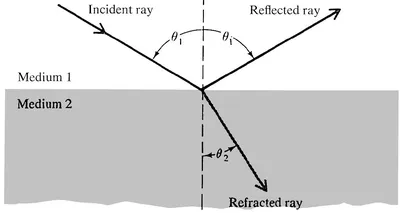
3. When light passes from one medium to another, its path is described by the equation n1 sin θ1 = n2 sin θ2.
Figure 1.1 summarizes these rules and defines the various angles. A â ray â is a line along the path the light follows. We think of this as a very narrow beam of light.

Figure 1.1: Reflection and refraction.
We may regard rule 3, which describes refraction, as defining the relative index of refraction: n2/n1.
If we follow custom and define the index of vacuum to be nvac = 1, then n1 and n2 are the indices of each medium relative to vacuum, and are so listed in handbooks. Later we will see that this ability to characterize each medium by a single number is extremely important. Among other consequences, it will lead us to regard nk as the ratio of the speed of light in vacuum (c) to (ck), the speed of light in medium k: nk = c/ck . This in turn allows us to deduce the three rules from the more general Fermatâs principle. The main asset of this principle is the esthetic one of unification. It is not essential to the conclusions of geometrical optics, although occasional simplifications are possible. But the three rules suffice.
A further statement limits the kinds of media usually considered. This is the reciprocity principle, which requires that if light can follow a certain path from A to B, then it can follow the same path from B to A. Some media do not support this principle, but they seldom occur in questions pertaining to geometrical optics.
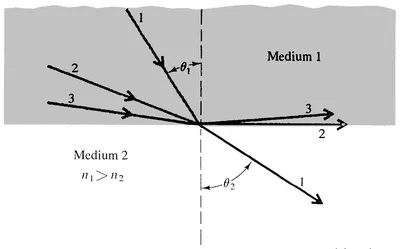
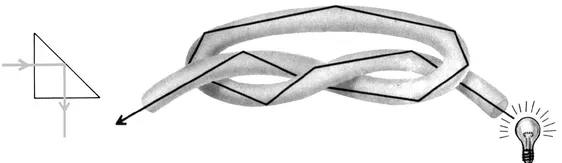
If we apply our rules directly to plane surfaces, they describe the behavior of mirrors and prisms (1.1â1.3)1. Rule 3 also predicts the phenomenon of total internal reflection. When light passes from a medium with a larger index to one with a smaller index (as, for instance, from glass to air), the ray is bent toward the surface. That is, θ2 > θ1. Eventually, the ray emerging from the âdenserâ medium (the one with larger index) lies parallel to the surface. This occurs at the critical angle: n1 sin θc = n2 sin(90°) = n2. If θ1 is bigger than θc, no light emerges. In this case, all incident light is contained in the reflected ray so that, from inside, the surface appears to be a perfect mirror. Such mirrors are important in various optical instruments. Familiar examples are the right-angle prisms in binoculars and the light pipes which illumine hard-to-reach places.

Figure 1.2: Total internal reflection.

Figure 1.3: Applications of total internal reflection.
Notice that all light incident from the outside of a totally reflecting surface will enter the surface, but it will not reach the region for which θ1 > θc. (1.4)
In applying rule 3, we find a new empirical fact: n is different for different colors of light. Later we will study the source of this dispersion in some detail, but in geometrical optics we merely use it, for example, when we separate colors with a prism. Or, we may compensate for it, as in making achromatic lenses of two kinds of glass, in which the dispersion of one compensates for that of the other. (1.5)
Rule 2 for reflection governs the behavior of instruments with curved mirrors, such as the astronomical telescope. Since the manipulation is similar to that of lenses, we can summarize the operations of the two devices together.
A...
Table of contents
- Title Page
- Copyright Page
- Table of Contents
- Preface
- 1 - Geometrical optics: summary
- 2 - Waves: description
- 3 - Superposition: reflection, standing waves, group velocity
- 4 - Electromagnetic waves, energy and momentum, doppler effect
- 5 - Scattering: index of refraction
- 6 - Polarized light
- 7 - Interference
- 8 - Interference from two sources
- 9 - Interference from many sources
- 10 - Multiple images: Interference of light from an extended source
- 11 - Diffraction
- 12 - Modern optics
- Appendix A: - Miscellaneous mathematical notes
- Appendix B: - Derivation of the wave equation
- Appendix C: - String
- Appendix D: - Summary on electricity and magnetismâderivation of electromagnetic wave equation
- Appendix E: - Resonance
- Appendix F: - Index of refractionâmacroscopic approach
- Appendix G: - Fresnel diffraction
- Appendix H: - Fourier transforms
- Bibliography
- Solutions to selected problems
- Index