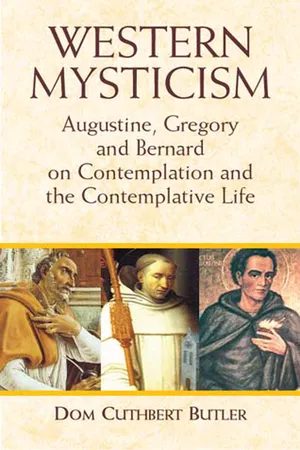
eBook - ePub
Western Mysticism
Augustine, Gregory, and Bernard on Contemplation and the Contemplative Life
- 304 pages
- English
- ePUB (mobile friendly)
- Available on iOS & Android
eBook - ePub
Western Mysticism
Augustine, Gregory, and Bernard on Contemplation and the Contemplative Life
About this book
A growing number of readers are seeking to incorporate the contemplative in their busy lives, and this volume offers them expert advice. Drawn from the works of Saint Augustine, Saint Gregory and Saint Bernard, the writings form a coordinated body of doctrine by three of Western culture's most revered teachers of mystical theology. In addition to accounts of the writers' own religious experiences and their related theories, the book discusses speculative contemplation, defines mysticism and characteristics of Western mysticism, and contrasts contemplative and active lives. Filled with valuable suggestions and insights into the spiritual condition, this volume is a must for all students of mysticism.
Information
Topic
PhilosophySubtopic
MysticismPART I: SPECULATIVE
CONTEMPLATION
PROLOGUE
WHAT MYSTICISM IS
THE writings of the mystics may be studied from three distinct points of view:
- They may be read for the sake of their religious philosophy and their theology.
- Or they may be taken as affording material for the study of that branch of modern psychology called Psycho-physiology, the borderland between mind and body, which investigates such phenomena as auto-suggestion, auto-hypnotism, ecstasy and trance, and such-like frequent psycho-physical concomitants of higher states of prayer.
- And lastly, they may be studied for the sake of their mysticism itself, as a religious experience.
Each one of these aspects of the writings of the great mystics has its own interest and its own value, recognizedly of a high order; but in the following pages the last-named of these objects of study is the one predominantly pursued. The purpose of this book is to set forth, in their own words, as a co-ordinated body of doctrine, what three great teachers of mystical theology in the Western Church have left on record concerning their own religious experience, and the theories they based on it.
It is incumbent on anyone writing a book on Mysticism to make plain at the outset the meaning to be attached to the word. There is probably no more misused word in these our days than ‘mysticism’. It has come to be applied to many things of many kinds: to theosophy and Christian science; to spiritualism and clairvoyance; to demonology and witchcraft; to occultism and magic; to weird psychical experiences, if only they have some religious colour; to revelations and visions; to other-worldliness, or even mere dreaminess and impracticability in the affairs of life; to poetry and painting and music of which the motif is unobvious and vague. It has been identified with the attitude of the religious mind that cares not for dogma or doctrine, for church or sacraments; it has been identified also with a certain outlook on the world—a seeing God in nature, and recognizing that the material creation in various ways symbolizes spiritual realities: a beautiful and true conception, and one that was dear to St Francis of Assisi, but which is not mysticism according to its historical meaning. And, on the other side, the meaning of the term has been watered down: it has been said that the love of God is mysticism;76 or that mysticism is only the Christian life lived on a high level; 77 or that it is Roman Catholic piety in extreme form. 78
Against all this stands the perfectly clear traditional historical meaning, handed down in the Christian Church throughout the centuries, not subject to confusion of thought until recent times.
Here it is necessary to explain that in the Latin Church the word used was not ‘mysticism’, but ‘contemplation’. The word ‘mystic’ was originally used in connexion with the Greek mysteries, as the Eleusinian. The Christian use of the word is due to the writer now known as pseudo-Dionysius, probably of the fifth century, who gave the title ‘Mystical Theology’ to the little treatise that was the first formulation of a doctrine on the subject. Though this treatise was at an early date translated into Latin and became well known in the West the old word ‘contemplation’ held its ground, so that ‘mystical’ did not become current until the later Middle Ages, and ‘mysticism’ is a quite modern word. Consequently, ‘contemplation’ is the word that will be met with in St Augustine, St Gregory, and St Bernard, to designate what is now commonly called ‘the mystical experience.’
The claim consistently and unequivocally made by the whole line of great mystics found, perhaps, its simplest and most arresting expression in these words of St Augustine: ‘My mind in the flash of a trembling glance came to Absolute Being—That Which Is.’79 This claim, as uttered by Augustine, has been recognized as the claim of the mystics, and has been formulated by recent writers of various schools of thought in such ways as these:
A (conscious) direct contact of the soul with Transcendental Reality.
A direct and objective intellectual intuition of Transcendental Reality.
The establishing conscious relation with the Absolute.
The soul’s possible union in this life with Absolute Reality.80
These definitions or descriptions are couched in the terminology of metaphysics; for the Christian and the Theist, ‘The Absolute’, ‘Absolute Being’, ‘Absolute Reality’, ‘Transcendental Reality’, are God. And so the mystic’s claim is expressed by Christian mystics as ‘the experimental perception of God’s Presence and Being,’ and especially ‘union with God’—a union, that is, not merely psychological, in conforming the will to God’s Will, but, it may be said, ontological of the soul with God, spirit with Spirit. And they declare that the experience is a momentary foretaste of the bliss of heaven.
This claim of the mystics will be illustrated by a selection of passages from representative Catholic mystics. The passages are chosen not as depicting the effects of the experience on the soul, but as stating the mystics’ belief as to what took place; they are chosen for the sake of the objective, not the subjective, information they purport to give, and they all may be taken as autobiographical, describing the personal experience of the writer.
It is well to warn the reader that much of the language used will appear hardly intelligible, and may even give rise to doubts as to the mental balance of some of the writers. It has to be asserted strongly that the great mystics were not religiously mad; nor were they pious dreamers: far from it—they were, most of them, peculiarly sane and strong men and women, who have left their mark, many of them, for good in history. The obscurity and apparent extravagance of their language is due to their courage in struggling with the barriers and limitations of human thought and language in order to describe in some fashion what they experienced in the height of the mystic state. The same explanation is to be given of any seeming pantheistic tendency in their language when attempting to describe their union with God; no matter what the terms may be in which they speak of the transformation of the soul or its absorption in God, the Catholic mystics are insistent in asserting that the soul retains its own individuality and full personality in the unions either of this life or of eternity.
It is to be understood that there are phases and stages of mysticism that fall short of the supreme experiences laid claim to in the following extracts. But for the sake of a clear understanding of the nature of mysticism, and of the problems that encircle it, it is essential that its claim be made to stand out distinctly in all the naked daring of its most extreme expression. Only so shall we know what we are really talking about. In this way, too, we shall know, not other people’s ideas about mysticism, but what the mystics themselves thought it to be.
PSEUDO-DIONY‘SIUS (Cent. V.)
Do thou, in the intent practice of mystic contemplation, leave behind the senses and the operations of the intellect, and all things that the senses or the intellect can perceive, and all things which are not and things which are, and strain upwards in unknowing, as far as may be, towards the union with Him Who is above all being and knowledge. For by unceasing and absolute withdrawal from thyself and all things in purity, abandoning all and set free from all, thou wilt be borne up to the ray of the divine Darkness that surpasseth all being (Mystical Theology, i.).
Unto this Darkness which is beyond Light we pray that we may come, and through loss of sight and knowledge may see and know That Which transcends sight and knowledge, by the very fact of not seeing and knowing; for this is real sight and knowledge (ibid. ii.).
(The mind) enters into the really mystic Darkness of Unknowing wherein it renounces all the perceptions of the understanding, and abides in That Which is wholly intangible and invisible, belonging wholly to Him that is beyond all, through being by inactivity of all cognition united in its highest part to Him Who is wholly unknowable, and by knowing nothing knows in a manner that is above understanding (ibid. i. fin.).
The divine Darkness is the unapproachable light in which God is said to dwell; ... in this everyone enters who is found worthy to know and to see God by not knowing or seeing Him, really being in Him Who is above sight and knowledge (Letter v.).
Besides the knowledge of God obtained by processes of philosophical and theological speculation, ‘there is that most divine knowledge of God which takes place through ignorance, in the union which is above intelligence, when the intellect, quitting all things that are, and then leaving itself also, is united to the superlucent rays, being illuminated thence and therein by the unsearchable depth of wisdom’ (de div. Nom. vii. 3).
‘Dionysius,’ as the Father of scientific Mystical Theology, is rightly given the first place. Augustine, Gregory, Bernard might come next, but their witness is to be found abundantly in what follows, and need not be anticipated in this place. The two latter speak for the early Middle Ages, the ‘Benedictine Centuries’; so we pass on to the later period, beginning with a younger contemporary of St. Bernard.
RICHARD OF ST VICTOR, Canon Regular of St Augustine, died 1173
The third grade of love is when the mind of man is rapt into the abyss of the divine light, so that, utterly oblivious of all exterior things (exteriorum?), it knows not itself and passes wholly into its God. And so in this state is held in check and lulled to deep sleep the crowd of carnal desires. In this state, while the mind is alienated from itself, while it is rapt unto the secret closet of the divine privacy, while it is on all sides encircled by the conflagration of divine love, and is intimately penetrated and set on fire through and through, it strips off self and puts on a certain divine condition, and being configured to the beauty gazed upon, it passes into a new kind of glory (de IV Gradibus Violentae Caritatis, Migne, Patr. Lat. cxvi. 1220).
S’T THOMAS AQUINAS, Dominican, died 1274 (This section I owe to Dom. John Chapman)
St Thomas in de Veritate, quaest. xviii. 1, distinguishes three ways of knowing God: (1) In the state after the Fall we need a kind of mirror in which to see a likeness of God, for we know Him only through His creatures. (2) But in the state of innocence this means was not needed, but only a means which was a kind of species of the thing seen, because God was seen by a spiritual light, flowing upon man’s mind from the divinity, which was an express likeness of the uncreated Light. (3) But in heaven not even this means is necessary, but God’s own Essence is the means by which It is seen. But St Thomas adds that the second kind of knowledge is still given to man: in contemplation, God is seen by a means which is the Light of Wisdom, which uplifts the soul to perceive the Divine, but not so that the divine Essence be immediately seen (as in heaven); and in this fashion by grace It is seen by the contemplative after the state of sin, though this took place in the state of innocence with greater perfection (ibid. ad 4).
This ‘Light of Wisdom’ is the first of the seven gifts of the Holy Ghost (Comm. in Sent. III. dist. xxxv. qu. ii. art. 1, sol. 1): ‘the gift of Wisdom goes forward to a (so to speak) deiform and (as it were) explicit contemplation of the articles which Faith holds after a human manner (as it were) under a veil.’ And so also the second gift: ‘If the mind be so far uplifted by a supernatural Light that it is introduced to the perception of spiritual things themselves, this is above human measure; and it is caused by the gift of Understanding’ (ibid. art. 2, sol. 1).
NOTE.—St Thomas teaches that these are not the ordinary effects of the gifts of the Holy Ghost, which are all infused at Baptism, and are necessarily present in all Christians who are not in mortal sin; but they represent a higher stage, and belong to the gratiae gratis dalae spoken of by St Paul in i Cor. xii (Summa Theol. 22ae, qu. xlv. art. 5). But the gift of Understanding is always a ‘supernatural light’ (Summa Theol. 22ae, qu. viii. art. 1); it is compatible with Faith, for it is at best an imperfect ‘understanding’ in this life.
‘THE CLOUD OF UNKNOWING’. (An anonymous English treatise of 14th century)
For at the first time when thou dost [this work], thou findest but a darkness, and as it were a cloud of unkowing, thou knowest not what, saving that thou feelest in thy will a naked intent unto God. This darkness and this cloud is, howsoever thou dost, betwixt thee and thy God, and telleth thee that thou mayest neither see Him clearly by light of understanding in thy reason, nor feel Him in sweetness of love in thine affection. And therefore shape thee to bide in this darkness as long as thou mayest, evermore crying after Him that thou lovest. For if ever thou shalt feel Him or see Him, as it may be here, it behoveth always to be in this cloud in this darkness. And if thou wilt busily travail as I bid thee, I trust in His mercy that thou shalt come thereto.
Then will He sometimes peradventure send out a beam of ghostly light, piercing this cloud of unknowing that is betwixt thee and Him; and shew thee some of His privity, the which man may not, nor cannot speak. Then shalt thou feel thine affection inflamed with the fire of His love, far more than I can tell thee, or may or will at this time. For of that work, that falleth only to God, dare I not take upon me to speak with my blabbering fleshly tongue: and shortly to say, although I durst I would do not (cc. 3 and 26).
BLESSED JOHN RUYSBROECK, Canon Regular of St Augustine, died 1381
In this storm of love two spirits strive together: the Spirit of God and our own spirit. God, through the Holy Ghost, inclines Himself towards us; and thereby we are touched in love. And our spirit, by God’s working and by the power of love, presses and inclines itself into God; and thereby God is touched. From these two contacts there arises the strife of love, at the very deeps of this meeting; and in that most inward and ardent encounter each spirit is deeply wounded by love. These two spirits, that is, our own spirit and the Spirit of God, sparkle and shine one into the other, and each shows to the other its face. This makes each of the spirits yearn for the other in love. Each demands of the other all that it is; and each offers to the other all that it is, and invites it to all that it is. This makes the lovers...
Table of contents
- Title Page
- Bibliographical Note
- Copyright Page
- Table of Contents
- PREFACE
- AFTERTHOUGHTS
- PART I: SPECULATIVE - CONTEMPLATION
- PART II: PRACTICAL - THE CONTEMPLATIVE AND ACTIVE LIVES
- APPENDIX
Trusted by 375,005 students
Access to over 1.5 million titles for a fair monthly price.
Study more efficiently using our study tools.
Frequently asked questions
Yes, you can cancel anytime from the Subscription tab in your account settings on the Perlego website. Your subscription will stay active until the end of your current billing period. Learn how to cancel your subscription
No, books cannot be downloaded as external files, such as PDFs, for use outside of Perlego. However, you can download books within the Perlego app for offline reading on mobile or tablet. Learn how to download books offline
Perlego offers two plans: Essential and Complete
- Essential is ideal for learners and professionals who enjoy exploring a wide range of subjects. Access the Essential Library with 800,000+ trusted titles and best-sellers across business, personal growth, and the humanities. Includes unlimited reading time and Standard Read Aloud voice.
- Complete: Perfect for advanced learners and researchers needing full, unrestricted access. Unlock 1.5M+ books across hundreds of subjects, including academic and specialized titles. The Complete Plan also includes advanced features like Premium Read Aloud and Research Assistant.
We are an online textbook subscription service, where you can get access to an entire online library for less than the price of a single book per month. With over 1.5 million books across 990+ topics, we’ve got you covered! Learn about our mission
Look out for the read-aloud symbol on your next book to see if you can listen to it. The read-aloud tool reads text aloud for you, highlighting the text as it is being read. You can pause it, speed it up and slow it down. Learn more about Read Aloud
Yes! You can use the Perlego app on both iOS and Android devices to read anytime, anywhere — even offline. Perfect for commutes or when you’re on the go.
Please note we cannot support devices running on iOS 13 and Android 7 or earlier. Learn more about using the app
Please note we cannot support devices running on iOS 13 and Android 7 or earlier. Learn more about using the app
Yes, you can access Western Mysticism by Dom Cuthbert Butler in PDF and/or ePUB format, as well as other popular books in Philosophy & Mysticism. We have over 1.5 million books available in our catalogue for you to explore.