- 176 pages
- English
- ePUB (mobile friendly)
- Available on iOS & Android
eBook - ePub
A Lady's Life in the Rocky Mountains
About this book
A cosmopolitan, middle-aged Englishwoman touring the Rocky Mountains in 1873, Isabella Bird had embarked upon a trip that called for as much stamina as would have been expected of an explorer or anthropologist — and she was neither! Possessing a prodigious amount of curiosity and a huge appetite for traveling, she journeyed later in life to India, Tibet, China, Japan, Korea, and Canada and wrote eight successful books about her adventures. In this volume, she paints an intimate picture of the "Wild West," writing eloquently of flora and fauna, isolated settlers and assorted refugees from civilization, vigilance committees and lynchings, and crude table manners yet a gentle civility — even chivalry — among the men she encountered in the wilderness. Thoughtfully written, this captivating narrative provides a vibrant account of a bygone era and the people that forever changed the face of the frontier.
Information
LETTER VIII
Estes Park—Big Game—“Parks” in Colorado—Magnificent Scenery—Flowers and Pines—An awful Road—Our Log Cabin—Griffith Evans—A miniature World—Our Topics—A night Alarm—A Skunk—Morning glories—Daily routine—The Panic—“Wait for the Waggon”—A musical evening.
ESTES PARK, COLORADO TERRITORY, October 2.
How time has slipped by I do not know. This is a glorious region, and the air and life are intoxicating. I live mainly out of doors and on horseback, wear my half threadbare Hawaiian dress, sleep sometimes under the stars on a bed of pine boughs, ride on a Mexican saddle, and hear once more the low music of my Mexican spurs. “There’s a stranger! Heave arf a brick at him!” is said by many travellers to express the feeling of the new settlers in these Territories. This is not my experience in my cheery mountain home. How the rafters ring as I write with songs and mirth, while the pitch-pine logs blaze and crackle in the chimney, and the fine snow-dust drives in through the chinks and forms mimic snow-wreaths on the floor, and the wind raves and howls and plays among the creaking pine branches and snaps them short off, and the lightning plays round the blasted top of Long’s Peak, and the hardy hunters divert themselves with the thought that when I go to bed I must turn out and face the storm!
You will ask, “What is Estes Park?” This name, with the quiet Midland Counties’ sound, suggests “park palings” well lichened, a lodge with a curtseying woman, fallow-deer, and a Queen Anne mansion. Such as it is, Estes Park is mine. It is unsurveyed, “no man’s land,” and mine by right of love, appropriation, and appreciation; by the seizure of its peerless sunrises and sunsets, its glorious afterglow, its blazing noons, its hurricanes sharp and furious, its wild auroras, its glories of mountain and forest, of canyon, lake, and river, and the stereotyping them all in my memory. Mine, too, in a better than the sportsman’s sense, are its majestic wapiti, which play and fight under the pines in the early morning, as securely as fallow-deer under our English oaks; its graceful “black-tails,” swift of foot; its superb big-horns, whose noble leader is to be seen now and then with his classic head against the blue sky on the top of a colossal rock; its sneaking mountain lion with his hideous nocturnal caterwaulings, the great “grizzly,” the beautiful skunk, the wary beaver, who is always making lakes, damming and turning streams, cutting down young cotton-woods, and setting an example of thrift and industry; the wolf, greedy and cowardly; the coyote and the lynx, and all the lesser fry of mink, marten, cat, hare, fox, squirrel, and chipmunk, as well as things that fly, from the eagle down to the crested blue-jay. May their number never be less, in spite of the hunter who kills for food and gain, and the sportsman who kills and marauds for pastime!
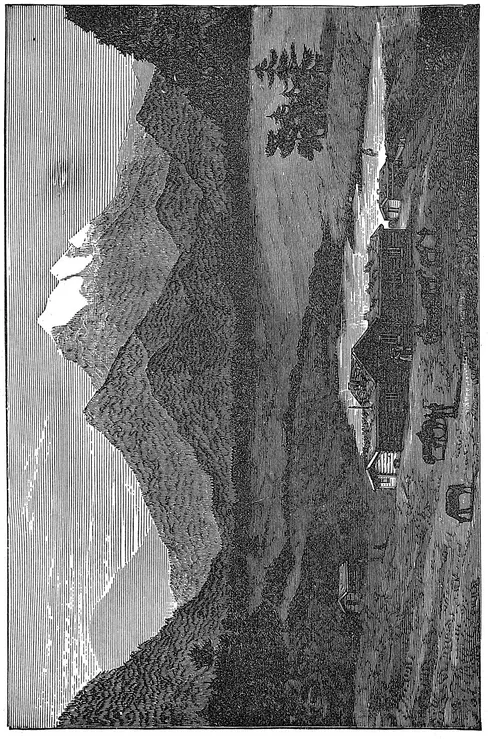
MY HOME IN THE ROCKY MOUNTAINS.
(Page 64)
But still I have not answered the natural question,13 “What is Estes Park?” Among the striking peculiarities of these mountains are hundreds of high-lying valleys, large and small, at heights varying from 6000 to 11,000 feet. The most important are North Park, held by hostile Indians; Middle Park, famous for hot springs and trout; South Park, rich in minerals; and San Luis Park. South Park is 10,000 feet high, a great rolling prairie 70 miles long, well grassed and watered, but nearly closed by snow in winter. But Parks innumerable are scattered throughout the mountains, most of them unnamed, and others nicknamed by the hunters or trappers who have made them their temporary resorts. They always lie far within the flaming Foot Hills, their exquisite stretches of flowery pastures dotted artistically with clumps of trees sloping lawnlike to bright swift streams full of red-waistcoated trout, or running up in soft glades into the dark forest, above which the snow peaks rise in their infinite majesty. Some are bits of meadow a mile long and very narrow, with a small stream, a beaver-dam, and a pond made by beaver industry. Hundreds of these can only be reached by riding in the bed of a stream, or by scrambling up some narrow canyon till it debouches on the fairy-like stretch above. These parks are the feeding-grounds of innumerable wild animals, and some, like one three miles off, seem chosen for the process of antler-casting, the grass being covered for at least a square mile with the magnificent branching horns of the elk.
Estes Park combines the beauties of all. Dismiss all thoughts of the Midland Counties. For park palings there are mountains, forest skirted, 9000, 11,000, 14,000 feet high; for a lodge, two sentinel peaks of gran-ite guarding the only feasible entrance; and for a Queen Anne mansion an unchinked log cabin with a vault of sunny blue overhead. The park is most irregularly shaped, and contains hardly any level grass. It is an aggregate of lawns, slopes, and glades, about eighteen miles in length, but never more than two miles in width. The Big Thompson, a bright, rapid trout-stream, snow-born on Long’s Peak a few miles higher, takes all sorts of magical twists, vanishing and reappearing unexpectedly, glancing among lawns, rushing through romantic ravines, everywhere making music through the still, long nights. Here and there the lawns are so smooth, the trees so artistically grouped, a lake makes such an artistic foreground, or a waterfall comes tumbling down with such an apparent feeling for the picturesque, that I am almost angry with Nature for her close imitation of art. But in another hundred yards Nature, glorious, unapproachable, inimitable, is herself again, raising one’s thoughts reverently upwards to her Creator and ours. Grandeur and sublimity, not softness, are the features of Estes Park. The glades which begin so softly are soon lost in the dark primæval forests, with their peaks of rosy granite, and their stretches of granite blocks piled and poised by nature in some mood of fury. The streams are lost in canyons nearly or quite inaccessible, awful in their blackness and darkness; every valley ends in mystery; seven mountain ranges raise their frowning barriers between us and the Plains, and at the south end of the park Long’s Peak rises to a height of 14,700 feet, with his bare, scathed head slashed with eternal snow. The lowest part of the Park is 7500 feet high; and though the sun is hot during the day, the mercury hovers near the freezing-point every night of the summer. An immense quantity of snow falls, but partly owing to the tremendous winds which drift it into the deep valleys, and partly to the bright warm sun of the winter months, the Park is never snowed up, and a number of cattle and horses are wintered out of doors on its sun-cured, saccharine grasses, of which the gramma grass is the most valuable. The soil here, as elsewhere in the neighbourhood, is nearly everywhere coarse, grey, granitic dust, produced probably by the disintegration of the surrounding mountains. It does not hold water, and is never wet in any weather. There are no thaws here. The snow mysteriously disappears by rapid evaporation. Oats grow, but do not ripen, and, when well advanced, are cut and stacked for winter fodder. Potatoes yield abundantly, and, though not very large, are of the best quality, mealy throughout. Evans has not attempted anything else, and probably the more succulent vegetables would require irrigation. The wild flowers are gorgeous and innumerable, though their beauty, which culminates in July and August, was over before I arrived, and the recent snow-flurries have finished them. The time between winter and winter is very short, and the flowery growth and blossom of a whole year are compressed into two months. Here are dandelions, buttercups, larkspurs, harebells, violets, roses, blue gentian, columbine, painter’s brush, and fifty others, blue and yellow predominating; and though their blossoms are stiffened by the cold every morning, they are starring the grass and drooping over the brook long before noon, making the most of their brief lives in the sunshine. Of ferns, after many a long hunt, I have only found the Cystopteris fragilis and the Blechnum spicant, but I hear that the Pteris aquilina is also found. Snakes and mosquitoes do not appear to be known here. Coming almost direct from the tropics, one is dissatisfied with the uniformity of the foliage; indeed, foliage can hardly be written of, as the trees properly so called at this height are exclusively Coniferœ, and bear needles instead of leaves. In places there are patches of spindly aspens, which have turned a lemon-yellow, and along the streams bear-cherries, vines, and roses lighten the gulches with their variegated crimson leaves. The pines are not imposing, either from their girth or height. Their colouring is blackish-green, and though they are effective singly or in groups, they are sombre and almost funereal when densely massed, as here, along the mountain sides. The timber line is at a height of about 11,000 feet, and is singularly well defined. The most attractive tree I have seen is the silver spruce, Abies Englemanii, near of kin to what is often called the balsam-fir. Its shape and colour are both beautiful. My heart warms towards it, and I frequent all the places where I can find it. It looks as if a soft, blue, silver powder had fallen on its deep-green needles, or as if a bluish hoar-frost, which must melt at noon, were resting upon it. Anyhow, one can hardly believe that the beauty is permanent, and survives the summer heat and the winter cold. The universal tree here is the Pinus ponderosa, but it never attains any very considerable size, and there is nothing to compare with the red-woods of the Sierra Nevada, far less with the sequoias of California.
As I have written before, Estes Park is thirty miles from Longmount, the nearest settlement, and it can be reached on horseback only by the steep and devious track by which I came, passing through a narrow rift in the top of a precipitous ridge, 9000 feet high, called the Devil’s Gate. Evans takes a lumber waggon with four horses over the mountains, and a Colorado engineer would have no difficulty in making a waggon road. In several of the gulches over which the track hangs there are the remains of waggons which have come to grief in the attempt to emulate Evans’s feat, which without evidence, I should have supposed to be impossible. It is an awful road. The only settlers in the park are Griffith Evans, and a married man a mile higher up. “Mountain Jim’s” cabin is in the entrance gulch, four miles off, and there is not another cabin for eighteen miles toward the Plains. The Park is unsurveyed, and the huge tract of mountainous country beyond is almost altogether unexplored. Elk-hunters occasionally come up and camp out here; but the two settlers, who, however, are only squatters, for various reasons are not disposed to encourage such visitors. When Evans, who is a very successful hunter, came here, he came on foot, and for some time after settling here he carried the flour and necessaries required by his family on his back over the mountains.
As I intend to make Estes Park my headquarters until the winter sets in, I must make you acquainted with my surroundings and mode of living. The “Queen Anne Mansion” is represented by a log cabin made of big hewn logs. The chinks should be filled with mud and lime, but these are wanting. The roof is formed of barked young spruce, then a layer of hay, and an outer coating of mud, all nearly flat. The floors are roughly boarded. The “living-room” is about sixteen feet square, and has a rough stone chimney in which pine logs are always burning. At one end there is a door into a small bedroom, and at the other a door into a small eating-room, at the table of which we feed in relays. This opens into a very small kitchen with a great American cooking-stove, and there are two “bed-closets” besides. Although rude, it is comfortable, except for the draughts. The fine snow drives in through the chinks and covers the floors, but sweeping it out at intervals is both fun and exercise. There are no heaps or rubbish-places outside. Near it, on the slope under the pines, is a pretty two-roomed cabin, and beyond that, near the lake, is my cabin, a very rough one. My door opens into a little room with a stone chimney, and that again into a small room with a hay bed, a chair with a tin basin on it, a shelf and some pegs. A small window looks on the lake, and the glories of the sunrises which I see from it are indescribable. Neither of my doors has a lock, and, to say the truth, neither will shut, as the wood has swelled. Below the house, on the stream which issues from the lake, there is a beautiful log dairy, with a water-wheel outside, used for churning. Besides this, there are a corral, a shed for the waggon, a room for the hired man, and shelters for horses and weakly calves. All these things are necessaries at this height.
The ranchmen are two Welshmen, Evans and Edwards, each with a wife and family. The men are as diverse as they can be. “Griff,” as Evans is called, is short and small, and is hospitable, careless, reckless, jolly, social, convivial, peppery, good-natured, “nobody’s enemy but his own.” He had the wit and taste to find out Estes Park, where people have found him out, and have induced him to give them food and lodging, and add cabin to cabin to take them in. He is a splendid shot, an expert and successful hunter, a bold mountaineer, a good rider, a capital cook, and a generally “jolly fellow.” His cheery laugh rings through the cabin from the early morning, and is contagious, and when the rafters ring at night with such songs as “D’ye ken John Peel?” “Auld Lang Syne,” and “John Brown,” what would the chorus be without poor “Griff’s” voice? What would Estes Park be without him, indeed? When he went to Denver lately we missed him as we should have missed the sunshine, and perhaps more. In the early morning, when Long’s Peak is red, and the grass crackles with the hoar-frost, he arouses me with a cheery thump on my door. “We’re going cattle-hunting, will you come?” or, “Will you help to drive in the cattle? You can take your pick of the horses. I want another hand.” Free-hearted, lavish, popular, poor “Griff” loves liquor too well for his prosperity, and is always tormented by debt. He makes lots of money, but puts it into “a bag with holes.” He has fifty horses and 1000 head of cattle, many of which are his own, wintering up here, and makes no end of money by taking in people at eight dollars a week, yet it all goes somehow. He has a most industrious wife, a girl of seventeen, and four younger children, all musical, but the wife has to work like a slave; and though he is a kind husband, her lot, as compared with her lord’s, is like that of a squaw. Edwards, his partner, is his exact opposite, tall, thin, and condemnatory-looking, keen, industrious, saving, grave, a teetotaler, grieved for all reasons at Evans’s follies, and rather grudging; as naturally unpopular as Evans is popular; a “decent man,” who, with his industrious wife, will certainly make money as fast as Evans loses it.
I pay eight dollars a week, which includes the unlimited use of a horse, when one can be found and caught. We breakfast at seven on beef, potatoes, tea, coffee, new bread, and butter. Two pitchers of cream and two of milk are replenished as fast as they are exhausted. Dinner at twelve is a repetition of the breakfast, but with the coffee omitted and a gigantic pudding added. Tea at six is a repetition of breakfast. “Eat whenever you are hungry, you can always get milk and bread in the kitchen,” Evans says—“eat as much as you can, it’ll do you good”—and we all eat like hunters. There is no change of food. The steer which was being killed on my arrival is now being eaten through from head to tail, the meat being hacked off quite promiscuously, without any regard to joints. In this dry, rarefied air, the outside of the flesh blackens and hardens, and though the weather may be hot, the carcass keeps sweet for two or three months. The bread is super-excellent, but the poor wives seem to be making and baking it all day.
The regular household living and eating together at this time consists of a very intelligent and high-minded American couple, Mr. and Mrs. Dewy, people whose character, culture, and society I should value anywhere; a young Englishman, brother of a celebrated African traveller, who, because he rides on an English saddle, and clings to some other insular peculiarities, is called “The Earl”; a miner prospecting for silver; a young man, the type of intelligent, practical “Young America,” whose health showed consumptive tendencies when he was in business, and who is living a hunter’s life here; a grown-up niece of Evans; and a melancholy-looking hired man. A mile off there is an industrious married settler, and four miles off, in the gulch leading to the Park, “Mountain Jim,” otherwise Mr. Nugent, is posted. His business as a trapper takes him daily up to the beaver-dams in Black Canyon to look after his traps, and he generally spends some time in or about our cabin, not, I can see, to Evans’s satisfaction. For, in truth, this blue hollow, lying solitary at the foot of Long’s Peak, is a miniature world of great interest, in which love, jealousy, hatred, envy, pride, unselfishness, greed, selfishness, and self-sacrifice can be studied hourly, and there is always the unpleasantly exciting risk of an open quarrel with the neighbouring desperado, whose “I’ll shoot you!” has more than once been heard in the cabin.
The party, however, has often been increased by “campers,” either elk-hunters or “prospectors” for silver or locations, who feed with us and join us in the evening. They get little help from Evans, either as to elk or locations, and go away disgusted and unsuccessful. Two Englishmen of refinement and culture camped out here prospecting a few weeks ago, and then, contrary to advice, crossed the mountains into North Park, where gold is said to abound, and it is believed that they have fallen victims to the bloodthirsty Indians of that region. Of course, we never get letters or newspapers unless some one rides to Longmount for them. Two or three novels and a copy of Our New West are our literature. Our latest newspaper is seventeen days old. Somehow the Park seems to become the natural limit of our interests so far as they appear in conversation at table. The last grand aurora, the prospect of a snow-storm, track and sign of elk and grizzly, rumours of a bighorn herd near the lake, the canyons in which the Texan cattle were last seen, the merits of different rifles, the progress of two obvious love affairs, the probability of some one coming up from the Plains with letters, “Mountain Jim’s” latest mood or escapade, and the merits of his dog “Ring” as compared with those of Evans’s dog “Plunk,” are among the topics which are never abandoned as exhausted.
On Sunday work is nominally laid aside, but most of the men go out hunting or fishing till the evening, when we have the harmonium and much sacred music and singing in parts. To be alone in the Park from the afternoon till the last glory of the afterglow has faded, with no books but a Bible and Prayer-book, is truly delightful. No worthier temple for a “Te Deum” or “Gloria in Excelsis” could be found than this “temple not made with hands,” in which one may worship without being distracted by the sight of bonnets of endless form, and curiously intricate “back hair,” and countless oddities of changing fashion.
I shall not soon forget my first night here.
Somewhat dazed by the rarefied air, entranced by the glorious beauty, slightly puzzled by the motley company, whose faces loomed not always quite distinctly through the cloud of smoke produced by eleven pipes, I went to my solitary cabin at nine, attended by Evans. It was very dark, and it seemed a long way off. Something howled—Evans said it was a wolf—and owls apparently innumerable hooted incessantly. The pole-star, exactly opposite my cabin door, burned like a lamp. The frost was sharp. Evans opened the door, lighted a candle, and left me, and I was soon in my hay bed. I was frightened—that is, afraid of being frightened, it was so eerie; but sleep soon got the better of my fears. I was awoke by a heavy breathing, a noise something like sawing under the floor, and a pushing and upheaving, all very loud. My candle was all burned, and, in truth, I dared not stir. The noise went on for an hour fully, when, just as I thought the floor had been made sufficiently thin for all purposes of ingress, the sounds abruptly ceased, and I fell asleep again. My hair was not, as it ought to have been, white in the morning!
I was dressed by seven, our breakfast-hour, and when I reached the great cabin and told my story, Evans laughed hilariously, and Edwards contorted his face dismally. They told me that there was a skunk’s lair under my cabin, and that they dare not make any attempt to dislodge him for fear of rendering the cabin untenable. They have tried to trap him since, but without success, and each night the noisy performance is repeated. I think he is sharpening his claws on the under side of my floor, as the grizzlies sharpen theirs upon the trees. The odour with which this creature, truly named Mephitis, can overpower its assailants is truly awful. We were driven out of the cabin for some hours merely by the passage of one across the corral. The bravest man is a coward in its neighbourhood. Dogs rub their noses on the ground till they bleed when they have touched the fluid, and even die of the vomiting produced by the effluvia. The odour can be smelt a mile off. If clothes are touched by the fluid they must be destroyed. At present its fur is very valuable. Several have been killed since I came. A shot well aimed at the spine secures one safely, and an experienced dog can kill one by leaping upon it suddenly without being exposed to danger. It is a beautiful beast, about the size and length of a fox, with long thick black or dark-brown fur, and two white streaks from the head to the long bushy tail. The claws of its fore-feet are long and polished. Yesterday one was seen rushing from the dairy and was shot. “Plunk,” the big dog, touched it and has to be driven into exile. The body was valiantly removed by a man with a long fork, and carried to a running stream, but we are nearly choked with the odour from the spot where it fell. I hope that my skunk will enjoy a quiet spirit so long as we are near neighbours.
October 3.
This is surely one of the most entrancing spots on earth. Oh, that I could paint with pen or brush! From my bed I look on Mirror Lake, and with the very earliest dawn, when objects are not discernible, it lies there absolutely still, a purplish lead-colour. Then suddenly into its mirror flash inverted peaks, at first a bright orange, then changing into red, making the dawn darker all round. This is a new sight, each morning new. Then the peaks fade, and when morning is no longer “spread upon the ...
Table of contents
- Title Page
- Copyright Page
- Dedication
- Table of Contents
- LETTER I
- LETTER II
- LETTER III
- LETTER IV
- LETTER V
- LETTER VI
- LETTER VII
- LETTER VIII
- LETTER IX
- LETTER X
- LETTER XI
- LETTER XII
- LETTER XIII
- LETTER XIV
- LETTER XV
- LETTER XVI
- LETTER XVII
Trusted by 375,005 students
Access to over 1.5 million titles for a fair monthly price.
Study more efficiently using our study tools.
Frequently asked questions
Yes, you can cancel anytime from the Subscription tab in your account settings on the Perlego website. Your subscription will stay active until the end of your current billing period. Learn how to cancel your subscription
No, books cannot be downloaded as external files, such as PDFs, for use outside of Perlego. However, you can download books within the Perlego app for offline reading on mobile or tablet. Learn how to download books offline
Perlego offers two plans: Essential and Complete
- Essential is ideal for learners and professionals who enjoy exploring a wide range of subjects. Access the Essential Library with 800,000+ trusted titles and best-sellers across business, personal growth, and the humanities. Includes unlimited reading time and Standard Read Aloud voice.
- Complete: Perfect for advanced learners and researchers needing full, unrestricted access. Unlock 1.5M+ books across hundreds of subjects, including academic and specialized titles. The Complete Plan also includes advanced features like Premium Read Aloud and Research Assistant.
We are an online textbook subscription service, where you can get access to an entire online library for less than the price of a single book per month. With over 1.5 million books across 990+ topics, we’ve got you covered! Learn about our mission
Look out for the read-aloud symbol on your next book to see if you can listen to it. The read-aloud tool reads text aloud for you, highlighting the text as it is being read. You can pause it, speed it up and slow it down. Learn more about Read Aloud
Yes! You can use the Perlego app on both iOS and Android devices to read anytime, anywhere — even offline. Perfect for commutes or when you’re on the go.
Please note we cannot support devices running on iOS 13 and Android 7 or earlier. Learn more about using the app
Please note we cannot support devices running on iOS 13 and Android 7 or earlier. Learn more about using the app
Yes, you can access A Lady's Life in the Rocky Mountains by Isabella L. Bird in PDF and/or ePUB format, as well as other popular books in History & North American History. We have over 1.5 million books available in our catalogue for you to explore.