![]()
Chapter I. The Frame
As the only purpose of an artistic anatomy is to help the artist in the observation of form, it can neglect the intricacies of nerves, veins, arteries and many other organs to concern itself almost exclusively with the bones and muscles — one might say the superficial muscles, if it were not that occasionally muscles that are completely hidden should be studied, because an understanding of their action leads to the better understanding of the action of the muscles that show.
Thus limited, the study of what we may call the mechanical anatomy of the horse is comparatively simple, the more so that a horse can do so few things. Outcry from some reader at this aspersion on a noble animal!
The horse excels indeed in trotting, galloping, jumping, pulling weights and carrying loads; a true title to nobility, for such powers serve the convenience and pleasure of man. Its strength and endurance are prodigious. It can lift itself with the added weight of a rider over a jump and recover safely on landing, and even when mounted can gallop down a free running deer.
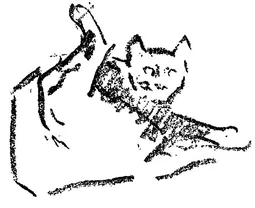
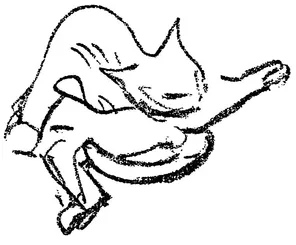
But to achieve such amazing feats it needs to be made rather rigid. Consequently though it goes forward so brilliantly it goes backwards moderately, lies down and gets up awkwardly, and generally has to make several clumsy efforts before it can roll over on its back. And this necessary rigidity of its backbone and other parts limits the variety of its possible attitudes, and reduces its scope as a subject for the draughtsman. Think of the bending and twisting powers of a cat.
Let us begin our study by looking at the bones, and try to see what is required of the muscles to make them act. Bones and muscles are, of course, interdependent, the bones deciding as it were the points of attachment of the muscles and the directions in which they are to pull; being moulded in their turn by the requirements of the muscles, with twists and channels and knobs, that the muscles may get their required purchase and be able to do their work without interfering with each other.
Look first at that essential principle in the construction of all quadrupeds, the difference in the way in which the body is supported by the fore and hind legs.
The support of the body by the hind legs is through the direct contact of bone with bone, the head of the femur being fitted into the socket of the pelvis, whereas in front the body is slung, being supported from the underside of the shoulder blade by muscles and tendons attached to the ribs (see skeleton, Frontispiece, and Pl. 5, p. 58).
Such differences in construction are adapted to the special duties of the fore and hind quarters. Thus the force of the hind legs, the chief engines of propulsion, is transmitted without loss through the direct thrust of bone on bone, and the fore legs are able to take up without shock the momentum of horse and rider alighting over a jump because the body is attached to them by slings. It may be objected that a man alights upon legs which are fitted directly into the socket of his pelvis and yet jumps without injury. But the comparison is not quite fair; for his legs both propel and catch him and so are not asked to catch more than they themselves have lifted, as the horse’s fore legs are. For a horse’s hind legs have a power which far exceeds that of the fore legs, galloping, jumping, pulling depending chiefly upon their action. A comparison of the masses of muscle that work the hind and fore legs makes this clear.
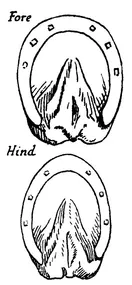
Another notable difference of structure is in the feet. The fore legs have hoofs which are larger and rounder than those of the hind feet, being designed to carry more weight, for they have to support the weight of the head and neck in addition to their share of the weight of the body; and the hind feet are narrower and more pointed, the better to grip the ground when galloping and jumping. The front feet too have a wider stance.1
Despite the differences, there is a correspondence between the fore and hind legs both in construction and in action (see skeleton, Frontispiece, and Pl. 11, p. 108). The shoulder blade, which transmits the propulsion of the fore limb to the body, slopes forwards and downwards to its junction with the upper arm, as the femur, which conveys the propulsion of the hind limb, does to its junction with the tibia at the stifle joint; the upper arm slopes backwards to the elbow, the ‘hock’ of the fore limb, as the tibia does to the hock; from which points the legs descend similarly to the pastern and hoof, the hind leg directly, the fore legs with an added joint, the ‘knee’.2 But the knee makes no difference in ordinary paces between the propulsive action of the fore leg and that of the hind leg, as it is maintained unbent; it is in the advancement of the foreleg that the use of the knee comes in, to lift the foot clear of the ground to prevent tripping, and to raise it well out of the way as when jumping.
In a quiet pace such as the walk, the fore and hind legs behave very similarly, serving much like the spoke of a wheel. It is only in violent movements such as galloping and jumping that their differences of action really come out and the purpose of their differences of structure becomes clear.
Often in books of artistic anatomy little or no attempt is made to study the effect of the action and interplay of the different parts, the muscles being merely mapped as flexors and extensors, that is, muscles that close a joint or pull it open. Such classifications, necessary as they are, should be supplemented with some explanation of the movements resulting from the action of muscles when working in combination. And this can best be done, I think, by trying to work out how some particular action is effected.
Let us think then not of how a horse shoots his foot backwards as in kicking, but of how from the resistance of the stationary hoof on the ground these same muscles of his leg are used to push him forwards. To think always of his movements in this way is to get, I believe, a better understanding of a horse’s action, a better ‘feel’ of the forces and stresses which create the sequence of shapes and rhythms that the artist enjoys. Let us approach the study of the muscles as an inventor’s problem of how best to operate the given levers, the bones, so as to supply the required momentum to the body. Study the skeleton and before you look at the diagrams of the muscles ask yourself what muscles you would design, and you will, I am sure, understand better nature’s solution of the problem.
But before studying the muscles, which are reserved for another chapter, let us continue our general survey of the skeleton (see the Frontispiece).
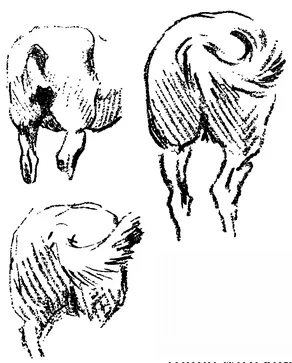
Look at the vertebral column and for the moment that part of it from the hips to the chest which forms the back. The vertebral column, which runs from the head to the tip of the tail, is composed of a series of bones connected by joints, which vary enormously in their construction and their flexibility, the neck bones being deeply embedded one in the other, with ball - and - socket joints, whereas the tail bones are really not socketed into each other at all. This gives such flexibility to the tail that a horse can swish it up and down, sideways or round and round with absolute freedom; and the deep ball and socketing of the neck bones allows for the pull of strong muscles without any danger of dislocation. In the backbone the vertebrae are firmly connected without much play, so that it may be a firm though not rigid column.
The horse’s power of carrying weight depends upon this firm knitting of the bones of the back, to which the slight arching of it contributes. The backbone runs up to the pelvis from a point in the middle of the chest where the neck properly begins. And the height of the withers, so characteristic of the shape of a horse, is, we see, not directly due to the backbone, but to the long processes which stand up from it.
The variation in the processes on the different vertebræ is very striking. They are, of course, modified to suit their duties. The long processes that form the withers serve to support the neck and head, and are raked backwards the better to resist this pull. On the loins the upright processes are shorter and blunter (it is the only comfortable place to sit on a bare-backed donkey, with its knife-edged backbone), and are inclined slightly forward: and the transverse processes are very strongly developed into broad flat blades, for the attachment of strong muscles (see illustration, p. 33). Where the pelvis is attached, a section of the backbone is actually rigid, for the vertebrae are welded into a solid mass, called the sacrum; and the sacrum, making a unit with the pelvis, transmits the drive of the hind legs to the body.
Neck straightened as much as possible before the separation of the bones
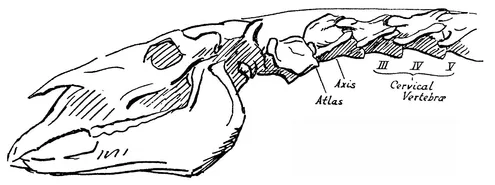
The neck is not equally flexible in all directions. It moves freely downwards, upwards to a certain height, but not very freely sideways; for the deep entry of the ball of one vertebra into the socket of its neighbour and the large development of their transverse processes check the lateral movement. The two points of its greatest flexibility are near the chest and just behind the head. There the skull is supported by the atlas bone on which it has an up-and-down movement only, the atlas being able to rotate upon the axis bone through about three-quarters of a circle. The flanges on the atlas, necessarily strongly developed for the attachment of the strong muscle...