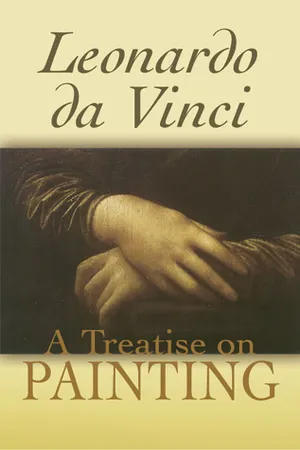
Leonardo da Vinci's written observations about painting rank among the most remarkable from any era. Never edited by the author himself into a single coherent book, these writings were compiled many years after Leonardo's death into the principal repository of his practical thoughts on the techniques of drawing and painting. A Treatise on Painting begins with precise instructions on drawing the human body and then moves on to techniques of rendering motion. Other topics include perspective, composition, the expression of various emotions, creating effects of light and shadow, and color. With 48 anatomical drawings by Nicholas Poussin and geometrical and architectural designs by Leon Battista Alberti, this famous volume remains one of the world's most useful and valuable art instruction books.
- 208 pages
- English
- ePUB (mobile friendly)
- Available on iOS & Android
eBook - ePub
A Treatise on Painting
About this book
Information
Topic
ArtSubtopic
Art TechniquesDRAWING.
PROPORTION.
1.—What the young Student in Painting ought in the first place to learn.
THE young student should, in the first place, acquire a knowledge of perspective, to enable him to give to every object its proper dimensions: after which, it is requisite that he be under the care of an able master, to accustom him, by degrees, to a good style of drawing the parts. Next, he must study Nature, in order to confirm and fix in his mind the reason of those precepts which he has learnt. He must also bestow some time in viewing the works of various old masters, to form his eye and judgment, in order that he may be able to put in practice all that he has been taught.1
2.—Rule for a young Student in Painting.
The organ of sight is one of the quickest, and takes in at a single glance an infinite variety of forms; notwithstanding which, it cannot perfectly comprehend more than one object at a time. For example, the reader, at one look over this page, immediately perceives it full of different characters; but he cannot at the same moment distinguish each letter, much less can he comprehend their meaning. He must consider it word by word, and line by line, if he be desirous of forming a just notion of these characters. In like manner, if we wish to ascend to the top of an edifice, we must be content to advance step by step, otherwise we shall never be able to attain it.
A young man, who has a natural inclination to the study of this art, I would advise to act thus: In order to acquire a true notion of the form of things, he must begin by studying the parts which compose them, and not pass to a second till he has well stored his memory, and sufficiently practised the first; otherwise he loses his time, and will most certainly protract his studies. And let him remember to acquire accuracy before he attempts quickness.
3.—How to discover a young Man’s Disposition for Painting.
Many are very desirous of learning to draw, and are very fond of it, who are, notwithstanding, void of a proper disposition for it. This may be known by their want of perseverance; like boys, who draw everything in a hurry, never finishing, or shadowing.
4.—Of Painting, and its Divisions.
Painting is divided into two principal parts. The first is the figure; that is, the lines which distinguish the forms of bodies and their component parts. The second is the colour contained within those limits.
5.—Division of the Figure.
The form of bodies is divided into two parts; that is, the proportion of the members to each other, which must correspond with the whole; and the motion, expressive of what passes in the mind of the living figure.
6.—Proportion of Members.
The proportion of members is again divided into two parts, viz., equality, and motion. By equality is meant (besides the measure corresponding with the whole), that you do not confound the members of a young subject with those of old age, nor plump ones with those that are lean; and that, moreover, you do not blend the robust and firm muscles of man with feminine softness; that the attitudes and motions of old age be not expressed with the quickness and alacrity of youth, nor those of a female figure like those of a vigorous young man. The motions and members of a strong man should be such as to express his perfect state of health.
7.—Of Dimensions in general.
In general, the dimensions of the human body are to be considered in the length, and not in the breadth; because in the wonderful works of Nature, which we endeavour to imitate, we cannot in any species find any one part in one model precisely similar to the same part in another. Let us be attentive, therefore, to the variation of forms, and avoid all monstrosities of proportion; such as long legs united to short bodies, and narrow chests with long arms. Observe also attentively the measure of joints, in which Nature is apt to vary considerably; and imitate her example by doing the same.
8.—Motion, Changes, and Proportion of Members.
The measures of the human body vary in each member, according as it is more or less bent, or seen in different views, increasing on one side as much as they diminish on the other.
9.—The Difference of Proportion between Children and grown Men.
In men and children I find a great difference between the joints of the one and the other, in the length of the bones. A man has the length of two heads from the extremity of one shoulder to the other, the same from the shoulder to the elbow, and from the elbow to the fingers; but the child has only one, because Nature gives the proper size first to the seat of the intellect, and afterwards to the other parts.
10.—The Alterations in the Proportion of the human Body from Infancy to full Age.
A man, in his infancy, has the breadth of his shoulders equal to the length of the face, and to the length of the arm from the shoulder to the elbow, when the arm is bent.2 It is the same again from the lower belly to the knee, and from the knee to the foot. But, when a man is arrived at the period of his full growth, every one of these dimensions becomes double in length, except the face, which, with the top of the head, undergoes but very little alteration in length. A well-proportioned and full-grown man, therefore, is ten times the length of his face; the breadth of his shoulders will be two faces, and in like manner all the above lengths will be double. The rest will be explained in the general measurement of the human body.3
11.—Of the Proportion of Members.
All the parts of any animal whatever must be correspondent with the whole. So that, if the body be short and thick, all the members belonging to it must be the same. One that is long and thin must have its parts of the same kind; and so of the middle size. Something of the same may be observed in plants, when uninjured by men or tempests: for, when thus injured, they bud and grow again, making young shoots from old plants, and by those means destroying their natural symmetry.
12.—That every Part be proportioned to its Whole.
If a man be short and thick, be careful that all his members be of the same nature, viz., short arms and thick, large hands, short fingers, with broad joints; and so of the rest.
13.—Of the Proportion of the Members.
Measure upon yourself the proportion of the parts, and, if you find any of them defective, note it down, and be very careful to avoid it in drawing your own compositions. For this is reckoned a common fault in painters, to delight in the imitation of themselves.
14.—The Danger of forming an erroneous Judgment in regard to the Proportion and Beauty of the Parts.
If the painter has clumsy hands, he will be apt to introduce them into his works, and so of any other part of his person, which may not happen to be so beautiful as it ought to be. He must, therefore, guard particularly against that self-love, or too good opinion of his own person, and study by every means to acquire the knowledge of what is most beautiful, and of his own defects, that he may adopt the one and avoid the other.
15.—Another Precept.
The young painter must, in the first instance, accustom his hand to copying the drawings of good masters; and when his hand is thus formed and ready, he should, with the advice of his director, use himself also to draw from relievos; according to the rules we shall point out in the treatise on drawing from relievos.4
16.—The Manner of drawing from Relievos, and rendering Paper fit for it.
When you draw from relievos, tinge your paper of some darkish demi-tint. And after you have made your outline, put in the darkest shadows, and, last of all, the principal lights, but sparingly, especially the smaller ones; because those are easily lost to the eye at a very moderate distance.5
17.—Of drawing from Casts or Nature.
In drawing from relievo, the draftsman must place himself in such a manner, as that the eye of the figure to be drawn be level with his own.6
18.—To draw Figures from Nature.
Accustom yourself to hold a plummet in your hand, that you may judge of the bearing of the parts.
19.—Of drawing from Nature.
When you draw from Nature, you must be at the distance of three times the height of the object; and when you begin to draw, form in your own mind a certain principal line (suppose a perpendicular); observe well the bearing of the parts towards that line; whether they intersect it, are parallel to it, or oblique.
20.—Of drawing Academy Figures.
When you draw from a naked model, always sketch in the whole of the figure, suiting all the members well to each other; and though you finish only that part which appears the best, have a regard to the rest, that, whenever you make use of such studies, all the parts may hang together.
In composing your attitudes, take care not to turn the head on the same side as the breast, nor let the arm go in a line with the leg.7 If the head turn towards the right shoulder, the parts must be lower on the left side than on the other: but if the chest come forward, and the head turn towards the left, the parts on the right side are to be the highest.
21.—Of studying in the Dark, on first waking in the Morning, and before going to sleep.
I have experienced no small benefit, when in the dark and in bed, by retracing in my mind the outlines of those forms which I...
Table of contents
- Title Page
- Copyright Page
- Epigraph
- Table of Contents
- DRAWING.
- INVENTION, OR COMPOSITION.
- LIGHT AND SHADOW.
- COLOURS AND COLOURING.
- MISCELLANEOUS OBSERVATIONS.
Trusted by 375,005 students
Access to over 1.5 million titles for a fair monthly price.
Study more efficiently using our study tools.
Frequently asked questions
Yes, you can cancel anytime from the Subscription tab in your account settings on the Perlego website. Your subscription will stay active until the end of your current billing period. Learn how to cancel your subscription
No, books cannot be downloaded as external files, such as PDFs, for use outside of Perlego. However, you can download books within the Perlego app for offline reading on mobile or tablet. Learn how to download books offline
Perlego offers two plans: Essential and Complete
- Essential is ideal for learners and professionals who enjoy exploring a wide range of subjects. Access the Essential Library with 800,000+ trusted titles and best-sellers across business, personal growth, and the humanities. Includes unlimited reading time and Standard Read Aloud voice.
- Complete: Perfect for advanced learners and researchers needing full, unrestricted access. Unlock 1.5M+ books across hundreds of subjects, including academic and specialized titles. The Complete Plan also includes advanced features like Premium Read Aloud and Research Assistant.
We are an online textbook subscription service, where you can get access to an entire online library for less than the price of a single book per month. With over 1.5 million books across 990+ topics, we’ve got you covered! Learn about our mission
Look out for the read-aloud symbol on your next book to see if you can listen to it. The read-aloud tool reads text aloud for you, highlighting the text as it is being read. You can pause it, speed it up and slow it down. Learn more about Read Aloud
Yes! You can use the Perlego app on both iOS and Android devices to read anytime, anywhere — even offline. Perfect for commutes or when you’re on the go.
Please note we cannot support devices running on iOS 13 and Android 7 or earlier. Learn more about using the app
Please note we cannot support devices running on iOS 13 and Android 7 or earlier. Learn more about using the app
Yes, you can access A Treatise on Painting by Leonardo da Vinci, John Francis Rigaud in PDF and/or ePUB format, as well as other popular books in Art & Art Techniques. We have over 1.5 million books available in our catalogue for you to explore.