Basic documents in Mahayana Buddhism, highly important in history of religions. The Buddha-karita of Asvaghosha, Larger Sukhavativyuha, more.
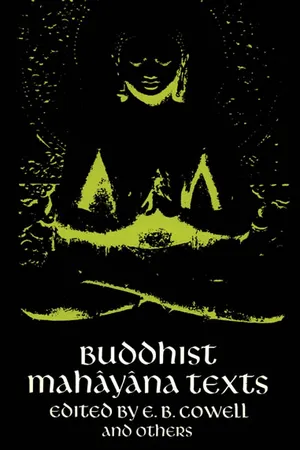
- 464 pages
- English
- ePUB (mobile friendly)
- Available on iOS & Android
eBook - ePub
Buddhist Mahayana Texts
About this book
Information
Topic
PhilosophySubtopic
Eastern PhilosophyPART I
INTRODUCTION.
THE Sanskrit text of the Buddha-karita was published at the beginning of last year in the ‘Anecdote Oxoniensia,’ and the following English translation is now included in the series of ‘Sacred Books of the East.’ It is an early Sanskrit poem written in India on the legendary history of Buddha, and therefore contains much that is of interest for the history of Buddhism, beside its special importance as illustrating the early history of classical Sanskrit literature.
It is ascribed to Asvaghosha; and, although there were several writers who bore that name, it seems most probable that our author was the contemporary and spiritual adviser of Kanishka in the first century of our era. Hiouen Thsang, who left India in A.D. 645, mentions him with Deva, Nâgârguna, and Kumâralabdha, ‘as the four suns which illumine the world1;’ but our fullest account is given by I-tsing, who visited India in 673. He states that Asvaghosha was an ancient author who composed the Alamkâra-sâstra and the Buddha-karita-kâvya,—the latter work being of course the present poem. Beside these two works he also composed the hymns in honour of Buddha and the three holy beings Amitâbha, Avalokitesvara, and Mahâsthâma, which were chanted at the evening service of the monasteries. ‘In the five countries of India and in the countries of the Southern ocean they recite these poems, because they express a store of ideas and meaning in a few words2.’ A solitary stanza (VIII, 13) is quoted from the Buddha-karita in Râyamukuta’s commentary on the Amarakosha I, 1. 1, 2, and also by Uggvaladatta in his commentary on the Unâdi-sûtras I, 156; and five stanzas are quoted as from Asvaghosha in Vallabha-deva’s Subhâshitâvali, which bear a great resemblance to his style, though they are not found in the extant portion of this poem 3.
The Buddha-karita was translated into Chinese4 by Dharmaraksha in the fifth century, and a translation of this was published by the Rev. S. Beal in the present series; it was also translated into Tiberan in the seventh or eighth century. The Tibetan as well as the Chinese version consists of twenty-eight chapters, and carries down the life of Buddha to his entrance into Nirvâna and the subsequent division of the sacred relics. The Tibetan version appears to be much closer to the original Sanskrit than the Chinese; in fact from its verbal accuracy we can often reproduce the exact words of the original, since certain Sanskrit words are always represented by the same Tibetan equivalents, as for instance the prepositions prefixed to verbal roots. I may here express an earnest hope that we may still ere long have an edition and translation of the Tibetan version, if some scholar can be found to complete Dr.Wenzel’s unfinished labour. He had devoted much time and thought to the work; I consulted him in several of my difficulties, and it is from him that I derived all my information about the Tibetan renderings. This Tibetan version promises to be of great help in restoring the many corrupt readings which still remain in our faulty Nepalese MSS.
Only thirteen books of the Sanskrit poem claim to be Asvaghosha’s composition; the last four books are an attempt by a modern Nepalese author to supply the loss of the original. He tells us this honestly in the colophon, —‘having searched for them everywhere and not found them, four cantos have been made by me, Amritânanda,—the fourteenth, fifteenth, sixteenth, and seventeenth.’ He adds the date 950 of the Nepalese era, corresponding to 1830 A.D.; and we have no difficulty in identifying the author. Râgendralâl Mitra in his ‘Nepalese Buddhist Literature’ mentions Amritânanda as the author of two Sanskrit treatises and one in Newârî; he was probably the father of the old pandit of the Residency at Kâtmându, Gunânanda, whose son Indrânanda holds the office at present. Dr. D. Wright informs me that the family seem to have been the recognised historians of the country, and keepers of the MS. treasures of sundry temples. The four books are included in this translation as an interesting literary curiosity. The first portion of the fourteenth book agrees partly with the Tibetan and Chinese, and Amritânanda may have had access to some imperfect copy of this portion of the original; but after that his account is quite independent, and has no relation to the two versions.
In my preface to the edition of the Sanskrit text I have tried to show that Asvaghosha’s poem appears to have exercised an important influence on the succeeding poets of the classical period in India. When we compare the description in the seventh book of the Raghuvamsa of the ladies of the city crowding to see prince Aga as he passes by from the Svayamvara where the princess Bhogyâ has chosen him as her husband, with the episode in the third book of the Buddha-karita (slokas 13—24); or the description of Kâma’s assault on Siva in the Kumârasambhava with that of Mâra’s temptation of Buddha in the thirteenth book, we can hardly fail to trace some connection. There is a similar resemblance between the description in the fifth book of the Râmâyana, where the monkey Hanumat enters Râvana’s palace by night, and sees his wives asleep in the seraglio and their various unconscious attitudes, and the description in the fifth book of the present poem where Buddha on the night of his leaving his home for ever sees the same unconscious sight in his own palace. Nor may we forget that in the Râmâyana the description is merely introduced as an ornamental episode; in the Buddhist poem it is an essential element in the story, as it supplies the final impulse which stirs the Bodhisattva to make his escape from the world. These different descriptions became afterwards commonplaces in Sanskrit poetry, like the catalogue of the ships in Greek or Roman epics; but they may very well have originated in connection with definite incidents in the Buddhist sacred legend.
The Sanskrit MSS. of Nepal are always negligently transcribed and abound with corrupt passages, which it is often very difficult to detect and restore. My printed text leaves many obscure lines which will have to be cleared up hereafter by more skilful emendations. I have given in the notes to the translation some further emendations of my own, and I have also added several happy conjectures which continental scholars have kindly suggested to me by letter; and I gladly take this opportunity of adding in a foot-note some which I received too late to insert in their proper places 5.
I have endeavoured to make my translation intelligible to the English reader, but many of the verses in the original are very obscure. Asvaghosha employs all the resources of Hindu rhetoric (as we might well expect if I-tsing is right in ascribing to him an ‘alamkâra-sâstra’), and it is often difficult to follow his subtil turns of thought and remote allusions; but many passages no doubt owe their present obscurity to undetected mistakes in the text of our MSS. In the absence of any commentary (except so far as the diffuse Chinese translation and occasional reference to the Tibetan have supplied the want) I have been necessarily left to my own resources, and I cannot fail to have sometimes missed my author’s meaning,
Prâmsulabhye phale mohâd udbâhur iva vâmanah; but I have tried to do my best, and no one will welcome more cordially any light which others may throw on the passages which I have misunderstood.
The edition of the original text was dedicated to my old friend Professor F. Max Müller, and it is a sincere gratification to me that this translation will appear in the same volume with similar translations from his pen.
E. B. C.
CAMBRIDGE:
Feb. 1, 1894.
Feb. 1, 1894.

THE BUDDHA-KARITA OF ASVAGHOSHA.
BOOK I.
1. That Arhat is here saluted, who has no counterpart,—who, as bestowing the supreme happiness, surpasses (Brahman) the Creator,—who, as driving away darkness, vanquishes the sun,—and, as dispelling all burning heat, surpasses the beautiful moon.
2. There was a city, the dwelling-place6 of the great saint Kapila, having its sides surrounded by the beauty of a lofty broad table-land as by a line of clouds, and itself, with its high-soaring palaces7, immersed in the sky.
3. By its pure and lofty system of government it, as it were, stole the splendour of the clouds of Mount Kailâsa, and while it bore the clouds which came to it through a mistake, it fulfilled the imagine-tion which had led them thither 8.
4. In that city, shining with the splendour of gems, darkness like poverty could find no place; prosperity shone resplendently, as with a smile, from the joy of dwelling with such surpassingly excellent citizens.
5. With its festive arbours, its arched gateways and pinnacles 9, it was radiant with jewels in every dwelling; and unable to find any other rival in the world, it could only feel emulation with its own houses.
6. There the sun, even although he had retired, was unable to scorn the moon-like faces of its women which put the lotuses to shame, and as if from the access of passion, hurried towards the western ocean to enter the (cooling) water.
7. ‘Yonder Indra has been utterly annihilated by the people when they saw the glories10 acquired by the Sâkyas,’—uttering this scoff, the city strove by its banners with gay-fluttering streamers to wipe away every mark of his existence.
8. After mocking the water-lilies even at night by the moonbeams which rest on its silver pavilions, —by day it assumed the brightness of the lotuses through the sunbeams falling on its golden palaces.
9. A king, by name Suddhodana, of the kindred of the sun, anointed to stand at the head of earth’s monarchs,—ruling over the city, adorned it, as a bee-inmate a full-blown lotus11.
10. The very best of kings with his train ever near him12,—intent on liberality yet devoid of pride13; a sovereign, yet with an ever equal eye thrown on all14,—of gentle nature and yet with wide-reaching majesty15.
11. Falling smitten by his arm in the arena of battle, the lordly elephants of his enemies bowed prostrate with their heads pouring forth quantities of pearls as if they were offering handfuls of flowers in homage.
12. Having dispersed his enemies by his pre-eminent majesty as the sun disperses the gloom of an eclipse, he illuminated his people on every side, showing them the paths which they were to follow.
13. Duty, wealth, and pleasure under his guidance assumed mutually each other’s object, but not the outward dress; yet as if they still vied together they shone...
Table of contents
- Title Page
- Buddhist Mahâyâna Texts
- Copyright Page
- Table of Contents
- PART I
- PART II - BUDDHIST MAHÂYÂNA TEXTS
- INDEX OF NAMES AND SUBJECTS - IN THE AMITÂYUR-DHYÂNA-SÛTRA.
- A CATALOG OF SELECTED DOVER BOOKS IN ALL FIELDS OF INTEREST
- A CATALOG OF SELECTED DOVER BOOKS IN ALL FIELDS OF INTEREST
- DOVER BOOKS ON EASTERN PHILOSOPHY AND RELIGION
Trusted by 375,005 students
Access to over 1.5 million titles for a fair monthly price.
Study more efficiently using our study tools.
Frequently asked questions
Yes, you can cancel anytime from the Subscription tab in your account settings on the Perlego website. Your subscription will stay active until the end of your current billing period. Learn how to cancel your subscription
No, books cannot be downloaded as external files, such as PDFs, for use outside of Perlego. However, you can download books within the Perlego app for offline reading on mobile or tablet. Learn how to download books offline
Perlego offers two plans: Essential and Complete
- Essential is ideal for learners and professionals who enjoy exploring a wide range of subjects. Access the Essential Library with 800,000+ trusted titles and best-sellers across business, personal growth, and the humanities. Includes unlimited reading time and Standard Read Aloud voice.
- Complete: Perfect for advanced learners and researchers needing full, unrestricted access. Unlock 1.5M+ books across hundreds of subjects, including academic and specialized titles. The Complete Plan also includes advanced features like Premium Read Aloud and Research Assistant.
We are an online textbook subscription service, where you can get access to an entire online library for less than the price of a single book per month. With over 1.5 million books across 990+ topics, we’ve got you covered! Learn about our mission
Look out for the read-aloud symbol on your next book to see if you can listen to it. The read-aloud tool reads text aloud for you, highlighting the text as it is being read. You can pause it, speed it up and slow it down. Learn more about Read Aloud
Yes! You can use the Perlego app on both iOS and Android devices to read anytime, anywhere — even offline. Perfect for commutes or when you’re on the go.
Please note we cannot support devices running on iOS 13 and Android 7 or earlier. Learn more about using the app
Please note we cannot support devices running on iOS 13 and Android 7 or earlier. Learn more about using the app
Yes, you can access Buddhist Mahayana Texts by E. B. Cowell, Francis A. Davis in PDF and/or ePUB format, as well as other popular books in Philosophy & Eastern Philosophy. We have over 1.5 million books available in our catalogue for you to explore.