From the archaic period, through the great Mayan civilization and the "Middle" civilizations of Olmecs, Toltecs and others, to the glory of the Aztecs, this classic study offers a comprehensive survey of the extent and variety of pre-Columbian civilizations in the New World. Profusely illustrated with 47 black-and-white plates, 86 text figures. New Introduction by Bruce E. Byland. Bibliography. Index, Map. Diagram of American Chronology.
- 304 pages
- English
- ePUB (mobile friendly)
- Available on iOS & Android
eBook - ePub
Ancient Civilizations of Mexico and Central America
About this book
Information
Subtopic
North American HistoryIndex
HistoryCHAPTER I
THE ARCHAIC HORIZON
IN 1910 an actual stratification of human products was found in the environs of Mexico City in which three principal culture horizons could be readily discerned. A collection made at the time, illustrating the objects characteristic of the three strata, is on exhibition in the American Museum of Natural History. In parts this stratification verified theories of culture succession already held by students working in this field. Since that time careful research in several localities has been carried on and many authentic specimens from the three layers have been brought together.
The stratigraphic series concerns sedentary life after the invention of agriculture. Presumably a nomadic horizon preceded that of the first farmers, but few traces of this have so far been reported from southern Mexico and Central America. The earliest known specimens of the lowest level are not rudimentary but are well stylized, and opinions vary as to the length of time necessary for a theoretical formative stage. It seems necessary to consider this old civilization as a stratigraphic unit admitting the probability that true beginnings await the archæologist’s spade.
The culture of the lowest stratum is here called archaic, a word meaning old, but not necessarily primitive. The word “horizon” carries an implication of chronological succession, but it would not be wise to insist that archaic remains everywhere represent a dead chronological level. Archaic art is oldest in its place of origin, the highlands of Mexico and Central America, and in or near this general region, it was first succeeded by higher types. On the margin of its distribution archaic art, or at least the most striking traits of archaic art, lasted into much more recent times, and in some places may even have survived till the coming of the Spaniards. Even when every allowance is made for independent expressions which may find nearly the same form, it seems that remarkable homogeneity and continuity can be demonstrated for products of the archaic civilization of the New World.
Most of the evidence of the old civilization consists of ceramic objects, but there is also some stonework including implements, ornaments, and crude statues. Common household pottery shows local variations, but as a rule the archaic wares can be recognized as such by qualities of paste, shape, and decoration. The motives are simply geometric or realistic and there is a lack of formalized designs. One process of decoration has wide distribution and seems to have been invented well along in the archaic period. This is the process of negative painting in which the lines of the decorative pattern, originally applied in wax or pitch, stand out in the natural surface color of the pot against an overpainted background. This “batik” pottery extends from central Mexico to northern Peru.
The most interesting and important objects of archaic art in clay are human figurines executed in peculiar styles. These not only reflect details of dress, etc., but also seem to stand for a set of religious ideas. Especially a type of figurine representing a nude female appears to be an agricultural fetish, symbolizing the fecundity of Mother-Earth.
Stratification of Remains. Atzcapotzalco was once an important center of the Tepanecan tribe situated on the shores of lake Texcoco. It was an early rival of Tenochtitlan, the Aztecan capital, and was conquered and partly destroyed in 1439. The principal modern industry of Atzcapotzalco is brick-making, and several mounds and much of the surface of the plain have been removed for this purpose. In the mounds are found many pottery objects of the late Toltecan period, while on the surface of the ground are encountered fragments of the typical Aztecan pottery in use when the Spaniards arrived.
The stratification of the plain varies in different places so far as the thickness of the different strata is concerned, but the order is always the same. At one locality it is as shown in Fig. 11. First comes a layer of fine soil of volcanic ash origin, probably deposited by the wind. This is five or six feet in thickness, yellowish at the top, and much darker towards the bottom, with streaks and discolorations. The Aztecan pottery is found close to the surface, while Toltecan pottery occurs in the middle and lower sections. Underneath the soil layers lies a thick stratum of water-bearing gravel mixed with sand. This gravel stratum is possibly the old bed of a stream that formerly entered Lake Texcoco near this point. In some places it is fifteen or eighteen feet in thickness. Scattered throughout the gravel are heavy, waterworn fragments of pots as well as more or less complete figurines of the archaic type.
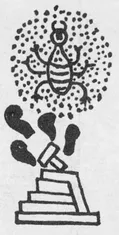
Fig. 10. Atzcapotzalco Destroyed. The temple burns at the Place of the Ant
At other sites, such as Colhuacan, the Toltecan layer is of greater thickness and the archaic layer of lesser thickness. The remains extend below the present level of the water and may indicate that considerable changes have taken place in the level of the lake. But we must remember that many of the ancient settlements were built over the water and that land was made in ancient times, as it is today in the gardens of Xochimilco, by deepening canals. Archaic remains are also common on the denuded tops of hills which may once have been covered by soil.
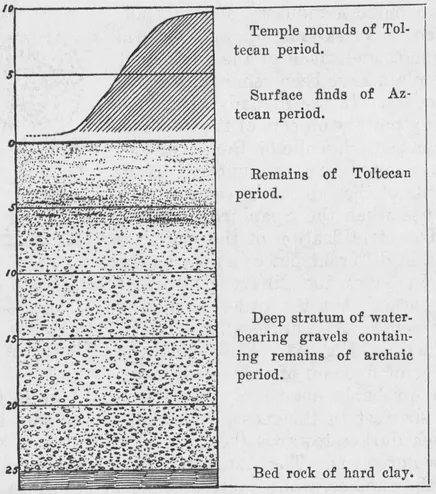
Fig. 11. Diagram of Culture Strata at Atzcapotzalco.
A stratification of archæological remains has recently been determined in Salvador.
The Cemetery under the Lava. An ancient cemetery lying under lava has recently been explored in Copilco, a suburb of Mexico City. The lava swept down from Mount Ajusco in some cataclysm perhaps 3000 years ago, covering many square miles of territory to the depth of thirty or forty feet, and burying such villages as chanced to lie in its path. (See Pl. VIb). The discovery of human remains was made several hundred feet back from the original front of the lava flow in a quarry where lava rock was being removed to build roads. Tales of clay figurines found under the lava in this quarry had been current for years, but no serious investigation was made until human burials were met with in the earth under the great lava cap. Then a series of tunnels was dug and a considerable number of ancient burials were uncovered, but not moved from their original position. One now enters an electric-lighted graveyard and sees human bodies lying exactly as they have lain for untold centuries, with the funeral offerings beside them. This enormously important find gives us an historical level in mid-Archaic.
Another site, at Cuicuilco, on the opposite side of the lava flow, has received attention from archæologists. Here a great round mound rises in terraces faced with cobblestones. It is surrounded by the lava flow and some persons have assumed that the mound was already abandoned and in decay when the lava flow took place. Perhaps, however, the mound was built on a piece of land that the lava flow had spared. There are no contacts between the lava and the mound except at the ends of two projecting aprons or causeways. The pottery at this site is sufficiently different from that found at Copilco.
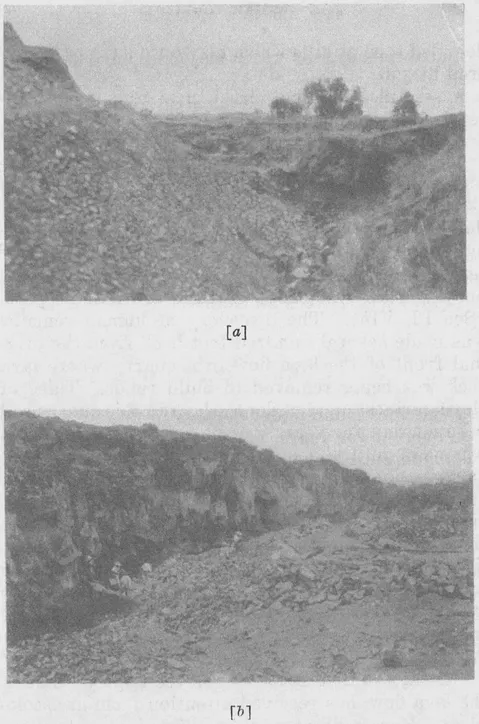
Plate VI. (a) Cuicuilco. A view showing cobblestone facing of mound and lava in contact with apron or causeway; (b) Archaic Site under Lava Flow near Mexico City. A local museum has been established at this site in electric-lighted tunnels.
Invention of Agriculture. Before examining in greater detail the art of the Archaic Horizon let us consider its real significance. It is generally admitted that America was originally populated from Asia, but on a culture level no higher than the Neolithic. The simple arts of stone chipping, basketry, fire-making, etc., were probably brought over by the earliest immigrants, but there is abundant evidence that pottery-making, weaving, and agriculture were independently invented long after the original settlement. The cultivated plants in the New World are different from those of the Old World and there is a vast area in northwestern America and northeastern Asia, upon the only open line of communication, where agriculture and the higher arts have never been practised.
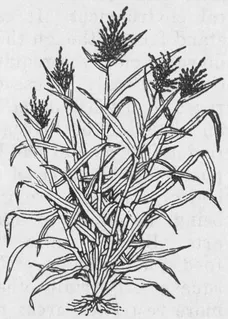
Fig. 12. Teocentli or Mexican Fodder Grass.
Now the invention of agriculture is an antecedent necessity for all the high cultures of the New World. It is equally clear that this invention must have taken place in a locality where some important food plant grew in a wild state. By far the most important food plant of the New World is maize. While this plant has changed greatly under domestication, botanists are inclined to find its nearest relative and possible progenitor in a wild grass growing on the highlands of Mexico and known by the Aztecan name teocentli, which means sacred maize. It is known that maize is at its best in a semi-arid tropical environment. It cannot be brought to withstand frost although the growing season can be cut down to meet the requirements of a short summer. Geographically its use extended from the St. Lawrence to the Rio de la Plata and from sea level to an elevation of fifteen thousand feet in tropical regions. The Mexican highlands occupy the central position in the area of its distribution and archæological evidence strongly points to this region as being the cradle of agriculture and the attendant arts. Besides maize, the most widely distributed food plants of the New World are beans and squashes. Certain other plants were cultivated in more restricted areas and may have had different places of origin. For instance, manioc was doubtless brought under cultivation in a humid lowland region, probably the Amazon Valley, and the same may be said of sweet potatoes. The common potato was found under domestication in Peru and there is no very good evidence that its use extended into Central America.
Irrigation would have been necessary before agriculture could have been developed to any great extent on the highlands of Mexico. Although irrigation is often looked upon as a remarkable sequel of the introduction of agriculture into an arid country, yet from the best historical evidence at our command we should rather regard it as a conception which accounts for the very origin of agriculture itself. The earliest records of cultivated plants are from Mesopotamia, Egypt, Mexico, and Peru where irrigation was practised. In these regions are also seen the earliest developments of the characteristic arts of sedentary peoples, namely, pottery and weaving, and the elaborate social and religious structures that result from a sure food supply and a reasonable amount of leisure.
If this theory is true we must admit that below the Archaic Horizon we should find traces of a horizon of non-agricultural peoples, living a nomadic life without pottery. Unfortunately, such peoples make fewer objects and scatter them more widely than do sedentary agriculturists.
No one on the basis of present knowledge can offer more than an opinion concerning the date of the invention of agriculture in the New World. The thick deposits left by the sedentary peoples argue great age and the wide area of homogeneous products argues slow change. In the most favored regions archaic art may have been succeeded by higher forms shortly before the time of Christ, and perhaps 5000 years is not too long a time to allow for the diversities of the domesticated plants of America.
Archaic Figurines. Archaic art is characterized by figures of men and women modeled in clay and sometimes painted. The forms are peculiar and the technique well standardized. Most are modeled in...
Table of contents
- DOVER BOOKS ON NATIVE AMERICANS
- Title Page
- Copyright Page
- INTRODUCTION TO THE DOVER EDITION
- REFERENCES CITED
- PREFACE
- Table of Contents
- INTRODUCTION
- CHAPTER I - THE ARCHAIC HORIZON
- CHAPTER II - THE MAYAN CIVILIZATION
- CHAPTER III - THE MIDDLE CIVILIZATIONS
- CHAPTER IV - THE AZTECS
- BIBLIOGRAPHY
- INDEX
- A CATALOG OF SELECTED DOVER BOOKS IN ALL FIELDS OF INTEREST
Trusted by 375,005 students
Access to over 1.5 million titles for a fair monthly price.
Study more efficiently using our study tools.
Frequently asked questions
Yes, you can cancel anytime from the Subscription tab in your account settings on the Perlego website. Your subscription will stay active until the end of your current billing period. Learn how to cancel your subscription
No, books cannot be downloaded as external files, such as PDFs, for use outside of Perlego. However, you can download books within the Perlego app for offline reading on mobile or tablet. Learn how to download books offline
Perlego offers two plans: Essential and Complete
- Essential is ideal for learners and professionals who enjoy exploring a wide range of subjects. Access the Essential Library with 800,000+ trusted titles and best-sellers across business, personal growth, and the humanities. Includes unlimited reading time and Standard Read Aloud voice.
- Complete: Perfect for advanced learners and researchers needing full, unrestricted access. Unlock 1.5M+ books across hundreds of subjects, including academic and specialized titles. The Complete Plan also includes advanced features like Premium Read Aloud and Research Assistant.
We are an online textbook subscription service, where you can get access to an entire online library for less than the price of a single book per month. With over 1.5 million books across 990+ topics, we’ve got you covered! Learn about our mission
Look out for the read-aloud symbol on your next book to see if you can listen to it. The read-aloud tool reads text aloud for you, highlighting the text as it is being read. You can pause it, speed it up and slow it down. Learn more about Read Aloud
Yes! You can use the Perlego app on both iOS and Android devices to read anytime, anywhere — even offline. Perfect for commutes or when you’re on the go.
Please note we cannot support devices running on iOS 13 and Android 7 or earlier. Learn more about using the app
Please note we cannot support devices running on iOS 13 and Android 7 or earlier. Learn more about using the app
Yes, you can access Ancient Civilizations of Mexico and Central America by Herbert J. Spinden in PDF and/or ePUB format, as well as other popular books in History & North American History. We have over 1.5 million books available in our catalogue for you to explore.