![]()
1
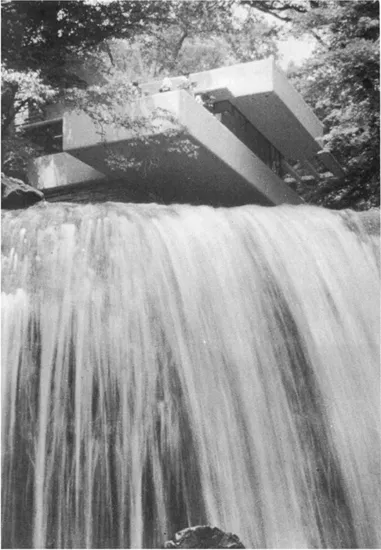
Fall, 1935. Taliesin, Wisconsin: “Come along, E.J. We’re ready for you,” boomed Mr. Wright into the hand-cranked telephone. The call was from Pittsburgh and E.J. was Edgar J. Kaufmann, Sr., department store president. Mr. Wright was to show him the first sketches for his new house, “Fallingwater.”
I looked across my drafting table at the apprentice in front of me, Bob Mosher, whose back had stiffened at the words. Ready? There wasn’t one line drawn.
Kaufmann, an important client, coming to see plans for his house, and was Mr. Wright still carrying the design confidently around in his head?
Their relationship had started in a discussion one Sunday evening the year before when Mr. and Mrs. Kaufmann came out to visit their son, also an apprentice. Sunday evening in the living room at Taliesin was our weekly social event, all in formal dress. There was homemade wine, dinner cooked and served by apprentices, then music—piano, violin, solos, chorus. This evening ended with Mr. Wright’s words of gratitude for our culinary labors and his general philosophical comments. Sitting back in his accustomed chair and addressing his remarks to the group, but his message to the potential client, he expanded his theory for the salvation of America—his vision of the future city based on the automobile, Broadacre City. Mr. Wright declared that if he could, he would create an exhibit of models and drawings of Broadacres and send the message all over the United States. E.J. asked, “What would it take to produce such an exhibit?” Mr. Wright replied without hesitation, “$1000.” E.J.: “Mr. Wright, you can start tomorrow.” We started tomorrow.
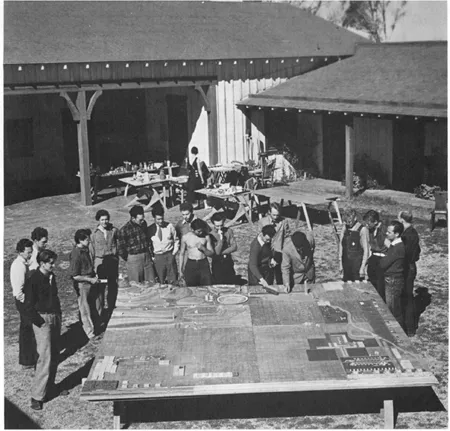
Apprentices gathered around Broadacre City model at La Hacienda, our temporary Arizona headquarters.
Apprentices working on details.
The exhibit was made that winter, our first in Arizona. In the spring four of us apprentices trucked it across the country and through a Kansas dust storm to an exhibit in Rockefeller Center, which then toured the country. That summer Kaufmann commissioned Mr. Wright to design his country house.
Mr. Wright visited the site to help select the appropriate spot on a 2000-acre piece of family land 60 miles south of Pittsburgh—there were fields, gulches, ravines, hillslopes wooded and bare. After much walking, according to Mr. Wright, he asked, “E.J., where do you like to sit?” And E.J. pointed to a massive rock whose crest commanded a view over a waterfall and down into a glen. That spot, Mr. Kaufmann’s stone seat, was to become the heart and hearthstone of the most famous house of the twentieth century.
So that morning in the drafting room, when we overheard him bellow, “Come along, E.J.,” we wondered what could happen. Kaufmann, calling from Pittsburgh, was planning to drive to Chicago, then to Milwaukee, and come to Taliesin. It was the morning that Kaufmann called again from Milwaukee, 140 miles away from Spring Green, and only 140 minutes of driving at a mile a minute, that Mr. Wright was to start drawing. Kaufmann was en route.
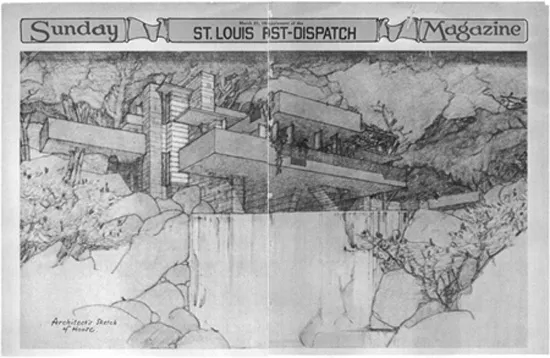
He hung up the phone, briskly emerged from his office, some twelve steps from the drafting room, sat down at the table set with the plot plan, and started to draw. First floor plan. Second floor. Section, elevation. Side sketches of details, talking sotto voce all the while. The design just poured out of him. “Liliane and E.J. will have tea on the balcony … they’ll cross the bridge to walk into the woods …” Pencils being used up as fast as we could sharpen them when broken—H’s, HB’s, colored Castell’s, again and again being worn down or broken. Erasures, overdrawing, modifying. Flipping sheets back and forth. Then, the bold title across the bottom: “Fallingwater.” A house has to have a name….
Just before noon Mr. Kaufmann arrived. As he walked up the outside stone steps, he was greeted graciously by the master. They came straight to the drafting table. “E.J.,” said Mr. Wright, “we’ve been waiting for you.” The description of the house, its setting, philosophy, poured out. Poetry in form, line, color, textures and materials, all for a greater glory: a reality to live in! Mr. Wright at his eloquent and romantic best—he had done it before and would often do it again—genius through an organic growth along with nature. Kaufmann nodded in affirmation.
They went up to the hill garden dining room for lunch, and while they were away Bob Mosher and I drew up the two other elevations, naturally in Mr. Wright’s style. When they came back, Mr. Wright continued describing the house, using the added elevations to reinforce his presentation. Second thoughts? The basic design never changed—pure all the way.
Mr. Kaufmann soon left, drawing continued, and a few days later Mr. Wright went to Pittsburgh, this time carrying still more drawings under his arm, including perspectives marvelously done with colored pencils. More color upon color, day after day—lastly, lavender for haze.
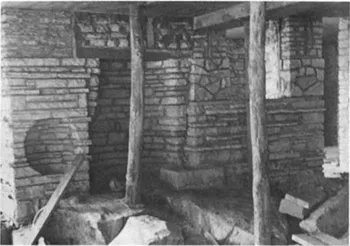
While he was designing, he kept up a running monologue, always with the client in mind. “The rock on which E.J. sits will be the hearth, coming right out of the floor, the fire burning just behind it. The warming kettle will fit into the wall here. It will swing into the fire, boiling the water. Steam will permeate the atmosphere. You’ll hear the hiss …” His pencil broke. One of us handed him another.
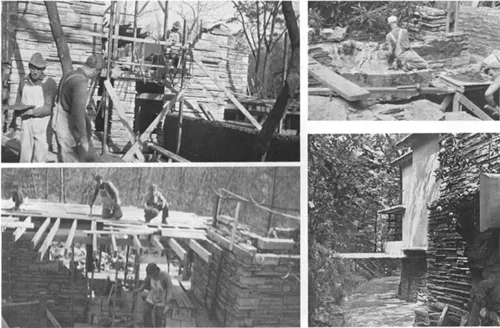
Fireplace for Fallingwater during construction; concave circular form receives kettle.
And always so sure of materials. “The vertical stone walls will be on solid rock, the horizontal slabs of poured concrete, set in like concrete shelves.” Then he visualized the approach. “You arrive at the rear, with the rock cliff on your right and the entrance door to the left. Concrete trellises above. Rhododendra and big old trees everywhere—save the trees, design around them. The sound of the waterfall as background.” Design for people.
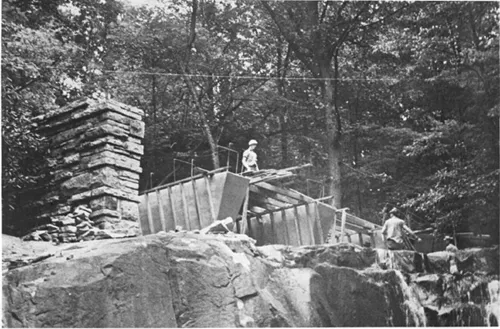
Mr. Wright called the concrete forms “bolsters”—construction up to first floor.
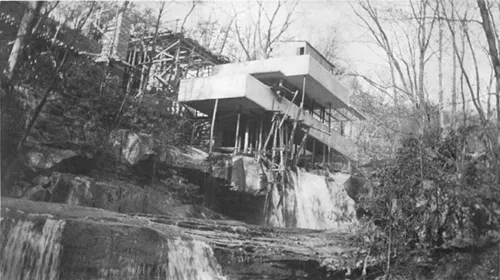
Contractor’s shanty on second-floor balcony of Fallingwater, placed in our absence in exactly the wrong location.
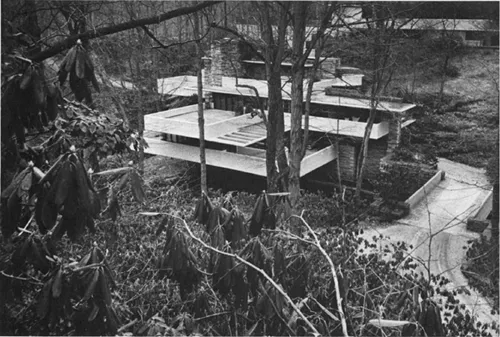
Entrance road to Fallingwater, rock ledge at left.
Winter, 1935: The second Fellowship trek to Arizona, where we produced the working drawings and also those for the Hanna “Honeycomb House” in Stanford. Both houses would eventually be given to the public by their owners.
Spring, 1936: Bob Mosher went to Fallingwater to start supervision from the bottom up. I took it later from the second level to the top. Meanwhile, we were working on the Johnson Building for Racine, other new commissions … Mr. Wright was again a busy architect after a dozen years of doldrums and disregard. The Fellowship was to be his springboard back to creativity. We apprentices were young. Inexperienced. Willing. Devoted. He taught us his way, we couldn’t miss, there was an awakening in architecture, and we were in its midst.
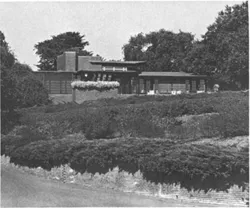
Paul R. Hanna “Honeycomb House,” Stanford, California, 1937.
At nineteen, studying architecture at New York University, I found in the school library a volume of Frank Lloyd Wright’s Princeton Lectures. I’d already read everything I could find by and about him—I was captivated by his designs. But here he seemed to be speaking out of the pages directly to me.
He was saying to the young man, start anew, keeping your inspirations, look to a new orderly way … human and scientific horizons, keep dignity. Words such as dignity, the individual … and with these elements, and a sense of order you can become an architect. The word “architect” was grandeur.
He was writing about the need for law and for nature—always the word “nature”—do not fear law. You will be for law if you are for nature. He went on discussing principle, how it was needed to gain the ends of accomplishment.
I read a newspaper account of a proposed Wright school. That did it. Not yet twenty, living in the depths of the Depression, I made up my mind to leave everything I’d known till then and go off to join Frank Lloyd Wright’s grand scheme—the Taliesin Fellowship. There was a hero!
I thought to myself, “I’d better hurry. The man’s already in his sixties … better get out there fast and learn what I can soon.”
Going to Taliesin meant leaving family, friends, college, whatever material security there was in those days. But it didn’t mean overturning my ideas and giving myself over to a whole new philosophy. No. Taliesin and Mr. Wright’s ideas only seemed a natural outgrowth of the kind of thinking I’d grown up with.
My family was anything but establishment. My parents, who were born in Russia, had a penchant for social change and high cultural ideals. “Greatness” was much discussed in our apartment on New York’s upper West Side, a neighborhood of business owners and executives. Both my father and mother were devotees of outstanding personalities. They were in the high fashion dress business—mother, the designer.
They tried hard to give us—my older brother and myself—an appreciation of the finest. As parents do, they soon extended their ideals and expectations to us. We boys were not only to admire greatness, we were to aspire toward greatness. Awareness of these demands and sensitivity to the very highest in human expression became a constant current throughout my young days, at home and at school.
In Mr. Wright, I found my own great man. I never discussed my feelings with him in exactly these terms, but he must have had an idea of my thoughts, knowing my background as he did. It’s not that I chose only to study under Mr. Wright. Here was the giant to look up to, the creative source to draw from and give form and character and clarity to what, some day, might be my own ideas. I didn’t think I could emulate such a giant, or anyone for that matter. I didn’t believe my ideas were especially creative or original, unlike many young people who begin architecture convinced that their buildings will change the world. On the other hand, I was never one to copy or parrot what I found around. By twenty, my spirit was already independent, and the next nine years in the Taliesin Fellowship made me more so, more myself and not a flat, faded image of someone else’s genius. This, I think, is the germ of my unique relationship with Mr. Wright—and possibly the cause of later difficulties.
Independence had always been given full license in my family. My schooling was more than progressive. It was quite extraordinary. When I was about eight, the family moved to New Jersey to join a colony. A group had organized as single-taxers, in the Henry George fashion, bought up land, put roads through, built houses, paid their “single tax” to the county as a farm. They set up their own school, where I was to go. The school was run on a simple system—learning by doing.
The educational process was something less than formal; the school demanded no discipline. A combination of arts and crafts, gardening and vegetable farming, and sports gave us vigorous spirits, but our academic training was a bit flimsy.
Nor was the teaching staff at all traditional. For example, “Uncle Scott” was the printing teacher, and since the children were taught to read by setting type and working the press, he had an important academic responsibility. Uncle Scott was a completely self-educated man. He’d grown up on a farm in Missouri, but he must have been quite literate, because when he wasn’t teaching us, he worked as a proofreader for The New York Times. Uncle Scott was also the champion marble player, and in marble season he was with us outside, by the road that ran past the school, shooting his glass “immies.” We admired a player so powerful that he could take an “aggie” and hit an immie and break it at great distance. In the printshop, we worked the presses and memorized all the cases for the letters. We learned to set type backwards, so it would give the correct image when printed. The most difficult thing was trying to keep our fingers out of the press. For us, the printshop wasn’t just a game. We actually printed all the stationery for the school and our own school magazine, as well as separate articles written by the adults in the community.
When our Ferrer School, named after a martyred Spanish freethinker, first set up, some innovative people incorporated the concepts of Froebel into the primary-level curriculum. By now, Froebel’s kindergarten has become so much a part of education that we don’t even think of it, but in the mid-nineteenth century, when he worked out his idea for preschool education, the concept was revolutionary. He gave much thought to channeling play-energy into constructive learning patterns and into a child’s spontaneity. The toys he designed, known as “gifts,” consisted mainly of beautiful, smooth, natural wood blocks in simple geometric shapes.
The cube, cylinder, and sphere were the first toys given to the young child, and each set of gifts was progressively more challenging. Along with the basi...