Realizing that matrices can be a confusing topic for the beginner, the author of this undergraduate text has made things as clear as possible by focusing on problem solving, rather than elaborate proofs. He begins with the basics, offering students a solid foundation for the later chapters on using special matrices to solve problems.
The first three chapters present the basics of matrices, including addition, multiplication, and division, and give solid practice in the areas of matrix manipulation where the laws of algebra do not apply. In later chapters the author introduces vectors and shows how to use vectors and matrices to solve systems of linear equations. He also covers special matrices — including complex numbers, quaternion matrices, and matrices with complex entries — and transpose matrices; the trace of a matrix; the cross product of matrices; eigenvalues and eigenvectors; and infinite series of matrices. Exercises at the end of each section give students further practice in problem solving. Prerequisites include a background in algebra, and in the later chapters, a knowledge of solid geometry. The book was designed as an introductory text for college freshmen and sophomores, but selected chapters can also be used to supplement advanced high school classes. Professionals who need a better understanding or review of the subject will also benefit from this concise guide.
Frequently asked questions
Yes, you can cancel anytime from the Subscription tab in your account settings on the Perlego website. Your subscription will stay active until the end of your current billing period. Learn how to cancel your subscription.
No, books cannot be downloaded as external files, such as PDFs, for use outside of Perlego. However, you can download books within the Perlego app for offline reading on mobile or tablet. Learn more here.
Perlego offers two plans: Essential and Complete
Essential is ideal for learners and professionals who enjoy exploring a wide range of subjects. Access the Essential Library with 800,000+ trusted titles and best-sellers across business, personal growth, and the humanities. Includes unlimited reading time and Standard Read Aloud voice.
Complete: Perfect for advanced learners and researchers needing full, unrestricted access. Unlock 1.4M+ books across hundreds of subjects, including academic and specialized titles. The Complete Plan also includes advanced features like Premium Read Aloud and Research Assistant.
Both plans are available with monthly, semester, or annual billing cycles.
We are an online textbook subscription service, where you can get access to an entire online library for less than the price of a single book per month. With over 1 million books across 1000+ topics, we’ve got you covered! Learn more here.
Look out for the read-aloud symbol on your next book to see if you can listen to it. The read-aloud tool reads text aloud for you, highlighting the text as it is being read. You can pause it, speed it up and slow it down. Learn more here.
Yes! You can use the Perlego app on both iOS or Android devices to read anytime, anywhere — even offline. Perfect for commutes or when you’re on the go. Please note we cannot support devices running on iOS 13 and Android 7 or earlier. Learn more about using the app.
Yes, you can access Introduction to Matrices and Vectors by Jacob T. Schwartz in PDF and/or ePUB format, as well as other popular books in Mathematics & Algebra. We have over one million books available in our catalogue for you to explore.
As we have done more and more sophisticated mathematics in our previous studies, we have had occasion to use more and more sophisticated kinds of “numbers.” We began with positive whole numbers, like 1, 2, 3, . . . . Then, in order to make subtractions like 3 − 7 possible, the negative whole numbers, like −1, −2, −3, . . . , had to be introduced. Next, in order to make it possible to divide any two numbers, fractions were invented:
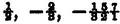
, etc. This still did not bring us to the end of our story; for, in order that every number have a square root, a cube root, a logarithm, a sine, and so forth, it was necessary to invent still more numbers: the infinite decimals, or real numbers, like 1.4142 . . . , 3.1415928 . . . , 0.13131313 . . . . Finally, in order that even negative numbers have square roots, it was necessary to invent complex numbers, like
Whenever there seemed to be good reason to do so, we have invented new kinds of numbers. For instance, in inventing complex numbers, we began not with the numbers but with a purpose: to find a system of numbers, including all the real numbers, in which every number had a square root. Once we have made such an invention, it should not be hard for us to realize that there is no reason to stop inventing; that is, there is no reason why other kinds of numbers should not be useful for other purposes. There is no reason why we should not hope to invent many different kinds of new numbers.
Of course, as an inventor, it is easy to invent things that do not work, but harder to invent things that do work; easy to invent things that are useless, but hard to invent things that are useful. The same is true about the invention of new kinds of numbers. The hard thing is to invent useful kinds of numbers, and kinds of numbers that work. It is easier to make inventions than to make successful inventions. Nevertheless, a large variety of more or less successful new kinds of numbers have been invented by mathematicians. In this course you are going to study one of the most successful of these new kinds of numbers: the matrices.
Before you are told what matrices are, it is well to emphasize their importance. Matrices are useful in almost every branch of science and engineering. A great number of the computations made on the giant “electronic brains” are computations with matrices. Many problems in statistics are expressed in terms of matrices. Matrices come up in the mathematical problems of economics. Matrices are extremely important in the study of atomic physics; indeed, atomic physicists express almost all their problems in terms of matrices. It would not be an exaggeration to say that the algebra of matrices is the language of atomic physics. Many other kinds of algebra, like complex-number algebra (and like vector algebra, which...
Table of contents
–DOVER BOOKS ON MATHEMATICS
Title Page
Copyright Page
PREFACE
Table of Contents
Chapter 1 - DEFINITION, EQUALITY, AND ADDITION OF MATRICES
Chapter 2 - MULTIPLICATION OF MATRICES
Chapter 3 - DIVISION OF MATRICES
Chapter 4 - VECTORS AND LINEAR EQUATIONS
Chapter 5 - SPECIAL MATRICES OF PARTICULAR INTEREST
Chapter 6 - MORE ALGEBRA OF MATRICES AND VECTORS
Chapter 7 - EIGENVALUES AND EIGENVECTORS
Chapter 8 - INFINITE SERIES OF MATRICES
INDEX
A CATALOG OF SELECTED DOVER BOOKS IN ALL FIELDS OF INTEREST
