![]()
CHAPTER ONE
Even and Odd
SOME results in arithmetic can be grasped by a single act of mental vision. For example, suppose someone has played dice sufficiently to realize that the pattern
represents 6. It is immediately apparent that 6 consists of 2 rows of 3. In this sense, the result 6 = 2 × 3 is one that we can see directly.
Unfortunately, this kind of direct vision leaves off almost as soon as it has begun. In the lines above, the words immediately, unfortunately, arithmetic have occurred. How many letters are there in each of these words? Few people can answer without counting or breaking these words into smaller groups. One might perhaps see arithmetic as arith metic and realize that it contained 2 groups of 5 letters, making 10 in all. Even so, we have gone beyond the bounds of direct vision. We have a fairly clear picture of the smallest numbers. Beyond them, we see only a blur.
The average man is often too modest. He sees only a blur. He may blame himself for this; cleverer people, he may think, see clearly. But this is not so. The blur into which all numbers dissolve soon after 4 or 5 is the common experience of us all. If I am shown the answer to a multiplication question, such as 127 × 419, I do not know at a glance whether the answer is correct or not. I can sympathize with children who are helpless before the question ‘What is 7 x 8?’ I know, of course, that the answer is 56, because that was well drilled into me in my childhood, but it is not something that I can see directly. So it is understandable that children have no idea at all of how to cope with this question, and give all kinds of answers at random.
How to organize the chaos that lies beyond the smallest numbers is therefore a problem that confronts the entire human race.
While we cannot see the correct answer to 127 × 419, there are certain tests we can apply. We would, for example, reject immediately the answer 23 as being much too small, or 1,000,000,000 as being much too large. We would also reject the answer 53,312 although it is about the right size. For 127 and 419 are both odd numbers. It is impossible that their product should be an even number, 53,312.
The classification into even and odd brings us once more within the scope of vision. If we look at this number:
we can probably not tell without counting what number it is, but we can see at a glance that it is even. It has the characteristic shape of an even number. It can be divided into two equal parts, like this:
Also, it can be broken up into pairs, like this:
At a dance, if there are several couples on the floor, and no eccentric individuals dancing alone or in threes or other groupings, we can be sure that the number of people dancing is even. Evenness is thus a quality we can recognize in collections which we have not counted.
An odd number, on the other hand, has a shape such as:
You cannot break it up into couples. One dot is left without a partner. Of course, we could place this shape the other way up:
It would still represent an odd number.
The addition properties of even and odd are now apparent. Addition may be pictured as ‘putting together’. If we put two even numbers together:
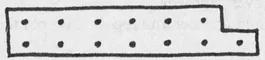
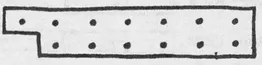
they form an even number, as we can see from the shape above. But if we put together an odd number and an even number, we obtain an odd number, as is shown by these shapes.
Finally, if we join together two odd numbers they dovetail to form the shape of an even number.
For multiplication, we might picture five sixes like this:
This has the shape of an even number. Clearly any number of sixes will give an even shape:
There is nothing special about six; the same illustration will serve for any even number. An even number multiplied any number of times gives an even number.
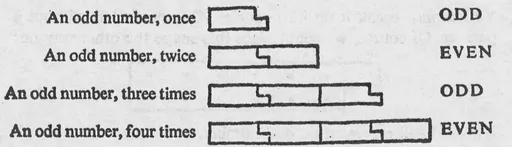
If we take an odd number and repeat it we obtain the following pictures.
Here it is fairly evident that odd and even shapes occur alternately. If we repeat an odd number an even number of times, the total is even. If we repeat an odd number an odd number of times, the total is odd. So ‘even times odd is even, odd times odd is odd’.
PICTURES OF MULTIPLICATION
If you are seeking to understand, or to remember, or to teach mathematics through pictures, you should never allow yourself to be tied to one particular image of a mathematical idea. A picture that is suitable for one purpose may be most awkward for another.
In attempting to illustrate the result ‘odd times odd is odd’, I had to consider different ways of representing multiplication and see which was most suitable. I am by no means sure I chose the best.
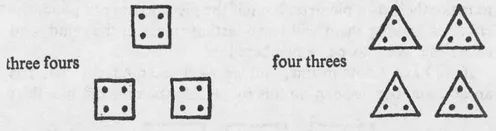
Here are a few ways of picturing multiplication. We might, for example, picture 3 fours and 4 threes like this:
In some connexion it might be desirable to picture 3 as
and 4 as
In that case, we might use these pictures:
Method B
In both of these, the special patterns for 3 and 4 are apparent.
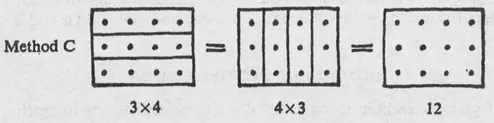
None of the above brings out the fact that 3 fours and 4 threes are the same number, 12. This can be shown by using a rectangle, as in Method C:
The rectangle is a very useful way of showing multiplication...