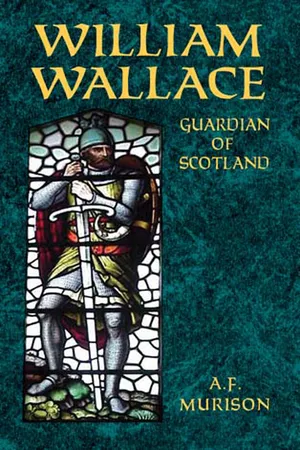
The assassination of Scotland's King Alexander III in 1286 foreshadowed troubles with the English. When Edward I of England failed in his attempt to place his niece upon the Scottish throne, a gap appeared in the royal succession, giving the Scots an opportunity to place one of their own at the head of government. The leader of the movement was William Wallace (c. 1270-1305), a fateful figure in the history of Scotland. This brief study recounts Wallace's legendary life — from his years as a youth and young man spearheading guerrilla warfare against the English, to his designation as "Guardian of Scotland," and his ultimate betrayal and execution. A vivid record of a leader with a powerful hold on the imagination of his people, this important book will be welcomed by students of history and admirers of the Scottish patriot.
‘ Quhen Alysandyr oure Kyng wes dede, That Scotland led in lu
e and lé, Away wes sons of ale and brede, Off wyne and wax, off gamyn and glé:
‘ Oure gold wes changyd in to lede. Cryst, borne in to Vyrgynyté, Succoure Scotland and remede, That stad [is in] perplexyté.’
WYNTOUN, VII. fin.
A MOST fateful date in the history of Scotland was the 19th of March 1285—86. In the dusk of that memorable day, King Alexander III., riding along the coast of Fife, near Kinghorn, was thrown over a precipice and killed. He was only in the forty-fifth year of his age, though in the thirty-seventh year of his reign. If we take our stand at Kinghorn on the next melancholy morning, and gaze backwards and forwards on the history of the country, we shall witness the most impressive contrast of peace and war that is presented in the annals of Scotland, or perhaps of any civilised nation in the world. This awful contrast forms a most essential element in determining the judgment of history on the policy of the Scots and of the English kings. At the death of Alexander, Scotland was a most prosperous country, steadily advancing in the arts of peaceful life—‘more civilised and more prosperous,’ says Innes, with the common assent of historians, ‘than at any period of her existence, down to the time when she ceased to be a separate kingdom in 1707.’ The policy of Edward I., however motived, was the prime cause of this lamentable subversion of the tranquillity of a hundred years.
THE PROJECT OF MARRIAGE
The shadows of coming trouble had fallen upon Scotland before the death of Alexander III. The family of the King had been swept away by death. His first queen, Margaret, eldest daughter of Henry III. and sister of Edward I. of England, had died in 1275. His younger son, David, had died in 1280. His elder son, Alexander, who married Margaret, daughter of Guy, Count of Flanders, in 1282, had died without issue early in 1283—84. His only daughter, who married Eric II., King of Norway, in 1281, had also died early in 1283—84, leaving a daughter. Alexander was little over forty. Still there is no assurance of length of days; and if he should die there would be a minority, probably a disputed succession, possibly an active revival of the English claim to over-lordship. In these circumstances, Alexander at once proceeded to take such precautions as he could. He summoned a Parliament at Scone on February 5, 1283—84, and obtained from his nobles their solemn acknowledgment of Margaret, Princess of Norway, as heiress of Scotland, failing issue of himself and of his late son. Towards the end of next year, he also married a second wife, Joleta (or Iolande), daughter of the Count de Dreux ; but she bore him no child. Alexander must have often and anxiously reflected upon the likelihood of a recurrence of such baronial rivalries as had proved a grave danger to the country during his own minority. On his tragic death on March 19, 1285—86, the hopes of the nation were left to rest upon the fragile Maid of Norway.
For a short period the affairs of the kingdom maintained a placid course. On April 11, 1286, the magnates assembled at Scone, and selected six of their number to act as a Council of Regency, with the official designation of ‘the Guardians of the Kingdom of Scotland appointed by the common advice.’ The Bishop of St. Andrews and the Earls of Fife and Buchan were to administer the districts north of the Forth ; the Bishop of Glasgow, Comyn of Badenoch, and James the Steward of Scotland, were to rule the lands south of the Forth. No question was raised as to the succession of the little princess, and ostensibly there was every disposition on the part of the barons to fulfil the solemn pledges they had made to her grandfather two years before. It may, however, be open to doubt whether intrigue had not commenced to operate by the time that Alexander III. was laid to rest at Dunfermline.
For one thing, there is extant a letter of credence, dated Dunfermline, March 29, 1286, addressed to King Edward by the Bishops of St. Andrews and Glasgow, ‘in their own name, and in the name of the clergy, earls, barons, and all others of the realm of Scotland, who had been present at the burial of the lord Alexander of good memory, the late illustrious King of Scotland,’ and commending to Edward’s confidence the two bearers, the Prior of the Dominicans of Perth and brother Arnold. The two friars were to deliver an oral communication, and bring back the King’s answer. There remains no record of the matter of either message or reply. It is not easy to suppose that the business was of no deeper import than formal and complimentary intercourse. In view of the circumstances, it all but certainly must have borne reference, in part at least, to the settlement of the succession. The political record of the Bishop of St. Andrews is not calculated to disarm suspicion. Edward, at any rate, appears to have been satisfied, for he presently embarked for France, and remained away for more than three years.
Again, a few months later, Bruce of Annandale—ex-Chief-Justice of England, smarting under his recent supersession—Bruce and his principal adherents took quiet action in view of contingencies. On September 20, at his son’s castle of Turnberry, fourteen Scots nobles—Patrick, Earl of Dunbar, and three sons ; Walter, Earl of Menteith, and two sons ; Bruce, lord of Annandale, and two sons ; James, Steward (and one of the Guardians) of Scotland, and John his brother ; and Angus, son of Donald of the Isles, and his son—entered into a stringent bond, obliging them to give faithful adherence to Richard de Burgh, Earl of Ulster, and Lord Thomas de Clare (brother of Gilbert, Earl of Gloucester, Edward’s son-in-law and Bruce’s brother-in-law), ‘in their affairs.’ The nature of these affairs is not indicated, neither is there any other record of them. There is a suggestive clause saving their fealty to the King of England, and to ‘him that shall obtain the kingdom of Scotland through blood relationship with King Alexander of blessed memory, according to the ancient customs in the Kingdom of Scotland approved and observed.’ There is no direct reference to the child queen. It is useless to inquire what was the business that Richard de Burgh and Thomas de Clare had on hand or in contemplation. Plainly the instrument was simply a diplomatic process of binding all the parties together in support of such action as Bruce might take on the advice of a majority of their number, for advancing his pretensions to the throne of Scotland, when opportunity should serve. There is nothing to show that Edward ever had knowledge of this bond.
Somewhere about this time, moreover, Bruce passed from speculation to action. Balliol, in his pleadings before Edward in 1291, averred that, in violation of their oath of fealty to Queen Margaret, ‘Sir Robert Bruce and the Earl of Carrick, his son, attacked the castle of Dumfries with fire and arms, and banners displayed, and against the peace expelled the forces of the Queen, who held the same. Hence Sir Robert advanced to the castle of Buittle. He then caused a proclamation to be made by one Patrick M‘Guffock, within the bailiary of the said castle,’ with the result that good subjects were driven from the land. ‘Furthermore,’ the allegation ran, ‘the Earl of Carrick, by the assent and power of his father, took the Lady of Scotland’s castle of Wigton, and killed several of her people there.’ A number of entries in the Exchequer Rolls combine to support Balliol’s charge, and even to show that the wave of disturbance was felt on the eastern seaboard. How Bruce was brought back to peaceable ways does not appear.
The temporary stir occasioned by Bruce’s eagerness was the only ripple on the face of affairs for some three years. Early in 1289, however, Edward seems to have made up his mind to strengthen his hold on Scotland by a marriage between the young Queen and Prince Edward of Wales. The proposed parties, being cousins-german, were within the degrees prohibited by the canon law ; and on May 8, Edward despatched Sir Otho de Grandison to Rome, with letters from himself and a petition from the Prince, soliciting from Pope Nicholas IV. the necessary dispensation. The idea may have presented itself to Edward’s mind two years earlier ; for on May 27, 1287, he had obtained a Bull from Pope Honorius IV. permitting him to marry his children to relatives in the fourth degree of affinity or consanguinity. However this may be, in April and May 1289, envoys passed to and fro between Edward and Eric on ‘certain affairs,’ which were no doubt affairs tending in the direction of the marriage. On November 6, commissioners representing the three countries concerned met at Salisbury, and concluded a treaty. Eric was to send the Queen to England or to Scotland by November 1 next year, free from matrimonial engagement. If she came to England, Edward would, on the establishment of security and peace in Scotland, and on the demand of the Scots nation, send her to Scotland, in like manner free from matrimonial engagement, provided ‘the good nation of Scotland’ gave ‘sufficient and good security’ to Edward not to marry her without the appointment and advice of himself and the assent of the King of Norway. The Scots envoys engaged to establish such order as to secure the Queen in the quiet enjoyment of her realm. The preamble of the treaty is framed so as to convey that Eric was the prime mover in the business. He is represented as having applied to Edward for aid and advice, the object being to secure for Edward’s niece the obedience of her subjects and the free exercise and enjoyment of her royal powers, after the manner of other kings in their own kingdoms. On receiving this appeal, Edward, in his zeal for the peace of Scotland, and for the establishment of his niece in her rightful position, invited the Guardians to send commissioners to the Salisbury convention. But there can be no doubt that Edward himself was the prime mover. Eric certainly was loth to part with his child; he had made no representation on her behalf to the Scots Guardians, nor had they indicated any wish to have her in Scotland. On the other hand, Edward’s project of marriage would naturally require her presence on this side of the North Sea ; and his influence with Eric was backed by a recent loan of 2000 marks with easy arrangements for repayment, which seems not to have been yet discharged. It may be greatly doubted whether Edward was taking all this trouble out of disinterested anxiety for the welfare and royal status of his niece, or for the security of peace on the English border. The treaty gives no hint that the Salisbury commissioners had before them the marriage contemplated by Edward; the terms of the engagement of the Scots, as well as the absence of an express statement, would seem to negative the idea. Sufficient reason may be found in the fact that the dispensation had not then been granted, as well as in Edward’s desire to proceed with most cautious steps. It is to be remarked that not only in the treaty, but also in the Prince’s petition to the Pope, and in a communication of Edward’s addressed to the Scottish people on the same day as the treaty was made, and counselling the obedience of all to the Guardians, the great object of the peace and reformation of Scotland is dwelt on with suspicious emphasis. Sir Otho de Grandison returned to London on December 31. With the irony of fate, the dispensation, which had been granted (and acknowledged handsomely in gold florins) on November 16, did not arrive in the form of a Bull till October 9, 1290, almost simultaneously with the arrival of the rumour of the Queen’s death.
At a conference held at Brigham on March 14, 1290, the treaty of Salisbury was confirmed. Three days later, the Guardians, who had now at least been informed of Edward’s intention and of the dispensation, addressed a letter to Edward assenting to the proposed marriage, and another letter to Eric urging him to send Margaret at once to England. It may seem strange that they should not have asked him to send her to Scotland ; but Edward obviously had laid great stress on the alleged risks of the unsettled condition of the country ; his solicitude, from a family point of view, was not at all unreasonable ; probably enough he had impressed Eric with anxiety on the same ground; and the Guardians seem to have had no serious anticipation that their Queen’s grand-uncle would infringe the international friendship of a century. The Guardians’ letter to Eric was followed by one from Edward in the same sense, on April 17. Already the King’s butler was down at Yarmouth, preparing and victualling ‘a great ship’ to carry Edward’s plenipotentiary, Antony Bek, the astute and magnificent Bishop of Durham, with an imposing retinue, to Norway. The preparations took forty days; and at length Bek sailed from Hartlepool on the 9th of May. Bek was an adept in smoothing the diplomatic path; he distributed judicious annuities to Norwegian friends to the extent of £400 a year till the Queen should attain the age of fifteen. Presumably the grand outfitting of the ship implies that the Queen was expected to come over in it; but it returned without her in June. It was not till September that Eric set out with his daughter. In the beginning of September, accordingly, Edward again despatched Bek, this time to Orkney, to meet the Maid. He was also attentive enough to send an ample variety of jewels for the Queen’s use. At almost every step in the proceedings, the records betray his eager haste. The Guardians exhibited no such fervour; it was not till October 3 that they accredited their envoys, and already they had been urged to action by Edward.
Meantime the Guardians had been taking thought for the security of the kingdom. The negotiations with Edward issued in the treaty of Brigham on July 18, 1290. By this treaty it was provided that the laws, liberties, and customs of Scotland should remain inviolate for ever, and that the realm should remain separate from, and entirely independent of, England. No parchment terms could have done more to secure independence. There was, indeed, an insidious saving clause, steadily recurrent, which reserved such rights as Edward or others might have; but whether intended to neutralise the specific provisions or not, it must be regarded as purely formal.
The ardent development of Edward’s care for his grand-niece and his son ought to have been at least suggestive. There remain two striking documents, dated August 28. In one of them, the Guardians agree to deliver the castles of Scotland under certain conditions to their Queen and Prince Edward ; and in the other, Edward notifies the Guardians of his appointment of Bishop Bek to act in concert with them as lieutenant of the royal couple. For it was incumbent upon him to respect his oath to maintain the laws of Scotland. He even appears to have gone so far as to demand the surrender of the castles to himself, but this demand the Guardians refused.
The whole of the laborious structure was levelled to the ground on October 7, when the Bishop of St. Andrews reported to Edward the rumour of the Queen’s death at Orkney. The Queen had died on the passage from ‘Norrowa’ o‘er the faem.’ The details are unknown. The very fact, indeed, has been questioned; for a young woman claiming to be Margaret, and telling a circumstantial story of her being kidnapped at Orkney on the voyage to Scotland, was burnt at the stake at Bergen in 1301 as an impostor. Be this as it may, the luckless Margaret now passes out of the history of Scotland, leaving a divided kingdom face to face with the aroused cupidity of a determined, astute, and unscrupulous neighbour.
THE ASSERTION OF OVER-LORDSHIP.
Who should now succeed Margaret on the Scottish throne? Fordun relates that Malcolm, the first ‘rex Scotiae,’ decreed a change in the principle of succession. This enactment is said to have provided that thenceforth each king should be succeeded by whoever was, at the time being, the next descendant; that is, a son or a daughter, a nephew or a niece, the nearest then living. It is not at all unlikely that the disturbance of the balance of the kingdom by the acquisition of Lothian may have rendered the substitution of the Teutonic for the Keltic law of succession expedient, or even necessary The claims of Balliol and Bruce alone need to be considered ; and if this law was formally established, the letter of it would be a strong support to Bruce’s candidature, whatever the spirit of its intention. For the present purpose, however, we are not concerned with the validity of the claims of either competitor, but mainly with the process whereby the final decision was reached. The essential point is to discern the real spirit governing the evolution of events.
The death of Margaret at once urged the competitors to fresh activity. The Guardians were divided in their sympathies, and the division no doubt ran deep into the community. The first overt movement, so far as existing documents indicate, was made by Bruce. It was an indirect, tentative operation. Towards the end of the year (1290), an appeal was preferred to Edward by ‘the seven earls’ and the community of the realm of Scotland against the Bishop of St. Andrews and Sir John Comyn in respect of their action as Guardians. The appellants asserted their privilege of placing the King of Scotland on the throne, complained of acts of oppression exercised by the Guardians on Donald Earl of Mar and the freemen of Moray, narrated the recognition of Robert Bruce of Annandale as next heir to the throne by Alexander II., and alleged some minor grievances. At this time there were only four Guardians, the Earl of Fife having been murdered and the Earl of Buchan having died; and the two not inculpated, the Steward of Scotland and the Bishop of Glasgow, were fast friends of Bruce. Mar and Moray also leant to Bruce’s faction. Evidently the appeal was promoted in the interests of Bruce, and with his knowledge, if not positively at his instigation. There is no record of any answer.
There is a glimpse of still earlier action by Bruce in the letter of the Bishop of St. Andrews to Edward, reporting the rumour of the Queen’s death. The rumour arrived when the Estates were sitting to receive Edward’s answer to the refusal to surrender the castles to him. Bruce, the Bishop says, had not intended to be present, but, on hearing the rumour, had appeared with a strong following. His ultimate intentions the Bishop could not tell. Then follows a significant point. Should it unhappily prove true that the Queen is dead, the Bishop urges Edward to come to the marches without delay, with the view of preventing bloodshed, and of aiding the faithful of the land to place on the throne the man that possesses the proper title—meaning, of course, Balliol. To interpret the Bishop as merely currying favour with the King is probably a large stretch of charity. He certainly stood in a small minority in desiring Edward’s intervention. The chroniclers, indeed, relate how the community of the realm, impressed by the ancient friendship between the two kingdoms and the particular cordiality of Alexander III. and Edward, invited the English King to arbitrate on the claims of the competitors. But no such invitation is traceable in the records, and, on that ground alone, apart from the strong probabilities, it may safely be believed that such an invitation was never sent. There was not the least occasion for it, on either side. It certainly would not have represented the true feeling of the community of Scotland ; and no doubt Edward was fully aware of the fact, for, in the whole transaction, he studiously treated that body with very scant regard.
The Waverley Annalist states that in March 1291, on the day after Ascension, Edward declared to his nobles, in the presence of nine of the competitors, who at the same time submitted their claims to him, that he was resolved to subdue Scotland as he had recently subdued Wales. But Edward was now on the peaceful tack of legal process. The competitors, though mostly great Scots nobles, were also mostly the liegemen of Edward for large possessions in England ; and not one of them could dare to claim the throne of Scotland without regard to Edward’s opinion. It was quite inevitable that every one of them should submit to his judgment. Besides their material interests in England, they were of Norman descent and of Norman upbringing and Norman sympathies, and thus they were largely alien to the mass of the Scottish population. Their interest in Scotland was little, if anything, more than a matter of land and lordship. They were quite content to take the kingdom of Scotland as a bigger fief. It was therefore the most natural thing in the world for them to leave the decision of the case in the hands of their liege lord, the King of England. For the community of Scotland the question wore a wholly different aspect.
Edward had taken good care not to allow the matter to slumber through the winter. He had sent forth his commands to all the religious houses of the land, requiring them to search diligently in their chronicles, and to transmit to him speedily extracts of all such passages as might bear on the relations of England and Scotland. Such of these extracts as had come to hand, he caused to be recited before his Parliament assembled at Norham on May 10. By the mouth of his Justiciary, Sir Roger le Brabazon, he set forth his solicitude for the peace of Scotland and his anxiety to do justice to all, and required the Scots prelates and nobles to recognise his superiority and direct lordship—a claim affirmed to be ‘clear, from chronicles found in different monasteries and other places in England and Scotland, from other sources of information, from certain documents, and on most evident reasons.’ The Scots nobles present, although previously informed of Edward’s intentions, represented their inability to reply without further consultation with nobles and others not then present. The meeting was adjourned till next day, when Bishop Bek, not Edward personally, announced that they might take three weeks, at the end of which time they would be expected to produce any evidence they might be able to find against the King’s claim of superiority.
Meantime the returns from the religious houses continued to pour in. The Scots nobles also must have exhibited anxiety for the independence of Scotland ; for on May 31 Edward made them a declaration that the coming of the magnates and the Community of Scotland to Norham should not be drawn into a precedent in prejudice of the liberties of the realm. Then, on June 2, the Scots nobles assembled on Upsetlington Green—Holywell Haugh—on the north side of the Tweed, opposite to Norham Castle. The Bishop of Bath and Wells, Chancellor of England, with the usual preliminary flourish about the gracious feelings and intentions of Edward, informed them that the Kings of England from the remotest times had held the over-lordship of Scotland. They themselves, he pointed out, had not even now brought forward ...
Table of contents
Title Page
Copyright Page
Dedication
PREFACE
Table of Contents
CHAPTER I - THE ENGLISH AGGRESSION
CHAPTER II - WALLACE’S FAMILY AND EARLY YEARS
CHAPTER III - GUERRILLA WARFARE
CHAPTER IV - THE DELIVERANCE OF SCOTLAND
CHAPTER V - WALLACE GUARDIAN OF SCOTLAND
CHAPTER VI - WALLACE IN FRANCE
CHAPTER VII - THE LEADERSHIP OF THE BARONS
CHAPTER VIII - THE BETRAYAL AND DEATH OF WALLACE
CHAPTER IX - THE PATRIOT HERO
Trusted by 375,005 students
Access to over 1.5 million titles for a fair monthly price.
Study more efficiently using our study tools.
Frequently asked questions
Yes, you can cancel anytime from the Subscription tab in your account settings on the Perlego website. Your subscription will stay active until the end of your current billing period. Learn how to cancel your subscription
No, books cannot be downloaded as external files, such as PDFs, for use outside of Perlego. However, you can download books within the Perlego app for offline reading on mobile or tablet. Learn how to download books offline
Perlego offers two plans: Essential and Complete
Essential is ideal for learners and professionals who enjoy exploring a wide range of subjects. Access the Essential Library with 800,000+ trusted titles and best-sellers across business, personal growth, and the humanities. Includes unlimited reading time and Standard Read Aloud voice.
Complete: Perfect for advanced learners and researchers needing full, unrestricted access. Unlock 1.5M+ books across hundreds of subjects, including academic and specialized titles. The Complete Plan also includes advanced features like Premium Read Aloud and Research Assistant.
Both plans are available with monthly, semester, or annual billing cycles.
We are an online textbook subscription service, where you can get access to an entire online library for less than the price of a single book per month. With over 1.5 million books across 990+ topics, we’ve got you covered! Learn about our mission
Look out for the read-aloud symbol on your next book to see if you can listen to it. The read-aloud tool reads text aloud for you, highlighting the text as it is being read. You can pause it, speed it up and slow it down. Learn more about Read Aloud
Yes! You can use the Perlego app on both iOS and Android devices to read anytime, anywhere — even offline. Perfect for commutes or when you’re on the go. Please note we cannot support devices running on iOS 13 and Android 7 or earlier. Learn more about using the app
Yes, you can access William Wallace by A. F. Murison in PDF and/or ePUB format, as well as other popular books in History & British History. We have over 1.5 million books available in our catalogue for you to explore.