![]()
EXTRACTS FROM DICTIONARY.
In the printed but unpublished Collection before mentioned, page 396, nearly three hundred quarto pages are devoted to descriptions of signs arranged in alphabetic order. A few of these are now presented to show the method adopted. They have been selected either as having connection with the foregoing discussion of the subject or because for some of them pictorial illustrations had already been prepared. There is propri-ety in giving all the signs under some of the title words when descriptions of only one or two of those signs have been used in the foregoing remarks. This prevents an erroneous inference that the signs so mentioned are the only or the common or the generally prevailing signs for the idea conveyed. This course has involved some slight repetition both of descriptions and of illustrations, as it seemed desirable that they should appear to the eye in the several connections indicated. The extracts are rendered less interesting and instructive by the necessity for omitting cross-references which would show contrasts and similarities for comparison, but would require a much larger part of the collected material to be now printed than is consistent with the present plan. Instead of occupying in this manner the remaining space allotted to this paper, it was decided to present, as of more general interest, the descriptions of TRIBAL SIGNS, PROPER NAMES, PHRASES, DIALOGUES, NARRATIVES, DISCOURSES, and SIGNALS, which follow the EXTRACTS.
It will be observed that in the following extracts there has been an attempt to supply the conceptions or origin of the several signs. When the supposed conception, obtained through collaborators, is printed before the authority given as reference, it is understood to have been gathered from an Indian as being his own conception, and is therefore of special value. When printed after the authority and within quotation marks it is in the words of the collaborator as offered by himself. When printed after the authority and without quotation marks it is suggested by this writer.
The letters of the alphabet within parentheses, used in some of the descriptions, refer to the corresponding figures in TYPES OF HAND POSITIONS at the end of this paper. When such letters are followed by Arabic numerals it is meant that there is some deviation, which is described in the text, from that type of hand position corresponding with the letter which is still used as the basis of description. Example: In the first description from (Sahaptin I) for bad, mean, page 412, (G) refers to the type of hand position so marked, being identically that position, but in the following reference, to (R 1), the type referred to by the letter R has the palm to the front instead of backward, being in all other respects the position which it is desired to illustrate; (R), therefore, taken in connection with the description, indicates that change, and that alone. This mode of reference is further explained in the EXAMPLES at the end of this paper.
References to another title word as explaining a part of a description or to supply any other portions of a compound sign will always be understood as being made to the description by the same authority of the sign under the other title-word. Example: In the second description by (Sahaptin I) for bad, mean, above mentioned, the reference to GOOD is to that sign for good which is contributed by Rev. G. L. DEFFENBAUGH, and is referred to as (Sahaptin I.).
ANTELOPE.
Pass the open right hand outward from the small of the back. (Wied.) This, as explained by Indians lately examined, indicates the lighter coloration upon the animal’s flanks. A Ute who could speak Spanish accompanied it with the word blanco, as if recognizing that it required explanation.
With the index only extended, hold the hand eighteen or twenty inches transversely in front of the head, index pointing to the left, then rub the sides of the body with the flat hands. (Cheyenne IV; Dakota VI.) “The latter sign refers to the white sides of the animal; the former could not be explained.”
Extend and separate the forefingers and thumbs, nearly close all the other fingers, and place the hands with backs outward above and a little in front of the ears, about four inches from the head, and shake them back and forth several times. Antelope’s horns. This is an Arapaho sign. (Dakota I, II, IV.)
Close the right hand, leaving the end of the index in the form of a hook, and the thumb extended as in Fig. 234; then wave the hand quickly back and forth a short distance, opposite the temple. (Hidatsa I; Arikara I.) “Represents the pronged horn of the animal. This is the sign ordinarily used, but it was noticed that in conversing with one of the Dakotas the sign of the latter (Dakota VI) was used several times, to be more readily understood.”
Place both hands, fingers fully extended and spread, close to the sides of the head. Wied’s sign was readily understood as signifying the white flanks. (Apache I.)
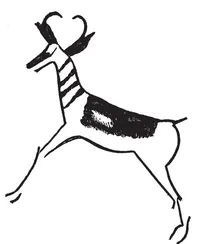
In connection with the above signs Fig. 235 is presented, which was drawn by Running Antelope, an Uncpapa Dakota, as his personal totem, or proper name.
BAD, MEAN.
Make the sign for GOOD and then that of NOT. (Long.)
Close the hand, and open it whilst passing it downward. (Wied.) This is the same as my description; but differently worded, possibly notes a less forcible form. I say, however, that the arm is “extended.” The precise direction in which the hand is moved is not, I think, essential. (Matthews.) This sign is invariably accompanied by a countenance expressive of contempt. (F. Jacker.)
Scatter the dexter fingers outward, as if spurting away water from them. (Burton.)
(1) Right hand partially elevated, fingers closed, thumb clasping the tips; (2) sudden motion downward and outward accompanied by equally sudden opening of fingers and snapping of the fingers from the thumb. (Cheyenne II.)
Right hand closed back to front is moved forcibly downward and forward, the fingers being violently opened at instant of stopping the motion of hand. (Cheyenne IV.)
Right hand closed (B) carried forward in front of the body toward the right and downward, during which the hand is opened, fingers downward, as if dropping out the contents. (Dakota I.) “Not worth keeping.”
Half close the fingers of the right hand, hook the thumb over the fore and middle fingers; move the hand, back upward, a foot or so toward the object referred to, and suddenly let the fingers fly open. Scattered around, therefore bad. An Arapaho sign. (Dakota IV.)
Close the fingers of the right hand, resting the tips against the thumb, then throw the hand do...