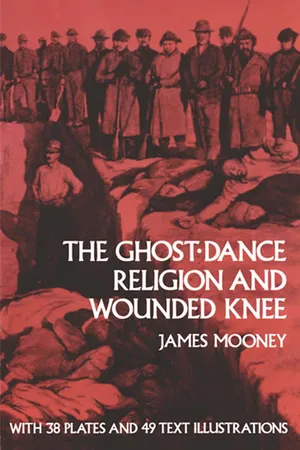
The Ghost-Dance Religion and Wounded Knee
eBook - ePub

The Ghost-Dance Religion and Wounded Knee

  1. 576 pages
  2. English
  3. ePUB (mobile friendly)
  4. Available on iOS & Android
eBook - ePub

The Ghost-Dance Religion and Wounded Knee

About this book

Immediately following the massacre of Wounded Knee (December 29, 1890), the well-known anthropologist James Mooney, under the auspices of the Bureau of American Ethnology and the Smithsonian, investigated the incident. His interest was primarily in the Indian background to the uprising. Admitting that the Indians had been generally overpowered by the Whites, what led the Indians to think they stood a chance against White arms? His answer was astonishing: the Ghost-Dance Religion.
Investigating every Indian uprising from Pontiac to the 1980s, every Indian resistance to aggression, every incident of importance, Mooney discovered a cultural pattern: a messianic religion that permeated leaders and warriors from Tecumseh and his brother The Prophet on up to the Plains tribes that revived the Ghost-Dance in the 1880s and 90s. The message was: abandon the ways of the Whites; go back to Indian ways; an Indian messiah is coming; the Indian dead are to be resurrected — indeed, some have already returned; and the Whites are to be killed by the Spirits.
Mooney made an exhaustive study of this cult, the rise of its latest version, diffusion to the Plains, and its relevance to the medicine man Sitting Bull and others. Citing many primary documents as well as anthropological data he gathered himself, Mooney gives an extremely detailed, thorough account of the cult; its songs and dances, ceremonies, and its social impact.
This work has always been considered one of the great classics of American anthropology, a book that not only offers an account of a very interesting cultural phenomenon, but also throws light on many events in Indian-White relations that are otherwise dark. Its data have never been superseded and the book remains a work of primary importance in Native American studies.

Frequently asked questions

Yes, you can cancel anytime from the Subscription tab in your account settings on the Perlego website. Your subscription will stay active until the end of your current billing period. Learn how to cancel your subscription.
At the moment all of our mobile-responsive ePub books are available to download via the app. Most of our PDFs are also available to download and we're working on making the final remaining ones downloadable now. Learn more here.
Perlego offers two plans: Essential and Complete
  • Essential is ideal for learners and professionals who enjoy exploring a wide range of subjects. Access the Essential Library with 800,000+ trusted titles and best-sellers across business, personal growth, and the humanities. Includes unlimited reading time and Standard Read Aloud voice.
  • Complete: Perfect for advanced learners and researchers needing full, unrestricted access. Unlock 1.4M+ books across hundreds of subjects, including academic and specialized titles. The Complete Plan also includes advanced features like Premium Read Aloud and Research Assistant.
Both plans are available with monthly, semester, or annual billing cycles.
We are an online textbook subscription service, where you can get access to an entire online library for less than the price of a single book per month. With over 1 million books across 1000+ topics, we’ve got you covered! Learn more here.
Look out for the read-aloud symbol on your next book to see if you can listen to it. The read-aloud tool reads text aloud for you, highlighting the text as it is being read. You can pause it, speed it up and slow it down. Learn more here.
Yes! You can use the Perlego app on both iOS or Android devices to read anytime, anywhere — even offline. Perfect for commutes or when you’re on the go.
Please note we cannot support devices running on iOS 13 and Android 7 or earlier. Learn more about using the app.
Yes, you can access The Ghost-Dance Religion and Wounded Knee by James Mooney in PDF and/or ePUB format, as well as other popular books in History & North American History. We have over one million books available in our catalogue for you to explore.

Information

THE SONGS

INTRODUCTORY

The Ghost-dance songs are of the utmost importance in connection with the study of the messiah religion, as we find embodied in them much of the doctrine itself, with more of the special tribal mythologies, together with such innumerable references to old-time customs, ceremonies, and modes of life long since obsolete as make up a regular symposium of aboriginal thought and practice. There is no limit to the number of these songs, as every trance at every dance produces a new one, the trance subject after regaining consciousness embodying his experience in the spirit world in the form of a song, which is sung at the next dance and succeeding performances until superseded by other songs originating in the same way. Thus, a single dance may easily result in twenty or thirty new songs. While songs are thus born and die, certain ones which appeal especially to the Indian heart, on account of their mythology, pathos, or peculiar sweetness, live and are perpetuated. There are also with each tribe certain songs which are a regular part of the ceremonial, as the opening song and the closing song, which are repeated at every dance. Of these the closing song is the most important and permanent. In some cases certain songs constitute a regular series, detailing the experiences of the same person in successive trance visions. First in importance, for number, richness of reference, beauty of sentiment, and rhythm of language, are the songs of the Arapaho.

THE ARAPAHO

TRIBAL SYNONYMY

Ƅhyä’to-Kiowa name; meaning unknown; the Kiowa call the wild plum by the same name.
Ano’s-anyotskano—Kichai name.
Ƅrä’p
e9780486143330_img_259.gif
ho
—popular name; derivation uncertain; but, perhaps, as Dunbar suggests, from the Pawnee word tirapihu or larap
e9780486143330_img_301.gif
hu,
ā€œhe buys or trades,ā€ in allusion to the Arapaho having formerly been the trading medium between the Pawnee, Osage, and others on the north, and the Kiowa, Comanche, and others to the south west (Grinnell letter).
ƄrƤp
e9780486143330_img_259.gif
kata
—Crow name, from word Arapaho.
B
e9780486143330_img_277.gif
tid
e9780486143330_img_277.gif
—Kiowa Apache name.
Detseka’yaa—Caddo name, ā€œdog eaters.ā€
HitƤniwo’
e9780486143330_img_301.gif
v
—Cheyenne name, ā€œcloud men.ā€
InĆ»n-ina—proper tribal name, ā€œour people,ā€ or ā€œpeople of our kind.ā€
Kaninahoic or Kanin
e9780486143330_img_259.gif
ā€˜vish
—Ojibwa name; meaning unknown.
Komse’ka-K’iƱahyup—former Kiowa name; ā€œmen of the worn-out leggings;ā€ from komsc’, ā€œsmoky, soiled, worn out;ā€ kati, ā€œleggings;ā€ k’iƱalyup, ā€œmen.ā€
Maqpi’
e9780486143330_img_259.gif
to
—Sioux name, ā€œblue cloud,ā€ i.e., clear sky; reason unknown.
Ni
e9780486143330_img_259.gif
d’rhari’s-kĆ»rikiw
e9780486143330_img_259.gif
’s-hĆ»ski
—Wichita name.
Sani’ti’ka—Pawnee name, from the Comanche name.
SƤr
e9780486143330_img_277.gif
t
e9780486143330_img_301.gif
ka
—Comanche and Shoshoni name, ā€œdog eaters,ā€ in allusion to their special liking for dog flesh.
Sar
e9780486143330_img_277.gif
tika
—Wichita name, from the Comanche name.

TRIBAL SIGNS

Southern Arapaho, ā€œrub noses;...

Table of contents

  1. Title Page
  2. Copyright Page
  3. Praise
  4. Table of Contents
  5. Table of Figures
  6. THE GHOST-DANCE RELIGION
  7. THE NARRATIVE
  8. THE SONGS - INTRODUCTORY
  9. AUTHORITIES CITED
  10. INDEX
  11. A CATALOG OF SELECTED DOVER BOOKS IN ALL FIELDS OF INTEREST
  12. DOVER BOOKS ON NATIVE AMERICANS