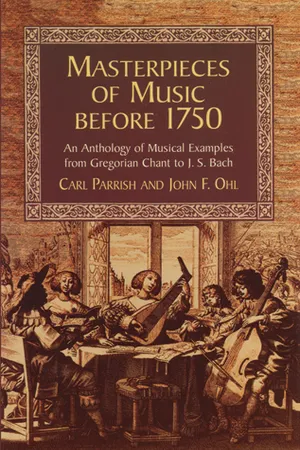
Anyone interested in the history and development of Western music will welcome this collection of outstanding musical examples illustrating the general course of musical style from the early Middle Ages to the mid-eighteenth century. Included are 50 carefully selected compositions of great historical importance — each masterful and beautiful in its own right.
Selections include chants, the organum, parts of masses, motets, chansons, canzonas, lute dances, madrigals, ricercari, and clavecin pieces. Among the pieces are exquisite motets by Josquin, Lassus, and Byrd; madrigals by Marenzio and Caccini; brilliant instrumental displays by Frescobaldi, Pachelbel, Couperin, and Domenico Scarlatti; choral music by Handel and Bach, and much more.
Each example is accompanied by notes that identify the place of the composition in the history of music and suggest ways for the reader to undertake a useful analysis of that music. Most examples are in easy-to-follow "short score" — i.e., in two staves, lending themselves to analysis and performance by the student singly or in informal ensembles. The music can be performed either vocally or at the keyboard, allowing the reader to gain unmatched insight into the character and significance of a rich cross-section of historic styles.
- 256 pages
- English
- ePUB (mobile friendly)
- Available on iOS & Android
eBook - ePub
Masterpieces of Music Before 1750
About this book
Information
Subtopic
Classical Music1. Gregorian Chant
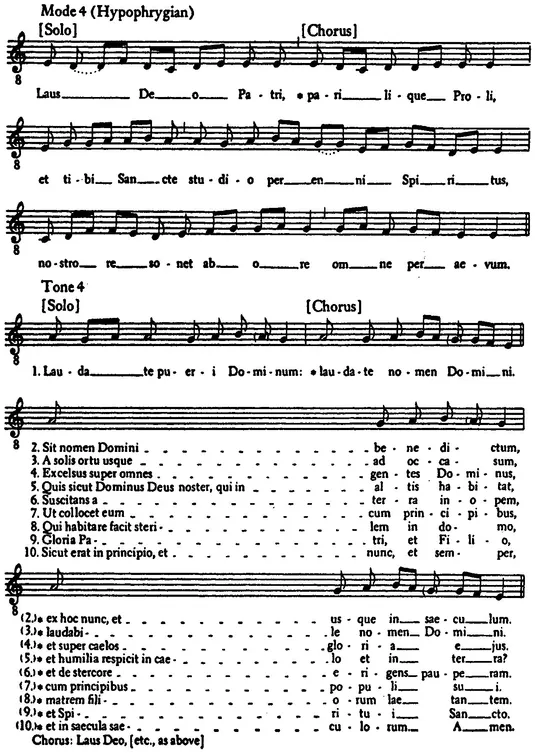
Antiphon, Laus Deo Patri, and Psalm 113, Laudate pueri
FOR SECOND VESPERS, FEAST OF THE HOLY TRINITY
Ant.
Let praise resound from our mouths to God the Father, and to the Son, His equal, and to Thee, Holy Spirit, with unceasing zeal, through all eternity.
Ps.
1. Praise the Lord, ye servants: O praise the Name of the Lord.
2. Blessed be the Name of the Lord: from this time forth for evermore.
3. The Lord’s Name is praised: from the rising up of the sun unto the going down of the same.
4. The Lord is high above all heathen; and his glory above the heavens.
5. Who is like unto the Lord our God, that hath his dwelling so high; and yet humbleth himself to behold the things that are in heaven and earth!
6. He taketh up the simple out of the dust: and lifteth the poor out of the mire:
7. That he may set him with the princes: even with the princes of his people.
8. He maketh the barren woman to keep house: and to be a joyful mother of children.
9. Glory be to the Father, and to the Son: and to the Holy Ghost;
10. As it was in the beginning, is now, and ever shall be: world without end. Amen.
Gregorian chant is purely melodic, one-line (monophonic) music; hence its other common name—plainsong. Its rhythm is free and irregular, corresponding to the natural accents of the text; thus the note values of editions in modern notation, such as the present example, are not intended to indicate precise durations. The classification and organization of the chants rest on a system of melodic formulas and scale relationships known as the eight church modes. The melodies fall into three main classes: syllabic, with one note to each syllable; neumatic, with groups of two to four notes to a syllable predominating (represented by neumes in the original notation); and melismatic, with still longer groups of notes to single syllables. When, as in the services of the Office, a whole Psalm is performed, it is chanted in simple syllabic style to a Psalm tone. The greater part of each verse of the Psalm is intoned on a single reciting note (the tenor), the opening of the first verse employing a simple melodic formula, and the mid-point and close of each verse being marked by a similar melodic rise and fall. There are eight Psalm tones, corresponding to the eight modes, so that the antiphon (see below) and Psalm tone are tonally connected. There is also an exceptional tone, called tonus peregrinus, which has two different reciting notes. In earliest times the two balancing parts of each verse of the Psalm were chanted antiphonally between two choruses. Later, a refrain, called the antiphon, was sung after each pair of verses. Nowadays on important festivals the antiphon is sung at the beginning of the Psalm and is repeated at the end after the Gloria Patri, which is always sung after the Psalm itself. On less important occasions only the first phrase of the antiphon is sung before the Psalm. The performance alternates between solo and chorus. Most antiphons are in syllabic style, but those for the greater feasts, like the present example, are often neumatic. (For a purely syllabic antiphon see the example given on page 90.)
Source:
Liber usualis (Edition No. 801), Tournai, 1934; Antiphon, p. 914; Psalm, p. 150.
1. Gregorian Chant
Antiphon, Laus Deo Patri
Psalm 113, Laudate pueri
2. Gregorian Chant
Alleluia, Vidimus stellam
FROM THE MASS FOR EPIPHANY
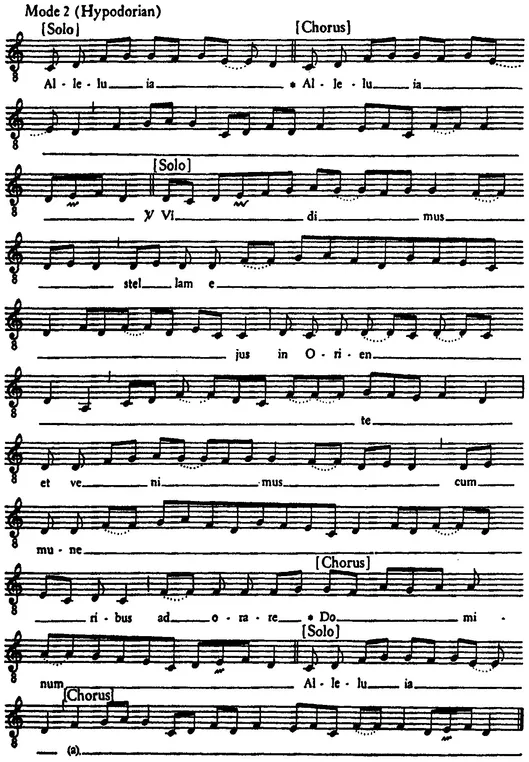
Alleluia. We have seen His star in the East, and are come with gifts to worship the Lord. Alleluia.
Those sections of the text of the Mass that are invariable throughout the church year—Kyrie, Gloria, Credo, Sanctus, Agnus Dei—are referred to as the Ordinary of the Mass. The Alleluia belongs to that group of chants of the Mass which is called the Proper, because the texts of these chants change according to the church season, or the occasion commemorated. The Alleluia is always in a highly melismatic style, this being particularly noticeable in the setting of the word “alleluia” itself, which concludes with a long and elaborate melisma on the final syllable, called the jubilus because of its joyful character. It was through the practice of adding text to this melisma that the sequence arose.1 The text of the versicle which follows is appropriate to the day for which the chant is intended, and its setting is usually less consistently melismatic. The formal organization of most Alleluias is rather complex because, in addition to the repetition of whole sections, motives from the Alleluia are used in the versicle, together with new material. The alternation of solo and chorus, and the repetition of sections in performance, are indicated in the example.
Source: Liber usualis (Edition No. 801), Tournai, 1934, p. 460.
2. Gregorian Chant
Alleluia, Vidimus stellam
3. Gregorian Chant
Sequence, Victimae Paschali
FROM THE MASS FOR EASTER
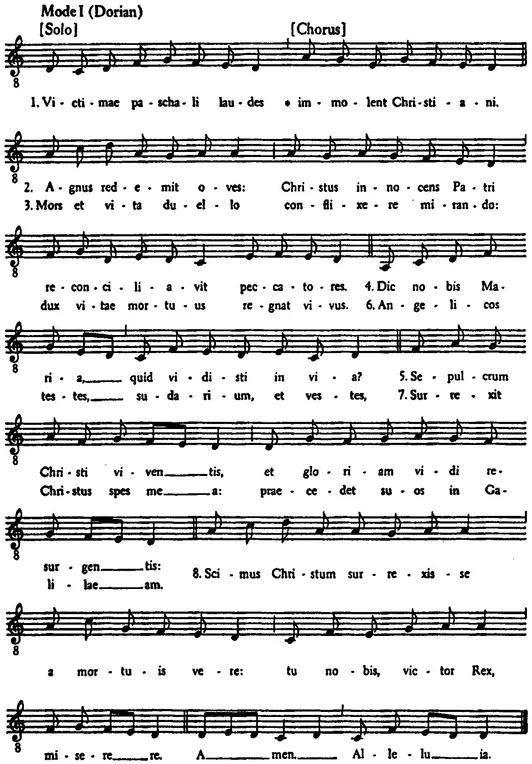
1. Christians, to the Paschal Victim offer your thankful praises.
2. The Lamb the sheep hath ransomed: Christ, by sin undefiled, reconcileth sinners to the Father.
3. Death and Life in a conflict sore and wondrous contended: Life’s Captain, he that died, deathless reigneth.
4. Speak, Mary, declaring, what thou sawest wayfaring?
5. His tomb, who passed through its portal, His glory, who rose from death immortal:
6. Bright angels attesting, the shroud and napkin resting,
7. The Lord, my hope, hath arisen: to Galilee He goeth before you.
8. We know that Christ is risen henceforth ever living: have mercy, Victor King, pardon giving.
The sequence is the earliest and most important type of trope.2 It was the result of a practice adopted by a ninth-century monk, Notker Balbulus, who added texts to the long melisma (jubilus) at the end of the Alleluia, to facilitate the memorizing of these long textless melodies. The practice of adding text to a pre-existing melody soon gave way to that of creating independent compositions, whose typical poetic and musical form is illustrated by this example. It consisted of a number of two-line versicles, varying in length, usually in unrhymed prose, the whole often being introduced and concluded by a single, unpaired versicle. Sequences continued to be composed through the thirteenth century, those of the later period being more strictly metrical, and even hymnlike. Of the five sequences in use at the present day, this example, attributed to the monk Wipo of Burgundy (eleventh century), is the only one in the typical early form. An instrumental counterpart of the sequence is the estampie (see page 33). The opening of another early sequence is shown on page 17.
Source:
Liber usualis (Edition No. 801), Tournai, 1934, p. 780. English translation from: Cook, The Use of Plainsong, Nashdom. Abbey, 1928, p. 24.
3. Gregorian Chant
Sequence, Victimae Paschali (11th c.)
4. Trouvère Song
Virelai, Or la truix
Monophonic secular music of the Middle Ages is represented principally by the lyrical melodies of the knightly troubadours and trouvères of the twelfth and thirteenth centuries. Nearly 1,700 of these melodies are extant, which are notated as music of a single line. Contemporaneous pictures usually show the singers of these melodies with an instrument which, it is thought, was restricted to brief improvisatory introductions, interludes, and postludes. These songs usually lie within the compass of an octave, and many are in the church modes, especially D...
Table of contents
- DOVER BOOKS ON MUSIC AND MUSIC HISTORY
- Title Page
- Copyright Page
- Table of Contents
- Foreword
- ACKNOWLEDGMENTS
- 1. Gregorian Chant - Antiphon, Laus Deo Patri, and Psalm 113, Laudate pueri
- 2. Gregorian Chant - Alleluia, Vidimus stellam
- 3. Gregorian Chant - Sequence, Victimae Paschali
- 4. Trouvère Song - Virelai, Or la truix
- 5. Neidhart von Reuenthal - Minnelied, Willekommen Mayenschein
- 6. Parallel Organum - Sequence, Rex caeli, Domine
- 7. Free Organum - Trope, Agnus Dei
- 8. Melismatic Organum - School of St. Martial, Benedicamus Domino
- 9. Perotin - Organum, Alleluya (Nativitas)
- 10. Motet - School of Notre Dame En non Diu! Quant voi; Eius in Oriente
- 11. Conductus - De castitatis thalamo
- 12. Estampie - Instrumental Dance
- 13. Guillaume de Machaut - Agnus Dei (I) from the Mass
- 14. Francesco Landini - Ballata, Chi più le vuol sapere
- 15. Guillaume Dufay - Kyrie (I) from the Mass “Se la face ay pale”
- 16. Gilles Binchois - Chanson, Adieu m’amour et ma maistresse
- 17. Johannes Ockeghem - Sanctus (first section) from the “Missa prolationum”
- 18. Jacob Obrecht - Motet, Parce, Domine
- 19. Josquin des Prez - Motet, Ave Maria
- 20. Thomas Crequillon Chanson, Pour ung plaisir - 21. Andrea Gabrieli Canzona francese deta Pour ung plaisir
- 22. Lute Dances - Der Prinzen-Tanz; Proportz
- 23. Orlandus Lassus - Motet, Tristis est anima mea
- 24. Giovanni Pierluigi da Palestrina - Agnus Dei (I) from the Mass “Veni sponsa Christi”
- 25. William Byrd - Motet, Ego sum panis vivus
- 26. Keyboard Canzona - Canzona per l’epistola
- 27. Luca Marenzio - Madrigal, S’io parto, i’ moro
- 28. John Bennet - Madrigal, Thyrsis, Sleepest Thou?
- 29. Giles Farnaby - Variations for Virginals, Loth to Depart
- 30. Giulio Caccini - Madrigal for Solo Voice and Lute Dovrò dunque morire
- 31. Claudio Monteverdi - Recitative from “Orfeo,” Tu se’ morta
- 32. Giacomo Carissimi - Scene from “Judicium Salomonis,” Afferte gladium
- 33. Heinrich Schütz - Sacred Cantata (Concerto), O Herr, hilf
- 34. Girolamo Frescobaldi - Ricercar dopo il Credo, for Organ
- 35. Johann Jakob Froberger - Suite in E Minor, for Clavichord
- 36. Jean Baptiste Lully - Overture to “Armide”
- 37. Johann Pachelbel - Toccata in E Minor, for Organ
- 38. Henry Purcell - Ground for Harpsichord, A New Ground
- 39. Arcangelo Corelli - Sonata da chiesa in E Minor, Op. 3, No. 7
- 40. François Couperin - Piece for Clavecin, La Galante
- 41. Jean-Philippe Rameau - Scene from “Castor et Pollux,” Séjour de l’eternelle paix
- 42. Domenico Scarlatti - Sonata in C Minor, for Harpsichord
- 43. George Frederick Handel - Concerto Grosso in C Major, First Movement, for Oboes, Strings, and Continuo
- 44. George Frederick Handel - Recitative, Al valor del mio brando, Sinfonia, and Aria, Cara sposa, from “Rinaldo”
- 45. George Frederick Handel - Chorus, Draw the Tear from Hopeless Love, from “Solomon”
- 46. Johann Sebastian Bach - Chorale, Christ lag in Todesbanden, from Cantata No. 4
- 47. Johann Sebastian Bach - Chorale Prelude for Organ, Christ lag in Todesbanden
- 48. Johann Sebastian Bach - Chorus, Es war ein wunderlicher Krieg, from Cantata No. 4
- 49. Johann Sebastian Bach - Arioso for Alto, Ach Golgatha, from the “St. Matthew Passion”
- 50. Johann Sebastian Bach - Fugue, Contrapunctus III, from “Die Kunst der Fuge”
Trusted by 375,005 students
Access to over 1.5 million titles for a fair monthly price.
Study more efficiently using our study tools.
Frequently asked questions
Yes, you can cancel anytime from the Subscription tab in your account settings on the Perlego website. Your subscription will stay active until the end of your current billing period. Learn how to cancel your subscription
No, books cannot be downloaded as external files, such as PDFs, for use outside of Perlego. However, you can download books within the Perlego app for offline reading on mobile or tablet. Learn how to download books offline
Perlego offers two plans: Essential and Complete
- Essential is ideal for learners and professionals who enjoy exploring a wide range of subjects. Access the Essential Library with 800,000+ trusted titles and best-sellers across business, personal growth, and the humanities. Includes unlimited reading time and Standard Read Aloud voice.
- Complete: Perfect for advanced learners and researchers needing full, unrestricted access. Unlock 1.5M+ books across hundreds of subjects, including academic and specialized titles. The Complete Plan also includes advanced features like Premium Read Aloud and Research Assistant.
We are an online textbook subscription service, where you can get access to an entire online library for less than the price of a single book per month. With over 1.5 million books across 990+ topics, we’ve got you covered! Learn about our mission
Look out for the read-aloud symbol on your next book to see if you can listen to it. The read-aloud tool reads text aloud for you, highlighting the text as it is being read. You can pause it, speed it up and slow it down. Learn more about Read Aloud
Yes! You can use the Perlego app on both iOS and Android devices to read anytime, anywhere — even offline. Perfect for commutes or when you’re on the go.
Please note we cannot support devices running on iOS 13 and Android 7 or earlier. Learn more about using the app
Please note we cannot support devices running on iOS 13 and Android 7 or earlier. Learn more about using the app
Yes, you can access Masterpieces of Music Before 1750 by Carl Parrish, Carl Parrish,John F. Ohl in PDF and/or ePUB format, as well as other popular books in Media & Performing Arts & Classical Music. We have over 1.5 million books available in our catalogue for you to explore.