![]()
CHAPTER I
PATTERN OF LIFE IN THE OLD SOUTH
IN 1850, an enthusiastic visitor from Massachusetts gave this vivid picture of the South and the Southerner:
“First, there is the slave himself, his condition, his cabin, his dress, his manners, his labors, his amusements, his religion, his domestic relations; then there is the plantation, with fences a mile apart, presenting in one broad enclosure land enough to make a score of Yankee pastures; then there is the cotton-plant, with its rich, pure, white fleecy treasures, hanging to the gathering hand; then there is the tobacco-plant, with its beautiful, tender green leaf in the spring, and its broad, palmetto-looking leaf in the autumn, green lined with brown; then there is the cotton-gin, with the negroes at work in it, the snowy cotton flying from the wind-fans in fleecy showers that mock a December snow-storm! Then there is the baling and screwing, the roping and marking with planter’s name, all objects of interest to witness; then there is the planter himself, so different in his manners, tastes, education, prejudices, notions, bearing, feelings, and associations, from the New England man; then there is his lady, accustomed to have slaves attend upon the glance of her eye from childhood, commanding and directing her large domestic establishment, where the food, clothing, comfort, and health sometimes of a hundred slaves depend upon her managing care; then there is the son, who is raised half-hunter, half-rustic, with as much book learning as his pastimes in the field and wood will allow him to turn his attention to—the idol of the old negroes and the hope of the younger ones —who has never seen a city, but may one day walk Broadway, or Chestnut street, ‘a fine young Southern blood,’ with a fortune to spend, high-spirited, chivalrous, quick to resent an insult, too proud to give one, ready to fight for his lady-love or his country! prone to high living and horse-racing, but at home courteous and hospitable as becomes a true country gentleman; then there is the daughter of the house, too, a lovely girl, with beautiful hands, for she has never used them at harder work than tuning her harp, (and hardly at this, if she can trust her maid), who rides like Di Vernon, is not afraid of a gun, nor a pistol, is inclined to be indolent, loves to write letters, to read the late poets, is in love with Byron, sings Jenny Lind’s songs with great taste and sweetness, has taken her diploma at the Columbia Institute, or some other conservatory of hot-house plants, knows enough French to guess at it when she comes across it in an English book, and of Italian to pronounce the names of her opera songs! she has ma’s carriage at her command to go and come at her pleasure in the neighborhood, receives long forenoon visits from young gentlemen who come on horseback, flirts at evening promenades on the piazza with others, and is married at sixteen without being courted!”
Such a pattern of life would command and develop a suitable architecture.
Architecture must never be separated from its economic and geographic background. The land and the climate ultimately determine the kind of materials used, the height of the ceilings, and the cost of the building. If we are to understand the houses of the ante-bellum South, we must first have in mind a clear picture of the geography of the country. Along the Atlantic coast lies the tidewater region, narrow in Virginia but widening as it goes South, and including rich plantations of tobacco and rice. To the west of it rise the mountains, the Blue Ridge and the Alleghenies, which are not productive agriculturally, and have never supported their inhabitants in luxury. Still farther west stretch long, lean foothills across Tennessee and into northern Georgia and Alabama; in between these ranges lie three fertile limestone areas: the Bluegrass of Kentucky, the Nashville Basin, and the region along the Tennessee River near Muscle Shoals. Another fertile belt is the great crescent that loops below the mountains and hills, one tip touching South Carolina and the other stretching to the Mississippi River at Memphis. This belt is the heart of the cotton kingdom. And, too, there is the incredibly rich valley of the Mississippi all the way down to New Orleans, and the Black Belt of Alabama which extends from the Tombigbee to the Alabama Rivers. Cotton, tobacco, rice, and sugar—these were the money crops of the South, together with grain and cattle and horses that by 1800 were making the South rich, and by 1861 convinced her that she could hope to win political independence. Cotton more than any other one product poured wealth into the lap of the Middle South.
Other factors, too, conspired to exalt the agricultural South a century ago. Science contributed its share when the steamboat appeared to speed the traffic on the many rivers that flow across the region toward the sea. When Nicholas Roosevelt courageously captained the first steamboat over the Falls of the Ohio in 1811, and dared to descend to New Orleans in the teeth of a great earthquake and flood, the era of the steamboat began. For fifty years or more the white floating palaces, as they appeared to the wide-eyed inhabitants on the shores of the inland rivers, dominated the imaginations and lives of the Middle South. The cotton gin, invented by Eli Whitney in 1793, removed the last obstacle to the production of cotton on a huge scale. By 1840 railroads were clumsily beginning to transport heavy goods to market. No wonder men speculated in land and slaves when half a dozen consecutive lucky years would enable them to build magnificent homes near the town or along the rivers and to fill them with elegant furniture and china imported from Paris.
Whenever we think of the homes of the old South, we must keep the fertile regions in mind, for they will be the stopping places on our architectural journey. They were the localities where simple pioneer cabins were soon replaced by more permanent structures and often by mansions. Were we to make a map indicating the while-pillared houses of the ante-bellum South, we should be duplicating the economic map of the staple crops of the section in 1861. It is axiomatic that where there is wealth, architecture develops new forms rapidly. The domestic architecture of the old South, especially that of the Middle South, between 1800 and 1861, is a good example of the axiom.
Other geographic factors besides land must be borne in mind in discussing life in the South. The winters are, for the most part, mild or temperate; the summers are long and usually very hot. Rains are likely to be hard and beating; floods along the rivers occur intermittently and unexpectedly. Timber lands spread widely and vegetation grows easily. It is a section easily developed and often exploited and then forgotten. Such was the promised land into which pioneers came in great numbers for three-quarters of a century after 1776, a land of dramatic geographic and economic contrasts, where rich valleys and bottom lands are flanked by rocky hillsides and barren gulleys. Almost inevitably this would be a land of rich men and poor men, of great houses and of small cabins, side by side.
While the land and climate were powerful determinants of the architecture of the old South, so also were the people. Who were they? What traditions did they bring with them? Those who poured through Cumberland Gap and down the rivers into Kentucky, Tennessee, Alabama, and Northern Mississippi were mostly English and Scotch-Irish and Germans from Virginia and the Carolinas. They were pugnacious, ambitious, democratic. Andrew Jackson represents the type. On the other hand, the earliest comers at the mouth of the Great River and along the Gulf were French and Spanish by descent, with a language and culture of their own. Eventually the two streams of colonization met and blended along the Mississippi and in the bayou country of Louisiana. As a result, the domestic architecture of the Middle and Deep South is marked by a basic similarity underlying a multitude of surface variations. Because of a similar environment, the builders solved their fundamental problems in much the same ways; but because of different inheritances and minor variations in locale, the effects are delightfully individual and full of unexpected contrasts. A “Southern” house is unmistakable, even though it eludes precise definition, for the reason that it is functionally adapted to a particular way of life. Yet all classifications fail that try to define the types by arbitrary rules. Perhaps this is why textbook makers have neglected the architecture of the South—it is not easily pigeon-holed as Colonial or Greek Revival or Early Republican, and above all things it cannot be called “Southern Colonial.”
A few generalizations may safely be made about the Southern way of life that is so large a factor in its home building. In a section that was made up principally of farms and small towns, land was plentiful to furnish yards, gardens, and even parks for homes. Family groups were generous in size and incessantly augmented by relatives and dependents. Houses were built on to whenever the need arose, or the masters’ fancy dictated. All sorts of work was done on the place by and for the household, for which special buildings were provided; smokehouse, dairies, spinning houses, kitchens, carpenter shops, servants’ quarters, and the like. Abundant slave labor made convenient and desirable the practice of having separate service buildings. Since the weather is mild, a house might sprawl at will with reckless disregard for heating facilities. Logs to cram the huge fireplaces were plentiful and so were stout darkies to chop and fetch them. Living was largely out of doors, especially in the Deep South; hence the numerous and spacious porches, windows, summer houses, and colonnades. The Southerner chose the site for his home either for its access to convenient transportation on road or river, or its elevation, from where he might see and be seen. Often he could accomplish both these ends by selecting a hill top overlooking the stream or highway. At any rate, his house, large or small, was pretty certain to have the stamp of his social and semi-public life, and to have provision for the coming and going of many persons.
The formative period of Southern domestic architecture, 1776-1830, was an era of great national pride and ambition. The winning of independence from Great Britain was followed by the erection of public buildings designed to be as impressive as possible. To Jefferson, Strickland, and other leaders in building, the style which best embodied the young nation’s ideals was the classic temple. The states and counties often strove to emulate the federal style in building their capitols and courthouses. Therefore many an American who knew no formal rules of architecture vaguely associated the grandeur of the tall columns on his courthouse or his home with the glory of the political commonwealth of which he was a citizen. It fitted his conception of democracy that a successful man’s house should resemble the Parthenon or, at least, the state capitol. Southerners were not unique in this era in admiring and appropriating the classic manner for their homes; the vogue for it appeared everywhere. However, they used it so independently and with such little regard for formal rules that they achieved more originality than did people of other sections.
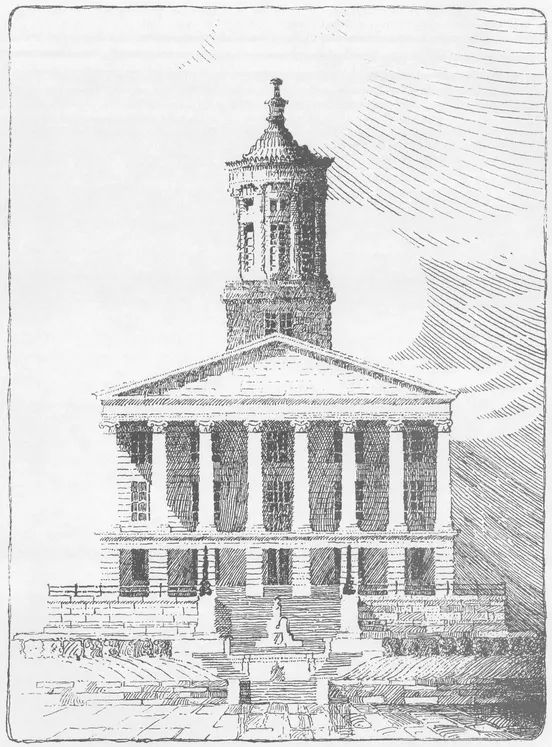
Nashville, Tennessee
TENNESSEE STATE CAPITOL 1845
This fine old building of Greek classical style shaped the destiny of white-pillared houses of Nashville and the Tennessee Basin, and extended its influence far into the Deep South. Visitors to the Tennessee Capitol building today are reminded of the epitaph on the tomb of Sir Christopher Wren, architect of St. Paul’s, London: “Si monumentum requiris, circumspice” (“if you seek his monument, look about you”), for here too the architect, William Strickland, is entombed in the north portico of this, his last creation.
![]()
CHAPTER II
WEST OF THE ALLEGHENIES
PART 1. NASHVILLE AND ITS NEIGHBORS
TENNESSEE STATE HOUSE
| A DOG TROT HOUSE | THE HERMITAGE |
| FAIRVIEW | BELLE MEADE |
| CRAGFONT | BEERSHEBA INN |
| BELMONT | MARYMONT |
PART 2. KENTUCKY—BLUEGRASS REGION
| DIAMOND POINT | WALNUT HALL |
| MOUNT BRILLIANT | ROSE HILL |
PART ONE
NASHVILLE AND ITS NEIGHBORS
LANDS beyond the Allegheny and the Blue Ridge Mountains, known as the Southwest, lay south of the Ohio and extended to the Mississippi. Earliest pioneering efforts pointed toward two fertile and favorite regions. First, the Bluegrass region of Kentucky, which nestles close to the Ohio and extends southward, and second, the Nashville Basin, with Nashville as a radius point around which the Tennessee River describes a great semi-circle as it winds northwardly again towards East Tennessee.
These two regions grew more important throughout the pioneer period. A full and wholesome life developed around the centers which became a definite influence in the later development of the Deep South (the Gulf States).
Tennessee was a battleground for the social forces that shaped the old Southwest. Her domain swept from the little valley farms of the east through a productive limestone section to the low-lying bottoms and forests of the Mississippi River water-shed. In these different environments, her pioneer settlers developed strikingly different social patterns, each exhibiting those baffling combinations of democracy and aristocracy that are the key to Southern life, social and political.
Long before the Revolution, as early as 1740, restless dwellers on the Atlantic seaboard were yearning for the good land they had heard about beyond the mountains. Wealthy men sent surveyors to investigate possibilities for profitable speculations. Landless men everywhere—younger sons, poor farmers who did not own their acres, ambitious craftsmen, new immigrants—all turned their eyes west. Land was the measure of opportunity and power. A little of it was necessary; a lot of it was desirable. Scouts like Daniel Boone reported a marvelously rich domain to be had for the taking in the back country which vaguely was thought to belong to Virginia and the Carolinas. To be sure, there were obstacles such as King George III’s express prohibition of all migration beyond the water-shed, and the peril of hostile Indians; but such hindrances were not enough to stop men who were land hungry. When they gathered up their wives and children with their scanty goods and chattels to start across the ridges, they would not have paused, even if they had known what hardships lay ahead of them. The gaps through the mountains made rough going; there were innumerable streams to swim or ford; the Indians and wild beasts were equally terrifying. No matter, they went ahead. Before a shot was fired at Lexington, they were in what is now Tennessee and Kentucky, and at King’s Mountain they contributed to the winning of independence. When the Revolutionary soldiers were paid with grants of western land, the tide of immigrants swelled rapidly.
In or about 1768, James Robertson, a stout North Carolinian of Scotch-Irish descent, and his little party lit their fires in a clearing on the banks of the Watauga River, tributary of the Holston, in what is now Washington County, Tennessee. Evan Shelby and John Sevier joined the Wataugans, and shared the battles of the group against Indians, and their struggles to establish a government, since neither Virginia nor North Carolina claimed Watauga Settlement. A decade or so later, Robertson likewise had a hand in establishing the Cumberland Settlements at the French Lick where Nashville now stands. He led a small party of men over Boone’s Wilderness Trail through Cumberland Gap, and reached the Lick on Christmas Day, 1778, to find the river frozen over. The larger part of the expedition including the women and children were coming down the Tennessee under the guidance of John Donelson, a well-known Virginia surveyor, in the boat Adventure, accompanied by a flotilla of forty craft. Past dangerous Muscle Shoals to the mouth of the river and back up the Cumberland they fought their way. The trip was a hard one, especially for the wife of Ephraim Payton, who was delivered of a child en route, only to have it “killed in the hurry and confusion” of an Indian attack next day.
On Monday, April 24, 1779, Colonel Donelson recorded in his journal:
“This day we arrived at our journey’s end and at the Big Salt Lick, where we have the pleasure of finding Captain Robertson and his company. . . . Though our prospects at present are dreary, we have found a few log-cabins which have been built on a cedar bluff above the Lick by Captain Robertson and his company.
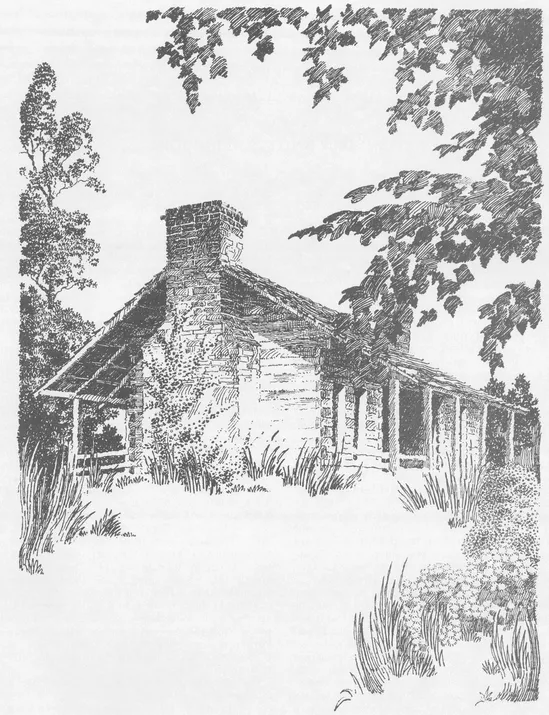
Nashville, Tennessee
THE CABIN AT BELLE MEADE
Double pioneer cabin, or dogtrot house, was an important step in evolution of the Tennessee and Kentucky white-pillared houses.
John Donelson made a clearing for himself at Clover Bottom about twelve miles from the bluff, where he planted a crop, which included the first cotton grown in Middle Tennessee. His daughter (the future Mrs. Andrew Jackson) would see her home, The Hermitage, stand upon a nearby site.
The cabin was the abode of the frontiersman. As we view today this log structure and its contents, we can reconstruct the life of the pioneer with striking approximation of the truth.
Thomas Perkins Abernethy in his From Frontier to Plantation in Tennessee gives us the following description of building a cabin:
“The cabin was, when possible, built by community effort. A common size for it was about twenty feet by sixteen feet, often with a low room or upper floor under the sloping roof. Work began by chopping down seventy or eighty of the tallest and straightest small trees in the immediate vicinity. When the felled trees had been chopped into proper lengths, the logs thus made were rolled to the site picked out. These preliminary processes required two or three days. Two logs, each sixteen feet long and of greater thickness than the others were then put in position twenty feet apart; at each end log a deep notch was cut on the upper surface extending through about one third of its diameter. Two other logs, each twenty feet long and correspondingly thick were next fitted with notches at the ends, both above and below, and were laid on the first pair, into which their lower notches were ”dovetailed“*. A foundation was thus obtained that lifted the body of the cabin some three feet abo...