After the bow and arrows of lightning were returned to the Sun, Hasjelti and Hasjohon came to First Man and First Woman and asked them what they thought about all that had happened. “What will take place now will be your plan,” they said. “Yes,” answered First Man and First Woman, “Now it must be our plan. We will think about it.”203
The Sun brought a turquoise man fetish and gave it to Yol gai esdzan, the White Bead Woman. She ground white beads into a powder and made a paste with which she molded a fetish like the one the Sun had given her, but it was a woman. When it was finished they laid the two side by side. Then they took the white corn which was brought up from the Dark World where the First Man was formed and they laid it beside the turquoise man fetish. And the yellow corn from the Dark World, which was formed with First Woman, was laid by the side of the White Bead Woman fetish.
Here the chanting begins.204 It covers the two fetishes and the two ears of corn and the four clouds and the four vapors. There are many chants sung here. They were sung before the fetishes could move. Then the two fetishes, the Turquoise Man and the White Bead Woman, and also, the two ears of corn, white and yellow, moved.205
The fetishes and the ears of corn moved but they were not able to rise. So word was sent to all the Holy Beings and to the Upper World where the Five Chiefs of the Wind dwelt. Gifts were offered to the Winds and they accepted them. They sent the Little Breeze down, and it entered the bodies of the two fetishes and the two ears of corn. Little, fine hairs appeared over the bodies, for it is through these that air comes out of the body. It was after that, that the four, the two fetishes and the two ears of corn, became human beings.
THE FIRST CLANS OF THE DÎNÉ 207
Toward the east side of the mesa called Dzil na’odili there is a place named Ta chee. On the top of this small mesa a man and a woman were found. From these two sprang the clan called Tlasch chee, or Tha’tsini, Red Under the Bank. At another place called Ash chee, salt, there arose two persons, a man and a woman. From these two came the clan called Ash chee, or Asi’hi, the Salt Clan. This clan was also called the Beautiful Goods Clan. To the east, toward the mountain called Sis na’ jin, a man and a woman arose. From them came the clan called Sis na’ jin ee’. Another man and a woman arose at a place called Tse nee tat net tsa. From them came the clan called Tat nes tsa nee, the home in the side of the cliff with sticks meeting, or joining, in a different way at top.
Now when the two fetishes and the two ears of corn became human beings there were 8 that arose with them, so in all there were 12—6 male beings and 6 female beings. (There must have been fetishes laid in all the above-mentioned places from which these people came. These 12, forming 6 clans were the first Dîné.)208
These 12 people first made their home around Dzil na’odili, which means “The People Move Round Me.” After so many years they multiplied. Then there were four who came to them, two men and two women. They came from a place called Tqo toda sihee, which was on the top of mountain Tso dzil. When night came the people gave these four a blanket to sleep on, but they would not accept it. They sat down and, crossing their arms tightly over their breasts, slept that way. From these four started the clan called Bit an he or Bita’ni, meaning, their arms folded under.
There was another people living at a place called Tqo hee tle, where the Pine River nears Ignacio. Here the two rivers empty into the San Juan, and the name of the place is Tqo hee tle. At a place a little above there on the San Juan lived another people. They also came and joined the Dine. From them came the clan called Tha ban ha, along the water. They were the descendants of the snipe people. Snipe always know where water is to be found. They even know when water will come and will show the high mark of flood water.
By this time there were many people living around Dzil na’odili.
There was a place called Tsa ya hat tso, a large cave lined with red which is southeast of Dulce. There is a black canyon, and farther on there is a cave. The Holy People who planned the White Bead Woman lived there. They said:
There are many people living near Dzil na’ odili. They have no guard at the entrance of their home. All others, the Sun, the Mountains, the Plains have guards for the entrances of their homes. Those people down there must have the same as the rest. They must have the red corn and the red banded corn and the dog for their guards.
Here the same ceremony as before was held. There were the turquoise male fetish and the white bead female fetish and the two ears of corn. They call upon the Five Chiefs of the Winds for help and they sent the Little Breeze. Four more people were formed, two men and two women, and from them sprang the clan called Tat chee nee, or Tha’tsini, meaning red lining of the cave.209
The Holy Beings formed the dog, male and female. The male dog was dressed with the dawn and he was white. He traveled to the East. The female dog was reddish or brownish yellow and she was dressed with the twilight. On their ears sat the Little Breeze. Their ears were made from the winds, and at the tip of the tail also there is a breeze. So when a dog passes another dog he can tell from the mouth to the tip of the tail. Burned food was put on their noses and they were black. A medicine stick, ke et an’dotishe, was placed inside their stomachs, and they say that is why a dog never gets enough to fill him. As he has the wind at the ears and at the tip of the tail he never gets lost. He knows many things, for he was sent to guard the doorways of the people.
The male dog was sent east of the Carrizos and the female dog to a place now known as Tohatchi. The white dog was a welcome animal. The people were good hunters and they fed him and petted him and he grew fat. But the female dog went to evil people who beat her and threw sticks at her and she grew poor and skinny.
The dogs were told to meet at a placed called Tse ha gaye. There are burning minerals under the ground there and one sees smoke.210 They met there as instructed, but when they met the male jumped on the female and threw her on the ground. The male dog treated her badly. They fought as dogs do now. Then they crossed. The dog said: “People were good to me and fed me lots of meat.” The bitch said: “People were cruel to me. They starved me all the time.” So they changed places; the white dog went to the home of the yellow dog, and the female went to the home of the male. And after a time they met again at the same place. This time the white dog had gotten the worst of the treatment and was thin and poor, whereas the bitch was fat. So the two got even with each other.
Then the two dogs started out for a place called Nat ege saka’te, where a lone currant bush grows on a plain south of Fruitland. A little ledge of rock and the lone currant bush are all that are there. When the dogs reached the ledge of rock they sat side by side with their backs toward the people who had been cruel to them. The one dog sent his bad wish with the gas from his stomach, and the other dog sent her bad wish from her backbone to the wicked people. The two then returned to the place where they were made. Later, the people who had been cruel to the dogs sickened. Their stomachs bloated, and they were very ill indeed.
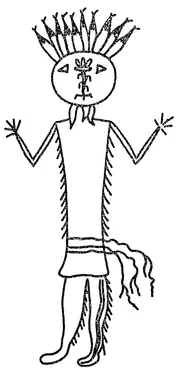
The being who was called Dotso, the All-Wise Fly, came and said: “The only person to make medicine here is Hasjelti (fig. 15) himself; but don’t tell anyone what I have said. Keep it a secret.” Now up to this time they had used ceremonies over the sick, but they could not cure them. When Hasjelti made the medicine the people recovered.
This is where the Dog Ceremony211 begins. The chant is here.
After this Hasjelti took one of the small boys from the clan Tat chee and carried him off to a dance of his people. He carried the boy to a place called Tse’hoghan (To’waya’lane or Taaitalone known as Thunder Mountain near Zuni). When they returned the little boy danced as he had seen those people dance. Hasjelti said: “My grandchild, you will be called Jil yenn taeye, and you must dance like the dancers that you have seen.”
Hasjelti said that the dancers must dress in the following manner: 12 tail feathers with little singing birds on their tips for the headdress; the growing corn with a tassel for a nose; the skirt and leggings and moccasins of buckskin with fringe; and a sacred belt with trimmings. Each dancer must hold a sacred fawnskin medicine bag in his right hand.
Now Hasjelti had planned how the monsters should be killed; how the White Bead Woman was to be formed; how the two dogs should be the guards of the people; and how the ceremonial people should dance. He planned the clan called Tat chee. The Tat chee people have fiery tempers, broad faces, and large heads.
Then Hasjelti spoke to the people he had made and said:
My grandchildren, you are not to live in this part of the country. You must go to other people and join them. I have shown you how this dance must be danced. It will be a sacred dance for you. It will be a holy dance for you. The first four dancers will have four words that they must use. These words will be the names of the corn which will grow from the earth.
He continued:
Secondly, they will name the water, the same being the rain from above. Thirdly, they will name the plants, all the plants on the earth. And last, they will name the pollen.
If a mistake is made in the first dance, it will be an evil thing and people will suffer from it. So the dancers must take great care from the beginning to the end. The first four dancers that come out in this dance will be called “at sal tle.” When these first four go out, and the people are well satisfied with them, they will open their medicine bags and sprinkle pollen on their heads as an offering, and they will call on Hasjelti saying: “May it be so from this day on. May we have corn. May we have rain. May we have all the growing plants with all their pollens. May we have the beautiful earth on which we can gather corn, beautiful goods and precious stones and all the animals that we use for food. May the sheep and the horses increase, and may our children increase. May their days be beautiful and may all be beautiful around us. Thus they must pray after the four dancers leave.”