Drawing Hands
eBook - ePub

Drawing Hands

  1. 48 pages
  2. English
  3. ePUB (mobile friendly)
  4. Available on iOS & Android
eBook - ePub

Drawing Hands

About this book

An indispensable and easy-to-follow companion for the intermediate art student, this concise guide focuses on how to capture the natural representation of the human hand in all its forms and motions.
Over 100 clear and expertly rendered drawings help artists discover:
• The subtle but crucial differences between hands of young and old, male and female
• How to accurately draw hands engaged in a variety of activities
• Skeletal and muscular depictions, which help reveal how to naturally draw the workings of the magnificent human hand
Educated in England at the Chelsea School of Art and the Royal College of Art, the works of Carl Cheek were widely exhibited in Europe throughout the 1950s. His artwork is included in numerous private and public collections, including Britain's important and often-visited Government Art Collection.

Frequently asked questions

Yes, you can cancel anytime from the Subscription tab in your account settings on the Perlego website. Your subscription will stay active until the end of your current billing period. Learn how to cancel your subscription.
No, books cannot be downloaded as external files, such as PDFs, for use outside of Perlego. However, you can download books within the Perlego app for offline reading on mobile or tablet. Learn more here.
Perlego offers two plans: Essential and Complete
  • Essential is ideal for learners and professionals who enjoy exploring a wide range of subjects. Access the Essential Library with 800,000+ trusted titles and best-sellers across business, personal growth, and the humanities. Includes unlimited reading time and Standard Read Aloud voice.
  • Complete: Perfect for advanced learners and researchers needing full, unrestricted access. Unlock 1.4M+ books across hundreds of subjects, including academic and specialized titles. The Complete Plan also includes advanced features like Premium Read Aloud and Research Assistant.
Both plans are available with monthly, semester, or annual billing cycles.
We are an online textbook subscription service, where you can get access to an entire online library for less than the price of a single book per month. With over 1 million books across 1000+ topics, we’ve got you covered! Learn more here.
Look out for the read-aloud symbol on your next book to see if you can listen to it. The read-aloud tool reads text aloud for you, highlighting the text as it is being read. You can pause it, speed it up and slow it down. Learn more here.
Yes! You can use the Perlego app on both iOS or Android devices to read anytime, anywhere — even offline. Perfect for commutes or when you’re on the go.
Please note we cannot support devices running on iOS 13 and Android 7 or earlier. Learn more about using the app.
Yes, you can access Drawing Hands by Carl Cheek in PDF and/or ePUB format, as well as other popular books in Art & Art Techniques. We have over one million books available in our catalogue for you to explore.

Information

eBook ISBN
9780486141909
Topic
Art

LATERAL WRIST MOVEMENT

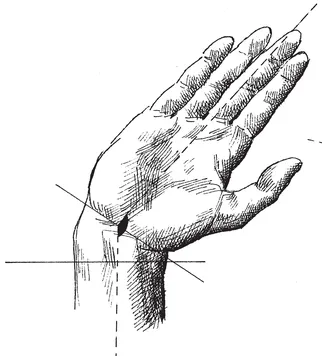
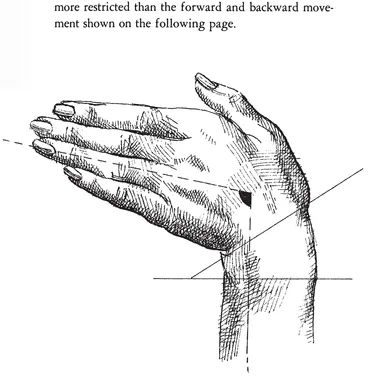
As can be seen from these diagrams, the lateral movement of the hand at the wrist in either direction is more restricted than the forward and backward movement shown on the following page.
e9780486141909_i0011.webp
Observe the angle of the fingers, shown by the dotted line, relative to the wrist. The movement shown is restricted, and the angle formed is thus obtuse (more than 90° ) .
e9780486141909_i0012.webp
This movement (toward center of the body) is less restricted than the other. The angle formed by the fingers and wrist is less obtuse.
e9780486141909_i0013.webp
e9780486141909_i0014.webp
Figure 1
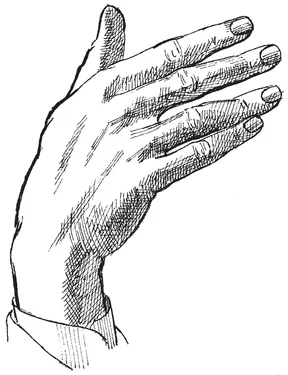
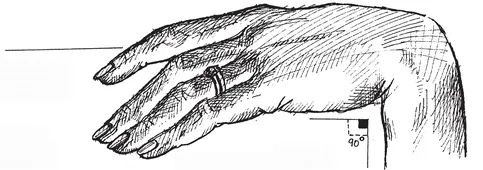
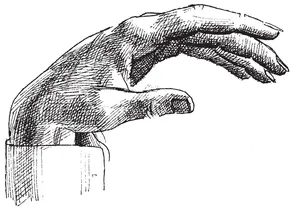
In this wrist movement the fingers tend to extend and straighten themselves.
e9780486141909_i0015.webp
Figure 2
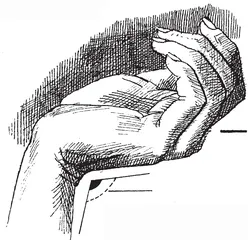
In this position the fingers tend to close over the palm.
 
In the backward movement the angle of the wrist and hand is more obtuse than in the forward movement (shown in figure 1) where the natural angle formed is about 90°.
e9780486141909_i0016.webp
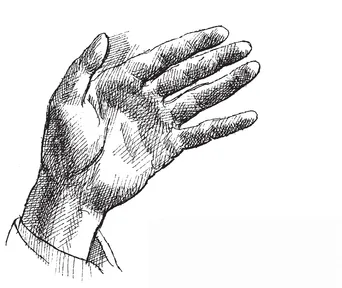
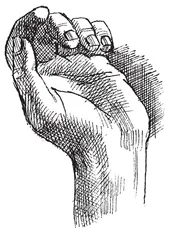
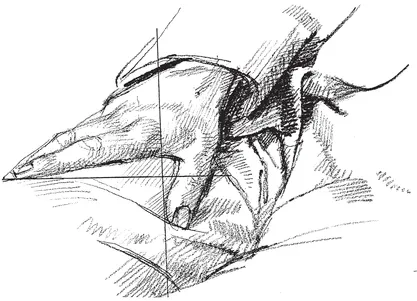
The movements shown on this page are the same as those on the preceding page, but the hands are viewed from different angles.
e9780486141909_i0017.webp
Notice how cushioned and fleshy the palm looks in comparison with the boniness of the back of the hand.
e9780486141909_i0018.webp

OBSERVATION

e9780486141909_i0019.webp
e9780486141909_i0020.webp
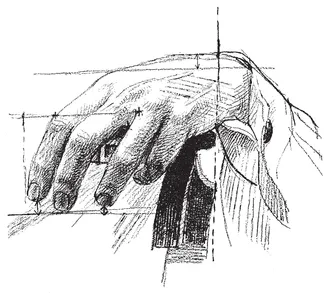
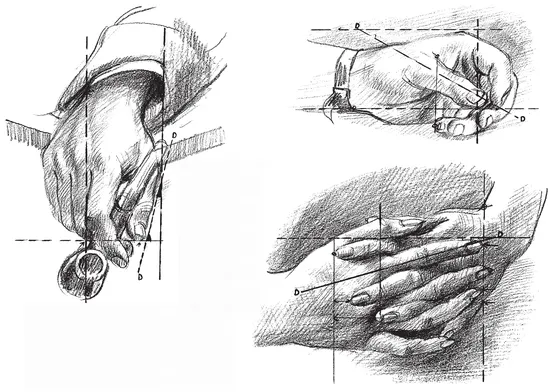
In the Introduction I drew your attention to the fact that no specific rule or recipe for drawing any particular object exists. There is, however, a discipline or method of observation applicable on any and every occasion and which is modified only by the length of time during which the object drawn remains stationary.
This method is explained on the next two pages, but here I should like to state that it may be employed in the most painstaking way in the actual building up of a drawing, or it may be used in a more summary fashion in a free drawing, or it may be used as a check on a completed drawing that was drawn quickly.
e9780486141909_i0021.webp
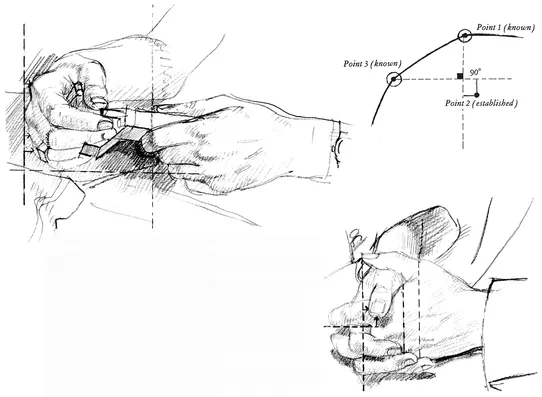
For the purpose of absolute accuracy you may find it imperative to know the exact position in distance of a part of a drawing from other parts of it. You may, for instance, need to determine the exact distances from the tip of the thumb to the tips of the small and middle fingers. By using this method absolute certainty is assured. To determine the exact distance away from two known points of an established but uncertain point, try this. From the highest known point (Point 1) drop a vertical line and from your other known point (Point 3) draw a horizontal line. Extend these two lines beyond their 90° angles of interception until they pass the points where they meet 90° angle lines drawn out toward them from your unmeasured point. Now, by measuring the last two lines, you can discover how far to the left or right of the vertical, and how far below or above the horizontal, Point 2 (the hitherto unmeasured point) falls.
e9780486141909_i0022.webp
certain angles of importance to the drawing as a whole are more easily understood and visualized when they are related to or compared with verticals and horizontals that form 90° angles. See the lines marked D on this page.
 
The vertical and horizontal lines have been drawn heavily only for the purposes of this book. In ordinary practice they would be much fainter and not necessarily drawn with a ruler. In drawings meant to exist in their own right, such as illustrations, there would remain no trace of any construction lines.

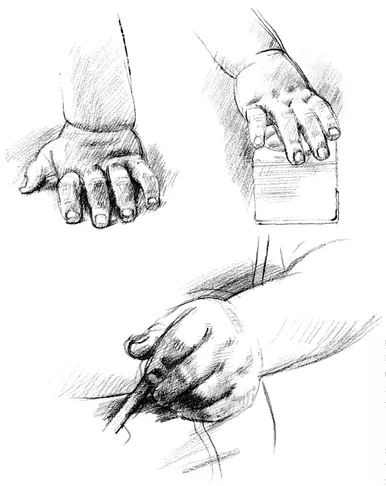
CHILDREN

e9780486141909_i0023.webp
e9780486141909_i0024.webp
Th...

Table of contents

  1. Title Page
  2. Copyright Page
  3. Table of Contents
  4. INTRODUCTION
  5. BONE STRUCTURE
  6. SIMPLIFIED CONSTRUCTION
  7. LATERAL WRIST MOVEMENT
  8. OBSERVATION
  9. CHILDREN
  10. MALE HAND
  11. FEMALE HAND
  12. ELDERLY PEOPLE
  13. THE ARTIST AS MODEL
  14. PULLING
  15. NOTES ON THE USE OF WASH
  16. LIFTING
  17. PUSHING
  18. MISCELLANY
  19. EMOTIONS AND MOODS