"It's like having an anatomy book at your fingertips." — Collectors' Corner
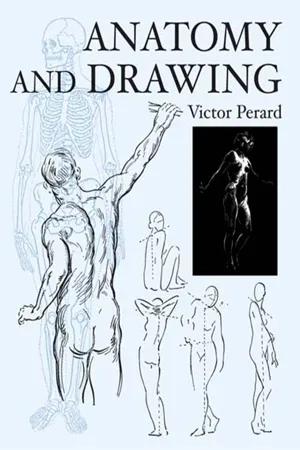
This instructive book presents excellent annotated line drawings of anatomical structure for the beginning artist. Explaining the subject in simple terms and with an extensive series of dynamic illustrations, the author identifies parts of the body and demonstrates a wide array of physical activities through his sketches.
Following notes on proportion and drawing, chapters cover the human skeleton, head and neck, torso, arm, hand, leg, foot, and musculature. Numerous illustrations depict various views of these structures, movements of the human figure, as well as changes in the relative proportions of features at different ages.
One of the best books in its field, Anatomy and Drawing helps demystify a complex subject by enabling students to visualize the muscles and bones under the skin, and covers just about everything a beginner needs to know about drawing the human anatomy.
- 224 pages
- English
- ePUB (mobile friendly)
- Available on iOS & Android
eBook - ePub
Anatomy and Drawing
About this book
Information
Topic
ArtSubtopic
Art General
PART ONE
PROPORTION and DRAWING
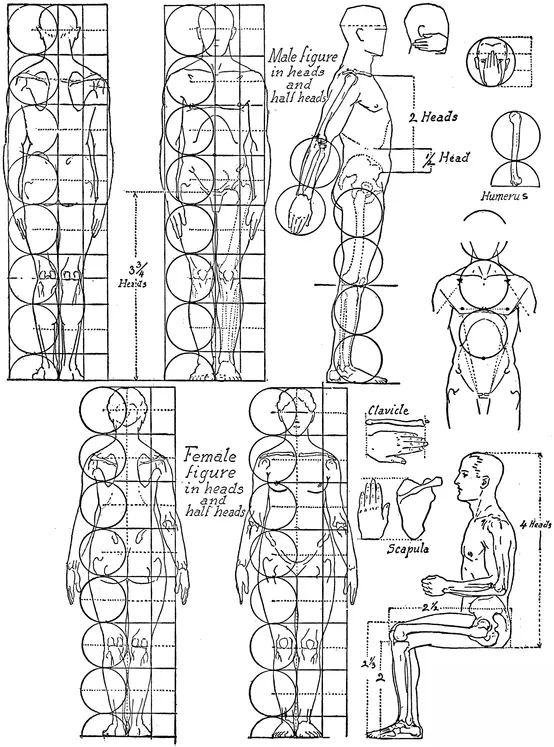
RELATIVE PROPORTION
Some of the mechanical principles of the human frame.
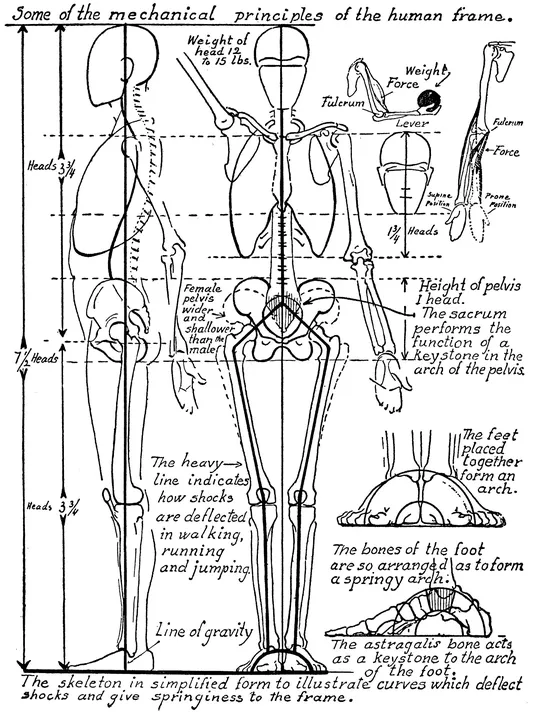
Relative proportion of bones by heads
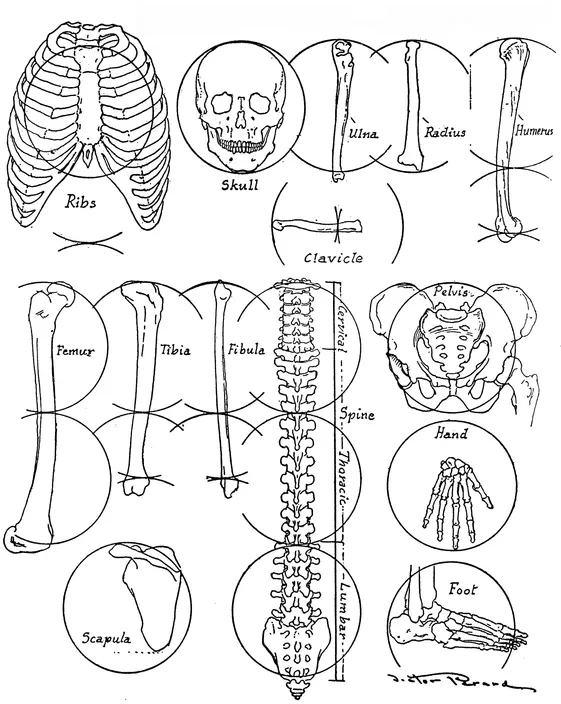
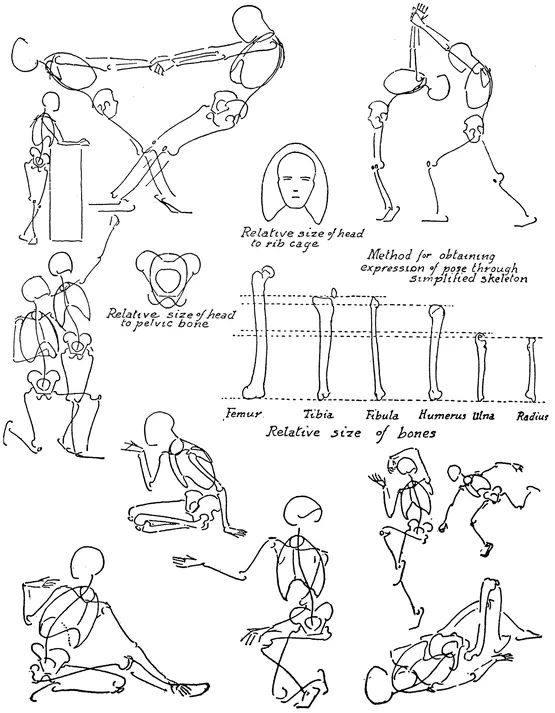
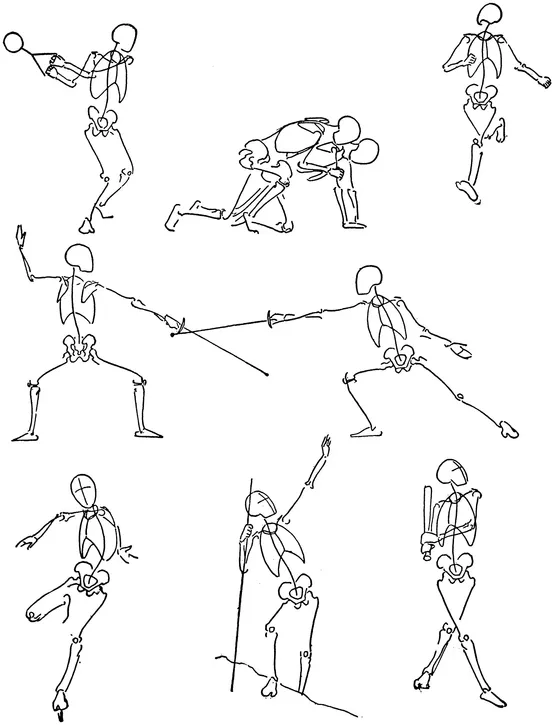
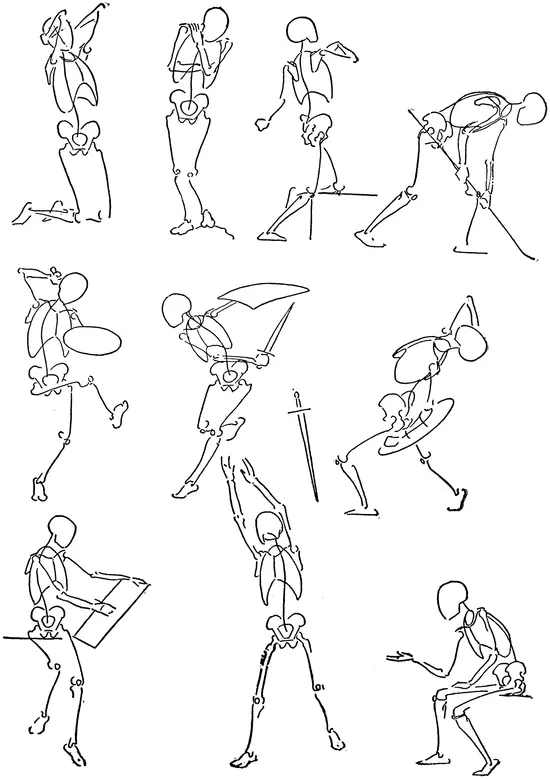
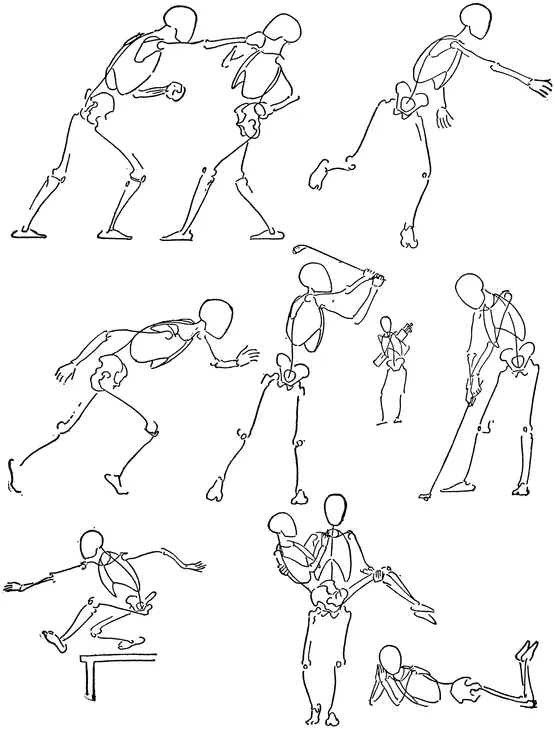
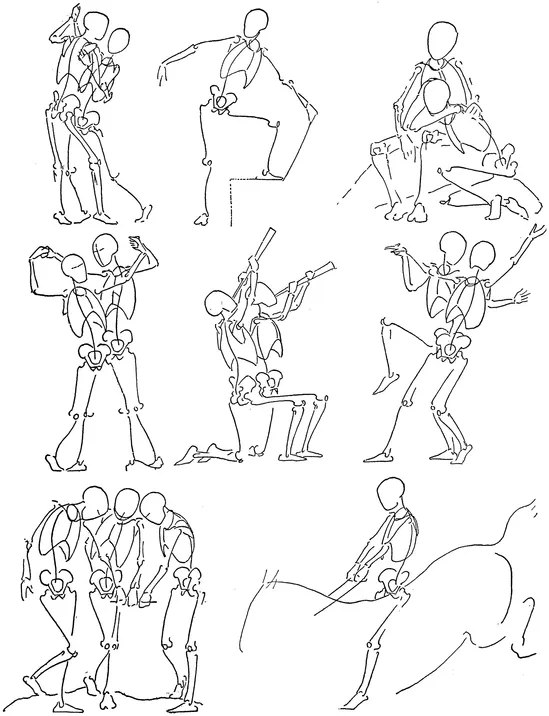
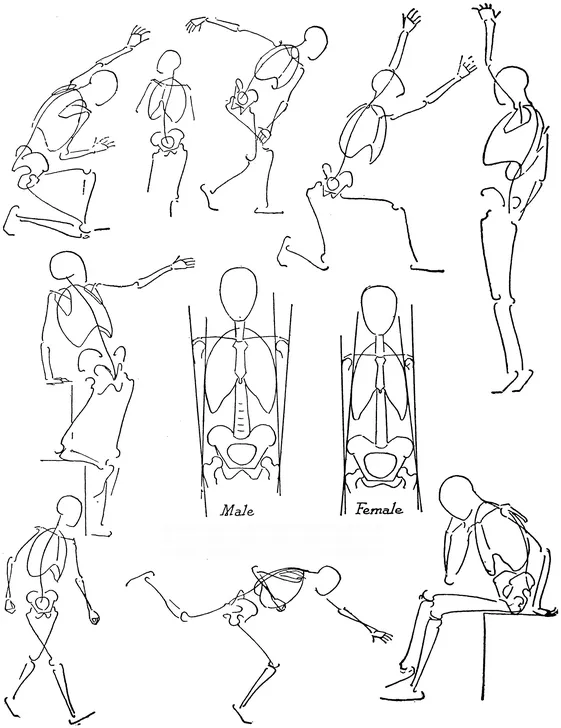
Expressing action by simplified skeleton
METHOD OF DRAWING
From Life or from the Cast
- Find the center of the paper by drawing lines from corner to corner. This is done to help center the study.
- Measure with the eye or pencil to find the center of the subject and make a line at that point as related to the center of the paper. Draw a line at the head and another at the feet.With free lines search for the rhythm of the pose, to help visualize the figure and to place it on the paper the size intended.Draw lightly so that the mental impression of the figure is not obliterated by a heavy drawing, and corrections can be easily made.
- Decide where the pit of the neck should be placed and draw a perpendicular line from this point (if a front view) to the feet. If a back view, draw the perpendicular line from the seventh cervical vertebra to the feet. Find the line of the shoulders, giving the angle of their positions.If a standing figure, first draw the leg on which there is most weight, to obtain the proper balance of the figure.
- Give the line showing the angle of the position of the pelvis. Indicate a line through the knee-caps. Draw the torso, indicating its bulk, marking the width of shoulders, hips, neck and head. Block with straight lines going beyond the intersections to obtain a better idea of the direction of line and to avoid a cramped feeling.
- Sketch within the lines a simplified skeleton, to check up on position of joints and bulk of chest. (Refer to pages on proportion.) See that the pit of the neck, the pubic bone, the navel, the pelvis, the knee-caps and the inner ankles are in proper relation to each other.Compare relative sizes of head...
Table of contents
- Title Page
- Copyright Page
- Dedication
- Table of Contents
- PREFACE TO THE FOLIRTH EDITION
- Preface
- NOTES ON PROPORTION
- PART ONE - PROPORTION and DRAWING
- PART TWO - THE SKELETON
- PART THREE - THE HEAD and NECK
- PART FOUR - THE TORSO
- PART FIVE - THE ARM
- PART SIX - THE HAND
- PART SEVEN - THE LEG
- PART EIGHT - THE FOOT
- PART NINE - THE ECORCHE AND MUSCLES OF THE BODY
- Dover Books on Art and Art History
- Art Instruction
Trusted by 375,005 students
Access to over 1.5 million titles for a fair monthly price.
Study more efficiently using our study tools.
Frequently asked questions
Yes, you can cancel anytime from the Subscription tab in your account settings on the Perlego website. Your subscription will stay active until the end of your current billing period. Learn how to cancel your subscription
No, books cannot be downloaded as external files, such as PDFs, for use outside of Perlego. However, you can download books within the Perlego app for offline reading on mobile or tablet. Learn how to download books offline
Perlego offers two plans: Essential and Complete
- Essential is ideal for learners and professionals who enjoy exploring a wide range of subjects. Access the Essential Library with 800,000+ trusted titles and best-sellers across business, personal growth, and the humanities. Includes unlimited reading time and Standard Read Aloud voice.
- Complete: Perfect for advanced learners and researchers needing full, unrestricted access. Unlock 1.5M+ books across hundreds of subjects, including academic and specialized titles. The Complete Plan also includes advanced features like Premium Read Aloud and Research Assistant.
We are an online textbook subscription service, where you can get access to an entire online library for less than the price of a single book per month. With over 1.5 million books across 990+ topics, we’ve got you covered! Learn about our mission
Look out for the read-aloud symbol on your next book to see if you can listen to it. The read-aloud tool reads text aloud for you, highlighting the text as it is being read. You can pause it, speed it up and slow it down. Learn more about Read Aloud
Yes! You can use the Perlego app on both iOS and Android devices to read anytime, anywhere — even offline. Perfect for commutes or when you’re on the go.
Please note we cannot support devices running on iOS 13 and Android 7 or earlier. Learn more about using the app
Please note we cannot support devices running on iOS 13 and Android 7 or earlier. Learn more about using the app
Yes, you can access Anatomy and Drawing by Victor Perard in PDF and/or ePUB format, as well as other popular books in Art & Art General. We have over 1.5 million books available in our catalogue for you to explore.