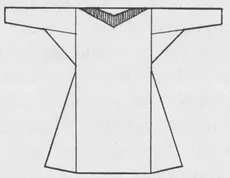
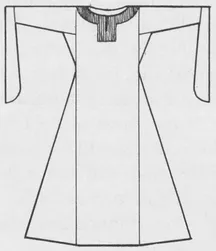
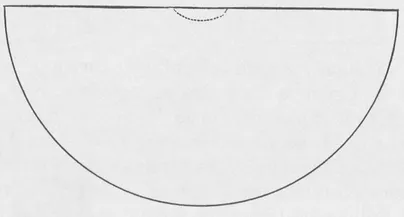
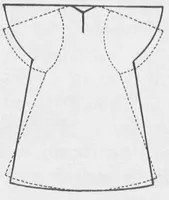
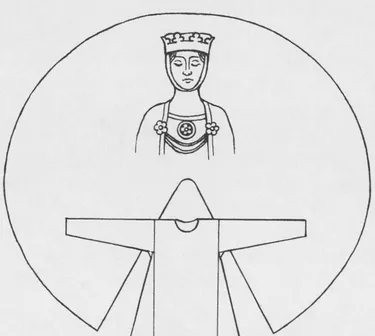
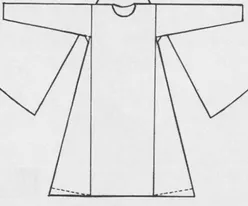
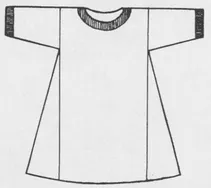
IT will help towards a clearer understanding of the style, if the illustrations of the flat patterns are studied, previously to those illustrations showing the costumes in wear, and when these latter are described, each drawing will be referred back to the flat pattern to which it pertains.
In general the costumes of this century are cut on the simplest geometric plans and, except for a few very early examples, there is no attempt to fit the figure as was seen in the twelfth and again in the fourteenth and fifteenth centuries. Undoubtedly this extreme simplicity of construction gives the great dignity of line which is the outstanding feature of thirteenth-century costume and which is only equalled by that of the dress of ancient Greece—Ecclesiastical Costume of the century will be treated of separately. Though there is little real difference between Ecclesiastical and Civil Dress at this period as far as the cutting out is concerned, it will be found more convenient to refer to the two types apart from one another.
EARLY EXAMPLES
Figs. 1 to 6 are taken from types in wear about the year 1200.
Fig. 1. This is the plan of a man’s tunic, reaching to the middle of the calf. The points distinguishing it as of early date are : first, the wide decorated band at neck ; second, the large gusset at the armhole, extending almost to the waist. This tunic was also worn full length and in the latter form was worn by women as well as by men. The wide armhole persisted till the middle of the century.
Fig. 2. Here we have a full length woman’s tunic. The points to note in this as giving the date are : first, the broadbanded decoration at neck ; second, the comparatively tight fit of the upper part ; third, the long hanging cuffs, a survival of the period of the exaggeratedly long sleeves of the eleventh and twelfth centuries.
Fig. 3. This is the semicircular cloak worn by both sexes, at least as early as the sixth century A.D. and continuously till the thirteenth century. In the thirteenth century it was gradually superseded by a circular or almost circular garment. It was worn in various ways, either fastened with a brooch on the right shoulder (this method more commonly by men), or was wrapped round the figure in various ways, and it was occasionally worn with the opening at centre front. In this last position it was clumsy round the shoulders, and for that reason, no doubt, an improvement was made (see dotted line). This was the cutting out of a curved notch for the neck. There is a large coloured drawing, in plan, of an actual thirteenth-century garment of this type in Bock’s Die Kleinodien des Heiligen Römischen Reiches Deutscher Nation. This is the Imperial Mantle (Paludamentum Imperiale) of the Emperor Otto IV. (1208–1212).
Fig. 4. This garment appears to be derived from that wide rectangular seamless robe of very ancient origin, which we find in Egypt as long ago as 1450 B.C. and in Persia (“The Royal Robe of Persia”) in the sixth and fifth centuries B.C. It continued in wear in Western Asia before and after the Christian era and in later times it is to be seen on a Romano-Byzantine Consular Ivory, fifth century A.D. (that of Stilicho and his wife Serena from the Cathedral of Monza). No longer rectangular, in the thirteenth century, but with the upper part curved inwards we find it cut as shown in the plan ; we note also the lower part is considerably narrower and seamed down at each side. Viollet-le-Duc calls this garment the “esclavine” and gives an alternative method of cutting it, see dotted lines. It persists through the thirteenth century as late as 1290 (tomb in Chalons-sur-Marne Cathedral) and is seen in an early fourteenth-century manuscript (Somme du Roi, B.M. MSS. Add. 28162, also Add. 17341, late thirteenth century). It is described in Vetusta Monumenta, Vol. VI., Plate XXXIX., as the “sclavine.” Here the garment is worn by a figure of St. John the Evangelist, as a pilgrim (which is reproduced from the original in the “Painted Chamber” at Westminster). A hood is usually attached to the sclavine during the latter years of its wear in the thirteenth century.
Fig. 5. Shows a cape-like garment or mantle characteristic of the early years of the thirteenth century. In England it appears in Saxon times, worn both by men and women (B.M. MSS. Cott. Claudius B. IV. and Harl. 2908). Where the representations show it full and voluminous, it would be cut as shown—simply a rectangular piece of stuff folded over and the front shortened more or less and rounded off, then a hole cut for the head. Other representations suggest a cut akin to certain early “extinguisher”-shaped chasubles of the period, and the construction would be more as shown by the dotted line. This latter shape restricts to some degree the movement of the arms. Fig. 5 does not persist through the century and, on the whole, it is rare even at the commencement.
Fig. 6 is the veil, head-cloth, peplum, couvre-chef, of almost universal wear by women during the thirteenth century. It was not, as a rule, quite so voluminous as that worn in the twelfth. Full scale, it measures about 22 inches across, and is rather more than double this in length. Towards the end of the century, women of position discarded it for more elaborate head-dresses, but it persisted for working-class women and elderly widows and still survives among the religious orders.
The methods of dressing the hair in the thirteenth century are easily understood when the illustrations of male costume are examined ; but in cases where the women’s heads are covered, it should be said that, for the most part, the hair was parted in the centre and dressed in two plaits, which were crossed at the back and then bound round the head. At the end of the century some figures show that each plait is coiled round above the ears, giving what was called the “ram’s horn” or, as we should now phrase it, “earphone” style.
That padding was used as well is easily seen when some of the head-dresses of the end of the century fashions are examined. Young girls wore their hair flowing naturally down their backs, at times confined by a fillet or chaplet. Widows wore the wimple, or gorget, round the face and the veil over their heads, in similar style to the head-coverings of the Religious Orders.