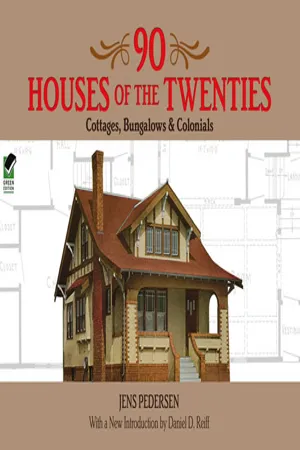
This outstanding house plan catalog from a prominent Midwestern builder was issued on the eve of the Great Depression. Its full-color, beautifully realistic illustrations depict colonials, bungalows, duplexes, and other residences, accompanied by floor plans and detailed descriptions of interiors. A nostalgic look back at the way homes were constructed during the 1920s, this volume offers an authentic resource for modern home restorers, builders, and interior designers and a splendid browsing book for fans of architecture, advertising, and Americana. Architectural historian Daniel D. Reiff provides an informative Introduction.
eBook - ePub
90 Houses of the Twenties
Cottages, Bungalows and Colonials
- 128 pages
- English
- ePUB (mobile friendly)
- Available on iOS & Android
eBook - ePub
About this book
Information
Topic
ArchitectureSubtopic
History of ArchitectureIntroduction to the Dover Edition
During the prosperous 1920s, if a middle- or upper-middle-class family wanted to have an attractive, well-designed five- to seven-room house built for themselves they had several options. One’s first inclination might be to “consult an architect,” though architects usually did not find it profitable to design small homes. But there were in fact a number of other choices, some quite economical, open to prospective home builders, thanks to the printed book. One of the most popular routes was to consult a catalog of house-plans published by one of the many mail-order plan companies, and order their plans and specifications for the preferred dwelling. Such catalogs, which provided a whole range of house designs to choose from, were often available at lumber yards and builders’ offices; they were also advertised in popular magazines. The prospective owner could then study the many designs at leisure.
Such plan catalogs were well known and of long standing. The first mail-order plans for houses seem to be those advertised by Cleaveland, Backus and Backus in their 1856 book of house designs Village and Farm Cottages. Other such volumes soon followed. Books of plans were published by Cummings and Miller in 1865; in the 1870s by George Palliser and also E. C. Hussey; in the 1880s books of house designs by R. W. Shoppell, and George F. Barber became popular. Some architects of this era, in their ads for their house plan catalogs, were perfectly forthright: “Some architects plan seventeen-story buildings, I never have; but I do draw little, cheap cottages, and beautiful ones. If you want a house, which because of its beauty will be a joy forever, send for this book. Price, 50 cents.”1
By 1898 one of the most prolific companies, the Chicago firm which became The Radford Architectural Company, was offering great numbers of appealing mail-order house plans. In the early twentieth century there were a vast number of such firms: Standard Homes Company of Washington, D.C. (beginning about 1921) and Home Builders Catalog Co., Chicago (beginning in 1926), were two of the most popular and prolific, each publishing hundreds of plans.2 The designs provided could be for frame, for face brick (on frame construction), solid brick, or concrete dwellings.
Jens Pedersen of St. Paul, Minnesota, published his Practical Homes catalog of “90 designs of moderately priced homes,” in 1929. His was part of this legion of mail-order plan companies catering to a national audience. Pedersen had been issuing such catalogs for several years; the 1922–23 edition of Practical Homes contained 55 designs. He is listed in city directories into the late 1930s.3 (He also seems to have been linked to other publications related to building.)4
House plans like these in Pedersen’s Practical Homes catalog were extremely popular. But where did he, and other such companies, get their plans? One source would have been the various building materials organizations. These organizations, to encourage homeowners and builders to use their specific product, frequently sponsored competitions for house designs, and published countless catalogs of the resulting designs (whose plans could be ordered by mail) themselves—or contributed the results quietly to house-plan companies. For example, The Association of American Portland Cement (Philadelphia) held such a competition in 1907; in a 1910 house plan catalog the Building Brick Association of America states that the plans were “a selection from more than 800 drawings submitted in a competition,” and their plan catalog of 1912 drew its designs from 666 entries in a competition. Almost every building-trade organization of the day held competitions for house designs of various sizes, as mentioned in their house plan catalogs, for example: National Fire Proofing Co., Philadelphia, 1912; Hydraulic-Press Brick Co., St. Louis, 1914; American Face Brick Association, Chicago, 1920; United States Gypsum Co., Chicago, 1925; California Redwood Association, San Francisco, 1925; W...
Table of contents
- Title Page
- Copyright Page
- Table of Contents
- Introduction to the Dover Edition
Trusted by 375,005 students
Access to over 1.5 million titles for a fair monthly price.
Study more efficiently using our study tools.
Frequently asked questions
Yes, you can cancel anytime from the Subscription tab in your account settings on the Perlego website. Your subscription will stay active until the end of your current billing period. Learn how to cancel your subscription
No, books cannot be downloaded as external files, such as PDFs, for use outside of Perlego. However, you can download books within the Perlego app for offline reading on mobile or tablet. Learn how to download books offline
Perlego offers two plans: Essential and Complete
- Essential is ideal for learners and professionals who enjoy exploring a wide range of subjects. Access the Essential Library with 800,000+ trusted titles and best-sellers across business, personal growth, and the humanities. Includes unlimited reading time and Standard Read Aloud voice.
- Complete: Perfect for advanced learners and researchers needing full, unrestricted access. Unlock 1.5M+ books across hundreds of subjects, including academic and specialized titles. The Complete Plan also includes advanced features like Premium Read Aloud and Research Assistant.
We are an online textbook subscription service, where you can get access to an entire online library for less than the price of a single book per month. With over 1.5 million books across 990+ topics, we’ve got you covered! Learn about our mission
Look out for the read-aloud symbol on your next book to see if you can listen to it. The read-aloud tool reads text aloud for you, highlighting the text as it is being read. You can pause it, speed it up and slow it down. Learn more about Read Aloud
Yes! You can use the Perlego app on both iOS and Android devices to read anytime, anywhere — even offline. Perfect for commutes or when you’re on the go.
Please note we cannot support devices running on iOS 13 and Android 7 or earlier. Learn more about using the app
Please note we cannot support devices running on iOS 13 and Android 7 or earlier. Learn more about using the app
Yes, you can access 90 Houses of the Twenties by Jens Pedersen, Daniel D. Reiff in PDF and/or ePUB format, as well as other popular books in Architecture & History of Architecture. We have over 1.5 million books available in our catalogue for you to explore.