X-Ray Diffraction
eBook - ePub

X-Ray Diffraction

In Crystals, Imperfect Crystals, and Amorphous Bodies

  1. 378 pages
  2. English
  3. ePUB (mobile friendly)
  4. Available on iOS & Android
eBook - ePub

X-Ray Diffraction

In Crystals, Imperfect Crystals, and Amorphous Bodies

About this book

This valuable text begins with the general theory of diffraction through the use of Fourier transforms. The author then applies the general results to various atomic structures including amorphous bodies, crystals, and imperfect crystals, whereby the elementary laws of x-ray diffraction from ideal structures follow as a special case. The presentation has been carefully developed to illustrate clearly the meaning of the general equations essential for the study of more complex cases.
Readers are assumed to be familiar with the elements of crystallography and x-ray diffraction, and the author has not discussed the problem of determining crystal structures. Rather the focus is on the great variety of imperfect crystals as well as amorphous bodies and liquids. The book should thus be especially useful solid-state physicists, materials scientists, chemists, and biologists with an interest in the scattering from defective structures. More generally, it will benefit all who require a thorough understanding of diffraction theory in order to interpret properly the information provided by modern x-ray diffraction instruments on line profiles, line intensities, diffuse scattering and other phenomena associated with disorder.

Frequently asked questions

Yes, you can cancel anytime from the Subscription tab in your account settings on the Perlego website. Your subscription will stay active until the end of your current billing period. Learn how to cancel your subscription.
No, books cannot be downloaded as external files, such as PDFs, for use outside of Perlego. However, you can download books within the Perlego app for offline reading on mobile or tablet. Learn more here.
Perlego offers two plans: Essential and Complete
  • Essential is ideal for learners and professionals who enjoy exploring a wide range of subjects. Access the Essential Library with 800,000+ trusted titles and best-sellers across business, personal growth, and the humanities. Includes unlimited reading time and Standard Read Aloud voice.
  • Complete: Perfect for advanced learners and researchers needing full, unrestricted access. Unlock 1.4M+ books across hundreds of subjects, including academic and specialized titles. The Complete Plan also includes advanced features like Premium Read Aloud and Research Assistant.
Both plans are available with monthly, semester, or annual billing cycles.
We are an online textbook subscription service, where you can get access to an entire online library for less than the price of a single book per month. With over 1 million books across 1000+ topics, we’ve got you covered! Learn more here.
Look out for the read-aloud symbol on your next book to see if you can listen to it. The read-aloud tool reads text aloud for you, highlighting the text as it is being read. You can pause it, speed it up and slow it down. Learn more here.
Yes! You can use the Perlego app on both iOS or Android devices to read anytime, anywhere — even offline. Perfect for commutes or when you’re on the go.
Please note we cannot support devices running on iOS 13 and Android 7 or earlier. Learn more about using the app.
Yes, you can access X-Ray Diffraction by A. Guinier in PDF and/or ePUB format, as well as other popular books in Physical Sciences & Physics. We have over one million books available in our catalogue for you to explore.

Information

CHAPTER 1

FUNDAMENTALS OF X-RAY DIFFRACTION THEORY

1.1. General Properties of X-Rays

1.1.1. The Nature of X-Rays

X-rays are transverse electromagnetic radiations, like visible light, but of much shorter wavelength. The range of wavelengths corresponding to X-rays is ill-defined, but it extends from radiations which are identical to ultraviolet light to others which are identical to the gamma rays emitted by radioactive substances. We shall consider here only the range of wavelengths which is commonly used for X-ray crystallography, namely 0.5 to 2.5Å.
Electromagnetic radiation has two complementary aspects: some experiments require a wave interpretation, while others can be understood only in terms of photons. In this book we shall be concerned mainly with the first of these aspects; however, it is in some cases useful to consider photons- of energy hv = hc/λ, where h is Planck’s constant, 6.62 × 10⁻³⁴ joule-second, and c is the velocity of light, 2.998 × 10⁸ m/sec.

1.1.2. Geometrical Optics of X-Rays

The geometrical optics of X-rays is simple compared to that of visible light. Whatever be the medium in which they propagate, X-rays have approximately the same velocity as light in a vacuum, the difference being always smaller than one part in 104. They are therefore practically not deviated by refraction. The index of refraction n is slightly smaller than unity; for a pure substance, the theoretical formula is
e9780486141343_i0002.webp
(1.1)
where ra is the classical radius of the electron, which is numerically equal to 2.818 × 10⁻¹⁵ m, N is the number of electrons per cubic meter, and λ is the wavelength in meters [1].
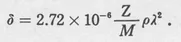
Numerically, if ρ is the density, if Z is the number of electrons in the atomic group (which can be either an isolated atom, a molecule, or a unit cell in a crystal lattice) of atomic mass M, and if λ is expressed in Ångströms,
e9780486141343_i0003.webp
Since M/Z is always approximately equal to 2,
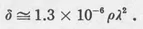
e9780486141343_i0004.webp
(1.2)
Even for the densest substances and for λ = 2Å, δ is still of the order of 10−4. In most cases, δ is of the order of 10−5.
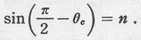
Since X-rays always propagate along straight lines, it follows that they cannot be focused with lenses. On the other hand, there do exist mirrors for X-rays. When a beam propagating in air meets the surface of a solid medium whose index n is less than unity, total reflection phenomena can be expected for grazing incidence. The general formula for the critical angle of incidence, θc, which is the angle between the incident ray and the reflecting surface, is
e9780486141343_i0005.webp
(1.3)
However, since n is close to unity, it follows from Eqs. (1.2) and (1.3) that
e9780486141343_i0006.webp
(1.4)
For usual values of ρ and λ, θc, is of the order of 10-30′ [2]. When the angle of incidence is larger than θc, the energy which is reflected according to the laws of optics is negligible, as can be shown from the Fresnel formulas [3].

1.1.3. Polarization of X-Rays

X-rays, like visible light, can be linearly polarized, either partially or totally, and the polarization factor will be used in many of our formulas. This polarization was demonstrated by the experiments of Barkla [4]. Polarized beams of X-rays can be obtained by scattering from a solid body and, for a scattering angle of 90°, polarization is complete, the electric vector being normal to the plane of the incident and scattered rays.

1.1.4. Definition of the Intensity of a Beam of X-Rays

The intensity of an approximately parallel beam of X-rays is the flux of energy which crosses a unit surface normal to the average ray of the beam per second. For a monochromatic plane wave, it is well known that the intensity is proportional to the square of the amplitude of the vibration.
The intensity of radiation emitted by a point source, or by a quasi-point source, in a given direction, is the energy emitted per second by the source per unit solid angle in the direction considered. For absolute intensity measurements, the simplest method is to determine the number of photons emitted or received per second, either per unit area or per unit soli...

Table of contents

  1. DOVER BOOKS ON PHYSICS
  2. Title Page
  3. Copyright Page
  4. PREFACE
  5. Table of Contents
  6. CHAPTER 1 - FUNDAMENTALS OF X-RAY DIFFRACTION THEORY
  7. CHAPTER 2 - GENERAL THEORY OF X-RAY DIFFRACTION FOR AN ARBITRARY STRUCTURE
  8. CHAPTER 3 - X-RAY DIFFRACTION FROM AMORPHOUS SUBSTANCES: GASES, LIQUIDS, AND VITREOUS SOLIDS
  9. CHAPTER 4 - DIFFRACTION OF X-RAYS BY CRYSTALS
  10. CHAPTER 5 - DIFFRACTION BY VERY SMALL CRYSTALS
  11. CHAPTER 6 - DIFFRACTION BY AN IMPERFECT CRYSTAL LATTICE
  12. CHAPTER 7 - DISPLACEMENT DISORDER IN CRYSTALS
  13. CHAPTER 8 - MIXED CRYSTALS AND SUBSTITUTION DISORDER
  14. CHAPTER 9 - CRYSTAL IMPERFECTIONS DESTROYING LONG-RANGE ORDER
  15. CHAPTER 10 - SMALL-ANGLE X-RAY SCATTERING
  16. APPENDIX A - THE FOURIER TRANSFORMATION
  17. APPENDIX B - CALCULATION OF cos nx, an cos nx, n cos nx, and nan cos nx
  18. INDEX
  19. A CATALOG OF SELECTED DOVER BOOKS IN SCIENCE AND MATHEMATICS