An expert treatise on the origin and evolution of dunes, this classic work was used by NASA in studying sand dunes on Mars and is appropriate for undergraduate and graduate students. The first book to deal exclusively with the behavior of blown sand and related land forms, its accessible style makes it an enduring reference more than half a century after its initial publication. The author studied the sands of North Africa for many years before World War II and is recognized as a leading authority on the subject. His three-part treatment begins with his wind-tunnel experiments, which he conducted to investigate the mechanism of sand transport. First, an account of the observed movement of the individual grains, followed by a chapter on the ground wind and its dependence on the type of surface over which it blows, form a comprehensive view of the interaction between wind and sand. Part Two considers small-scale surface phenomena, such as ripples and ridges, and the closely related subject of size-grading the grains. The third part uses the foregoing results to explain the growth and movement of dunes in general, and the peculiar characteristics of the two main dune types. A method of determining the internal structure of accumulated sand illuminates both the sand's carrying power for motor transport and its water-retention potential. A final chapter, derived from firsthand knowledge, examines the intriguing subject of "singing sand."
1. THE ORDER OF SIZE OF SMALL PARTICLES. USE OF THE LOGARITHMIC SCALE
FIGURE 1 is intended to show approximately, in diagrammatic form, the relative sizes of material particles which are susceptible to the action of winds of normal speeds. They range from little pebbles, on the large side, through sand grains and rain and fog drops to specks of dust and the tiny water droplets which constitute clouds. Thence, smaller and smaller, to the minute particles that form thin smokes and hazes. The estimated diameter of large molecules of matter is included for completeness.
FIG. 1.—RELATIVE SIZE AND RATE OF FALL OF SMALL PARTICLES
The diameter of the largest particle in the diagram is seen to be some fifty million times that of the smallest. For such a diagram the ordinary linear scale is clearly unsuitable. If a linear scale (one in which 10 is added to 10 in the ordinary way to give the position of the succeeding division 20) had been used, 99 per cent. of the horizontal space in the diagram would have been occupied by the pebbles and the larger sand grains ; and all the rest of the material, all the vast range of small particles from sand grains to hazes, would have been squashed up into the last single millimetre of the scale.
The linear scale, since it was first cut on the wall of an Egyptian temple, has come to be accepted by man almost as if it were the one unique scale with which Nature works and builds. Whereas it is nothing of the sort. Its sole value lies in giving due prominence to the differences and sums of quantities, when these are what we want to display. But Nature, if she has any preference, probably takes more interest in the ratios between quantities ; she is rarely concerned with size for the sake of size.
For many purposes a far more convenient scale is one in which equal divisions represent equal multiples—one which multiplies 10 by 10 to make 100 rather than one which adds 10 to 10 to make 20. This point is stressed, because throughout the subject with which we are dealing the relations between one quantity and another are very often found to be of the logarithmic type ; so that we have the choice, in representing relations of this kind diagrammatically, between dealing with awkward logarithmic curves on a linear scale (with the added disadvantage of being limited in the extent of the scale) or exhibiting simple straight-line relations on an unlimited ratio scale such as that of Fig. 1. I shall use both scales indiscriminately, according to which is most suitable to the occasion.
It will be seen from the diagram that of the whole size range of 50,000,000 to 1, sand occupies but a tiny belt between 1 mm. and
mm., or a ratio of 50 to 1. That is, the size range of sand grains occupies but one-millionth of the whole range of size of small particles which are affected by the wind. The truth of this statement depends, of course, on how we define sand ; and that, in turn, from the nature of the subject, depends on the relative behaviour of small particles in a wind. It is to this question that we must first turn.
2. THE DEFINITION OF GRAIN SIZE
If an object of any size, shape, or material is allowed to fall from rest through any fluid, whether air, water, or oil, its velocity will increase, at first with the acceleration of gravity, but thereafter at a decreasing acceleration till it reaches a constant value known as the Terminal Velocity of Fall. The reason is that the net force on the object is the resultant of the pull of gravity acting downwards, and the resisting force of the fluid acting always in a direction opposite to that of the motion. As the velocity of the motion increases, so does the resistance against that motion, till eventually the two are equal. No net force any longer acts on the object, which therefore moves at a constant speed.
The downward force of gravity depends on the volume of the object and its density. The resisting force depends on the area of frontage exposed to the fluid, on the shape of the object, and on its speed through the fluid. Hence, since natural solid particles are of irregular and haphazard shape, the individuals, even of a collection of particles or grains chosen to be all of the same average size, will not have the same rate of fall.
The first task is to find a convenient way of specifying the average size and shape of the grains of a given sample so that the average rate of fall of these specified grains can be calculated. Now a great deal of experimental work has been done on the behaviour of spherical objects in air and other fluids, and the fluid resistance of a sphere of a given diameter and a given density can be accurately calculated. The most useful method, therefore, of specifying our sand grains is to replace them by a collection of imaginary spheres of the same material and of such a diameter that they will behave in air in the same way as the average sand grain of the sample. We then have a simple workable material of identical grains completely specified by diameter and density ; and, starting with any given initial conditions, we can calculate with confidence the subsequent paths of these ideal average grains through the air.
To obtain the diameter of a sphere which will be equivalent to a given sand grain, the mean dimensions of the grain are found by passing it through a series of sieves each having a known size of aperture which differs but slightly from that of the next in the series. The mean dimension is taken to be that midway between the size of the aperture of the sieve through which the grain will just pass and of that of the next sieve which will retain it. This mean diameter is then multiplied by a suitable shape-factor. For desert sand this factor can be taken as 0.75.
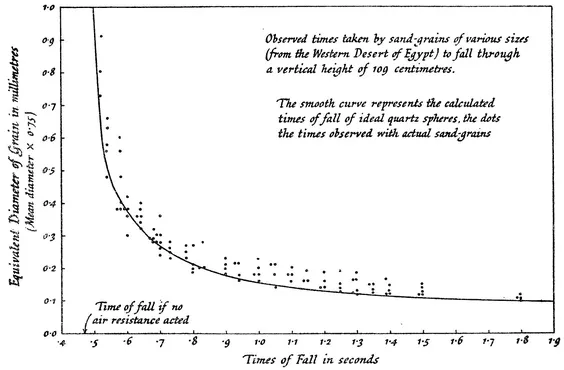
The value of this factor can be found very simply by experiment. A small shower of mixed sand of all grain sizes is allowed to fall from a known height on to a slowly rotating disc covered with sticky paper, from a hopper which is made to open by a trigger operated by a cam on the disc. By this means the beginning of the fall is made to correspond in time with the passage of a fixed zero radius on the disc below. The exact time of fall can then be measured by the angle between the zero radius and the radius passing through any required grain (which is held in position by the sticky paper). The continuous curve in Fig. 2 gives the calculated time of all of quartz spheres of various diameters given by the scale on the left. The dots show the measured times of fall of actual sand grains whose measured diameters have been multiplied by a shape-factor of 0.75 to reduce them to their corresponding equivalent diameters, as explained above. The figure shows fairly well the degree to which sand grains of the same general size may be expected to vary as regards their wind resistance. It also shows the degree of closeness with which one can calculate the wind resistance and the rate of fall of a real grain of a given size.
FIG. 2.—EXPERIMENTAL DETERMINATION OF THE SHAPE-FACTOR
The above is but a very brief reference to the subject of grain size and rate of fall. In contrast to our imperfect knowledge of the general effect of the presence of numerous particles on the motion of a fluid, a really formidable amount of detailed work has been devoted both to the rate of fall of individual particles through a fluid at rest, and to the measurement of the size of small particles. An excellent bibliography of original papers on the subject is given in a paper by Heywood 2 ; and the whole subject is treated of at length by Krumbein and Pettijohn.3
3. THE SUSPENSION OF SMALL PARTICLES. THE DISTINCTION BETWEEN SAND AND DUST
Returning to Fig. 1 ; in the lower part will be found given the rates of fall of the various kinds of particles sho...
Table of contents
Title Page
Copyright Page
PREFACE TO 1954 REPRINT
Table of Contents
INTRODUCTION - THE NATURE OF THE PROBLEM
PART I - THE PHYSICS OF GRAIN MOVEMENT
PART II - SMALL-SCALE EFFECTS. GRAIN SIZE DISTRIBUTION. SURFACE RIPPLES AND RIDGES
PART III - LARGE-SCALE EFFECTS. SAND ACCUMULATION. DUNES. INTERNAL STRUCTURE, ETC.
INDEX
Trusted by 375,005 students
Access to over 1.5 million titles for a fair monthly price.
Study more efficiently using our study tools.
Frequently asked questions
Yes, you can cancel anytime from the Subscription tab in your account settings on the Perlego website. Your subscription will stay active until the end of your current billing period. Learn how to cancel your subscription
No, books cannot be downloaded as external files, such as PDFs, for use outside of Perlego. However, you can download books within the Perlego app for offline reading on mobile or tablet. Learn how to download books offline
Perlego offers two plans: Essential and Complete
Essential is ideal for learners and professionals who enjoy exploring a wide range of subjects. Access the Essential Library with 800,000+ trusted titles and best-sellers across business, personal growth, and the humanities. Includes unlimited reading time and Standard Read Aloud voice.
Complete: Perfect for advanced learners and researchers needing full, unrestricted access. Unlock 1.5M+ books across hundreds of subjects, including academic and specialized titles. The Complete Plan also includes advanced features like Premium Read Aloud and Research Assistant.
Both plans are available with monthly, semester, or annual billing cycles.
We are an online textbook subscription service, where you can get access to an entire online library for less than the price of a single book per month. With over 1.5 million books across 990+ topics, we’ve got you covered! Learn about our mission
Look out for the read-aloud symbol on your next book to see if you can listen to it. The read-aloud tool reads text aloud for you, highlighting the text as it is being read. You can pause it, speed it up and slow it down. Learn more about Read Aloud
Yes! You can use the Perlego app on both iOS and Android devices to read anytime, anywhere — even offline. Perfect for commutes or when you’re on the go. Please note we cannot support devices running on iOS 13 and Android 7 or earlier. Learn more about using the app
Yes, you can access The Physics of Blown Sand and Desert Dunes by R. A. Bagnold in PDF and/or ePUB format, as well as other popular books in Physical Sciences & Geology & Earth Sciences. We have over 1.5 million books available in our catalogue for you to explore.