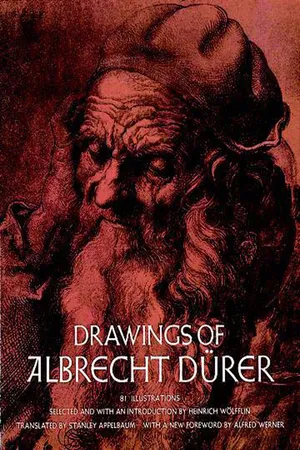
Originally published in Munich in 1914, this selection of Albrecht Dürer's finest drawings by the great art historian Heinrich Wöfflin has long been regarded as a basic book in the arts. It has gone through many editions in Europe, even though this is its first appearance in English.
Professor Wöfflin selected 81 drawings by the master both for their individual interest and for the light they cast on Dürer's artistic growth and evolution. They begin with the self-portrait Dürer drew at the age of 13 in 1484 and end with his Head of Saint Mark, done in 1526, approximately two years before his death. Included are many favorites as well as many works that are little known. Of special interest are sketches that Dürer prepared for famous works in other media, such as drawings for the famous woodcut series The Life of the Virgin.
Professor Wöfflin's penetrating essay, which is considered one of the foundations of modern art criticism, has been translated by Stanley Appelbaum.
Several features have been added to this Dover edition of Dürer's drawings: a revised statement on ownership of originals; bibliographical note; Winkler numbers; and a new Foreword by Alfred Werner, art critic and lecturer.
- 73 pages
- English
- ePUB (mobile friendly)
- Available on iOS & Android
eBook - ePub
Drawings of Albrecht Dürer
About this book
Information
Topic
ArtSubtopic
Artist MonographsDÜRER’S DRAWINGS
The historical significance of Dürer as a draftsman lies in his construction of a purely linear style on the foundation of the modern three-dimensional representation of the real world. All drawing moves between the two poles of expression by line and expression by tone areas or masses. In the latter, of course, line need not be wholly absent, but it does not become important for its own sake. Rembrandt used the pen, too, yet the individual pen stroke is not present as a final end operative in its own right, but as an element incorporated into the impression made by the drawing as a whole. The viewer does not follow the course of the individual line, and cannot do so, because the line stops every moment, shifting his attention, or else becomes complicated to the point of inextricability: the masses are to convey the message, not the framework of lines itself. With Dürer it is just the opposite; the drawing is a crystal-clear configuration in which every stroke, rendered pure and perspicuous, not only has the function of defining forms, but possesses its own ornamental beauty. It is not enough to praise the power of Dürer’s line and to ascertain that the expression is entirely entrusted to the interconnection of the major lines and the even flow of their directionality: there is, beyond this, the development of the stroke as an element in a decorative overall figure.
This style is not present at the outset. The fifteenth century did not yet possess it, and there are early drawings of Dürer which have a more “painterly” appearance than his later classic drawings. It is conceivable that modern sympathies may even lie more with those youthful works, but this does not alter the fact that it was the pure linear style that made Dürer’s draftsmanship the cornerstone of sixteenth-century art.
There are no lines in nature. Any beginner can learn this if he sits down in front of his house with a pencil and tries to reduce what he sees to a series of lines. Everything opposes this task: the foliage on the trees, the waves in the water, the clouds in the sky. And if it seems that a roof clearly exposed against the sky, or a dark tree trunk, must surely be able to be rendered in outline, even in these cases it is soon apparent that the line can only be an abstraction, because it is not lines that one sees, but masses, bright and dark masses that contrast with a background of a different color. After all, there are no black threads running along the edges of objects!
It is extremely strange that nevertheless it is possible to wrest an expression in line from the real world. Our eyes have become accustomed to linear abstraction; thanks to the efforts of generations, there is a language of line in which everything or at least practically everything can be said. And Dürer is one of the great discoverers; he extended the expressiveness of line in all directions and found the unsurpassable formula for rendering certain phenomena.
There are two senses in which we speak of lines in drawing: there are contour lines and there are modeling or shading lines.
There are contours in every drawing, but the greater or lesser accentuation of these contours makes a great difference. The more significance they have for the definition of form—that is, the more the figure approaches an objective silhouette—the greater significance the contours will have in comparison with the other lines. (By silhouette is meant not only the overall outline of a figure; inner forms also have their silhouette.) The significance of the contour line is further increased when it gains independence as a melodic voice. That is what happened in the sixteenth century. Now more, now less emphasized, the contour nevertheless is always a sure and clearly marked path. Beautiful in its own right, it contains the interpretation of the form.
Wherever this linear style turns toward the painterly, the contour quickly loses its importance. The eye is hindered in every way from using it as a path for observation. Finally all that is left, as resting places on the old road, is a few isolated line fragments or dots.
In its second application, line is used to achieve modeling. To be sure, line is not a self-evident means of representing light and shade, but the viewer raises no objection to seeing the dark area of a vaulted surface, or the part of a room that lies in shadow, transformed into a system of individual strokes. Here too the sixteenth century is the first century of decided linearity. Whereas previously longer or shorter strokes were placed side by side and one above the other to indicate the form of a mass, the technique becomes refined toward the close of the fifteenth century, and the classic linear artists make it their rule that the line systems of shaded areas be kept perfectly transparent and open, so that each individual stroke carries its own weight. Once again clarification of form and decorative beauty go hand in hand. The stroke that models is felt to be ornamental, but at the same time its movement is conditioned by the necessity for the course of the line to follow the given form. The line in a vaulted form is different from that in a flat form, an empty dark area in a room is not characterized in the same way as the shadow cast by a body. In fact, it is possible to communicate the qualities of textures by purely linear means, to express hardness and softness, the muscular firmness of a man’s thigh and the gentle manner in which a woman’s body yields to the touch.
Then, under the influence of painterly tendencies, the schema becomes confused. The individual line is lost in the overall mass. Alienated from form, it no longer retains any special ornamental significance, and only the large-scale rhythm of clusters and tone areas is left to tell the story. The drawing has forfeited its transparency, but in the same measure its power to differentiate textures has grown, and dark and light have acquired a mysterious life of their own.
Dürer used a great variety of media. There are pen drawings and brush drawings; he worked with charcoal and chalk; and alongside a lead-like metal point the older silverpoint is also to be found. The tools change according to time and occasion. For examp...
Table of contents
- Dover Books on Fine Art
- Title Page
- Copyright Page
- Table of Contents
- FOREWORD
- BIBLIOGRAPHICAL NOTE
- LIST OF PLATES
- DÜRER’S DRAWINGS
Trusted by 375,005 students
Access to over 1.5 million titles for a fair monthly price.
Study more efficiently using our study tools.
Frequently asked questions
Yes, you can cancel anytime from the Subscription tab in your account settings on the Perlego website. Your subscription will stay active until the end of your current billing period. Learn how to cancel your subscription
No, books cannot be downloaded as external files, such as PDFs, for use outside of Perlego. However, you can download books within the Perlego app for offline reading on mobile or tablet. Learn how to download books offline
Perlego offers two plans: Essential and Complete
- Essential is ideal for learners and professionals who enjoy exploring a wide range of subjects. Access the Essential Library with 800,000+ trusted titles and best-sellers across business, personal growth, and the humanities. Includes unlimited reading time and Standard Read Aloud voice.
- Complete: Perfect for advanced learners and researchers needing full, unrestricted access. Unlock 1.5M+ books across hundreds of subjects, including academic and specialized titles. The Complete Plan also includes advanced features like Premium Read Aloud and Research Assistant.
We are an online textbook subscription service, where you can get access to an entire online library for less than the price of a single book per month. With over 1.5 million books across 990+ topics, we’ve got you covered! Learn about our mission
Look out for the read-aloud symbol on your next book to see if you can listen to it. The read-aloud tool reads text aloud for you, highlighting the text as it is being read. You can pause it, speed it up and slow it down. Learn more about Read Aloud
Yes! You can use the Perlego app on both iOS and Android devices to read anytime, anywhere — even offline. Perfect for commutes or when you’re on the go.
Please note we cannot support devices running on iOS 13 and Android 7 or earlier. Learn more about using the app
Please note we cannot support devices running on iOS 13 and Android 7 or earlier. Learn more about using the app
Yes, you can access Drawings of Albrecht Dürer by Heinrich Wölfflin in PDF and/or ePUB format, as well as other popular books in Art & Artist Monographs. We have over 1.5 million books available in our catalogue for you to explore.