![]()
1
Girlhood
No more unlikely a background for an internationally known markswoman could be imagined than that of Annie Oakley! Her parents, Jacob and Susan Moses, were Quakers who reared their children in a quiet, religious manner. Yet from this modest environment emerged one of the world’s most famous entertainers.
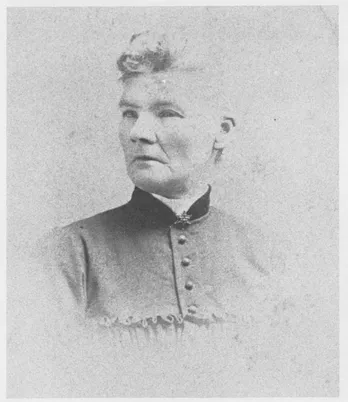
Family tradition tells how a mature Jacob fell in love with 15-year-old Susan Wise and, after obtaining permission from her parents, placed her on a pillion and took her away on his horse. After their marriage in Blair County, Pennsylvania, in 1850, they became the parents of Mary Jane, Lyda and Elizabeth.
The Moseses kept a small inn near the termination of the eastern division of the Pennsylvania Canal at Hollidaysburg. One night, after a careless guest upset an oil lamp, the log tavern burned to the ground and the family was homeless. The year was 1855. Jacob had heard so much about the fertile Ohio country that he decided to pack up what few possessions they had left and to move West. The Quakers allowed their members to carry a gun as a necessary tool of survival on the frontier, and we know Jacob took his muzzle-loader with him. It was this very gun that later launched one of his daughters into a phenomenal career.
1. Annie Oakley’s mother, née Susan Wise. (Photo by C. M. Hengen, Versailles, Ohio)
Mr. and Mrs. Moses settled on a small rented farm in northern Darke County, Ohio, and five more children were born. After Sarah Ellen came Phoebe Ann (Annie) on August 13, 1860, and later John and Hulda. One daughter died in infancy.
Jacob died of pneumonia on February 11, 1866, leaving Susan with little but their lively family of seven. She tried to keep her home together by going into the community as a practical nurse, but jobs were scarce and the pay small.
When the widow Moses married Dan Brumbaugh, it looked as if the family fortunes were greatly improved—but not for long. He died after an accident and she again had to assume the responsibility of supporting her growing family. At his death, their daughter Emily was only five months old.
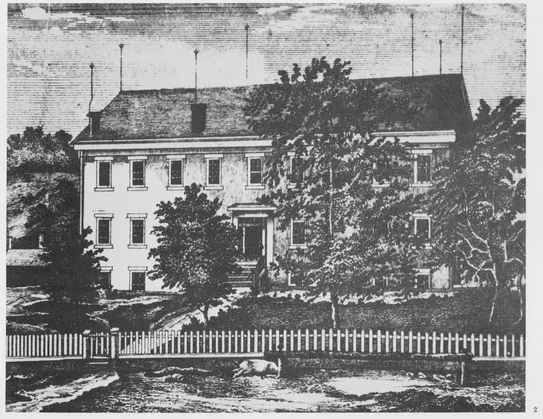
Mrs. Crawford Edington, matron at the Darke County Infirmary, offered to take Annie and train her in exchange for help with the children. In a Darke County history, George W. Wolfe describes what must have been a deplorable condition at the home:
Many persons incapable of attending to their own wants were housed at the Infirmary and a shortage of rooms compelled the children to associate with these unfortunates, whose habits of life and language were not intended to exert that influence for good that should always surround the child.
Apparently, the Infirmary was the dumping ground for the elderly, the orphaned and the insane. Perhaps this early experience, working at such a place, aroused in Annie the tremendous compassion she had for children wherever she went.
Mrs. Edington taught her a skill and appreciation for fine sewing which helped when she later made her own costumes. It must be pointed out that the Edingtons tried to make life tolerable for the inmates with all the resources they could find. Later, a larger home was built and the children were separated from the adults.
2. The Darke County Infirmary in 1870.
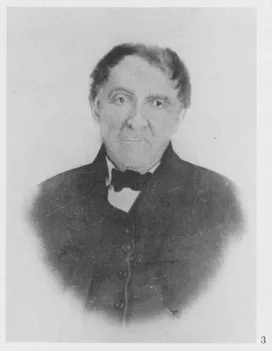
3. Annie’s stepfather Joseph Shaw.
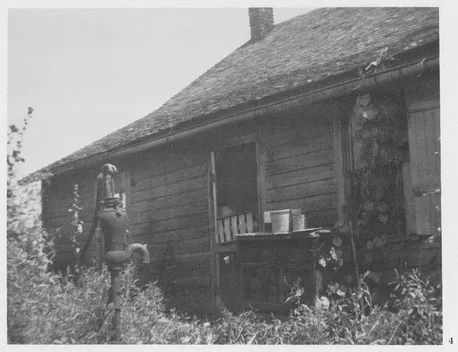
4. The Shaw cabin near North Star, Ohio.
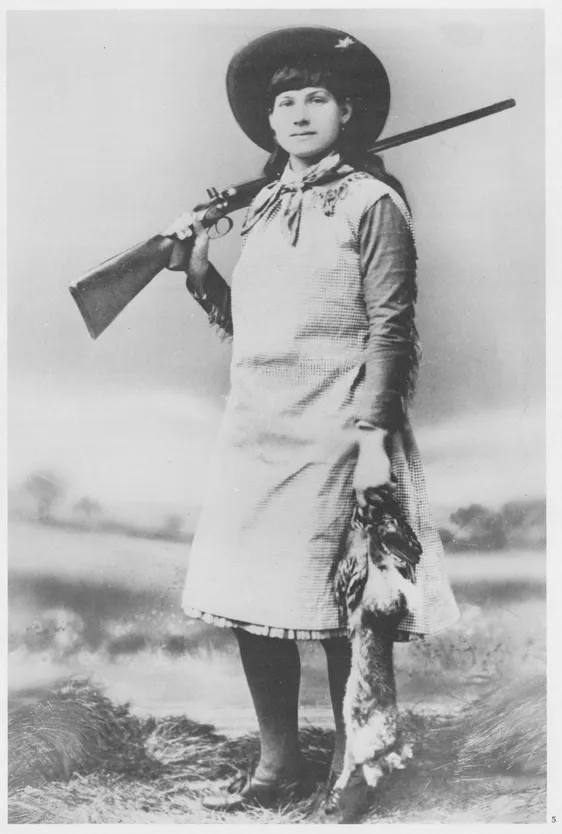
5. Annie as a purveyor of game.
Many years after Annie lived with the Edingtons, their son Frank related:
Mother couldn’t stand to see her placed with the other children and brought her over to our living quarters in another part of the institution. We went to school together. After she left and became famous, Mother and she kept up a correspondence that continued until Mother’s death.
I can’t think her skill with firearms was the most important factor in causing the people of the world to hold her in such esteem. It was the fine unexplainable personality that gripped and held them.
When Annie was given an opportunity to work as a mother’s helper in a private home south of Greenville, she discovered much more was expected of her than she could possibly endure. She was lonesome and frightened and unable to communicate with her mother, who lived north of town.
Finally, in desperation, Annie ran away from her employer and tried to locate her mother. She discovered that in her absence, Joseph Shaw had become her new stepfather and had built a cabin for his wife and children near North Star. At last Susan had a permanent home—complete with orchard, garden and cellar—where she planted, harvested and stored the surplus for winter.
Like all pioneer children, the Moses brood was expected to do their share of farm chores before play. Since the three oldest Moses daughters were married and gone, Annie, being the eldest girl at home, assumed many household tasks. Though she loved her sister Hulda and half-sister Emily Brumbaugh, she spent most of her free time with her only brother, John.
John, who was two years younger, helped his sister when she first used their father’s old gun to down an unwary rabbit. In an interview in 1914, Annie said:
When I first commenced shooting in the field of Ohio, my gun was a single-barrel muzzle-loader and, as well as I can remember, was 16-bore. I used black powder, cut my own wads out of cardboard boxes, and thought I had the best gun on earth. Anyway, I managed to kill a great many ruffed grouse, quail and rabbits, all of which were quite plentiful in those days.
My father [probably her stepfather, Joseph Shaw] was a mail carrier and made two trips a week to Greenville, which was the county seat, a distance of 20 or 40 miles a day—not very far in these days of good roads. On each trip he carried my game, which he exchanged for ammunition, groceries and necessities. A few years ago, I gave an exhibition at Greenville, and met the old gentleman who had bought all of my game. He showed me some old account books showing the amount of game he had purchased. I won’t say how much, as I might be classed as a game-hog, but any man who has ever tried to make a living and raise a family on 27 acres of poor land will readily understand that it was a hard proposition, and that every penny derived from the sale of game shipped helped.
The great performer Fred Stone, a friend in later years, reported she once told him: “From the time I was nine, I never had a nickel I did not earn for myself.”
The storekeeper mentioned in the quotation was Charles Katzenberger, who bought Annie’s game and shipped it to hotels in Cincinnati and Dayton and to the famous Golden Lamb in Lebanon. The diners at Bevis House in Cincinnati often commented to the manager, Jack Frost, how much they appreciated not finding shot in their game dinners. Annie was so good, she shot each critter in the head.
The modest Shaw cabin was home to Annie for several more years, and it was here she returned between show tours in her later life. She delighted in sending money to her mother to buy new berry bushes or an especially fine fruit tree, because she knew how much pleasure her mother took in “putting up” fruit for the winter.
![]()
2
Marriage and Early Career
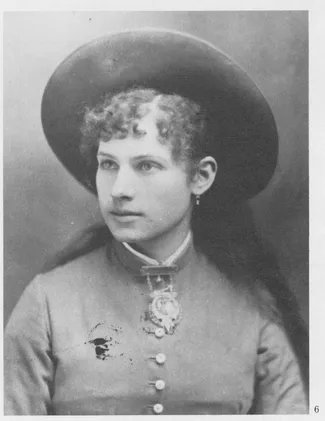
6. Annie Moses Butler, about 1880. (Photo by Martin, Chicago)
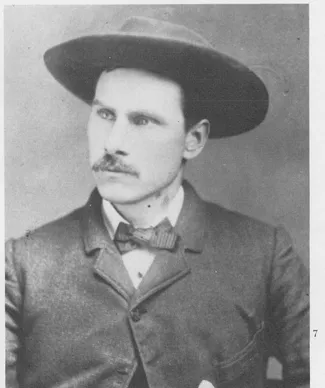
7. Frank Butler, about 1880. (Photo by Martin, Chicago)
When Jack Frost, the Cincinnati hotelkeeper who bought some of Annie’s game, discovered she was visiting her sister, Mrs. Joseph Stein, in town, he decided to match the youthful huntress with a professional sharpshooter. A trio of marksmen headed by Frank Butler was appearing at a local theater, and Frost thought this competition would be a great Thanksgiving afternoon entertainment. Butler agreed to the contest but was dumbfounded when he discovered his opponent was a diminutive country girl.
“Kentucky Frank,” who later ran a shooting gallery on North Vine Street in Cincinnati, told a reporter about witnessing the famous match between Annie Moses and Butler. Butler killed his first bird. Annie stepped to the post and when she called, “Pull,” got a dark, lively pigeon, which she managed to shoot. They were tied until Butler missed a fast, quavering bird. Annie was ahead until she too had a miss, leaving them tied. The last bird was a hard one and Butler missed. She killed her twenty-fifth bird and won the match. This was quite a feat for a girl who had never shot trap-released birds before. As far as can be determined, the match was held in 1875. The area in which it was held, northeast of Cincinnati near the route of the Cincinnati Northern Railroad, was called Oakley.
Frank Butler was hardly what a Quaker mother would choose as an ideal mate for her shy daughter Ann, but nevertheless court her he did. Besides his vaudeville career, Mrs. Shaw might have objected to the fact that Frank was divorced and in debt when he and her daughter first met.
Frank was a sentimental Irishman who had emigrated to the States when just a boy. Unskilled but determined, he managed to support himself with a variety of jobs. First he delivered milk with a pony cart in New York City, next he was a stable boy and later became a fisherman.
Mrs. Shaw liked Frank and, after gaining her consent, Annie and Frank were married in 1876, thus beginning a happy 50 years together. During the first years, while Frank was on tour, Annie stayed with her mother and tried to improve her education, which had been inter-rupte das a child. In 1877 Frank became a naturalized American citizen.
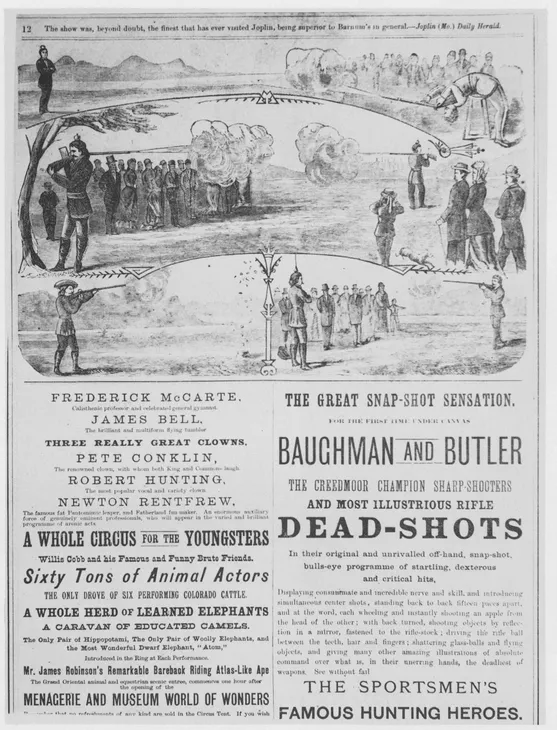
8. The Baughman and Butler act, as advertised in the Sells Brothers Circus Courier, 1881.
Always patient with animals, Frank had started his stage career with a group of trained dogs, but eventually developed a shooting act that was booked into theaters. Frank later teamed up with a performer named Baughman and they were billed in the Sells Brothers Circus Courier for 1881 as “The Creedmoor Cham...