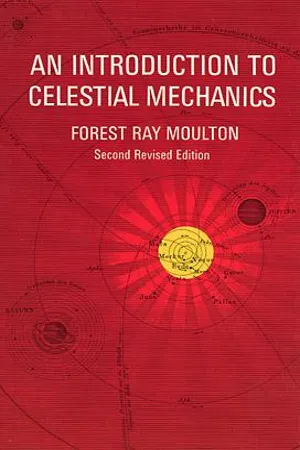
An unrivaled text in the field of celestial mechanics, Moulton's theoretical work on the prediction and interpretation of celestial phenomena has not been superseded. By providing a general account of all parts of celestial mechanics without an over-full treatment of any single aspect, by stating all the problems in advance, and, where the transformations are long, giving an outline of the steps which must be made, and by noting all the places where assumptions have been introduced or unjustified methods employed, Moulton has insured that his work will be valuable to all who are interested in the subject.
The text is divided into ten chapters which progress logically in terms of the difficulty of their subject matter. They are: Fundamental Principles and Definitions, Rectilinear Motion, Central Forces, The Potential and Attractions of Bodies, The Problem of Two Bodies, The Determination of Orbits, The General Integrals of the Problem of n Bodies, The Problem of Three Bodies, Perturbations ― Geometrical Considerations, and Perturbations ― Analytical Method. Important topics cove red include general equations, motion of falling particles, the heat of the sun, simultaneous differential equations, examples where J is a function of the coordinates alone, the universality of Newton's law, determination of the orbit from the law of force, attractions of simple solids, potential and attractions of simple bodies and ellipsoids, Ivory's method and level surfaces, elements of orbits, expansions and positions in orbits, transformations of coordinates, the Laplacian and Gaussian methods of determining orbits, motion of center of mass and area integrals, motion of the infinitesimal body, surfaces of zero relative velocity, effects of the components of the disturbing force, lunar theory, method of computing perturbations, and the perturbative function.
Each chapter is followed by a historical sketch and bibliography pertaining to that subject. Over 200 problems appear at key points in the text, many of them answered.
- 464 pages
- English
- ePUB (mobile friendly)
- Available on iOS & Android
eBook - ePub
An Introduction to Celestial Mechanics
About this book
Information
Topic
Physical SciencesSubtopic
Astronomy & AstrophysicsCHAPTER I.
FUNDAMENTAL PRINCIPLES AND DEFINITIONS.
1. Elements and Laws. The problems of every science are expressible in certain terms which will be designated as elements, and depend upon certain principles and laws for their solution. The elements arise from the very nature of the subject considered, and are expressed or implied in the formulation of the problems treated. The principles and laws are the relations which are known or are assumed to exist among the various elements. They are inductions from experiments, or deductions from previously accepted principles and laws, or simply agreements.
An explicit statement in the beginning of the type of problems which will be treated, and an enumeration of the elements which they involve, and of the principles and laws which relate to them, will lead to clearness of exposition. In order to obtain a complete understanding of the character of the conclusions which are reached, it would be necessary to make a philosophical discussion of the reality of the elements, and of the origin and character of the principles and laws. These questions cannot be entered into here because of the difficulty and complexity of metaphysical speculations. It is not to be understood that such investigations are not of value; they forever lead back to simpler and more undeniable assumptions upon which to base all reasoning.
The method of procedure in this work will necessarily be to accept as true certain fundamental elements and laws without entering in detail into the questions of their reality or validity. It will be sufficient to consider whether they are definitions or have been inferred from experience, and to point out that they have been abundantly verified in their applications. They will be accepted with confidence, and their consequences will be derived, in the subjects treated, so far as the scope and limits of the work will allow.
2. Problems Treated. The motions of a material particle subject to a central force of any sort whatever will be briefly considered. It will be shown from the conclusions reached in this discussion, and from the observed motions of the planets and their satellites, that Newton’s law of gravitation holds true in the solar system. The character of the motion of the binary stars shows that the probabilities are very great that it operates in them also, and that it may well be termed “the law of universal gravitation.” This conclusion is confirmed by the spectroscope, which proves that the familiar chemical elements of our solar system exist in the stars also.
In particular, the motions of two free homogeneous spheres subject only to their mutual attractions and starting from arbitrary initial conditions will be investigated, and then their motions will be discussed when they are subject to disturbing influences of various sorts. The essential features of perturbations arising from the action of a third body will be developed, both from a geometrical and an analytical point of view. There are two somewhat different cases. One is that in which the motion of a satellite around a planet is perturbed by the sun; and the second is that in which the motion of one planet around the sun is perturbed by another planet.
Another class of problems which arises is the determination of the orbits of unknown bodies from the observations of their directions at different epochs, made from a body whose motion is known. That is, the theories of the orbits of comets and planetoids will be based upon observations of their apparent positions made from the earth. This incomplete outline of the questions to be treated is sufficient for the enumeration of the elements employed.
3. Enumeration of the Principal Elements. In the discussion of the problems considered in this work it will be necessary to employ the following elements:
(a) Real numbers, and complex numbers incidentally in the solution of certain problems.
(b) Space of three dimensions, possessing the same properties in every direction.
(c) Time of one dimension, which will be taken as the independent variable.
(d) Mass, having the ordinary properties of inertia, etc., which are postulated in elementary Physics.
(e) Force, with the content that the same term has in Physics.
Positive numbers arise in Arithmetic, and positive, negative, and complex numbers, in Algebra. Space appears first as an essential element in Geometry. Time appears first as an essential element in Kinematics. Mass and force appear first and must be considered as essential elements in physical problems. No definitions of these familiar elements are necessary here.
4. Enumeration of the Principles and Laws. In representing the various physical magnitudes by numbers, certain agreements must be made as to what shall be considered positive, and what negative. The axioms of ordinary Geometry will be considered as being true.
The fundamental principles upon which all work in Theoretical Mechanics may be made to depend are Newton’s three Axioms, or Laws of Motion. The first two laws were known by Galileo and Huyghens, although they were for the first time announced together in all their completeness by Newton in the Principia, in 1686. These laws are as follows:1
LAW I. Every body continues in ...
Table of contents
- Title Page
- Copyright Page
- PREFACE TO FIRST EDITION.
- PREFACE TO SECOND EDITION.
- Table of Contents
- CHAPTER I. - FUNDAMENTAL PRINCIPLES AND DEFINITIONS.
- CHAPTER II. - RECTILINEAR MOTION.
- CHAPTER III. - CENTRAL FORCES.
- CHAPTER IV. - THE POTENTIAL AND ATTRACTIONS OF BODIES.
- CHAPTER V. - THE PROBLEM OF TWO BODIES.
- CHAPTER VI. - THE DETERMINATION OF ORBITS.
- CHAPTER VII. - THE GENERAL INTEGRALS OF THE PROBLEM OF n BODIES.
- CHAPTER VIII. - THE PROBLEM OF THREE BODIES.
- CHAPTER IX. - PERTURBATIONS—GEOMETRICAL CONSIDERATIONS.
- CHAPTER X. - PERTURBATIONS-ANALYTICAL METHOD.
- INDEX.
Trusted by 375,005 students
Access to over 1.5 million titles for a fair monthly price.
Study more efficiently using our study tools.
Frequently asked questions
Yes, you can cancel anytime from the Subscription tab in your account settings on the Perlego website. Your subscription will stay active until the end of your current billing period. Learn how to cancel your subscription
No, books cannot be downloaded as external files, such as PDFs, for use outside of Perlego. However, you can download books within the Perlego app for offline reading on mobile or tablet. Learn how to download books offline
Perlego offers two plans: Essential and Complete
- Essential is ideal for learners and professionals who enjoy exploring a wide range of subjects. Access the Essential Library with 800,000+ trusted titles and best-sellers across business, personal growth, and the humanities. Includes unlimited reading time and Standard Read Aloud voice.
- Complete: Perfect for advanced learners and researchers needing full, unrestricted access. Unlock 1.5M+ books across hundreds of subjects, including academic and specialized titles. The Complete Plan also includes advanced features like Premium Read Aloud and Research Assistant.
We are an online textbook subscription service, where you can get access to an entire online library for less than the price of a single book per month. With over 1.5 million books across 990+ topics, we’ve got you covered! Learn about our mission
Look out for the read-aloud symbol on your next book to see if you can listen to it. The read-aloud tool reads text aloud for you, highlighting the text as it is being read. You can pause it, speed it up and slow it down. Learn more about Read Aloud
Yes! You can use the Perlego app on both iOS and Android devices to read anytime, anywhere — even offline. Perfect for commutes or when you’re on the go.
Please note we cannot support devices running on iOS 13 and Android 7 or earlier. Learn more about using the app
Please note we cannot support devices running on iOS 13 and Android 7 or earlier. Learn more about using the app
Yes, you can access An Introduction to Celestial Mechanics by Forest Ray Moulton in PDF and/or ePUB format, as well as other popular books in Physical Sciences & Astronomy & Astrophysics. We have over 1.5 million books available in our catalogue for you to explore.