Drawing Lessons
eBook - ePub

Drawing Lessons

  1. 128 pages
  2. English
  3. ePUB (mobile friendly)
  4. Available on iOS & Android
eBook - ePub

Drawing Lessons

About this book

In this essential guide to the basic principles of drawing the human figure, Pogany—one of the leaders of the Golden Age of Illustration—shows readers the path to artistic mastery. With a warm and supportive tone, he seamlessly blends instruction and insight with 375 masterful illustrations. The aim: to build a foundation for those who wish to draw skillfully and easily.
Beginning with the humble dot and moving forward to perspective, anatomy, shading, portraiture, balance, motion, and more, this step-by-step resource is a genuine inspiration. Details of the human head, eyes, ears, and feet add depth to the instruction, followed by simple demonstrations that clearly illustrate how fundamental techniques are put into practice. Easy to follow and concise, this guide has long been considered an important resource for artists of all abilities.
Frequently asked questions

Yes, you can cancel anytime from the Subscription tab in your account settings on the Perlego website. Your subscription will stay active until the end of your current billing period. Learn how to cancel your subscription.
At the moment all of our mobile-responsive ePub books are available to download via the app. Most of our PDFs are also available to download and we're working on making the final remaining ones downloadable now. Learn more here.
Perlego offers two plans: Essential and Complete
  • Essential is ideal for learners and professionals who enjoy exploring a wide range of subjects. Access the Essential Library with 800,000+ trusted titles and best-sellers across business, personal growth, and the humanities. Includes unlimited reading time and Standard Read Aloud voice.
  • Complete: Perfect for advanced learners and researchers needing full, unrestricted access. Unlock 1.4M+ books across hundreds of subjects, including academic and specialized titles. The Complete Plan also includes advanced features like Premium Read Aloud and Research Assistant.
Both plans are available with monthly, semester, or annual billing cycles.
We are an online textbook subscription service, where you can get access to an entire online library for less than the price of a single book per month. With over 1 million books across 1000+ topics, we’ve got you covered! Learn more here.
Look out for the read-aloud symbol on your next book to see if you can listen to it. The read-aloud tool reads text aloud for you, highlighting the text as it is being read. You can pause it, speed it up and slow it down. Learn more here.
Yes! You can use the Perlego app on both iOS or Android devices to read anytime, anywhere — even offline. Perfect for commutes or when you’re on the go.
Please note we cannot support devices running on iOS 13 and Android 7 or earlier. Learn more about using the app.
Yes, you can access Drawing Lessons by Willy Pogány in PDF and/or ePUB format, as well as other popular books in Art & Art Techniques. We have over one million books available in our catalogue for you to explore.

Information

eBook ISBN
9780486140414
Topic
Art

PERSPECTIVE

We know that a cube has six sides.
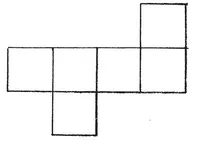
We know also that each side is a perfect square, but if we draw a cube as we know it to be, it does not look like a cube.
For example, here are six perfect squares but this drawing does not look like a cube.
e9780486140414_i0010.webp
We know that a man has a front and a back, but we have never seen both front and back at the same time.
e9780486140414_i0011.webp
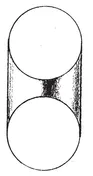
We know that a tin can has a circular top and a circular bottom of equal size, but we must admit that we never have seen a tin can like this.
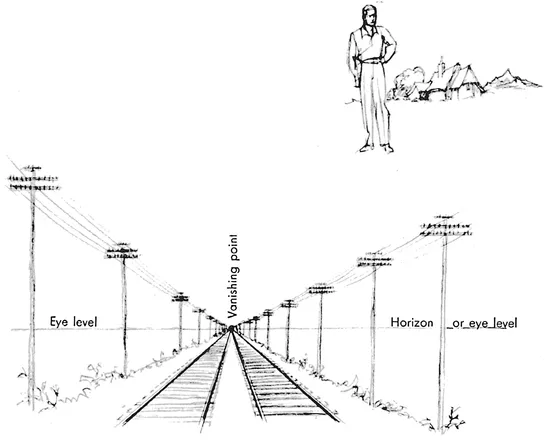
We know that the house in the distance is considerably larger than the man in the foreground.
We know also that the mountain in the far distance is much larger than the house, but we see the man larger than the house and we see the house larger than the mountain.
Objects near us seem larger and those in the distance seem smaller.
e9780486140414_i0012.webp
We know that the tracks are parallel.
We know too that they are the same distance apart all along the line.
We know that the telegraph poles are all about equal in height.
Still we see the tracks getting nearer and nearer to one another, and we see the poles getting smaller and smaller the farther they recede until finally the tracks and the poles seem to disappear into a point.
The point into which parallel lines converge is called a VANISHING POINT.
e9780486140414_i0013.webp
e9780486140414_i0014.webp
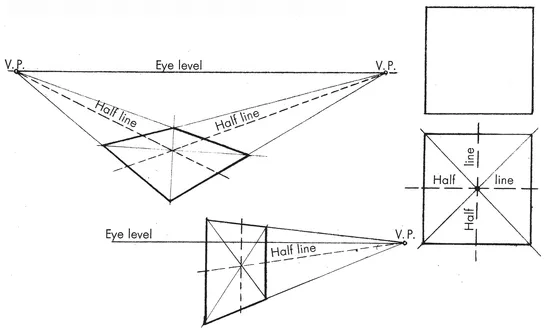
Here is a simple way to find the center of a square or an oblong. Draw the diagonals and they will intersect in the center.
e9780486140414_i0015.webp
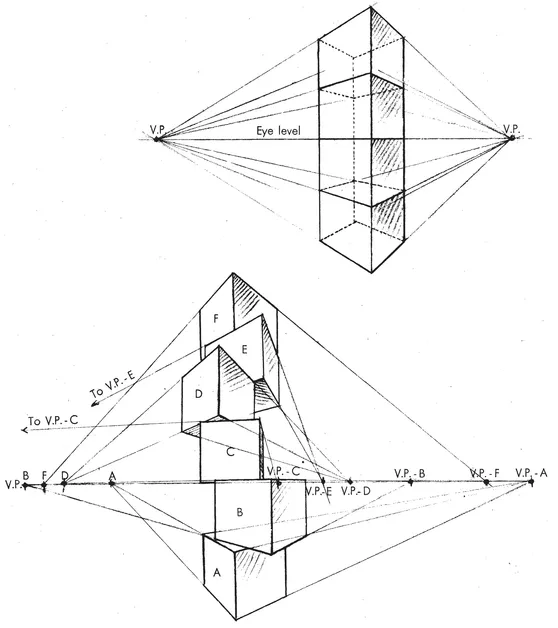
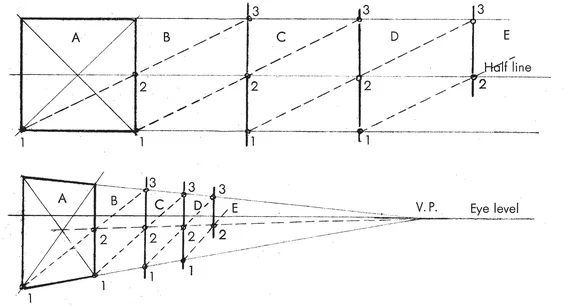
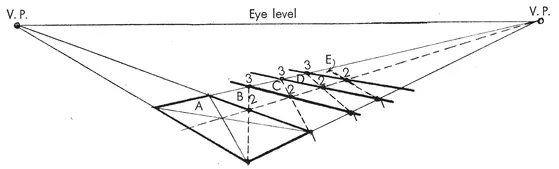
These diagrams show to repeat squares or oblongs in perspective.
e9780486140414_i0016.webp
e9780486140414_i0017.webp
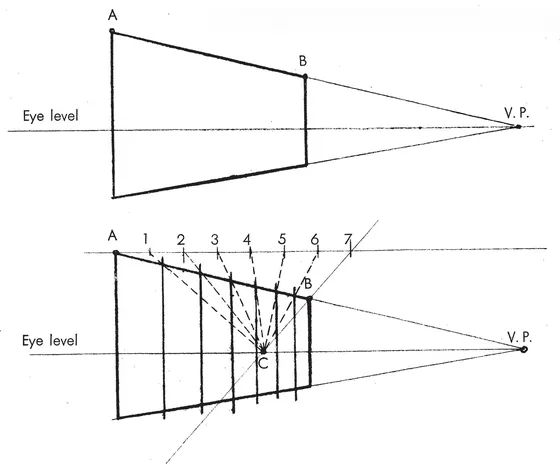
These diagrams show how an oblong is divided into equal spaces.
e9780486140414_i0018.webp
Draw a line parallel to Eye level through A.
Mark equally the desired number of measurements on this line.
Draw a line from the last measurement through corner B to the Eye level.
Draw all your dividing lines to this point C.
Where these converging lines cross A-B will be your points of division.
e9780486140414_i0019.webp
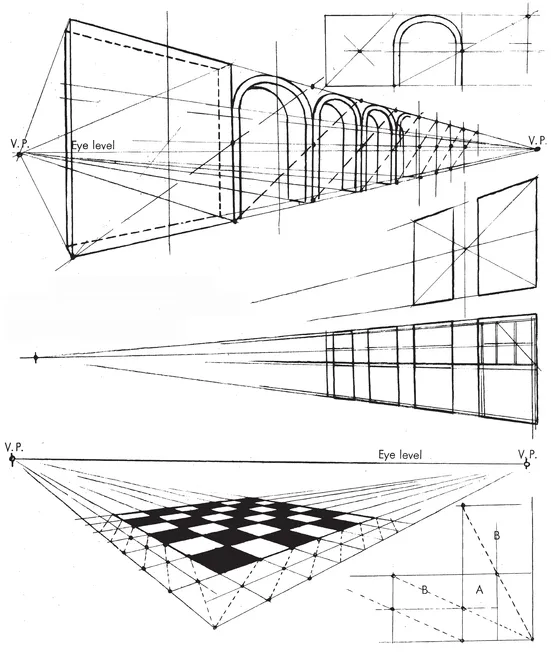
Use the same system of repeating squares or oblongs in drawing these arches, windows and checker board.
e9780486140414_i0020.webp
e9780486140414_i0021.webp
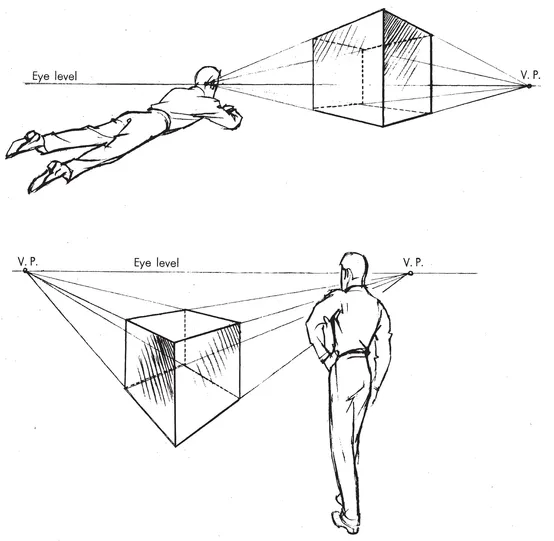
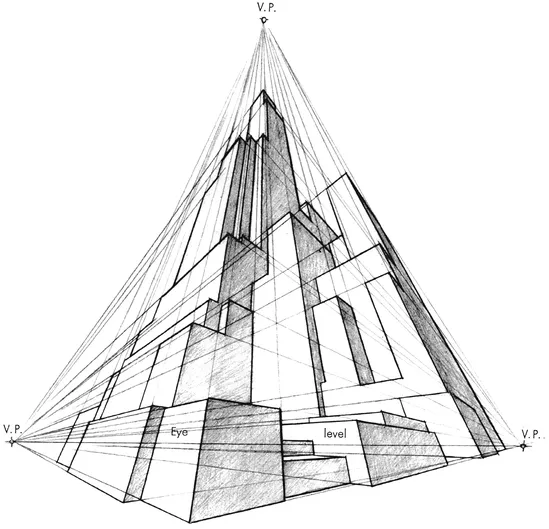
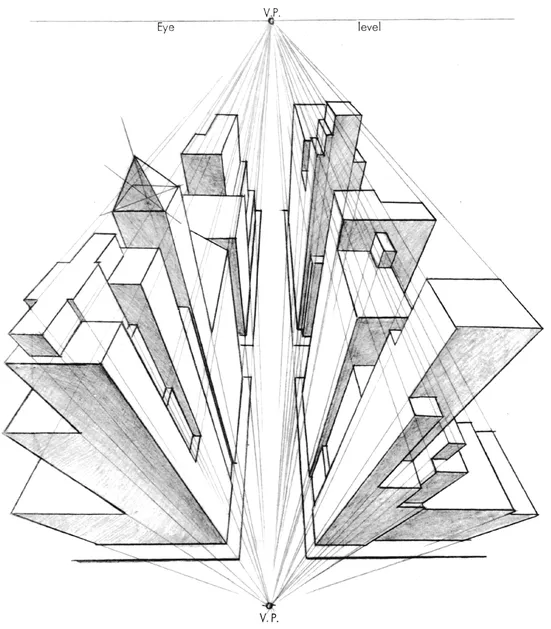
If you look up at a group of high buildings you will find the center vanishing point far above your eye level.
When looking down, your main vanishing point is below eye level.
e9780486140414_i0022.webp

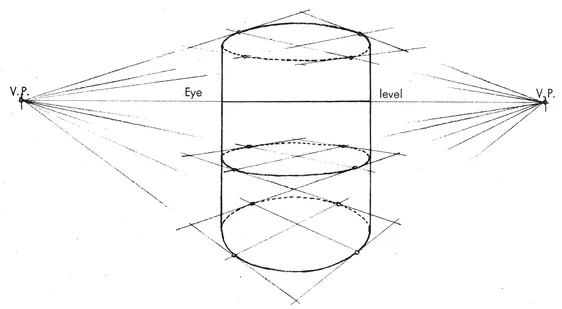
PERSPECTIVE DRAWING OF A CYLINDER.

Note that the circles seem flatter as they come nearer to eye level.
e9780486140414_i0023.webp
At eye level we see only the edge of the circle as a horizontal line.
Above eye level we see the bottom of the circle.

TRY THIS EXPERIMENT:

Raise a glass vertically and observe how the circular rim changes shape until it becomes a straight line at eye level.
...

Table of contents

  1. Title Page
  2. Dedication
  3. Table of Contents
  4. Copyright Page
  5. INTRODUCTION
  6. THE DOT
  7. PERSPECTIVE
  8. SHADING
  9. THE HEAD
  10. PORTRAITURE
  11. THE EYES
  12. THE MOUTH
  13. THE EARS
  14. THE NOSE
  15. THE HANDS
  16. THE FEET
  17. THE FIGURE
  18. BALANCE AND MOTION
  19. FIGURE SKETCHING
  20. Sketches and studies