![]()
SEASCAPE PAINTING IN OILS
![]()
CHAPTER I
The General Idea
IT is astonishing how very few real consistent sea painters there have been in the art history of our country. And this applies particularly to contemporary artists. When I say real sea painters, I allude to those who confine their works solely to sea and coast, without the introduction of incidents of shipping or of figure. The true seascape artists, past and present, can be almost reckoned on the fingers of one hand.
The late Henry Moore, R.A., and Julius Olsson, R.A., our contemporary painter, are outstanding masters of true sea moods; and their works, or at least good reproductions of them, should be studied whenever possible. I feel that pictures devoted to the incidents I have mentioned should be classed as the work of Marine Painters.
When a seascape picture calls for the addition of incident to make up for its apparent emptiness, it proves there has not been enough convincing sea interest in the work. It is lacking in observation, colour, form, composition, and the study of sea phenomena necessary to its completeness.
I have heard it remarked that seascapes are not good selling subjects; that people prefer landscapes or still-life subjects.
This would seem extraordinary, if true, in view of the fact that we are essentially a Maritime Nation.
That the sea has an enormous appeal is evident by the lure of the seaside health resorts of to-day, and this is inconsistent with the suggestion that such pictures are unpopular.
It is very evident that this subject has its fascination for the student, and even for many professional painters in other branches of Art who visit our coastal beauty spots.
It is particularly to the student lover of the sea and coast that I make this attempt to help them in their endeavour.
Sea painting is not an easy subject. The element is ever restless and changing, and commands quick observation. Direct painting is necessary.
A well-known artist, giving advice to a student, remarked: “Don’t hesitate, but splash.” The simile sounds humorous if I apply it to sea painting, but the criticism hits off the idea perfectly. The first two lines of a sea song, however, I think convey more of the general ideal to be aimed at by the student. It runs—
The sea, the sea, the open sea,
The blue, the fresh, the ever free.
This phrasing is applicable to a good sea picture, and suggests that the work should be colourful, pure in expressive painting, and the whole executed with a freedom of handling consistent with the subject.
The serious young artist has to guard against being satisfied with a “pretty pretty” type of work—the sort of picture that is “cooked up” eventually from memory with false tints. This may please the eye of the uninitiated, but it has no regard to truth of tone or form.
The sea and coast is at all times dignified and big in spaces. This should be studied and realized with the continued application of serious endeavour.
![]()
CHAPTER II
Realization of Form, and Preliminary Method Suggested
FIRST of all I want to analyse a wave form to give you some idea of its action.
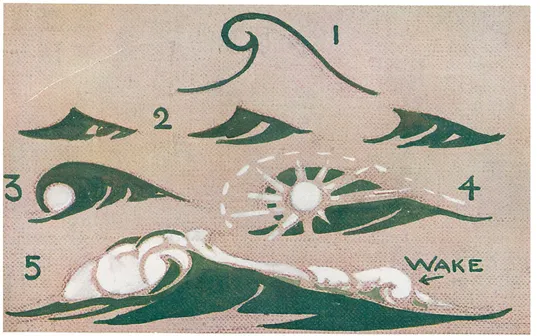
The coloured diagram is designed to emphasize the successive stages of movement and what you should note.
No. 1 shows the well-known Greek wave pattern; the simplest and most expressive drawing of a breaking wave in the world.
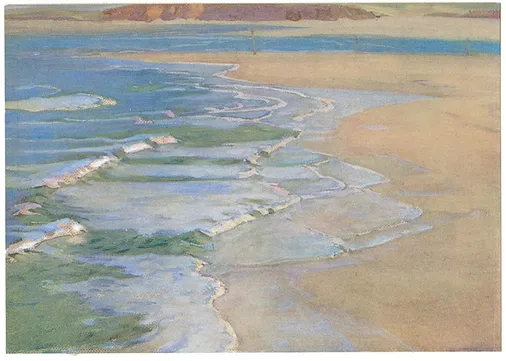
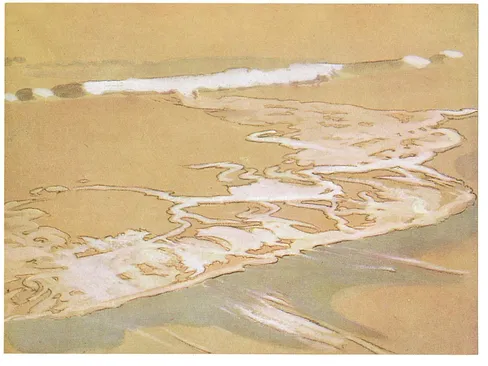
Consider a wave moving towards the shore (No. 2). The weight behind it carries it forward until it reaches that point of shallow water where the influence of the beach causes the top to fall over (No. 3). It seems as if the weight of water in falling imprisons the air which instantly expands (No. 4), and breaks the wave top into foam. The movement continues forward, but a wake is left behind, partly caused by a blow back of the force (No. 5). It is this formation or wake that is so complete a contrast to the parallel lines of shore breakers. It adds movement to the picture. This will be seen in the next picture, which shows shallow waves breaking on a flat beach. The perspective of their wakes contributes a share in the forward movement of the breakers. The tumbling foam catches the full side light of the sun, while the wake which is of a lower level mirrors the sky tone. You will notice, when you check this for yourself on the spot, that this wake has a calming influence on its particular patch of water between the breakers. This provides a valuable contrast to the tumble of the foam.
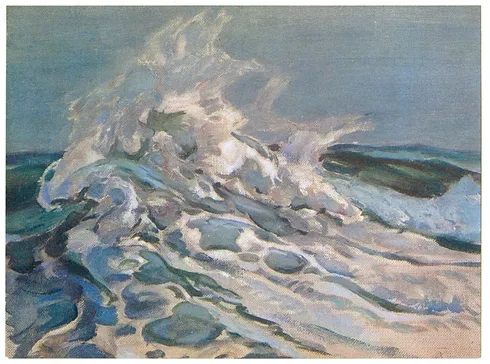
Note also the rush back of a receding wave after it has rebounded from a rock and meets an oncoming one. When this happens, it is like two waves breaking in opposite directions. The rush back meets the oncoming breaker, the top of which is forced up in a mass of broken water and foam. The coloured illustration of this effect is descriptive of such an incident. In spite of the problem of depicting two such opposing forces, I have tried to retain the individuality of the movement of each mass, to give you some impression of this battle of the element.
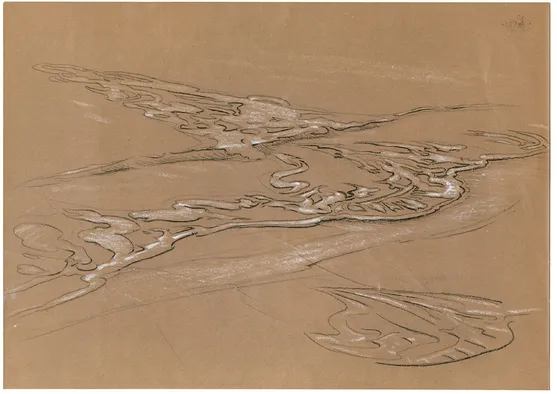
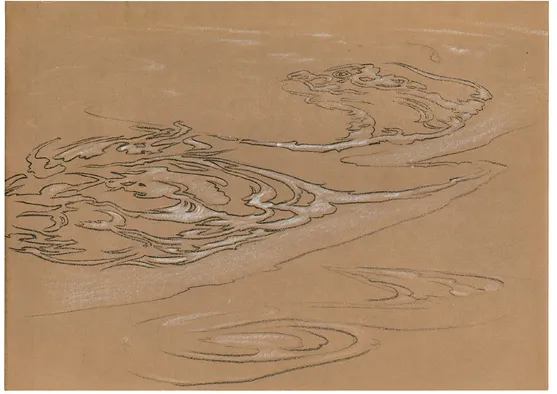
Preliminary Method of Work. As a preliminary to any actual painting, I should advise you to go out of doors with several sheets of thick brown wrapping paper, or some dark toned Michalet paper, cut down to about 14 in. by 10 in. in size, pinned to a board. Take also a black crayon and a stick of white chalk. Instead of a pocket knife, use an old “Valet” safety razor blade. It provides a perfect cutting edge for chalk and crayon. One edge of this type of blade is blunted and thickened, and the blade can be used quite easily and safely and carried in an ordinary matchbox. The pocket knife, if not kept sharp, is apt to drag the crayon out of the wood, or sharpen the white chalk badly. It is just as well to have a responsive medium.
The general characteristics of wave form and the outline and shadows of rocks are drawn with the crayon. The white chalk (cut chisel-edged) is a quick and expressive medium for the touching in of the masses and tracery of foam pattern.
The illustration shows a study on brown paper of the forward movement of shallow waves breaking on a flat beach, sketched from the cliff edge. The viewpoint enabled me to note the whole formation. The creeping pattern of foam suggested the appearance of lace work. The small sketch in the right bottom comer is the first rough outline of the main pattern immediately above.
ANALYSIS OF IN-SHORE WAVE MOVEMENT AND ITS EFFECT ON FOAM FORMATION
HAYLE BAR, ST. IVES
Perspective of breakers and their wakes help the forward movement of the tide
OPPOSING FORCES IN TIDAL MOVEMENT
The meeting of oncoming and receding waves
STUDY OF FOAM PATTERN (1)
Forward movement on a flat beach, sketched from cliff edge
STUDY OF FOAM PATTERN (2)
Showing the end of forward movement
STUDY OF FOAM PATTERN (3)
The forward movement from a heavy breaker
The next is a study of the end of the movement. There is just a suspicion of activity in the top right-hand one. The larger mass of foam is quietly swirling in a slight depression of the sand before dispersing. The pattern of lace work remains, but the force that projected the wave is exhausted. The two small notes at the bottom show how the main lines were blocked in first.
Try to get accustomed to drawing in black and white the general idea almost as fast as a wave moves or breaks. You will obtain more motion in your work. It will express something. No two waves break alike, but there is a similarity.
Try to grasp the idea with a continuous series of almost shorthand notes. Note the movement of one bit at a time and put it down on paper instantly before you become confused with the incidents of other forms moving in quick succession.
The third study, opposite, gives an impression of the added strength in the forward movement of foam from a heavier breaker. There is more volume because the flow-in is deeper, and has the initial force behind it. On a flat beach this tidal action would travel a considerable distance. Note the design of the pattern again with its definite lines of movement.
![]()
CHAPTER III
Composition
THE lines of design, or the main outlines, are very necessary to the completion of a good study. This is important in regard to composition. The lines of the sea and foam are examples of the finest elements of design, and a successful picture embraces balance, symmetry, growth, movement, massing, and spacing. Above all occurs a centre of interest or focus-point of attraction. In any composition this cent...