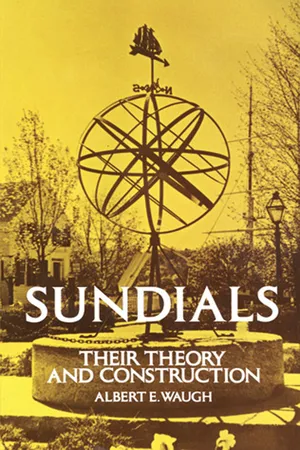
Have you every wanted to build a sundial or to understand how one works? Then you have probably been frustrated as you search vainly for help. Most books on the subject are either rare out-of-print works published centuries ago and available only in highly specialized collections, or highly complicated treatises whose information is hidden behind frightening arrays of involved formulas. But now your search is over. This book is designed to meet sundialing needs at either the simple or the sophisticated level.
Albert E. Waugh, professor and administrator at the University of Connecticut for 40 years, and an expert on the subject of sundials and their curious history, presents, on the one hand, a rigorous appraisal of the science of sundials, including mathematical treatment and an explanation of the pertinent astronomical background; on the other hand, he presents simple and non-technical treatments such that several of the dials can be built by children!
The subject matter is arranged in 19 chapters, each covering a different aspect of dialing science. All the common types of dials are covered, but the reader can also learn about analemmatic dials, polar dials, equatorial dials, portable dials, memorial dials, armillary spheres, reflected ceiling dials, cross dials, and old-fashioned noon marks. There are also sections on dial furniture, mottoes, the actual layout out of a dial, the equation of time, finding time in other cities, how to find the meridian, how to find time by moonlight — even how to estimate time from the length of one's own shadow! Directions are given for designing dials for any part of the country, or any place in the world. The author has designed many dials, and his text is filled with helpful hints based on his own personal experience. There are over 100 illustrations, charts, and tables, followed by an appendix which is filled with material which reduces or eliminates the need for calculation on the part of the reader.
- 256 pages
- English
- ePUB (mobile friendly)
- Available on iOS & Android
eBook - ePub
About this book
Information
Subtopic
Astronomy & Astrophysics1
Historical Sketch
Fortunately we need not start by defining time, since the concept has perplexed philosophers and lexicographers and served as the basis for learned and inconclusive arguments. We shall assume, with the man in the street, that we know what time is, and that our problem is measuring it rather than defining it.
Very early in human history men must have recognized the passage of time. Its major subdivisions were marked by the sequence of day and night and by the passage of the seasons. Timekeeping at this level involved merely counting the days or the years—or, with the American Indian, the cycles of moon phases. There were no such obvious subdivisions of the day, and no one knows when men first began to count the hours, nor what they used to measure their passage. It is certain that one of the early methods involved observations of shadows. As the hours of any day passed it was apparent that the shadows changed slowly in their direction and in their length. The shadows of early morning were long, and stretched toward the west. As noon approached the shadows grew shorter and swung into the north.1 Then through the afternoon the shadows lengthened again and reached toward the east. The hour of the day could be estimated from either the length or the direction of the shadow.
At first the day was apparently merely divided into three parts—morning, afternoon and night—by the three phenomena of dawn, noon and sunset. Dawn and sunset were obvious, and noon was the moment when the shadows were shortest for the day. Later, men noted the change in length of shadows more carefully, and judged the time of day roughly by measuring their own shadows—stepping them off with their own feet, “heel to toe.” The Venerable Bede
1 In the Southern Hemisphere the noon shadows lie toward the south. gave a table2 about 700 A.D. for use in telling the time of day by this method (Table 1.1).
TABLE 1.1
LENGTH OF ONE’S SHADOW IN “FEET” AT VARIOUS HOURS OF THE DAY AT
VARIOUS TIMES OF THE YEAR
LENGTH OF ONE’S SHADOW IN “FEET” AT VARIOUS HOURS OF THE DAY AT
VARIOUS TIMES OF THE YEAR
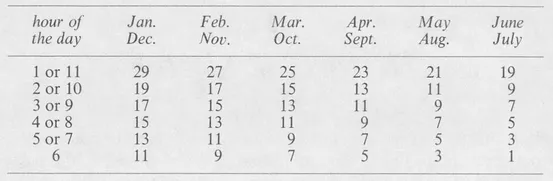
In interpreting this table one must understand that in Bede’s day men counted the hours from dawn, so that the hour of “3” means “the end of the third hour after dawn.” The time from dawn to sunset was divided into 12 equal “hours,” but since the time from dawn to sunset was longer in summer than in winter, the ”hours” of summer were also longer than the “hours” of winter. For many centuries these “unequal hours” or “temporary hours” were used over much of the earth. The “hours” of any one day were equal, but the “hours” of summer long. It is for this latter reason that we refer to them as “unequal hours.”
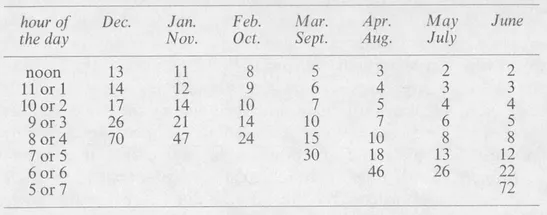
We shall have occasion to speak further of these old unequal hours, but the modern reader may find it amusing to experiment with a roughly comparable table computed for modern hours and for the latitude of New York City or Chicago (Table 1.2). If you live fairly close to this latitude you may test the table by stepping off the length of your own shadow with your own feet and comparing the time estimated from the table with that shown on your watch.
Chaucer, who wrote his Canterbury Tales about 1390 or 1400 A.D., gives at least two illustrations of this method of telling the time of day. In the opening lines of his “Parson’s Prologue” he says:
It was four o’clock according to my guess,
Since eleven feet, a little more or less,
My shadow at the time did fall,
Considering that I myself am six feet tall.
Since eleven feet, a little more or less,
My shadow at the time did fall,
Considering that I myself am six feet tall.
TABLE 1.2
LENGTH OF ONE’S SHADOW IN “FEET” ON THE 22ND DAY OF VARIOUS MONTHS
IN LATITUDE 41° 3
LENGTH OF ONE’S SHADOW IN “FEET” ON THE 22ND DAY OF VARIOUS MONTHS
IN LATITUDE 41° 3
And near the opening of the Introduction to his “Man of Law’s Tale” he tells us:
. . . the shadow of each tree
Had reached a length of that same quantity
As was the body which had cast the shade;
And on this basis he conclusion made:
. . . for that day, and in that latitude,
The time was ten o’clock . . . .
Had reached a length of that same quantity
As was the body which had cast the shade;
And on this basis he conclusion made:
. . . for that day, and in that latitude,
The time was ten o’clock . . . .
But in many ways the direction of a shadow is a more satisfactory time-teller than its length. Boy Scouts are told that they can tell the direction from their watches. They are instructed to hold the watch face upwards and point the hour hand toward the sun. The south point will then lie, it is said, half way between the hour hand and 12 o’clock. This rule is actually very rough, but perhaps better than none at all.
We do not know when men first began to use instruments which were at all similar to modern sundials. A stone fragment in a Berlin museum is thought to be the earliest known sundial, dating from about 1500 B.C. The Bible mentions what some authorities take to have been a sundial (although the meaning is by no means certain) in the days of Ahaz, king of Judah some 700 years before Christ.4 About a century later the Greek philosopher and astronomer Anaximander of Miletus is said to have introduced the sundial into Greece. Herodotus, who lived in Asia Minor and Greece about 450 B.C., tells us that “It was from the Babylonians that the Greeks learned about the pole, the gnomon and the twelve parts of the day” ; and sundials had become so common in Rome by 200 B.C. that the comic dramatist Plautus condemned in verse “the wretch who first . . . set a sundial in the market place to chop my day to pieces.” Vitruvius, a contemporary of Julius Caesar, bemoaned the fact that he could not invent new types of sundials, since the field was already exhausted. He lists a dozen or more types, giving the names of their inventors. We do not know anything about the appearance of many of these early dials, and cannot guess the degree of their accuracy.
Many medieval English churches carry what appear to be crude sundials cut or scratched directly into the stone of their walls. These appear to have been used primarily to note the times of the prayers. One of these dials, at Kirkdale in Yorkshire, carries an inscription in Old English which reads in part, “This is the day’s sun-marker at every tide.”5 This will be understood only if we realize that the Saxons divided the day not into hours, but into “tides”—from which we still get such words as “noontide” and “eventide.”
Sometime and somewhere—no one knows when or where—it was discovered that the shadow cast by a slanting object might be a more accurate timekeeper than the shadow cast by a vertical one. If, in fact, the shadow-casting object was parallel to the earth’s axis, the direction of its shadow at any given hour of the day was constant regardless of the season of the year. It has been suggested6 that this discovery occurred in the first century A.D., but be that as it may, men had now discovered the system which remained the principal basis for time-telling for nearly thirteen centuries. In fact, sundials remained in use long after the invention of the clock, since early clocks were erratic and needed frequent correction by the sundial. Our frontispiece reproduces an old print showing three gentlemen waiting to set their watches when the sun dial shows that the moment of noon has arrived,7 and many a New England housewife paced her morning’s chores with the movement of the shadows across the kitchen floor. While men have used many other means of telling time—sandglasses, waterclocks, candles and graduated oil lamps (or else relied on the crowing of cocks and other natural phenomena), nevertheless for at least ten and perhaps twenty centuries the sundial was the major timekeeping device used by man.8
2
Kinds of Time
American newspapers on July 21, 1969, featured accounts of man’s first landing on the moon, and at various places they gave the time of Neil Armstrong’s first step on the moon as:
10:56 P.M. Eastern Daylight Time on the 20th.
9:56 P.M. Eastern Standard Time on the 20th.
2:56 A.M. Greenwich Mean Time on the 21st.
3:56 A.M. British Summer Time on the 21st.
9:56 P.M. Eastern Standard Time on the 20th.
2:56 A.M. Greenwich Mean Time on the 21st.
3:56 A.M. British Summer Time on the 21st.
Here were four different ways of describing the same moment of time; yet they were but four of a great many possible ways which must certainly have been used by newspapers in various parts of the world as they interpreted the news for their readers. If we are to design a sundial to “tell time,” we must first decide what kind of time it is to tell.
The Sun’s Apparent Motion. Every schoolchild knows that the earth revolves around the sun even though it looks as though the sun were revolving around us. For our purposes it really makes no difference, since a sundial designed to tell time on an earth with the sun revolving around it would be identical in every detail with one designed for use on an earth which was revolving around the sun. In our treatment of the matter we shall ordinarily describe things as they seem rather than as they really are. We shall thus speak of the sun’s “rising in the east” and “moving across the sky from east to west” until it “sets in the west” in the evening.
Differences in Longitude. A train running from New York to San Francisco appears in Albany before it reaches Chicago, and in Chicago before it reaches Denver. Similarly as the sun moves across the sky from east to west it appears first to people living on the East Coast, and later to people living farther west. When we see the sun directly south of us at midday9 it has already passed its high point for people to our east and they see it already falling in the west, while people to our west see it still rising higher in their eastern sky. They all see the same sun at the same moment, but they see it in different directions reflecting differences in their points of view.
The meridians are imaginary lines running along the earth’s surface from the North to the South Pole, lying everywhere exactly in a north-south direction. Our own meridian is, then, nothing more than a north-south line running through the particular spot where we happen to be. At any moment of time the sun is over one of these meridians, and everyone who is located on that meridian says that it is noon. Everyone east of that meridian says it is afternoon, and everyone to the west calls it morning. If we are to keep time by the sun we must realize that all places on the same meridian (all places due north and south of each other) will have the same time, but in all other places on the earth’s surface the time will be different—later in places to the east and earlier in places to the west. Places on the same meridian are said to have the same longitude, and we commonly measure longitudes by their angular distances east or west fro...
Table of contents
- DOVER SCIENCE BOOKS
- Title Page
- Copyright Page
- Dedication
- Preface
- Table of Contents
- 1 - Historical Sketch
- 2 - Kinds of Time
- 3 - The Noon Mark
- 4 - The Equatorial Sundial
- 5 - The Horizontal Sundial
- 6 - Vertical Direct South Dials
- 7 - The Vertical Direct North Dial
- 8 - Vertical Direct East and West Dials
- 9 - The Polar Dial
- 10 - Vertical Declining Dials
- 11 - Direct Reclining or Inclining Dials
- 12 - Dials Which Both Decline and Recline
- 13 - The Analemmatic Dial
- 14 - Reflected Ceiling Dials
- 15 - Dial Furniture
- 16 - Portable Dials
- 17 - The Armillary Sphere
- 18 - Memorial Dials
- 19 - Practical Hints on Dialling
- Appendix - HOW TO USE THE TABLES
- Bibliography
- Index
Trusted by 375,005 students
Access to over 1.5 million titles for a fair monthly price.
Study more efficiently using our study tools.
Frequently asked questions
Yes, you can cancel anytime from the Subscription tab in your account settings on the Perlego website. Your subscription will stay active until the end of your current billing period. Learn how to cancel your subscription
No, books cannot be downloaded as external files, such as PDFs, for use outside of Perlego. However, you can download books within the Perlego app for offline reading on mobile or tablet. Learn how to download books offline
Perlego offers two plans: Essential and Complete
- Essential is ideal for learners and professionals who enjoy exploring a wide range of subjects. Access the Essential Library with 800,000+ trusted titles and best-sellers across business, personal growth, and the humanities. Includes unlimited reading time and Standard Read Aloud voice.
- Complete: Perfect for advanced learners and researchers needing full, unrestricted access. Unlock 1.5M+ books across hundreds of subjects, including academic and specialized titles. The Complete Plan also includes advanced features like Premium Read Aloud and Research Assistant.
We are an online textbook subscription service, where you can get access to an entire online library for less than the price of a single book per month. With over 1.5 million books across 990+ topics, we’ve got you covered! Learn about our mission
Look out for the read-aloud symbol on your next book to see if you can listen to it. The read-aloud tool reads text aloud for you, highlighting the text as it is being read. You can pause it, speed it up and slow it down. Learn more about Read Aloud
Yes! You can use the Perlego app on both iOS and Android devices to read anytime, anywhere — even offline. Perfect for commutes or when you’re on the go.
Please note we cannot support devices running on iOS 13 and Android 7 or earlier. Learn more about using the app
Please note we cannot support devices running on iOS 13 and Android 7 or earlier. Learn more about using the app
Yes, you can access Sundials by Albert Waugh in PDF and/or ePUB format, as well as other popular books in Technology & Engineering & Astronomy & Astrophysics. We have over 1.5 million books available in our catalogue for you to explore.